
Limited Time Offer!
For Less Than the Cost of a Starbucks Coffee, Access All DevOpsSchool Videos on YouTube Unlimitedly.
Master DevOps, SRE, DevSecOps Skills!
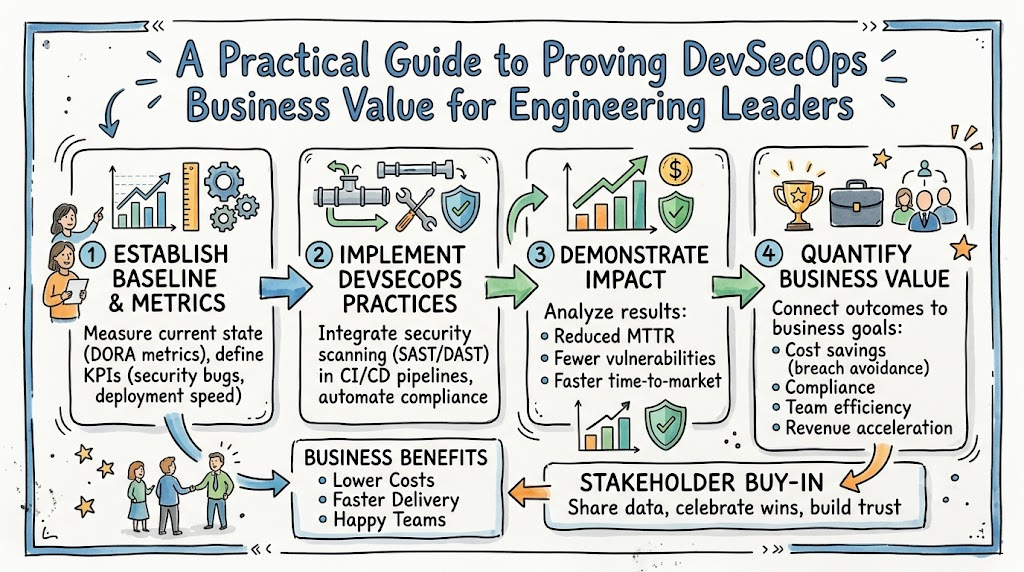
Introduction
In the current software development landscape, companies invest heavily in DevSecOps to protect their infrastructure while maintaining rapid release cycles. Modern applications are highly complex, moving through fast-paced continuous integration and continuous delivery pipelines. Security can no longer live as an isolated review stage at the very end of the development lifecycle. When security checks are delayed, software delivery slows down, engineering costs climb, and code vulnerabilities bypass protection systems.
Corporate leadership, including Chief Technology Officers, Chief Information Security Officers, and Chief Financial Officers, requires measurable proof of performance for every budget allocation. While investing in security engineering tools, automated vulnerability scanners, and continuous deployment workflows is essential, leadership inevitably asks a foundational business question: what is the return on investment for these engineering choices? Proving security ROI has historically been difficult because success is often defined by the absence of negative events, such as data breaches, production downtime, regulatory penalties, and compliance failures.
To bridge this communication gap between software development teams and business executives, organizations must implement business-focused performance metrics. Engineering metrics like code coverage or build counts must be translated into commercial outcomes like reduced development cycles, minimized incident response times, and optimized cloud infrastructure costs. This educational guide helps technology professionals, software engineers, and IT managers utilize frameworks from platforms like DevOpsSchool to quantify the business value of DevSecOps ROI and align engineering workflows with corporate strategic goals.
What Is DevSecOps ROI?
Return on Investment, or ROI, is a fundamental financial calculation used to evaluate the efficiency and profitability of an expenditure. The basic mathematical concept is straightforward:
$$ROI = \frac{\text{Net Financial Benefits} – \text{Total Cost of Investment}}{\text{Total Cost of Investment}} \times 100$$
When applied to DevSecOps, calculating this ratio requires a broader perspective than standard financial models. DevSecOps ROI measures the financial, operational, and risk-reduction benefits gained by integrating automated security practices directly into every stage of the software development lifecycle, balanced against the total cost of tools, personnel, and process training.
Security value is naturally difficult to measure because traditional security frameworks function like insurance policies. If an automated vulnerability scanner identifies and blocks a critical vulnerability in a staging environment before it reaches public production infrastructure, the organization has successfully prevented a potential security breach. However, documenting the exact financial value of a security event that never occurred requires structured baseline metrics and historical data comparisons.
Consider a practical example: a software development team manually reviews source code for security vulnerabilities right before a major application release. This manual review process takes 40 engineering hours per release cycle, and the team deploys software four times a year, totaling 160 hours annually. If the organization adopts a DevSecOps model by integrating automated static application security testing into the build pipeline, the automated scan completes in 10 minutes per deployment. Even if the team increases deployment frequency to 50 times per year, the automated scans consume less than 9 hours of compute processing time annually, freeing up human engineering hours for feature development. The return on investment combines the reclaimed engineering time with the financial risk reduction of catching code defects early.
Why Measuring DevSecOps Business Value Matters
Budget Justification
Securing corporate budget approvals for security tools, continuous integration infrastructure, and advanced engineering training requires clear data. Executive leadership faces competing requests from product management for new user features, from sales teams for market expansions, and from operations for infrastructure scaling. By presenting a data-backed business case that shows how DevSecOps tools reduce engineering rework and prevent downtime, technology leaders can move conversations from cost discussions to strategic investment reviews.
Risk Reduction Visibility
Corporate boards and executive leadership teams look at organizational risk through a financial lens. They evaluate risk by calculating the probability of a negative event multiplied by the financial impact of that event. DevSecOps metrics transform technical security tasks, like dependency updates and configuration hardening, into clear data points regarding risk mitigation. Showing a steady reduction in open critical vulnerabilities across production systems gives leadership verifiable proof of an improved corporate security posture.
Faster Delivery Confidence
When software delivery pipelines lack automated security verification, every production deployment introduces operational risk. Engineering teams often delay software releases out of concern that new code changes might introduce stability flaws or security vulnerabilities. Measuring DevSecOps value proves that automated security checks can run alongside standard software tests without delaying the pipeline. This gives management the confidence to accelerate release cycles, deliver customer value faster, and maintain a competitive edge.
Common Mistakes Organizations Make
Measuring Only Vulnerabilities
A frequent mistake when assessing DevSecOps performance is focusing exclusively on the total number of security vulnerabilities detected and resolved. While tracking vulnerability counts is helpful for engineering teams, a declining vulnerability count does not automatically mean business performance has improved. If an engineering team fixes 500 minor code bugs but takes three months to deploy a critical business feature to market, the organization loses revenue opportunities. Measuring security in isolation overlooks core operational efficiency.
Ignoring Operational Efficiency
DevSecOps is a cultural, operational, and technical methodology, not just a security checklist. Organizations often track security metrics while failing to monitor how security tasks affect overall engineering velocity. If security guardrails are poorly integrated, they can create friction for software developers, resulting in longer build times, failing pipelines, and developer frustration. True ROI evaluations must account for how security automation affects developer productivity and overall software delivery times.
Short-Term Thinking
Implementing a comprehensive DevSecOps model requires changes to engineering workflows, tool configurations, and team communication patterns. Some organizations expect clear financial returns within weeks of installing new automated scanning software. In reality, initial phases often show a spike in detected vulnerabilities as automated scanners review legacy codebases for the first time. Teams must commit to long-term tracking, using a multi-quarter view to observe real trends in remediation efficiency and deployment stability.
No Baseline Metrics
Organizations frequently adopt new automated security testing tools without documenting their historical engineering performance metrics first. Without a clear understanding of your historical manual code review times, past security incident frequencies, or average software remediation cycles, it is impossible to calculate precise efficiency gains. Without a reliable starting baseline, any claims of improved performance remain anecdotal rather than data-driven.
Core Areas of DevSecOps ROI
To accurately calculate the business impact of a DevSecOps transformation, organizations should break down their evaluation framework into specific operational categories. The following overview table summarizes how technical improvements translate directly into corporate business outcomes:
| ROI Area | Business Impact |
| Security Improvement | Minimizes public data exposure risks, lowers potential regulatory compliance penalties, and prevents financial losses from security breaches. |
| Faster Deployments | Lowers time-to-market for business software features, increasing competitive advantage and customer satisfaction. |
| Reduced Downtime | Decreases production outages caused by software misconfigurations and security flaws, protecting continuous business revenue. |
| Compliance Efficiency | Automates governance documentation preparation, lowering audit collection costs and engineering stress. |
| Productivity Gains | Removes repetitive manual security testing processes, allowing engineering teams to focus on core product development. |
| Cost Reduction | Lowers resource expenditures by identifying and resolving software architectural flaws early in the development lifecycle. |
Key DevSecOps Metrics and KPIs
To move away from vague qualitative assessments and toward rigorous quantitative analysis, engineering organizations must track specific Key Performance Indicators. The KPI framework below links operational engineering metrics directly to measurable business outcomes:
| KPI | Why It Matters | Example Outcome |
| Mean Time to Detect (MTTD) | Measures how quickly a security vulnerability or system misconfiguration is discovered after code is introduced. | Dropped from 14 days during annual manual reviews to 12 minutes via automated pipeline scanning. |
| Mean Time to Respond (MTTR) | Tracks the total elapsed time from identifying a security flaw or operational incident to deploying a verified fix. | Reduced from 48 hours of emergency firefighting down to 2 hours using automated rollout and hotfix pipelines. |
| Deployment Frequency | Assesses how often the organization successfully publishes working code modifications to the production environment. | Increased from 1 major software release every quarter to multiple stable production deployments every single week. |
| Change Failure Rate | Calculates the percentage of production deployments that result in systemic degradation, outages, or immediate rollbacks. | Decreased from 22% of manual deployments failing down to less than 2% through automated infrastructure testing. |
| Vulnerability Remediation Time | Tracks the average lifespan of an identified software flaw from initial discovery to successful production patching. | High-priority security vulnerabilities are systematically resolved in 24 hours instead of lingering for months. |
| Security Incident Rate | Monitors the actual frequency of confirmed production security breaches or operational policy violations. | Production-level security incidents decreased by 85% within the first year of pipeline policy enforcement. |
Area #1: Security Risk Reduction
Earlier Vulnerability Detection
In traditional software development frameworks, security reviews occur late in the deployment process, right before code goes live. This dynamic creates a significant bottleneck. When a security scanner identifies an architectural flaw just days before a scheduled release, engineers must halt the deployment, decipher code written weeks prior, and apply rushed modifications.
DevSecOps addresses this by introducing automated scanning early in the development lifecycle, a practice commonly known as shifting security left.
[Traditional Model]
Design -> Develop -> Test -> BUILD COMPLETE -> Manual Security Audit (Bottleneck) -> Deploy

[DevSecOps Model]
Design -> Develop + Auto Scan -> Test + Container Scan -> Build -> Automated Compliance -> Deploy
By embedding static application security testing directly into the developer’s local environment and code repository workflows, security issues are flagged immediately as code is written. Fixing a security bug while the logic is fresh in the engineer’s mind takes minutes, compared to the days required to address a bug found weeks later.
Reduced Breach Exposure
The financial consequences of a production security breach extend far beyond immediate remediation costs. Organizations face potential regulatory non-compliance fines, expensive forensic investigations, legal fees, customer compensation claims, and long-term damage to their brand reputation.
DevSecOps directly reduces this exposure by automating software dependency scanning. Modern applications rely heavily on open-source packages and external libraries. If a public vulnerability is announced in a widely used open-source library, a mature DevSecOps pipeline automatically flags every corporate software project using that specific dependency version. This enables infrastructure teams to deploy updated, secure library patches before malicious actors can exploit the vulnerability in production environments.
Area #2: Faster and Safer Deployments
CI/CD Security Automation
When software security validation depends on manual audits, release velocities naturally stall. Human security specialists must manually review code changes, evaluate firewall rules, and verify container base images. This manual approach cannot scale as organizations grow their engineering teams and software footprints.
Integrating security automation directly into continuous integration and continuous delivery (CI/CD) pipelines removes these operational bottlenecks. As an engineer commits code to a repository, the automated pipeline runs unit tests, verifies code quality, checks for hardcoded credentials, and scans container configurations in parallel.
[Developer Commits Code]
          │
          ▼
┌─────────────────────────────────┐
│  Automated CI/CD Pipeline       │
│  ├─ Unit & Integration Tests    │
│  ├─ Static Security Scan (SAST) │
│  ├─ Secret & Credential Check   │
│  └─ Container Base Image Scan   │
└─────────────────────────────────┘
          │
          ├─► [Pass] ──► Automated Staging Deploy
          │
          └─► [Fail] ──► Immediate Developer Feedback
If the code passes all automated checks, it proceeds to staging; if it fails, the pipeline halts and gives the developer immediate feedback. This automated approach ensures that software velocity increases safely, without bypassing essential security policies.
Area #3: Reduced Downtime and Incidents
Better Reliability
Production system outages are expensive, costing organizations valuable revenue and eroding customer trust. Many production outages are not caused by malicious external attacks, but rather by internal human errors, such as software misconfigurations, improperly configured cloud access rules, or untested infrastructure modifications.
DevSecOps treats infrastructure configurations with the same rigor as application source code, a methodology called Infrastructure as Code (IaC). Instead of manually configuring cloud servers and networks via interactive web dashboards, engineers define infrastructure architectures using structured configuration files. These files are stored in version control repositories and run through automated linting and security scanning tools. This process catches configuration errors, open network ports, and non-compliant access permissions before the infrastructure changes are applied to production environments.
MTTR Improvement
When a production incident or security anomaly does happen, every minute spent troubleshooting impacts the company’s bottom line. In legacy environments, resolving an incident requires assembling an emergency group of developers, operations engineers, and security analysts to manually comb through log files and track down the root cause.
Legacy Incident Response:
Incident occurs ──► Alert triggered ──► Assemble team ──► Manual log analysis ──► Manual patch creation ──► Manual deployment (Hours to Days)

DevSecOps Incident Response:
Incident occurs ──► Auto-monitoring alert ──► Pinpoint precise code commit ──► Automated pipeline roll-back or hotfix deploy (Minutes)
DevSecOps practices improve Mean Time to Respond (MTTR) by combining automated system observability with reliable deployment pipelines. Centralized logging, real-time metrics tracking, and distributed tracing tools help engineering teams quickly pinpoint the exact application layer or code change that caused an incident. Once identified, developers can push a security hotfix or roll back to the last stable container image through the automated CI/CD pipeline, resolving production issues in minutes rather than hours.
Area #4: Compliance and Audit Efficiency
Automated Compliance Checks
For organizations operating in highly regulated fields like banking, insurance, healthcare, and defense, regulatory compliance is a major operational requirement. Traditional compliance auditing involves substantial manual effort. Teams spend weeks collecting logs, exporting system configurations, taking user permission screenshots, and reviewing past change tickets to prove adherence to standards such as PCI-DSS, HIPAA, or SOC 2.
DevSecOps transforms compliance from an annual, stressful auditing event into a continuous, automated process. Automated policy-as-code engines continuously monitor cloud environments to ensure compliance with corporate governance rules.
If a cloud storage container is accidentally changed from private to public, the policy engine detects the violation, generates an audit log, and can automatically revert the setting to private. When external auditors ask for compliance data, the organization can provide automated reports and pipeline logs that prove compliance policies are programmatically enforced for every code deployment.
Area #5: Productivity Improvements
Less Manual Security Work
In traditional engineering setups, developers often view security teams as blockers who slow down product releases. Conversely, security teams often feel overwhelmed, reviewing thousands of lines of new code right before major launch dates. This tension creates operational friction and saps team productivity.
Traditional Workplace Tension:
Developers (Want Speed) ──► [Friction & Silos] ◄── Security Teams (Want Safety)

DevSecOps Shared Responsibility:
Developers + Security Engineers ──► Shared Automated Guardrails ──► Secure, Fast Releases
By embedding automated security tooling into the everyday development environment, security professionals shift their focus from manual code auditing to building scalable security guardrails. Security engineers write the scanning rules, configure the automated pipelines, and design secure architecture patterns. Meanwhile, software developers receive real-time security feedback directly within their existing workflows, reducing manual back-and-forth communication and allowing both teams to operate more efficiently.
Real-World Example: Company Without DevSecOps Metrics
To understand the business value of tracking DevSecOps performance, consider Enterprise A, a financial services firm operating without automated security workflows or baseline performance metrics.
[Enterprise A Workflow: High Friction]
Code Complete (Day 1) ──► Wait for Audit Queue (Day 5) ──► Manual Vulnerability Scan (Day 7) ──► Vulnerability Found ──► Return to Developer (Day 9) ──► Rewrite Code (Day 12) ──► Re-test (Day 14)
- The Setup: Enterprise A employs 120 software engineers who build code in isolated development branches. They deploy software updates once every quarter. Security reviews are handled manually by a separate team of four security analysts right before code goes live.
- The Process: A month before a major software release, the development team hands over a massive code update to the security team. The security analysts must manually run vulnerability scans, sift through hundreds of false positives, and write up a spreadsheet of required fixes.
- The Reality: This manual process creates an immediate bottleneck. The security review takes two full weeks, during which the developers have already moved on to other projects. When critical code defects are discovered, developers must halt their current work, re-read the old code, and spend days rewriting application logic.
- The Outcome: Because leadership has no baseline metrics to measure these delays, they cannot pinpoint why projects consistently miss deadlines. The company experiences frequent software delays, declining developer morale, and high operational costs. Even worse, subtle configuration errors occasionally slip through into production, leading to unexpected system outages that disrupt customer access and hurt company revenue.
Real-World Example: Company Measuring DevSecOps ROI
In contrast, consider Enterprise B, an e-commerce platform that has implemented a mature DevSecOps model and tracks its returns using clear performance metrics.
[Enterprise B Workflow: Automated & Measured]
Code Commit ──► Automated Pipeline Scan (15 Mins) ──► Pass/Fail Feedback ──► Continuous Deployment ──► Real-Time Cloud Monitoring
- The Setup: Enterprise B integrates automated security scanning directly into its Git-based code repositories and CI/CD pipelines. Every code change is automatically scanned for software flaws, outdated dependencies, and cloud configuration risks before it can be merged.
- The Process: The engineering leadership team establishes a clear baseline of performance metrics, tracking Deployment Frequency, Mean Time to Detect (MTTD), and Change Failure Rates through automated dashboards.
- The Reality: When a software developer commits code, the automated pipeline delivers detailed security feedback within 15 minutes. If a vulnerability is found, the developer fixes it immediately before the code ever leaves their workstation. The security team spends its time optimizing scanning policies and building shared architecture patterns rather than auditing code manually.
- The Outcome: By analyzing their automated dashboard metrics, Enterprise B’s leadership can definitively track their investment performance:
- Deployment frequency increased from one release per month to fifteen successful production deployments every week.
- The engineering change failure rate fell from 18% down to under 3%.
- Mean Time to Detect vulnerabilities dropped from weeks to minutes.
- By catching software defects early in the lifecycle, the company saved an estimated $320,000 in developer rework costs over the course of a single business year, providing executive leadership with clear proof of DevSecOps business value.
Common Misconceptions
Understanding what DevSecOps ROI does not mean is just as important as tracking real performance metrics. Organizations often falter by chasing unrealistic outcomes based on common industry misconceptions:
- Security ROI means zero production breachesNo security framework, tool, or engineering practice can guarantee absolute protection against every possible cyber threat. DevSecOps is designed to minimize risk, reduce vulnerability exposure windows, and build resilient architectures that allow teams to respond to and recover from production incidents quickly.
- Buying more security tools automatically equals better ROISimply purchasing expensive security software licenses does not guarantee better protection or performance. In fact, deploying too many disconnected security tools can overwhelm development teams with conflicting alert data and false positives. True value comes from deeply integrating and automating a focused set of tools within existing engineering workflows.
- DevSecOps practices only benefit dedicated security teamsWhile DevSecOps helps optimize security workloads, its operational benefits extend across the entire technical organization. Software developers gain faster feedback loops, operations teams experience more stable production deployments, and product managers can ship user features to market with much higher velocity.
- Measurable ROI appears immediately after implementationDevSecOps requires meaningful changes to cultural habits, team workflows, and engineering processes. An organization will not see optimized performance metrics the day after installing a new pipeline scanner. Real returns accumulate over multiple quarters as automation scales, legacy code cleanups wrap up, and workflows become smooth.
Challenges in Measuring DevSecOps ROI
Long-Term Measurement Difficulty
One of the primary difficulties in calculating DevSecOps ROI is that the most significant returns build up slowly over time. Financial savings from avoided compliance fines, prevented system outages, and reduced security breach exposures are realized over multi-year horizons. Maintaining consistent data tracking across multiple fiscal quarters requires sustained commitment from engineering leadership.
Hidden Benefits
Many of the cultural and operational advantages of a DevSecOps transformation are difficult to capture in a simple spreadsheet. Benefits like increased developer job satisfaction, reduced burnout among security teams, improved collaboration across departments, and higher customer trust do not map directly to a single financial line item. These factors require qualitative assessments alongside quantitative metrics.
Cultural Resistance
Introducing automated security guardrails often meets with resistance from teams comfortable with traditional development models. Developers may view automated pipeline rejections as a hindrance, while traditional security analysts may worry that automation undermines human oversight. Overcoming these cultural silos requires clear communication from management and shared performance goals across teams.
Data Collection Complexity
Gathering accurate metrics across an enterprise environment can be technically complex. Software projects often use different toolsets, cloud platforms, and issue tracking systems. Building a unified data dashboard that pulls info from code repositories, testing suites, deployment pipelines, and production monitors requires dedicated engineering time and clear data reporting standards.
Best Practices for Measuring DevSecOps Business Value
To successfully track and report DevSecOps value over time, organizations should follow a structured, programmatic approach. Use this practical implementation checklist to guide your measurement strategy:
- [ ] Document Baseline Engineering Performance: Before configuring new automated security tools, record your existing baseline metrics, including manual code review times, deployment frequencies, and incident remediation speeds.
- [ ] Combine Security and Software Delivery Metrics: Avoid tracking security data in isolation. Always analyze security improvements alongside operational delivery metrics like Change Failure Rates and Deployment Frequency to ensure security guardrails are not slowing down development pipelines.
- [ ] Automate Performance Data Collection: Do not rely on engineers to log metrics manually in spreadsheets. Use integrated dashboards within your CI/CD platforms and project management tools to harvest performance data automatically.
- [ ] Focus on Trends Over Isolated Data Points: A single week’s metrics can be skewed by an unusually large software release or a complex third-party outage. Evaluate performance by analyzing rolling multi-week and monthly trends to ensure engineering velocity and security postures are improving consistently.
- [ ] Translate Technical Metrics for Business Leaders: When presenting performance data to corporate executives, translate technical milestones into financial outcomes. Frame reduced remediation times as engineering cost savings, and position automated compliance checks as minimized regulatory risk.
Role of DevOpsSchool in Learning DevSecOps Metrics
Building a successful DevSecOps practice requires more than just installing automation software; it depends on cultivating a skilled engineering workforce that understands both security principles and modern operational metrics. Navigating this technical transition requires comprehensive professional training that goes beyond theoretical knowledge.
Educational platforms like DevOpsSchool help technical professionals build these essential skills. Through structured, hands-on learning paths, engineers, system administrators, and technology managers gain direct experience configuring automated CI/CD security pipelines, writing policy-as-code configurations, and setting up centralized system monitoring dashboards.
By working through real-world enterprise scenarios, students learn how to select relevant Key Performance Indicators, eliminate pipeline bottlenecks, and minimize false positives in automated scans. This practical training ensures that technical professionals can implement security automation effectively while understanding how to measure, optimize, and report the business value of DevSecOps investments to corporate leadership.
Career Importance of Understanding DevSecOps ROI
As modern enterprises scale their cloud infrastructure, technical professionals who understand how to connect engineering work to business value are in high demand. Organizations want engineers who can design secure systems while keeping overall business goals in mind.
Understanding DevSecOps metrics is highly valuable across several key technology roles:
DevSecOps Engineer
These professionals design and maintain the automated CI/CD pipelines, select security tools, and configure automated guardrails. Understanding performance metrics allows them to fine-tune scanning rules, minimize false positives, and ensure security checks don’t slow down deployment pipelines.
Security Engineer
Moving from traditional manual auditing to automated infrastructure security requires shifting focus toward scalable guardrails. Security engineers use performance data to identify vulnerable application areas, optimize threat response workflows, and prove the efficacy of security controls to auditors.
SRE Engineer (Site Reliability Engineer)
SREs focus on system availability, uptime, and performance stability. Tracking metrics like Mean Time to Respond (MTTR) and Change Failure Rates helps them identify how code modifications impact production stability, ensuring software updates don’t compromise system reliability.
Cloud Security Engineer
Tasked with protecting cloud infrastructure networks, identities, and storage systems, these specialists use policy-as-code automation to track configuration drift and quickly remediate cloud security non-compliance issues before they cause public exposure.
Engineering Manager
Managers supervise development teams and balance feature release dates with code quality goals. Tracking DevSecOps metrics allows them to optimize developer workflows, reduce time spent on code rework, and justify engineering resource requests to executive leadership with clear data.
To excel in these roles, technical professionals need a balanced mix of specialized skills:
                  ┌─────────────────────────────────────────┐
                  │      Modern DevSecOps Professional      │
                  └────────────────────┬────────────────────┘
                                       │
         ┌─────────────────────────────┼─────────────────────────────┐
         ▼                             ▼                             ▼
┌─────────────────┐           ┌─────────────────┐           ┌─────────────────┐
│ Technical Skills│           │ Analytical Skills│           │ Business Skills │
│ ├─ CI/CD Pipelines          │ ├─ Metrics Tracking         │ ├─ ROI Alignment │
│ ├─ Security Tools           │ ├─ Trend Analysis           │ ├─ Risk Mapping  │
│ └─ Infrastructure/Code      │ └─ Bottleneck Discovery     │ └─ Cross-Team Comm│
└─────────────────┘           └─────────────────┘           └─────────────────┘
Industries Measuring DevSecOps ROI
The business value of security automation and performance tracking is clear across many different commercial sectors:
Banking & Finance
Financial institutions operate under strict regulatory standards and face sophisticated cyber threats. They use DevSecOps metrics to ensure that every code update to digital banking apps is scanned for security flaws automatically. Tracking automated policy compliance data allows banks to clear regulatory audits efficiently while protecting customer financial transactions.
Healthcare
Healthcare systems must maintain continuous uptime for patient applications while protecting sensitive medical records under strict privacy laws like HIPAA. They use DevSecOps frameworks to continuously monitor cloud data storage systems and ensure security hotfixes are deployed quickly without interrupting access to medical software.
SaaS Platforms
Software-as-a-Service companies operate in highly competitive markets where software release velocity is critical. They track deployment frequencies and change failure rates to ensure their engineering teams can ship new user features daily without introducing performance issues or security vulnerabilities.
E-Commerce
Digital retail platforms experience major traffic fluctuations during holiday sales periods, making system availability critical for revenue. They use automated infrastructure scanning to catch configuration errors before peak shopping events, protecting transaction revenue and keeping shopping experiences secure.
Telecom
Telecommunications providers manage massive, distributed network environments. They use automated compliance and configuration tracking to protect communication channels, identify configuration drift across cloud environments, and maintain continuous infrastructure reliability.
Future of DevSecOps ROI Measurement
AI-Assisted Security Analytics
As software systems grow more complex, analyzing the massive volume of pipeline security data manually becomes impractical. The future of DevSecOps measurement lies in AI-driven analytics engines that automatically evaluate historical testing data to identify patterns in code defects. These smart systems help teams focus on high-risk code segments and optimize testing workflows.
Predictive Risk Scoring
Rather than simply reporting past security defects, modern analytics dashboards are moving toward predictive risk modeling. By evaluating metrics like the complexity of recent code changes, team experience levels, and historical security patterns, engineering platforms can calculate a real-time risk score for upcoming software releases, allowing managers to allocate testing resources more accurately.
[Predictive Risk Engine]
Evaluates: Code Complexity + Team Experience + Historical Bugs
  │
  ▼
Calculates Real-Time Risk Score ──► Guides Resource Allocation Before Deployment
Observability-Driven KPIs
The boundary between development-phase security testing and production-phase monitoring is blurring. Future metrics frameworks will tie pipeline security data closely to real-time production observability metrics. This unified visibility helps teams trace production performance anomalies directly back to specific code commits or dependency changes instantly.
Automated Compliance Metrics
Regulatory compliance reporting is becoming fully integrated into real-time operational dashboards. Instead of collecting documentation manually for periodic audits, future enterprise platforms will feature continuous compliance scoring. These systems generate real-time audit trails and automatically flag any non-compliance issues across public cloud environments instantly.
FAQs
What is DevSecOps ROI?
DevSecOps ROI is a business framework used to measure the financial, operational, and risk-reduction benefits gained by embedding automated security testing throughout the entire software development lifecycle, balanced against the costs of tools, personnel, and training.
Why is security ROI hard to measure?
Security performance has historically been difficult to quantify because success is often defined by the absence of negative events, such as data breaches or system outages. Measuring security value requires tracking operational efficiency gains alongside risk-reduction metrics.
Which KPIs matter most?
The most impactful DevSecOps metrics combine security and delivery performance, including Mean Time to Detect (MTTD), Mean Time to Respond (MTTR), Deployment Frequency, Change Failure Rate, and Vulnerability Remediation Time.
How does DevSecOps reduce costs?
DevSecOps lowers engineering costs by catching security vulnerabilities and architectural flaws early in the development process, where they take far less time and effort to resolve compared to fixing defects found in live production systems.
Why track MTTR and MTTD?
Mean Time to Detect (MTTD) measures how quickly security issues are identified, while Mean Time to Respond (MTTR) tracks how fast a team can deploy a verified fix. Improving these metrics minimizes your exposure window and reduces the impact of production incidents.
Can small companies measure ROI?
Yes, businesses of any size can track DevSecOps performance. Smaller teams can focus on foundational metrics like automated scan durations, deployment frequencies, and tracking the reduction of manual testing tasks.
Does DevSecOps improve productivity?
Yes, integrating automated security testing into developer workflows removes the friction of late-stage manual code audits, allowing developers to receive real-time feedback and helping security teams focus on building scalable guardrails.
How long does ROI measurement take?
While technical metrics like pipeline scan speeds are available immediately, comprehensive business metrics—such as reduced downtime and lower compliance audit costs—typically require a multi-quarter view to show reliable performance trends.
How do you calculate the cost of a vulnerability?
The cost is calculated by multiplying the engineering hours required to fix the defect by the average developer hourly rate, combined with any operational costs from deployment delays, system downtime, or remediation work.
Does DevSecOps eliminate data breaches?
No methodology can guarantee absolute protection against every threat. DevSecOps focuses on reducing risk, minimizing your vulnerability exposure windows, and building resilient systems that allow teams to respond to and recover from incidents quickly.
What is the role of Policy-as-Code in ROI?
Policy-as-Code automates infrastructure governance by checking cloud configurations against corporate compliance rules automatically, reducing manual audit preparation work and preventing costly misconfigurations.
How do false positives affect ROI?
High rates of false positives can disrupt developer workflows and slow down release cycles. Optimizing security scanners to reduce false positives is critical for maintaining developer trust and pipeline efficiency.
What is shifting left?
Shifting left means integrating automated security scanning early in the software development lifecycle, such as inside the developer’s local code environment, rather than waiting for a manual audit right before release.
How do you present DevSecOps metrics to executives?
Translate technical data into financial and business terms. Focus on how automation lowers developer rework costs, shortens product time-to-market, and mitigates corporate risk.
Why are baseline metrics necessary?
Without documenting your historical engineering metrics—such as manual code review times and incident frequencies—before adopting automation, it is impossible to accurately calculate your efficiency gains or financial returns.
Final Thoughts
Measuring the business value of a DevSecOps adoption is not merely about generating technical reports; it is about building a clear, data-driven link between engineering practices and corporate strategic goals. True technical value is realized when automated security workflows cease to be viewed as a standalone engineering cost and are instead recognized as a core driver of operational efficiency, system reliability, and risk mitigation.
By moving past superficial metrics and tracking comprehensive Key Performance Indicators like Mean Time to Respond, Change Failure Rates, and early vulnerability remediation trends, management can move beyond guesswork and make strategic, data-backed decisions. These metrics help technical teams show how their day-to-day work directly supports broader business outcomes, such as accelerating feature time-to-market, protecting revenue streams from downtime, and optimizing infrastructure costs.
As software delivery models become faster and cloud environments grow more complex, the ability to analyze and communicate engineering value becomes critical. Organizations that commit to long-term performance tracking, continuous workflow optimization, and comprehensive team training will build resilient, high-velocity engineering environments perfectly aligned for long-term business success.