
Limited Time Offer!
For Less Than the Cost of a Starbucks Coffee, Access All DevOpsSchool Videos on YouTube Unlimitedly.
Master DevOps, SRE, DevSecOps Skills!
Introduction
In the current landscape of rapid software development, the transition to cloud-native architectures has fundamentally changed how applications are built and deployed. While this shift has enabled unparalleled speed and scalability, it has also expanded the attack surface, making traditional, perimeter-based security measures insufficient. Cybersecurity threats are no longer isolated incidents; they are constant risks that evolve as quickly as code is deployed.
To navigate this environment, organizations are moving beyond siloed development and security models. This is where a robust DevSecOps strategy becomes vital. By integrating security into every phase of the Software Development Life Cycle (SDLC), enterprises can balance the need for high-velocity delivery with the imperative of rigorous protection. Leading training providers like DevOpsSchool emphasize that DevSecOps is not just a toolset—it is a cultural and operational paradigm shift. Whether you are scaling a startup or transforming a legacy enterprise, establishing a clear strategy is the foundation for resilient, cloud-native software delivery.
What Is a DevSecOps Strategy?
At its core, a DevSecOps strategy is the integration of security practices, tools, and mindsets into the DevOps process. Instead of treating security as a final “gate” before production, it embeds security checks throughout the development pipeline.
This strategy relies on a shared responsibility model. Developers, operations staff, and security teams work in tandem, treating security as an essential quality attribute rather than an afterthought. Key pillars include automation-first security, continuous compliance, and proactive monitoring, ensuring that every line of code deployed is as secure as possible.
Why Organizations Need a DevSecOps Strategy
The necessity for a formal strategy arises from several enterprise challenges:
- Expanded Attack Surfaces: Microservices and containerized environments create thousands of moving parts, each requiring protection.
- Velocity Demands: Traditional manual security audits create bottlenecks that clash with CI/CD requirements.
- Compliance Pressures: Regulations like GDPR, HIPAA, and PCI-DSS require constant auditability, which manual processes cannot sustain.
- Cloud-Native Complexity: Misconfigurations in cloud environments are a primary cause of data breaches.
A well-architected strategy allows teams to catch vulnerabilities at the “left” side of the pipeline—during the initial code commit—saving costs and reducing risk.
Evolution from DevOps to DevSecOps
Historically, security teams operated in isolation, often reviewing applications only when they were ready for release. This “bolted-on” approach caused significant friction.
The rise of CI/CD pipelines necessitated a change. As deployment frequency increased, security had to become automated. This transition—often called “shift-left”—redefines the role of security from a blocker to an enabler. In modern enterprise environments, the evolution from DevOps to DevSecOps signifies the move from “move fast and break things” to “move fast and stay secure.”
Core Components of a DevSecOps Strategy
To succeed, an enterprise must focus on these foundational elements:
Security Automation
Automating repetitive tasks—such as vulnerability scanning, license auditing, and secret detection—is non-negotiable for scale.
Secure CI/CD Pipelines
Pipelines must enforce security policies, ensuring no vulnerable code reaches production environments.
Infrastructure as Code (IaC) Security
Since infrastructure is defined by code (Terraform, Ansible), this code must be scanned for misconfigurations just like application code.
Continuous Monitoring
Security doesn’t stop at deployment. Real-time observability ensures that runtime threats are identified and mitigated immediately.
Step-by-Step DevSecOps Strategy Roadmap
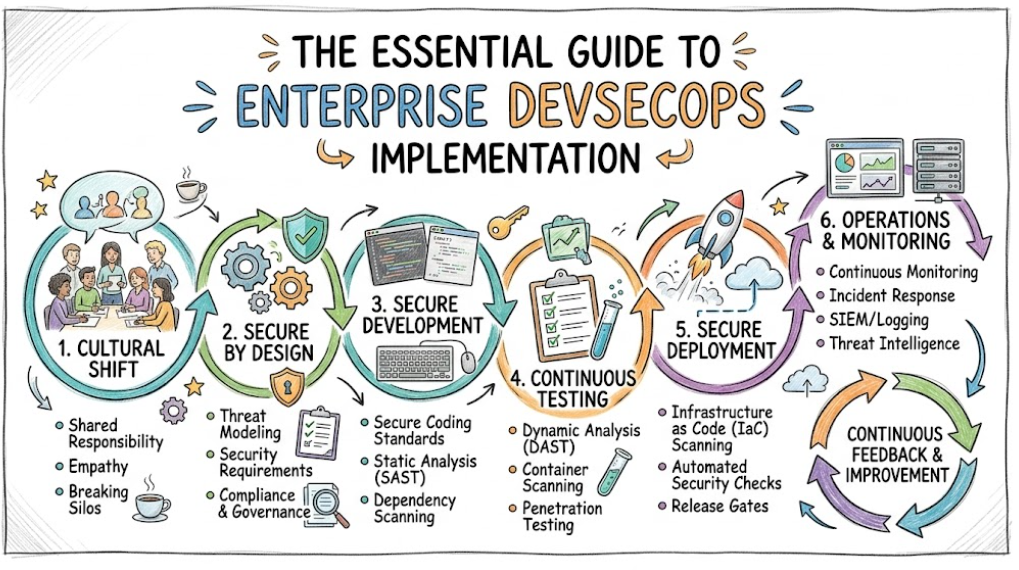
- Assess Security Posture: Evaluate existing processes, tools, and team skills.
- Identify Critical Risks: Determine the most significant threats to your specific business model.
- Define Policies: Establish clear, automated security standards.
- Integrate Security into CI/CD: Add automated testing triggers.
- Automate Security Testing: Implement SAST/DAST tools.
- Secure Infrastructure: Apply policy-as-code to cloud environments.
- Monitor & Observe: Deploy real-time security telemetry.
- Incident Response: Create automated playbooks for breaches.
- Continuous Improvement: Review metrics and refine the strategy regularly.
Shift-Left Security Explained
Shift-left security is the practice of moving security testing and validation to the earliest possible stages of the SDLC. By testing during the design and coding phases, developers receive immediate feedback. This reduces the cost of fixing vulnerabilities, which increases exponentially the closer a bug gets to production.
Security in CI/CD Pipelines
A secure pipeline includes:
- SAST (Static Application Security Testing): Analyzes source code for security flaws.
- DAST (Dynamic Application Security Testing): Tests the running application for vulnerabilities.
- Dependency Scanning: Checks open-source libraries for known vulnerabilities (CVEs).
- Secret Management: Ensuring API keys and passwords are never hardcoded in repositories.
Infrastructure as Code (IaC) Security
Modern infrastructure is immutable and programmable. Tools like Terraform or Ansible allow for rapid deployment, but they can also propagate security misconfigurations at scale. Using scanners like Checkov or tfsec within the pipeline ensures that your cloud environment is compliant with best practices before it is even provisioned.
Kubernetes & Container Security Strategy
In a containerized world, security is multi-layered:
- Image Scanning: Every container image must be scanned for vulnerabilities before being pushed to a registry.
- RBAC (Role-Based Access Control): Limiting who can interact with the Kubernetes cluster.
- Network Policies: Defining how pods communicate to prevent lateral movement of threats.
- Runtime Security: Using tools to detect unauthorized processes within containers.
Popular DevSecOps Tools
| Tool | Purpose | Security Area | Difficulty Level |
| SonarQube | Code Quality | SAST | Beginner |
| Checkov | IaC Scanning | Infrastructure | Intermediate |
| Falco | Runtime Security | Kubernetes | Advanced |
| HashiCorp Vault | Secrets Mgmt | Identity/Secrets | Advanced |
| OWASP ZAP | Web App Testing | DAST | Intermediate |
Real-World DevSecOps Workflow Example
- Commit: Developer pushes code to Git.
- Scan: CI pipeline triggers an automated SAST scan.
- Validate: IaC templates are scanned for cloud misconfigurations.
- Build: Container image is built and scanned for vulnerabilities.
- Deploy: Policy-as-code checks authorize deployment to Kubernetes.
- Monitor: Runtime security agents flag any abnormal pod behavior.
- Alert: Anomalies trigger a ticket in the incident management system.
Common Challenges in DevSecOps Adoption
- Cultural Resistance: Teams often fear that security will slow them down.
- Alert Fatigue: Too many false positives from security tools can lead to teams ignoring alerts.
- Skill Gaps: Finding talent that understands both deep security principles and modern cloud-native engineering is difficult.
Mitigation Strategy: Start small, automate incrementally, and prioritize developer education over strict enforcement.
DevSecOps Team Structure
A successful structure often involves:
- Security Champions: Developers within product teams who advocate for security.
- Platform Engineers: Responsible for building secure, “paved-road” infrastructure.
- Security Engineers: Focus on policy design and advanced threat detection.
Collaboration is facilitated by bi-weekly syncs and shared documentation.
DevSecOps Metrics That Matter
| Metric | Goal | Importance |
| MTTD | Decrease | Faster threat detection. |
| MTTR | Decrease | Faster recovery from incidents. |
| Deployment Success | Increase | Ensures security is not breaking production. |
Career Opportunities in DevSecOps
The demand for DevSecOps professionals is at an all-time high. Roles like Cloud Security Engineer or Kubernetes Security Specialist offer excellent growth potential. Mastering cloud-native security is a top-tier skill set in the current IT market.
Certifications & Learning Paths
Hands-on experience is paramount. Building personal projects—such as a secure Kubernetes cluster or an automated CI/CD pipeline—is the best way to learn. Explore the comprehensive learning paths provided by DevOpsSchool to gain the structured knowledge needed for professional certifications.
| Certification | Best For | Skill Level | Focus Area |
| CKS | K8s Security | Advanced | Container Security |
| AWS/Azure Security | Cloud Security | Intermediate | Cloud Infrastructure |
| DevOpsSchool Programs | Holistic DevSecOps | All Levels | Full Lifecycle |
Common Beginner Mistakes
- Ignoring Linux Fundamentals: You cannot secure what you do not understand.
- Tooling Over Process: Don’t buy a security tool and expect it to fix your culture.
- Lack of Automation: If you aren’t automating, you aren’t doing DevSecOps.
Future of DevSecOps Strategies
The future lies in AI-assisted security, where machine learning models predict vulnerabilities before they are even written, and automated remediation (Self-healing infrastructure) becomes standard. GitOps will further solidify security by maintaining infrastructure state through version-controlled declarative configurations.
FAQs
- What is a DevSecOps strategy? It is a framework that integrates security into the entire SDLC via automation and collaboration.
- Why is DevSecOps important? It mitigates risk without sacrificing the speed required by modern software businesses.
- What is shift-left security? Moving security checks earlier in the development process.
- How do CI/CD pipelines support DevSecOps? By providing a platform to run automated security tests on every code change.
- Is Kubernetes security part of DevSecOps? Yes, it is a critical component of modern cloud-native security.
- What tools are commonly used? Tools like SonarQube, Checkov, and Falco are standard.
- How does DevSecOps improve compliance? By providing automated audit trails for every deployment.
- Is DevSecOps a good career path? It is one of the highest-paying and most in-demand fields in IT.
- Do I need to be a programmer? Basic coding knowledge is essential for writing secure code and automation scripts.
- How long does adoption take? It is an ongoing journey rather than a destination.
- Can I use DevSecOps in legacy systems? Yes, though it requires a phased approach.
- What is the first step? Cultural alignment and security awareness training.
- How do I measure success? Through metrics like MTTR and vulnerability remediation time.
- Is it only for large enterprises? No, startups can benefit from security-first practices from day one.
- Where can I learn more? Platforms like DevOpsSchool offer industry-recognized training.
Final Thoughts
Building a DevSecOps strategy is not a “quick fix”; it is a sustained effort to build a culture of security. By prioritizing automation, observability, and cross-team collaboration, you can transform your security from a bottleneck into a competitive advantage. Focus on incremental improvements, learn the fundamentals of your cloud environment, and never stop iterating on your processes.