
Limited Time Offer!
For Less Than the Cost of a Starbucks Coffee, Access All DevOpsSchool Videos on YouTube Unlimitedly.
Master DevOps, SRE, DevSecOps Skills!
Introduction
Imagine standing at the departures gate, passport in hand, ready to embark on a journey that will change your life forever. For millions of skilled professionals, students, and families, the dream of obtaining Permanent Residency (PR) in a country like Canada, Australia, or New Zealand is the ultimate goal. It represents security, world-class healthcare, quality education, and a thriving career.
But before you pack your bags, there is a crucial hurdle to clear: The PR Points Calculator.
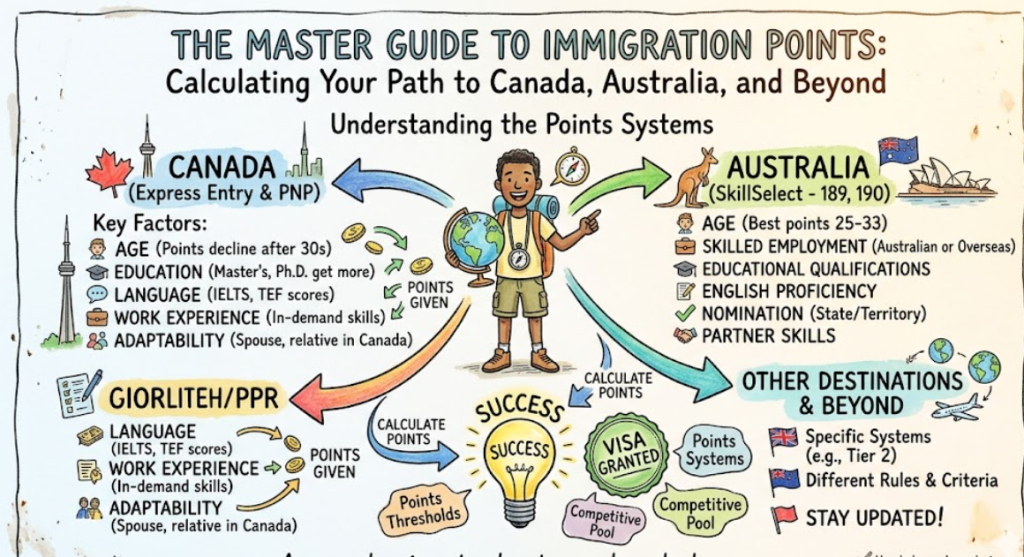
Most modern immigration systems have moved away from “who you know” to “what you know.” To manage the high volume of applicants, governments use a points-based system to rank candidates fairly. This system evaluates your age, education, language skills, and work history to determine if you are a “high-potential” candidate.
Understanding your points is the difference between a successful application and years of uncertainty. In this ultimate guide, we will break down the complexities of the PR points calculator, explore how different countries rank you, and provide actionable strategies to boost your score. Whether you are a first-time applicant or someone looking to improve an existing profile, this guide is your definitive resource.
What Is a PR Points Calculator?
At its core, a PR Points Calculator is a digital tool or a mathematical framework used by immigration authorities to assess an individual’s eligibility for permanent residency.
Definition and Purpose
The points system (often called a Merit-Based Immigration System) is designed to select immigrants who are most likely to integrate into the local economy successfully. Instead of a first-come, first-served basis, countries use these calculators to create a “pool” of candidates and invite the highest-scoring individuals to apply for a visa.
How It Works
The calculator assigns specific numerical values to various human capital factors. For example:
- Age: Usually, younger applicants (20–35) get the highest points.
- Education: A Master’s degree scores higher than a Bachelor’s.
- Experience: Five years of work history is worth more than two.
Eligibility Score vs. Invitation Score
This is where many beginners get confused.
- Eligibility Score: The minimum points required to enter the pool (e.g., 67 points for Canada’s FSWP).
- Invitation Score (Cut-off): The score required to actually receive an Invitation to Apply (ITA). This fluctuates based on competition (e.g., the CRS cut-off in Canada).
How PR Points Systems Work: The Core Pillars
Every country has its own flavor of the points system, but they all share common pillars. Let’s look at the factors that carry the most weight.
1. Age (The Youth Premium)
Immigration systems prefer younger workers because they can contribute to the economy and tax base for a longer period.
- Peak Points: Usually between ages 18 and 30.
- The Decline: Points often start dropping significantly after age 40.
2. Education
Your academic credentials must usually be verified through an Educational Credential Assessment (ECA).
- Ph.D.: Maximum points.
- Double Credentials: Having two degrees or a post-graduate diploma often provides a “bonus” jump in points.
3. Language Proficiency
This is the “X-Factor.” Even with a great degree, poor language scores can tank your application. Most countries accept:
- English: IELTS, PTE, or CELPIP.
- French: TEF or TCF (huge bonus points in Canada).
4. Work Experience
Countries look for “Skilled” work experience (Managers, Professionals, Technicians).
- Foreign Experience: Experience outside the destination country.
- Local Experience: Experience inside the destination country (highly valued).
5. Spouse/Partner Factors
If you are applying with a spouse, their education and language skills can either add to your score or, in some cases, slightly lower the primary applicant’s potential maximum.
Summary Table: General Points Distribution (Estimated)
| Factor | Importance | Why it matters |
| Language Skills | High | Vital for workplace integration |
| Education | High | Indicates specialized skill level |
| Age | Medium | Longevity of economic contribution |
| Work Experience | Medium | Proof of professional competence |
| Job Offer | Bonus | Immediate economic utility |
Canada PR Points Calculator: The Express Entry Era
Canada is the pioneer of the points-based system. Their primary system is Express Entry, which manages three main programs: Federal Skilled Worker (FSW), Federal Skilled Trades (FST), and Canadian Experience Class (CEC).
The Comprehensive Ranking System (CRS)
The CRS is the 1,200-point scale Canada uses to rank you against other candidates.
CRS Score Breakdown
| Category | Max Points (With Spouse) | Max Points (Without Spouse) |
| Core Human Capital (Age, Edu, Lang) | 460 | 500 |
| Spouse Factors | 40 | 0 |
| Skill Transferability | 100 | 100 |
| Additional Points (PNP, Job Offer) | 600 | 600 |
Real-World Example: “The Software Engineer”
- Candidate: Arjun, 29 years old.
- Education: Master’s Degree.
- Language: IELTS 8.0 (CLB 9).
- Experience: 3 years outside Canada.
- Result: Arjun would likely score around 469–475. If the current cut-off is 470, he is in a prime position for an ITA.
Tips to Improve Your CRS Score
- Max out Language: Moving from IELTS 7 to 8 can grant a 20+ point jump.
- Learn French: Even basic French proficiency can add up to 50 points.
- Provincial Nomination (PNP): Getting a nomination from a province like Ontario or Alberta grants an automatic 600 points, guaranteeing an invitation.
Australia PR Points Calculator: Skilled Migration
Australia uses a points-based system for its General Skilled Migration (GSM) program. Unlike Canada, the minimum threshold to submit an Expression of Interest (EOI) is typically 65 points.
Popular Visa Subclasses
- Subclass 189: Skilled Independent (Points-tested).
- Subclass 190: Skilled Nominated (Requires State nomination).
- Subclass 491: Skilled Work Regional (Provisional).
Australia Points Table (Quick View)
| Factor | Criteria | Points |
| Age | 25–32 years | 30 |
| English | Superior (IELTS 8/PTE 79) | 20 |
| Employment | 8+ years experience | 20 |
| Education | Doctorate (Ph.D.) | 20 |
| Study in Australia | 2 years or more | 5 |
Profile Calculation Example
A 31-year-old Accountant with a Master’s degree, 5 years of experience, and “Proficient” English (IELTS 7) would score:
- Age: 30
- English: 10
- Education: 15
- Experience: 10
- Total: 65 Points. (Meeting the minimum, but likely needing state nomination for a competitive edge).
New Zealand PR Points Calculator
New Zealand’s Skilled Migrant Category (SMC) recently underwent changes to a “6-point system.”
The 6-Point System Explained
Applicants need 6 points to apply for residency. You can claim points from:
- Professional Registration, Qualifications, or Income: (You can only pick one of these to claim 3 to 6 points).
- Skilled Work Experience in NZ: (1 point per year, up to 3 points).
Example: If you have a Ph.D. (6 points), you meet the threshold immediately, provided you have a job offer from an accredited employer.
PR Systems in Other Countries
The points-based model is spreading. Here is how other giants compare:
- Germany (Opportunity Card / Chancenkarte): Requires 6 points. Points are given for language, age, and ties to Germany.
- Japan (Highly Skilled Professional): Focuses heavily on academic achievements and high salaries (70 points required).
- UK (Skilled Worker Visa): Not a “pool” system like Canada, but you must “score” 70 points based on having a job offer, meeting salary thresholds, and speaking English.
| Country | System Name | Core Focus |
| Canada | Express Entry | Balanced (Age, Edu, Lang) |
| Australia | SkillSelect | Age and English Proficiency |
| Germany | Opportunity Card | Potential to find work |
| UK | Points-Based System | Job Offer & Salary |
Benefits of Using a PR Points Calculator
Why should you use an online calculator like the one at DesiNRI?
- Instant Reality Check: It tells you immediately if you are eligible or if you need to work harder.
- Gap Analysis: You can see exactly where you are losing points (e.g., “If I get an 8 in IELTS, my score jumps by 30”).
- Country Comparison: You might find that while you don’t qualify for Canada, you are a perfect fit for Australia.
- Saves Money: Don’t pay a consultant hundreds of dollars just to tell you your basic score. Do it yourself first.
Step-by-Step Guide to Calculate Your PR Points
Ready to find your score? Follow these steps:
Step 1: Gather Your Documents
Don’t guess. Have your transcripts, old pay stubs, and any previous test results ready.
Step 2: Check Language Test Scores
If you haven’t taken the test, use a “mock” score. For Canada, aim for CLB 9 (Listening 8.0, others 7.0).
Step 3: Evaluate Your Education
Determine if your degree is equivalent to a local degree. A 4-year Engineering degree is usually a “Bachelor’s.”
Step 4: Calculate Skilled Work Experience
Only count work that falls under skilled categories (NOC in Canada, ANZSCO in Australia). Internship hours usually don’t count.
Step 5: Factor in Your Partner
Calculate your score both “With Spouse” and “Without Spouse.” Sometimes, if a spouse has low English scores, it’s better for the primary applicant to apply alone (if the system allows).
Step 6: The Final Tally
Use a trusted calculator to get your final number. Compare this against the most recent “rounds of invitations.”
How to Increase Your PR Score: Expert Strategies
Is your score too low? Don’t panic. Here is how the pros boost their numbers:
- The “IELTS Retake”: This is the fastest way. Moving from “Proficient” to “Superior” English can be the equivalent of 3 years of work experience in points.
- Sibling Bonus: In Canada, having a brother or sister who is a PR/Citizen gives you 15 extra points.
- Spouse’s Contribution: Have your spouse take the English test and get an ECA for their degree. It can add up to 20 points.
- The Second Program: Apply for a Provincial Nomination. It is the “Golden Ticket” that adds massive points.
- More Experience: Sometimes, just waiting one more year at your current job pushes you into the next points bracket.
Common Mistakes to Avoid
- Miscalculating Work Experience: Counting “unskilled” work or part-time work incorrectly.
- Using Outdated Calculators: Immigration laws change monthly. Ensure the tool you use is updated for 2024-2025.
- Ignoring the “Expiry” of Points: Language tests expire after 2 years. If your test expires while you are in the pool, your score drops to zero.
- Over-estimating Education: Assuming a “Diploma” is a “Master’s.” Always check with WES or relevant bodies first.
Real-Life Case Studies
Case Study 1: The Young Techie
- Name: Leo (24, Brazil)
- Profile: Bachelor’s, 2 years experience, IELTS 7.5.
- Initial Score: 430 (Canada).
- Problem: Too low for current cut-offs.
- Action: Leo studied for 3 months and retook IELTS, getting an 8.5. He also gained 1 more year of work.
- Final Result: Score jumped to 481. Received ITA in 2 weeks.
Case Study 2: The Married Couple
- Name: Preeti & Amit (34, India)
- Profile: Amit (Primary) had a Ph.D. but low English.
- Initial Score: 60 (Australia).
- Action: They realized Preeti had a high-demand skill (Nursing). They switched Preeti to the Primary Applicant.
- Final Result: With Amit’s partner points and Preeti’s skill, they hit 85 points and got a Subclass 190 nomination.
Case Study 3: The Healthcare Hero
- Name: Sarah (28, Philippines)
- Profile: Registered Nurse.
- Goal: New Zealand.
- Action: Sarah used the “Green List” pathway. Since her profession was Tier 1, she bypassed the complex points tally and went straight to the “Straight to Residence” visa.
FAQs: Everything Beginners Need to Know
1. What is a “good” PR score?
For Canada, anything above 500 is currently very strong. For Australia, 85-90 points is usually the sweet spot for an invitation in competitive fields.
2. Does age really matter that much?
Yes. Most systems are designed to attract people who will work for 30+ years in the country. After age 40, points drop significantly.
3. Can I apply if I don’t have a job offer?
Absolutely. Many programs (like Canada’s Express Entry or Australia’s 189) do not require a job offer.
4. How accurate are online PR calculators?
They are highly accurate for “Core” points, but they cannot predict “Officer Discretion” or specific document verification issues.
5. How often do the cut-off scores change?
Every time there is a “Draw” (usually every 2 weeks). It’s like a stock market for immigrants.
6. What if my degree is from a non-English speaking country?
You must get an ECA (Educational Credential Assessment) to prove it meets the destination country’s standards.
7. Can I include my children in the points calculation?
Children don’t usually add points, but they are included in your application as dependents.
8. Is IELTS the only test I can take?
No, PTE Academic is widely accepted by Australia and New Zealand, and now Canada (PTE Core).
9. What is the “Provincial Nomination” everyone talks about?
It’s when a specific province (like British Columbia) “picks” you from the pool because they need your specific skills.
10. How long is my score valid?
Your profile in the pool usually lasts for 12 months. If you aren’t invited, you have to re-submit.
11. Does my net worth or bank balance add points?
Generally, no. Wealth doesn’t give you points, but you must show “Proof of Funds” to prove you can support yourself.
12. Which country has the “easiest” points system?
Currently, Germany and Canada (for French speakers) are among the most accessible.
Conclusion: Start Your Journey Today
The PR Points Calculator is more than just a tool; it’s a mirror reflecting your current standing in the global labor market. It shows you your strengths and highlights your weaknesses.
Immigration is a marathon, not a sprint. If your score isn’t where it needs to be today, use this guide to build a plan. Improve your English, gain that extra year of experience, or look into a provincial nomination. The dream of a new life abroad is achievable, provided you have the right data and a solid strategy.
Your future self will thank you for taking the first step today.
Call To Action
Don’t leave your future to chance!
- Calculate Your Score: Head over to our PR Points Calculator to get your baseline score.
- Compare Programs: Check the requirements for Canada vs. Australia to see where you rank higher.
- Book Your Language Test: If you haven’t taken the IELTS or PTE, schedule it today—it’s the fastest way to boost your profile!
- Stay Updated: Subscribe to our newsletter for the latest immigration draw results and policy changes.