
Limited Time Offer!
For Less Than the Cost of a Starbucks Coffee, Access All DevOpsSchool Videos on YouTube Unlimitedly.
Master DevOps, SRE, DevSecOps Skills!
Introduction
In the current era of cloud-native computing, the pressure to deliver software rapidly has transformed how enterprises operate. Developers are no longer just writing code; they are responsible for infrastructure, deployment, and performance. This shift led to the rise of DevOps, which broke down silos between development and operations teams. However, as delivery speeds increased, security often became an afterthought, creating vulnerabilities in fast-paced CI/CD pipelines.
This is where the paradigm of DevSecOps enters the conversation. It is not merely a tool-based evolution but a cultural and operational shift that embeds security into the entire software development lifecycle. For professionals looking to understand these methodologies deeply, DevOpsSchool provides comprehensive insights into mastering these frameworks in real-world scenarios.
In this guide, we will break down the fundamental distinctions between these two approaches, how they function in enterprise environments, and why integrating security into the DNA of your pipeline is the most critical step for any modern engineering organization.
What Is DevSecOps?
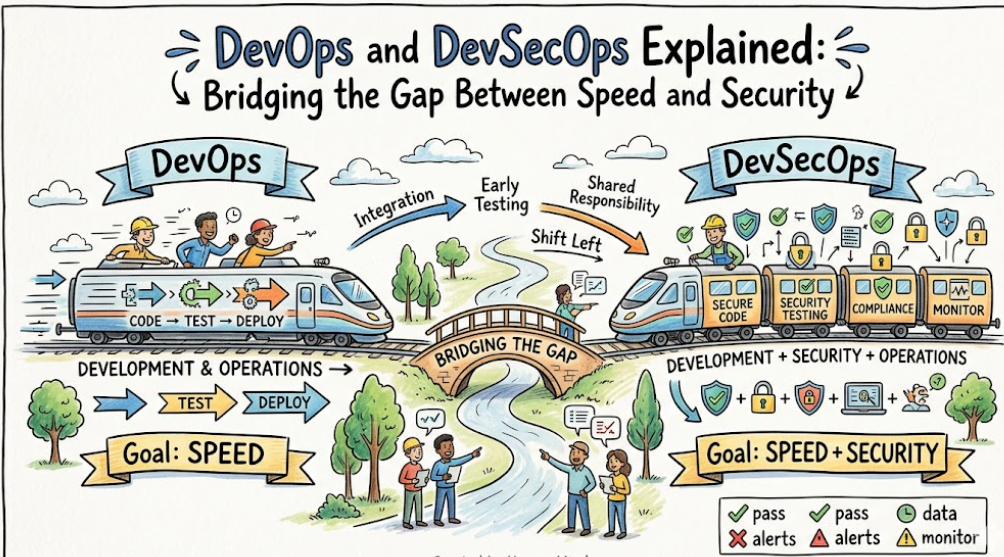
DevSecOps is the practice of integrating security testing and compliance at every phase of the software development lifecycle. Instead of treating security as a final “gate” before production, it is embedded from the planning stage onwards. This philosophy is often referred to as “Shift-Left” security, meaning developers and security engineers identify vulnerabilities early in the coding phase rather than discovering them after deployment.
In a DevSecOps model, security is treated as code. Policies, compliance checks, and vulnerability scans are automated within the CI/CD pipeline. This approach allows organizations to move quickly without compromising on the integrity of their infrastructure or data.
What Is DevOps?
DevOps is a set of practices that combines software development (Dev) and IT operations (Ops) to shorten the systems development life cycle and provide continuous delivery with high software quality. The primary goal of DevOps is to increase an organization’s ability to deliver applications and services at high velocity.
By using automation, CI/CD pipelines, and infrastructure-as-code, DevOps teams ensure that the software is reliable, scalable, and easy to deploy. It focuses heavily on collaboration, breaking down the traditional walls where developers would “throw code over the wall” to operations teams.
Why DevSecOps Became Necessary
As DevOps accelerated delivery, the gap between development speed and security rigor widened. Traditional security models—where security teams audited applications weeks after development—were too slow for the daily or hourly deployment cycles of modern DevOps.
Furthermore, the rise of containerization and Kubernetes introduced complex attack surfaces. With microservices, a single vulnerability in a dependency or an insecure container configuration can expose the entire cluster. DevSecOps became necessary to automate these checks, ensuring that security keeps pace with the agility offered by DevOps.
DevSecOps vs DevOps: Core Differences
| Feature | DevOps | DevSecOps |
| Primary Focus | Speed, efficiency, and collaboration. | Security, compliance, and risk mitigation. |
| Security Ownership | Often handled by a separate security team. | Shared responsibility among all stakeholders. |
| Pipeline Integration | Focuses on build and deployment speed. | Integrates security testing in every step. |
| Compliance | Often reactive or manual. | Automated and continuous. |
| Risk Management | Focuses on system availability. | Focuses on data integrity and threat detection. |
| Testing | Focuses on functional and performance. | Includes SAST, DAST, and dependency scanning. |
DevOps Lifecycle Explained
The DevOps lifecycle is an iterative process designed to foster continuous improvement:
- Plan: Defining project requirements and strategy.
- Code: Writing and managing code in version control systems.
- Build: Compiling code into executable artifacts.
- Test: Running unit and integration tests.
- Release: Packaging and preparing the application.
- Deploy: Moving code into production environments.
- Operate: Managing infrastructure and performance.
- Monitor: Tracking application health and user feedback.
DevSecOps Lifecycle Explained
DevSecOps adds a security layer to each of the phases mentioned above:
- Threat Modeling: Identifying potential risks during the planning phase.
- Secure Development: Using IDE plugins to prevent insecure coding patterns.
- SAST (Static Analysis): Checking source code for vulnerabilities during the build.
- Dependency Scanning: Ensuring third-party libraries have no known CVEs.
- DAST (Dynamic Analysis): Testing the running application for runtime vulnerabilities.
- Infrastructure Security: Scanning IaC templates (like Terraform or Kubernetes manifests) for misconfigurations.
- Runtime Security: Using agents to detect anomalous behavior in production.
Security Automation in DevSecOps
Automation is the engine of DevSecOps. Without it, manual security checks would bottleneck the pipeline. Key automation areas include:
- Vulnerability Scanning: Automatically failing a build if critical vulnerabilities are found.
- Secrets Management: Using tools to inject credentials dynamically rather than hardcoding them.
- Policy Enforcement: Using tools like OPA (Open Policy Agent) to enforce security rules in Kubernetes.
- Infrastructure Scanning: Auditing cloud configurations to ensure compliance with CIS benchmarks.
Popular DevOps Tools
| Tool | Purpose | Enterprise Usage | Difficulty |
| Jenkins | CI/CD Automation | High | Medium |
| Docker | Containerization | High | Easy |
| Kubernetes | Orchestration | High | Hard |
| Terraform | IaC | High | Medium |
| Prometheus | Monitoring | High | Medium |
Popular DevSecOps Tools
| Tool | Purpose | Enterprise Usage | Difficulty |
| SonarQube | SAST | High | Easy |
| OWASP ZAP | DAST | High | Medium |
| HashiCorp Vault | Secrets Management | High | Hard |
| Snyk | Dependency Scanning | High | Easy |
| Aqua Security | Container/K8s Security | High | Hard |
Real-World DevOps Workflow Example
A typical DevOps flow starts with a developer pushing code to Git. A CI tool like Jenkins detects the change, triggers a build, runs unit tests, and creates a Docker image. This image is pushed to a registry and deployed to a Kubernetes cluster via Helm charts. The operations team monitors the deployment for uptime and latency using tools like Grafana.
Real-World DevSecOps Workflow Example
In a DevSecOps flow, the process is identical but with security gates. Before the build, Snyk checks for vulnerable dependencies. During the build, SonarQube performs static analysis. Before deployment, a Kubernetes admission controller checks the manifest for security misconfigurations. If any check fails, the pipeline halts, and the developer receives an immediate alert to fix the issue.
Benefits of DevOps
- Faster time to market.
- Improved team collaboration.
- Reduced time between fixes.
- Higher efficiency through automation.
Benefits of DevSecOps
- Proactive threat mitigation.
- Reduced cost of fixing bugs later in the lifecycle.
- Continuous compliance automation.
- Increased customer trust through verified security.
Challenges in DevOps
- Tool Sprawl: Managing too many disparate tools.
- Cultural Resistance: Overcoming “silo” mindsets.
- Monitoring Complexity: Managing massive amounts of logs and metrics.
Challenges in DevSecOps
- Skill Gaps: Finding talent that understands both code and security.
- False-Positive Fatigue: Security tools can flag issues that are not actually dangerous.
- Developer Friction: Security checks can slow down the development process if not tuned correctly.
DevSecOps and DevOps Career Paths
Both paths offer high growth potential. A DevOps Engineer focuses on pipeline stability and infrastructure automation. A DevSecOps Engineer specifically focuses on hardening those pipelines and implementing security controls. SREs focus on reliability and uptime, often working closely with both teams. Salaries for these roles remain among the highest in the IT industry, with demand growing across all sectors.
Certifications for DevOps & DevSecOps
| Certification | Level | Focus Area | Best For |
| AWS Certified DevOps | Advanced | Cloud Platforms | Practitioners |
| CKA (Kubernetes) | Advanced | Orchestration | K8s Admins |
| CompTIA Security+ | Beginner | General Security | Security Starters |
| DevSecOps Certs | Intermediate | Secure Pipelines | Engineers |
Common Beginner Mistakes
- Skipping the Basics: Trying to master Kubernetes without understanding Linux or networking.
- Tool Fetishism: Learning a tool without understanding the underlying concept.
- Ignoring Security: Believing security is “someone else’s problem.”
- Hardcoding Credentials: Storing passwords in scripts or code repositories.
Future of DevSecOps and DevOps
The future lies in AI-driven security, where machine learning models predict vulnerabilities before they even reach the pipeline. GitOps is also becoming the standard for managing infrastructure, where the state of the system is entirely defined in a repository. We are also seeing the rise of Platform Engineering, where internal teams build developer portals to abstract complexity.
FAQs
- What is the difference between DevSecOps and DevOps?
DevOps focuses on development and operations collaboration; DevSecOps adds security to that collaboration. - Is DevSecOps more secure than DevOps?
Yes, because security is a continuous, automated process rather than an afterthought. - Does DevSecOps require cybersecurity skills?
It requires an understanding of security principles, but you do not need to be a penetration tester. - Which tools are used in DevSecOps?
Tools like Snyk, SonarQube, and HashiCorp Vault are common. - Is Kubernetes important for DevSecOps?
Extremely, as it is the standard for modern, scalable, and secure deployments. - Can DevOps engineers become DevSecOps engineers?
Yes, by upskilling in security automation and compliance. - Is coding required for DevSecOps?
Yes, primarily in scripting (Python, Go, Bash) and Infrastructure as Code. - Which career has better long-term growth?
Both are excellent, but DevSecOps is seeing higher demand due to increasing cyber threats. - How do I start learning?
Begin with Linux, then Cloud, then CI/CD, and finally Security tools. - Is DevSecOps just for large enterprises?
No, it is essential for any business that processes user data. - Do I need to be a developer first?
It helps to have a background in either dev or ops to understand the context. - What is “Shift-Left”?
Moving security testing earlier in the development lifecycle. - What is Infrastructure as Code?
Managing servers and networks through configuration files instead of manual setup. - Why is culture important?
Security is a mindset; without collaboration, tools alone will not work. - Does DevSecOps eliminate all risks?
No, but it significantly reduces the attack surface and improves response time.
Final Thoughts
Transitioning to DevSecOps is a journey, not a destination. It requires an honest look at your current processes, a willingness to break down silos, and a commitment to continuous learning. Whether you are an engineer looking to grow or a manager trying to build a resilient team, the key is to prioritize security alongside speed. Do not treat security as an obstacle—view it as an essential component of quality.