
Limited Time Offer!
For Less Than the Cost of a Starbucks Coffee, Access All DevOpsSchool Videos on YouTube Unlimitedly.
Master DevOps, SRE, DevSecOps Skills!
Introduction
The dream of living in Austria—a nation consistently ranked among the most livable in the world—is increasingly attainable for professionals with the right qualifications. Whether you are an IT specialist, a healthcare practitioner, or a researcher, Austria’s immigration landscape is designed to welcome talent that contributes to its economic growth.
However, navigating the bureaucracy can feel daunting. Many applicants fail to understand that the immigration system is not just about having a job offer; it is about qualifying under a rigorous points-based assessment. This is where the Austria PR Points Calculator becomes your most valuable asset. It allows you to simulate your application score, helping you identify where you stand and where you might need to bolster your credentials.
In this guide, we will peel back the layers of the Red-White-Red (RWR) Card system. You will learn why eligibility checking is the cornerstone of a successful visa application and how you can proactively manage your profile to meet the threshold.
What Is an Austria PR Points Calculator?
At its core, the Austria PR points calculator is an analytical tool that mirrors the official assessment criteria used by the Austrian Public Employment Service (AMS). It acts as a compass, allowing you to input your specific profile—age, education, language skills, and experience—to generate an estimated score.
Why Austria Uses a Points-Based System
Austria operates on a demand-driven immigration model. They seek to fill specific labor market gaps. By utilizing a points system, the government can objectively measure the human capital of an applicant. It ensures that the individuals invited to settle are those most likely to integrate successfully, thrive in the workplace, and contribute meaningfully to the economy.
Understanding the Red-White-Red Card System
The Red-White-Red Card is the gateway to permanent residency (PR) in Austria. It is not a single visa but a system of pathways tailored to different professional profiles:
- Very Highly Qualified Workers: For those with exceptional academic and professional achievements.
- Skilled Workers in Shortage Occupations: For professionals in fields where Austria faces a labor supply deficit.
- Other Key Workers: For qualified professionals filling specific roles that meet defined salary and criteria thresholds.
The calculator helps you determine which of these categories aligns best with your professional reality. Crucially, remember that your eligibility score is distinct from visa approval. The score gets you in the door, but the assessment process remains under the jurisdiction of the relevant Austrian authorities.
How the Austria Immigration Points System Works
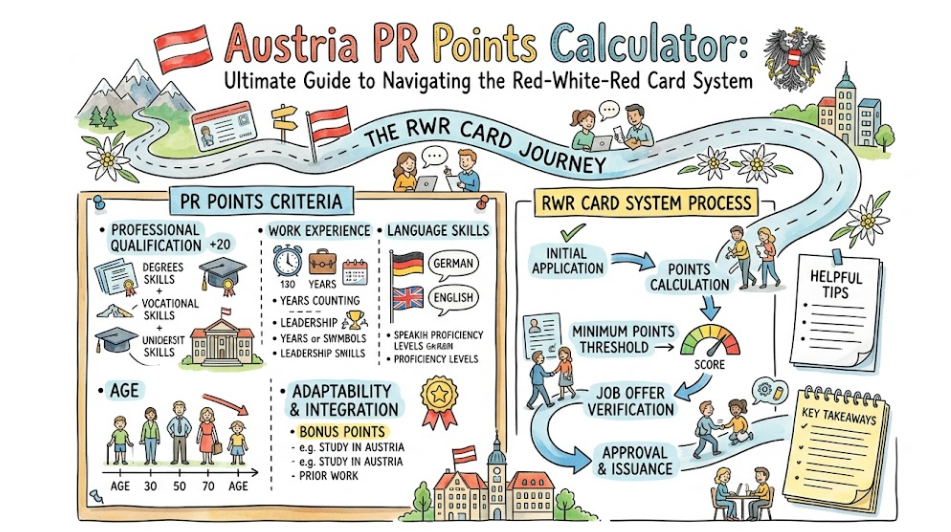
The points system is categorized into several key pillars. While each visa stream has its own nuances, these five areas are the backbone of almost every calculation.
Age Points
Age is an indicator of your long-term career potential in the Austrian labor market. Generally, younger professionals are awarded higher points, as they are expected to have a longer productive career ahead of them.
Education Points
Your academic pedigree is a significant weight-bearer. Whether you hold a bachelor’s degree, a master’s degree, or a PhD, each qualification tier is evaluated based on its relevance and duration. Degrees obtained from recognized global institutions are viewed favorably.
Language Skills
Austria values linguistic integration. Proficiency in German is highly rewarded, though English proficiency is also recognized, especially in multinational corporate environments. Achieving a B1 or B2 level in German can often be the difference between meeting or missing the cut-off score.
Work Experience
Your professional history is evaluated based on the relevance of your work to your target occupation. The system gives higher weight to experience gained in Austria, but international professional experience is also a core component of your score.
Salary & Job Offer
In many streams, a concrete job offer with a salary that meets specific Austrian benchmarks is a prerequisite. The higher the salary relative to the market standard, the stronger your application is perceived to be.
Austria Red-White-Red Card Explained
The Red-White-Red Card is the tangible result of a successful points-based application. It serves as both a residence permit and a work permit, linking you to a specific employer.
Key Pathways
- Very Highly Qualified Workers: This pathway is unique because it does not always require an initial job offer. If you have an exceptional academic profile and professional background, you can apply for a Job Seeker Visa to look for work in Austria.
- Skilled Workers in Shortage Occupations: Austria updates a list of occupations that are currently in high demand. If your profession is on this list, your barrier to entry is significantly lower.
- Other Key Workers: This covers professionals who do not fit into the “shortage” category but still possess high-demand skills and have secured a well-paying job offer.
- Start-up Founders: An innovative pathway for entrepreneurs who can demonstrate a viable business plan and potential capital investment.
Transition to Permanent Residency
Your Red-White-Red Card is typically valid for 24 months. During this period, you are tied to your sponsoring employer. However, once you have completed a set period of qualified employment, you can transition to the “Red-White-Red Card Plus,” which grants you unrestricted access to the labor market—an essential precursor to permanent settlement.
Austria PR Points Calculator Breakdown
To visualize how this works, consider this generalized breakdown. Please note that exact points per category can shift based on official regulatory updates.
| Factor | Maximum Contribution Potential |
| Age | Significant weighting for applicants in their early-to-mid career stages. |
| Education | High weighting for degrees, PhDs, and specialized vocational training. |
| Language Skills | Substantial weighting for German proficiency; moderate for English. |
| Work Experience | Weighted based on duration and relevance to the specific role. |
| Job Offer | Vital in most streams; salary thresholds are mandatory. |
Step-by-Step Example of Austria PR Score Calculation
Let’s look at three hypothetical profiles to understand the scoring logic.
Example 1: The Software Engineer
- Profile: 32 years old, Master’s in Computer Science, 5 years of international experience, English C1, German A1.
- Result: This candidate scores well on age and education. Since Software Engineering is often a “Shortage Occupation,” they gain extra points for their qualification, likely pushing them well over the minimum threshold.
Example 2: The Healthcare Worker
- Profile: 35 years old, Nursing degree from a recognized institution, 8 years of experience, German B1 level.
- Result: Healthcare is consistently in high demand. The German B1 level provides a massive boost to the score. Even without “Austrian” experience, their education and language skills usually make them a strong candidate.
Example 3: The Student Transitioning to Work
- Profile: Completed a Bachelor’s in Austria, 24 years old, internship experience, English/German B2.
- Result: The “Studies in Austria” bonus is significant. They have an advantage because they have already proven their ability to integrate into the Austrian system.
Austria PR Eligibility Requirements
Beyond just “points,” there are hard requirements that every applicant must satisfy.
- Educational Qualifications: Your degree must be verified or recognized by the Austrian recognition agency (ENIC NARIC).
- Work Contracts: You must have a formal job offer that meets the minimum salary thresholds defined by the Austrian government for your specific role.
- Financial Proof: You must demonstrate that you have the means to support yourself during the initial settling-in period.
- Insurance: Proof of valid health insurance coverage is non-negotiable.
Benefits of Using an Austria PR Points Calculator
Why should you spend time with a calculator before filing your paperwork?
- Objective Assessment: It removes the guesswork. You stop wondering if you “might” qualify and start looking at data.
- Strategic Planning: If the calculator shows you are slightly below the threshold, you know exactly what to improve—be it your German language level or a professional certification.
- Risk Reduction: Filing an application that has no chance of success is a waste of time and money. The calculator helps you avoid premature applications.
- Visa Stream Selection: It clarifies whether you should apply as a “Very Highly Qualified” individual or an “Other Key Worker.”
Step-by-Step Guide to Calculate Austria PR Points
- Gather Educational Documents: Have your degrees and transcripts ready. Verify if they are considered “tertiary” level.
- Assess Language Proficiency: Get a certified result from a recognized testing center (ÖSD, Goethe-Institut, etc.).
- Audit Work Experience: List your professional roles and calculate the duration in months.
- Check Job Offer Details: Ensure the salary package matches the “Key Worker” or “Shortage Occupation” requirements.
- Evaluate Bonus Categories: Do you have research publications? Are you a specialized researcher? These “hidden” points can be game-changers.
- Calculate Final Score: Use a reliable tool to run the numbers.
How to Increase Austria PR Score
If your score is not where it needs to be, do not get discouraged. You can actively influence your profile:
- Learn German: This is the most effective lever. Moving from A1 to B1 can drastically change your point standing.
- Upskill: Professional certifications in your field (DevOps, Cloud Security, specialized healthcare licenses) can count toward “special qualifications.”
- Target Shortage Occupations: If you are a generalist, look into specific niches that are currently listed on the Austrian shortage occupation list.
- Job Offer Negotiations: Ensure your employment contract is structured to meet the minimum salary thresholds for the RWR card.
Common Mistakes to Avoid
- Ignoring Language Requirements: Many professionals assume English is enough. While it is useful, ignoring German is a missed opportunity for points.
- Outdated Criteria: Immigration laws change. Always use the most current points table, not one from three years ago.
- Misinterpreting “Shortage Occupations”: Just because you are in IT doesn’t mean your specific role is on the list. Verify the current list with the official AMS portal.
- Overestimating Salary: Check the gross salary requirements, not your expected net income.
Real-Life Case Studies
Case Study 1: The IT Professional
A 34-year-old software developer was initially rejected because they applied for a generic permit. After using the calculator, they realized they qualified as a “Shortage Occupation” worker. They updated their application with the correct category and highlighted their specific technical skills, resulting in a successful approval.
Case Study 2: The Married Couple
A professional and their spouse looked at their combined profile. They realized the primary applicant’s score was on the edge. By focusing on obtaining a B1 German certificate for the primary applicant, they boosted their score by 15 points, ensuring a safe margin for approval.
FAQs
- What is the Austria PR points calculator?It is a tool that helps you estimate your eligibility for the Red-White-Red Card by calculating points based on age, education, and skills.
- How many points are needed for Austria PR?The threshold varies by visa stream (e.g., 70 for Very Highly Qualified, 55 for others).
- What is the Red-White-Red Card?It is the unified residence and work permit for skilled non-EU citizens in Austria.
- Is German language mandatory?It is not always mandatory for the job itself, but it is highly recommended and offers significant points for your application.
- Can I move to Austria without a job offer?Only if you qualify under the “Very Highly Qualified” route, which may allow for a Job Seeker Visa.
- Does age affect eligibility?Yes, younger applicants (usually under 35 or 40) generally receive more points.
- Can students settle permanently in Austria?Yes, after completing studies and finding qualifying employment, students can transition to the RWR Card and eventually permanent residency.
- How accurate are online calculators?They are accurate indicators based on current rules but should be used as a guide; final approval lies with the Austrian authorities.
- What is the “Shortage Occupation” list?A yearly government list of professions that are in high demand within Austria.
- Do I need a lawyer?It is not mandatory, but for complex cases, legal advice can be helpful.
- How long is the RWR card valid?Usually 24 months.
- Can my family come with me?Yes, the RWR card generally allows for family reunification, subject to meeting financial and housing requirements.
Conclusion
The Austria PR points calculator is more than just a digital tool—it is a strategic partner in your immigration journey. By understanding the components of the Red-White-Red Card system, you move from a place of uncertainty to a position of clarity. Whether you are improving your German proficiency, searching for that crucial job offer, or polishing your professional credentials, every action you take now brings you closer to your goal of living and working in Austria.