
Limited Time Offer!
For Less Than the Cost of a Starbucks Coffee, Access All DevOpsSchool Videos on YouTube Unlimitedly.
Master DevOps, SRE, DevSecOps Skills!
Introduction
In the current era of rapid software delivery, the speed at which we push code to production is often the primary metric of success. However, as cloud-native architectures become the standard, the attack surface has expanded significantly. We are seeing a rise in sophisticated cyber threats that target vulnerabilities in our supply chain, container images, and misconfigured cloud environments. Security can no longer be a final hurdle before release; it must be an integrated, foundational element of the entire development lifecycle.
This shift is where DevSecOps comes into play. It is not just about buying new tools; it is a fundamental shift in mindset. It requires embedding security practices directly into the engineering workflow, from the initial line of code to the final deployment. For those looking to master these methodologies, platforms like DevOpsSchool provide the necessary frameworks and training to navigate this complex transition. Whether you are an SRE, a developer, or a security professional, understanding the core principles of secure delivery is critical for building resilient, future-proof systems.
What Are DevSecOps Principles?
DevSecOps principles represent the fusion of development, security, and operations. At its core, it is the practice of integrating security decisions, tools, and processes into the existing DevOps pipeline. Rather than viewing security as a checkpoint at the end of the SDLC (Software Development Life Cycle), DevSecOps principles treat security as a continuous, shared responsibility.
This involves moving away from the traditional model where developers write code and security teams audit it afterward. Instead, we empower developers to write secure code from the start. We automate security testing so that vulnerabilities are caught while the code is being written, not after it is deployed. It is an engineering mindset where security is baked into the architecture, ensuring that protection is not an afterthought, but a design requirement.
Why DevSecOps Principles Matter
In modern engineering, the cost of a security breach extends far beyond financial loss; it impacts customer trust and brand reputation. DevSecOps matters because it shifts the focus from reactive firefighting to proactive prevention.
- Faster Vulnerability Detection: By testing early, we find flaws before they reach production.
- Compliance Automation: Automated governance ensures that your infrastructure adheres to standards like PCI-DSS or HIPAA without manual audits.
- Reduced Cyber Risk: By automating security, we eliminate human error, which is the leading cause of cloud misconfigurations.
- Operational Resilience: A secure pipeline allows for rapid patching, enabling teams to respond to new threats (like Zero-Day vulnerabilities) in minutes rather than weeks.
Evolution from DevOps to DevSecOps
The evolution toward DevSecOps was born out of necessity. In traditional IT setups, security was a bottleneck. Security teams operated in silos, manually reviewing code or infrastructure, which frequently delayed deployments. This created a friction-filled environment where “speed” and “security” were viewed as mutually exclusive.
As we moved to the cloud, the infrastructure became programmable (Infrastructure as Code). This allowed us to apply the same version control and automation techniques used in software development to security policies. We moved from “Security at the end” to “Shift-Left Security,” integrating testing into the CI/CD pipeline. Today, DevSecOps is the natural maturity model for organizations that have already adopted DevOps and need to secure their cloud-native footprint.
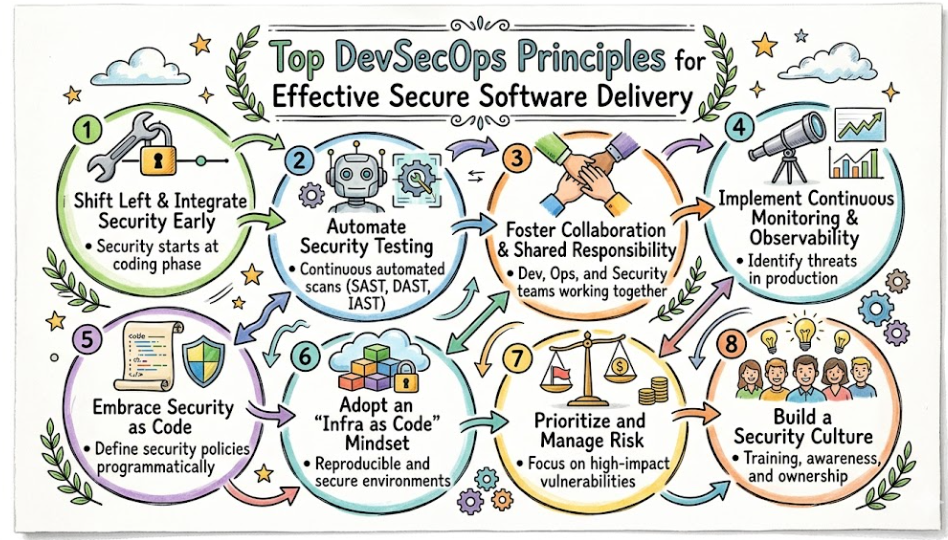
Overview of Top DevSecOps Principles
| Principle | Purpose | Real-World Benefit |
| Shift-Left Security | Test early in the SDLC | Reduces cost of fixing bugs |
| Security as Code | Define policies in code | Ensures repeatable enforcement |
| Continuous Monitoring | Real-time threat detection | Faster incident response |
| Least Privilege | Limit access rights | Reduces blast radius of attacks |
| IaC Security | Validate infrastructure templates | Prevents cloud misconfigurations |
| Secure CI/CD | Automate pipeline security | Eliminates manual review bottlenecks |
| Container Security | Harden runtime environments | Protects microservices |
| Compliance as Code | Automate regulatory audits | Ensures continuous compliance |
| Shared Responsibility | Align dev and security teams | Improves communication/culture |
| Continuous Feedback | Learn from past incidents | Prevents recurring vulnerabilities |
Principle 1: Shift-Left Security
Shift-left is the practice of moving security testing to the earliest possible stages of development. Instead of waiting for a security audit after deployment, we run static analysis (SAST) and linting during the IDE phase or upon commit. This allows developers to receive immediate feedback and fix issues while the logic is still fresh in their minds, significantly lowering the technical debt and remediation costs.
Principle 2: Security as Code
Security as Code involves writing your security policies, firewall rules, and access controls in the same format as your application code. By using tools to define these parameters, you create a version-controlled, auditable, and repeatable security posture. When you change a policy, it goes through the same peer review process as your application code.
Principle 3: Secure CI/CD Pipelines
The CI/CD pipeline is the heart of software delivery. A secure pipeline must include automated vulnerability scanning, dependency checks, and secrets management. It is critical to ensure that the pipeline itself is secure—protecting the build environment, signing artifacts, and ensuring only authorized code makes it to production.
Principle 4: Continuous Security Testing
Testing should never be a one-time event. Integrate automated tests into your build process:
- SAST (Static Analysis): Checking source code for patterns.
- DAST (Dynamic Analysis): Testing the running application for vulnerabilities.
- SCA (Software Composition Analysis): Scanning dependencies for known CVEs.
Principle 5: Least Privilege Access
This is a foundational concept. Every user, service, or container should only have the permissions necessary to perform its specific task. In Kubernetes, this means using RBAC (Role-Based Access Control) to restrict what a pod can do, rather than running everything as root.
Principle 6: Infrastructure as Code (IaC) Security
If you use Terraform or CloudFormation, you are managing infrastructure with code. IaC security involves scanning these configuration files before they are applied. Tools like Checkov or Terrascan can identify if a storage bucket is public or if an EC2 instance has an open port before the resources are ever provisioned in your cloud account.
Principle 7: Container and Kubernetes Security
Containers are immutable, but they are also dynamic. You must secure the image (scanning for vulnerabilities), the registry (signing images), and the runtime (using tools like Falco to detect anomalous behavior in your pods).
Principle 8: Continuous Monitoring and Threat Detection
Visibility is non-negotiable. You need centralized logging (using ELK or Splunk) and real-time monitoring (Prometheus/Grafana) to visualize security events. If an attack occurs, you need the logs to reconstruct the timeline and identify the source of the breach.
Principle 9: Compliance as Code
Manual compliance checks are slow and prone to error. By treating compliance as code, you write scripts that constantly verify if your environment meets standards. If a configuration drifts out of compliance, your system can trigger an automated alert or even auto-remediate the issue.
Principle 10: Shared Security Responsibility
The final, and perhaps most important, principle is culture. Security is not the job of the “Security Team”—it is the job of every engineer. When developers understand the security implications of their code and operations teams understand the security risks of their configuration, the entire organization becomes a stronger line of defense.
Real-World Example of DevSecOps Principles in Action
Imagine a standard deployment workflow:
- Commit: A developer pushes code to Git. A pre-commit hook runs a lightweight SAST scan.
- Pipeline Trigger: The CI pipeline initiates. It runs dependency scans to ensure no libraries have critical vulnerabilities.
- Infrastructure Check: The Terraform plan is generated and scanned by an IaC security tool.
- Build: A container image is built. It is scanned for OS-level vulnerabilities.
- Test: Automated functional tests run, followed by DAST.
- Deploy: The image is deployed to Kubernetes with limited RBAC permissions.
- Monitor: Runtime security agents monitor for unauthorized processes.
If any stage fails, the pipeline halts. This automated loop ensures only secure code reaches production.
Benefits of Following DevSecOps Principles
- Increased Speed: Security automation removes manual reviews, speeding up the release cycle.
- Proactive Posture: You stop playing catch-up with vulnerabilities and start preventing them.
- Enhanced Reliability: Secure systems are generally more robust and less prone to outages caused by malicious exploitation.
- Compliance Readiness: With Compliance as Code, you are effectively in a state of “continuous audit,” ready for regulatory inspections at any time.
Common Mistakes Teams Make in DevSecOps
- Tool Obsession: Buying expensive security tools without changing the development process or training the team.
- Alert Fatigue: Enabling every possible security check without tuning them, leading to too many false positives and developers ignoring alerts.
- Ignoring Secrets Management: Hardcoding credentials in Git is a common failure. Always use a vaulting solution.
- Shadow IT: Developing infrastructure outside of established security pipelines, creating blind spots.
Best Practices for Applying DevSecOps Principles
- Automate Everything: If you can’t automate it, document it and aim to automate it later.
- Educate Teams: Invest in ongoing training. Security knowledge among developers is your greatest asset.
- Start Small: Do not try to overhaul everything at once. Secure your pipeline, then your infrastructure, then your runtime.
- Feedback Loops: Make sure security findings are actionable and go directly to the developers who wrote the code.
DevSecOps Principles vs Traditional Security Practices
| Feature | Traditional Security | DevSecOps Principles |
| Security Timing | End of SDLC (Gateway) | Integrated throughout (Continuous) |
| Automation | Low (Manual Reviews) | High (Automated Pipelines) |
| Monitoring | Periodic Audits | Real-time/Continuous |
| Deployment Speed | Slow (Security Bottlenecks) | Fast (Automated Guardrails) |
| Collaboration | Siloed (Dev vs Security) | Shared Responsibility |
| Compliance | Manual/Point-in-time | Automated/Continuous |
Popular Tools Supporting DevSecOps Principles
- Secure Coding: Snyk, SonarQube
- CI/CD Security: GitHub Actions, GitLab CI, Jenkins (with security plugins)
- Vulnerability Scanning: Trivy, Clair, Anchore
- Container Security: Falco, Aqua Security
- Monitoring/Logging: Prometheus, Grafana, Splunk
- Compliance: Open Policy Agent (OPA), Chef InSpec
Industries Benefiting from DevSecOps Principles
- Banking & Finance: Heavily regulated, requires auditability and rigorous data protection.
- Healthcare: Must comply with HIPAA and protect sensitive patient data.
- SaaS Platforms: Fast release cycles require automated security to keep up with agile development.
- Telecom: High-traffic infrastructure requires robust, real-time threat monitoring.
Career Opportunities After Learning DevSecOps Principles
Mastering these principles opens doors to high-demand roles:
- DevSecOps Engineer: Bridges the gap between security and engineering.
- Cloud Security Engineer: Focuses on securing cloud architectures (AWS/Azure/GCP).
- SRE (Site Reliability Engineer): Increasingly involves security as part of system reliability.
- Automation Engineer: Specializes in building secure CI/CD pipelines.
Certifications & Learning Paths
Continuous learning is the only way to stay relevant in this field. Organizations often look for certified expertise to ensure standardized skill sets.
| Certification | Best For | Skill Level | Focus Area |
| CKA/CKAD | Kubernetes Security | Intermediate | K8s Architecture |
| AWS Security Specialty | Cloud Security | Advanced | Cloud Governance |
| DevSecOps Professional | General Principles | Intermediate | Integrated SDLC |
| CISSP | Management/Strategy | Expert | Holistic Security |
Common Beginner Mistakes
- Ignoring Linux/Networking Basics: You cannot secure a network or server if you do not understand how they work under the hood.
- Trying to Learn Everything at Once: Focus on one area—like CI/CD security—before jumping into complex container orchestration security.
- Lack of Project Experience: Theory is good, but building a mock pipeline in a lab environment is essential.
- Skipping Monitoring: Building a pipeline but not setting up logs is like driving a car without a dashboard.
Future of DevSecOps Principles
The future lies in AI-powered threat detection and Zero-Trust architectures. We are moving toward “self-healing” infrastructure where systems can automatically isolate and patch vulnerabilities upon detection. Policy-as-Code will become even more granular, and GitOps will be the standard for ensuring that production state always matches the desired secure configuration.
FAQs
- What are DevSecOps principles?They are methodologies that integrate security as a shared responsibility throughout the entire software development lifecycle, moving away from siloed security.
- Why are DevSecOps principles important?They reduce the risk of data breaches, ensure compliance, and allow for faster, more secure software releases.
- What is shift-left security?It is the practice of moving security testing to the beginning of the development process to catch issues early.
- Is Kubernetes security necessary?Yes, containers are dynamic and complex, making them primary targets for misconfiguration and attack.
- What tools support DevSecOps?Tools like Snyk, SonarQube, Falco, and Terraform are commonly used for scanning, compliance, and infrastructure protection.
- What is SAST and DAST?SAST is Static Analysis (scanning code), while DAST is Dynamic Analysis (scanning the running application).
- Is DevSecOps a good career path?Absolutely. As cloud-native adoption grows, the demand for security-conscious engineers significantly outstrips supply.
- How is DevSecOps different from DevOps?DevOps focuses on speed and collaboration; DevSecOps adds security as an explicit, integrated requirement to that collaboration.
- Does DevSecOps slow down development?Initially, it may require a culture shift, but once automated, it actually speeds up development by eliminating manual security review bottlenecks.
- What is Infrastructure as Code security?It is the practice of scanning IaC templates for misconfigurations before the infrastructure is provisioned.
- How can I start learning DevSecOps?Start by learning the basics of Linux, cloud platforms, and basic CI/CD. Resources like DevOpsSchool offer structured learning paths.
- Do I need to be a security expert to do DevSecOps?No, you need to understand security principles, but you work in tandem with security teams.
- What is the biggest challenge in DevSecOps?Culture. Changing how teams think about security is much harder than buying new tools.
- How does DevSecOps help with compliance?Through Compliance as Code, you ensure that your infrastructure is automatically monitored and audited against standards.
- Can DevSecOps work for small startups?Yes, it is easier to implement DevSecOps at the start than to retrofit security into a legacy organization.
Final Thoughts
Integrating DevSecOps principles is a journey, not a destination. It requires an investment in culture, processes, and skills. Do not let the complexity intimidate you. Start by securing one part of your pipeline, educate your team on the “why,” and iterate. Security is not a product you buy; it is a process you live. By building with a security-first mindset, you provide not just code, but reliable, trustworthy value to your users.