
Limited Time Offer!
For Less Than the Cost of a Starbucks Coffee, Access All DevOpsSchool Videos on YouTube Unlimitedly.
Master DevOps, SRE, DevSecOps Skills!
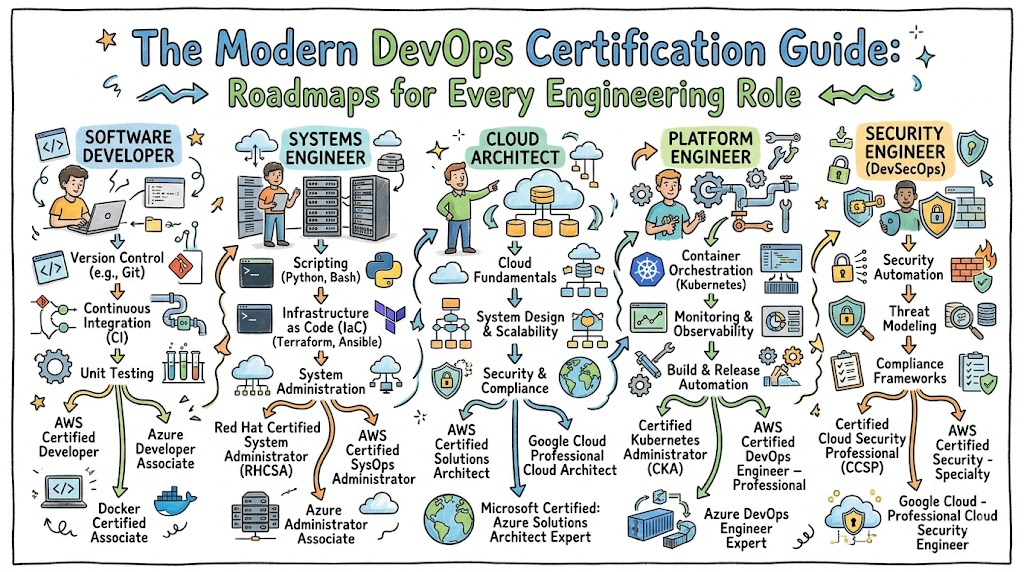
The world of DevOps is moving incredibly fast, and choosing how to validate your skills can feel overwhelming. With so many platforms, tools, and shifting career requirements, it is easy to see why professionals and beginners alike feel confused. Many learners find themselves stuck picking random certifications without a clear plan, spending time and money on certificates that might not fit their actual day-to-day work or long-term career goals.
Choosing the wrong certification path usually happens when you focus on a specific trendy tool instead of looking at the bigger picture. A single certificate does not automatically make you a DevOps engineer. What actually matters is building a cohesive sequence of skills where each step builds naturally on top of the last. A structured learning path ensures that you learn foundational concepts before moving on to complex automation or orchestration systems.
This master guide is designed to remove that confusion. By mapping out a clear roadmap, you can align your learning path with your current professional background and future aspirations. Whether you are a system administrator, a software developer, or an absolute beginner, this guide will help you select the precise credentials that deliver the highest return on investment for your career growth.
Why DevOps Certifications Matter
Validating your engineering skills through a structured certification program provides a clear framework for professional advancement. Instead of learning tools in isolation, preparing for a verified certification forces you to understand how different technologies integrate across the entire software development lifecycle. This systematic approach ensures you do not leave critical gaps in your knowledge, such as skipping network security basics or infrastructure automation principles.
Beyond gaining technical knowledge, earning industry-recognized certifications builds career confidence and reinforces your expertise during technical interviews. It shows hiring managers that your skills have been measured against established industry benchmarks. As organizations rapidly adopt cloud-native setups, container systems, and automated deployment pipelines, holding verified credentials makes your resume stand out in a competitive job market.
Ultimately, the real value of a modern DevOps certification lies in hands-on practice. The top technical credentials require you to solve real problems in live lab environments rather than just memorizing multiple-choice questions. This practical experience ensures that when you complete a certification, you possess the operational capability to manage production infrastructure, automate complex workflows, and maintain system reliability.
Who Should Read This Guide
This guide provides targeted engineering pathways for a wide range of technology professionals looking to build or validate their skills:
- Freshers & Graduates: Individuals looking for a structured, step-by-step introduction to automated software pipelines and cloud architecture.
- Developers & Software Engineers: Professionals aiming to move into platform engineering by learning infrastructure management and deployment automation.
- Linux & System Administrators: Experienced infrastructure specialists looking to modernize their systems administration background by adopting Infrastructure as Code (IaC) and cloud-native tools.
- Cloud & Kubernetes Engineers: Specialists focused on deepening their expertise in container orchestration, microservices management, and advanced cloud-native platforms.
- SRE & Platform Engineers: Professionals responsible for building internal developer platforms, optimizing system uptime, and engineering highly resilient production systems.
- DevSecOps Learners: Security-minded engineers looking to embed automated security controls, compliance checks, and vulnerability scanning directly into continuous delivery pipelines.
DevOps Certification Categories
To build a balanced skill set, it helps to understand how different certifications fit into distinct operational categories.
Foundation Certifications
Foundational programs establish the baseline concepts of collaboration, automated deployment pipelines, and system architecture. They introduce the core principles of continuous integration and continuous delivery without tying you completely to a single vendor tool. This baseline is essential for anyone starting fresh in the discipline.
Tool-Based Certifications
These technical credentials focus heavily on specific industry-standard tools. They validate your practical ability to operate key technologies like Docker for containerization, Terraform for provisioning infrastructure, or Istio for managing service meshes. Mastering these certifications proves you can handle day-to-day implementation tasks.
Cloud DevOps Certifications
Cloud-focused tracks validate your ability to design, deploy, and manage automated infrastructure within major public cloud ecosystems. These programs combine vendor-specific cloud architecture with engineering best practices, teaching you how to run scalable applications on platforms like AWS, Microsoft Azure, or Google Cloud.
DevSecOps Certifications
DevSecOps programs focus entirely on shifting security to the left—integrating security checks early in the development lifecycle. They teach engineers how to automate vulnerability scanning, secure container images, and manage compliance validation directly inside active deployment pipelines.
SRE and Platform Engineering Certifications
These advanced pathways focus on system availability, performance optimization, and building internal developer infrastructure. They cover deep system monitoring, automated emergency response, and infrastructure scaling, ensuring that large-scale software systems remain stable under heavy traffic.
Advanced and Specialized Certifications
Specialized engineering tracks dive deep into cutting-edge architectural patterns. This includes modern automation methodologies like GitOps, specialized monitoring setups using Prometheus and Grafana, and emerging fields like MLOps, which applies delivery pipeline automation directly to machine learning workflows.
Best DevOps Certifications at a Glance
The following comparison table outlines 20 industry-standard certifications available on the Best DevOps Certification platform to help you identify the right fit for your current skill level and operational goals.
| Certification Name | Best For | Level | Main Skills | Career Scope |
| DevOps Certified Professional (DCP) | Core DevOps Foundations | Beginner | CI/CD Pipelines, Automation, Core Toolsets | DevOps Associate, Systems Engineer |
| DevSecOps Certified Professional (DSOCP) | Pipeline & Pipeline Security | Intermediate | Automated Security, Vulnerability Scanning | DevSecOps Engineer, Security Analyst |
| Site Reliability Engineering (SRE) Certified Professional | High Availability & Automation | Advanced | SLA/SLO/SLI Metrics, Monitoring, Scaling | SRE Engineer, Operations Lead |
| Master in DevOps Engineering (MDE) | End-to-End Delivery Automation | Intermediate | Build Automation, Testing, Deployment | Senior DevOps Engineer, Infrastructure Engineer |
| Master in Azure DevOps | Microsoft Cloud Ecosystems | Advanced | AZ-900, AZ-104, AZ-400 Architecture | Azure Cloud Specialist, Platform Engineer |
| AWS Certified DevOps Professional | Amazon Web Services Operations | Advanced | AWS Architecture, Cost Optimization, Security | AWS DevOps Engineer, Cloud Architect |
| Master in Python Programming | Automation & Systems Scripting | Beginner | Scripting Logic, Functions, Data Structures | Automation Engineer, Tools Developer |
| Hashicorp Certified Terraform Associate | Infrastructure as Code (IaC) | Intermediate | Declarative Configuration, State Management | Cloud Infrastructure Engineer |
| Certified Kubernetes Administrator (CKA) | Container Orchestration Management | Advanced | Cluster Architecture, Troubleshooting, Scheduling | Kubernetes Specialist, Platform Architect |
| Docker Certified Associate (DCA) | Containerization Fundamentals | Beginner | Container Runtimes, Images, Basic Storage | Container Engineer, Systems Administrator |
| Envoy ISTIO Certification Training | Microservices & Service Mesh | Advanced | Traffic Routing, L7 Proxying, Telemetry | Microservices Architect, Network Engineer |
| MLOps Certification Training Course | Machine Learning Pipelines | Advanced | Model Deployment, Data Pipeline Automation | MLOps Engineer, Data Platform Specialist |
| Google Cloud Professional Cloud DevOps Engineer | Google Cloud Infrastructure | Advanced | GCP Services, Performance Monitoring | GCP DevOps Specialist, Site Reliability Engineer |
| Master in Machine Learning | Smart Automation Engineering | Intermediate | Predictive Algorithms, Data Engineering | ML Systems Engineer, Data Automation Analyst |
| Master in Artificial Intelligence | Intelligent Operations (AIOps) | Advanced | Cognitive Automation, Complex Systems | AIOps Architect, Advanced Automation Engineer |
| Master in AppDynamics | Enterprise Application Monitoring | Intermediate | Application Performance Management (APM) | Monitoring Engineer, Performance Analyst |
| Master in Data Science | Operational Data Analysis | Intermediate | Statistical Analysis, Data Interpretation | Data Ops Engineer, Infrastructure Analyst |
| Master in Deep Learning | Neural Network Automation | Advanced | Complex Model Operations, Framework Tuning | Deep Learning Infrastructure Engineer |
| Prometheus with Grafana | Open-Source Metrics & Alerting | Intermediate | Time-Series Data, Dashboard Engineering | Observability Engineer, Systems Monitor |
| GitOps Certified Professional (GOCP) | Declarative Continuous Deployment | Intermediate | Git-Driven Infrastructure, Reconcilers | GitOps Engineer, Release Manager |
Certification Deep Dive
1. DevOps Certified Professional (DCP)
- What It Is: A comprehensive foundational course designed to introduce core engineering principles and cover the top 20 industry toolsets.
- Who Should Take It: Ideal for tech freshers, system administrators, and software developers transitioning into modern infrastructure management.
- Best Career Fit: DevOps Beginner, Cloud Support Engineer, Associate Systems Administrator.
- Difficulty Level: Beginner
- Career Scope: Establishes the necessary groundwork for entry-level engineering roles and provides a solid foundation for advanced cloud paths.
- Skills You Will Learn: Continuous Integration principles, release lifecycle automation, container basics, and team collaboration frameworks.
- Tools and Technologies Covered: Git, Docker, Jenkins, Linux basics, and foundational automation tools.
- Exam Details: Handled directly through the Best DevOps Certification platform via structured online evaluations.
- Study Roadmap: Focus on understanding the software development lifecycle, practice basic Git commands, and build a simple automated build pipeline.
- Real-World Use Case: Standardizing development workflows across a growing engineering team to eliminate manual application delivery mistakes.
- Pros: Covers a massive variety of tools in a single curriculum; excellent structured starting point.
- Cons: Focuses more on broad foundational concepts rather than hyper-deep specialization in a single cloud platform.
- Best Recommendation: Perfect for launching your learning path without getting overwhelmed by high-level cloud architecture early on.
2. DevSecOps Certified Professional (DSOCP)
- What It Is: A specialized program focused entirely on injecting automated security gates into every single stage of the software delivery lifecycle.
- Who Should Take It: Intermediate systems engineers, security analysts, and developers looking to master infrastructure security automation.
- Best Career Fit: DevSecOps Engineer, Cloud Security Specialist, AppSec Infrastructure Engineer.
- Difficulty Level: Intermediate
- Career Scope: High demand across enterprise environments that require strict compliance, automated vulnerability checking, and secure delivery pipelines.
- Skills You Will Learn: Automated compliance checking, static and dynamic application security testing (SAST/DAST), and secure container configuration.
- Tools and Technologies Covered: Ansible, Docker, Git, GitHub, Kubernetes, Terraform, and automated scanning tools.
- Exam Details: Verified through online practical assessment options via the source platform.
- Study Roadmap: Learn how to configure declarative infrastructure securely, practice image signing, and study secrets management strategies.
- Real-World Use Case: Automating vulnerability scans within a code repository so that insecure container layers are caught before deploying to production.
- Pros: Shifts security from a manual bottleneck to an automated, integrated pipeline step.
- Cons: Requires a solid pre-existing understanding of container platforms and basic deployment structures.
- Best Recommendation: Highly recommended for cloud professionals looking to stand out by adding specialized security automation to their skillset.
3. Site Reliability Engineering (SRE) Certified Professional
- What It Is: An advanced engineering course that uses software engineering practices to solve complex operations, scalability, and system reliability problems.
- Who Should Take It: Experienced operations engineers and developers who want to manage high-availability production environments.
- Best Career Fit: SRE Engineer, Infrastructure Operations Lead, Platform Reliability Specialist.
- Difficulty Level: Advanced
- Career Scope: Critical role for internet-scale organizations focused on reducing application downtime and maintaining top-tier performance.
- Skills You Will Learn: Defining SLAs, SLOs, and SLIs; managing error budgets; automated incident mitigation; and capacity planning.
- Tools and Technologies Covered: 20+ specialized toolsets focusing on automation, deep monitoring, cloud infrastructure, and configuration management.
- Exam Details: Practical assessment and instructor-led evaluation via Best DevOps Certification.
- Study Roadmap: Master time-series metrics collection, learn log aggregation methods, and practice scripting automated responses to system failures.
- Real-World Use Case: Setting up automated self-healing scripts that detect when an application’s latency spikes and gracefully spin up healthy resource blocks.
- Pros: Shifts the traditional operations mindset toward automated software engineering solutions.
- Cons: Demands strong analytical skills and a solid understanding of application architectures.
- Best Recommendation: The absolute gold standard path for engineers who enjoy troubleshooting complex systems and creating highly stable platforms.
4. Master in DevOps Engineering (MDE)
- What It Is: An intermediate-to-advanced program designed to take you beyond basic tool usage and turn you into an expert in end-to-end delivery pipelines.
- Who Should Take It: Professionals who have mastered basic automation and want to design enterprise-grade delivery strategies.
- Best Career Fit: Senior DevOps Engineer, Release Manager, Platform Infrastructure Engineer.
- Difficulty Level: Intermediate
- Career Scope: Opens up senior-level positions by validating your ability to manage complex corporate deployment architectures.
- Skills You Will Learn: Advanced build automation, multi-stage artifact management, continuous testing integration, and zero-downtime deployment strategies.
- Tools and Technologies Covered: Enterprise CI/CD engines, configuration managers, multi-environment deployment platforms, and container orchestration engines.
- Exam Details: Online evaluation based on comprehensive project submissions.
- Study Roadmap: Study advanced pipeline orchestration patterns, practice managing multi-stage artifact promotions, and design canary deployment strategies.
- Real-World Use Case: Transitioning a legacy monolithic application into an automated, container-driven deployment across multiple testing environments.
- Pros: Deeply practical focus on real-world engineering environments and complete end-to-end setups.
- Cons: Requires a larger time commitment to successfully complete the advanced project requirements.
- Best Recommendation: Ideal if you already know the basics and want to learn how real-world enterprise infrastructure operates at scale.
5. Master in Azure DevOps
- What It Is: A deep-dive training track that bundles three major Microsoft credentials (AZ-900, AZ-104, and AZ-400) into a single path to build an Azure Expert status.
- Who Should Take It: Systems administrators and cloud engineers working primarily within Microsoft-focused enterprise environments.
- Best Career Fit: Azure Cloud Engineer, Azure Platform Architect, Microsoft System Specialist.
- Difficulty Level: Advanced
- Career Scope: Massive market presence across large enterprises that rely heavily on the Microsoft cloud ecosystem.
- Skills You Will Learn: Azure cloud architecture, identity access management, enterprise pipeline design, and cloud governance.
- Tools and Technologies Covered: Azure Boards, Azure Pipelines, Azure Repos, Azure Resource Manager templates, and core cloud services.
- Exam Details: Prepares you for official certification tracks through comprehensive online training modules.
- Study Roadmap: Start with core cloud services (AZ-900), move to system management (AZ-104), and finish with automated pipeline design (AZ-400).
- Real-World Use Case: Managing cloud migrations for enterprise applications by configuring secure infrastructure pipelines directly within Azure.
- Pros: Provides a clear, comprehensive path from cloud basics up to expert-level architecture.
- Cons: Highly focused on the Microsoft ecosystem, making it less applicable for purely open-source or multi-cloud environments.
- Best Recommendation: The clear choice for engineers working in companies utilizing Microsoft cloud technologies.
6. AWS Certified DevOps Professional
- What It Is: An expert-level certification program designed to validate your ability to automate, secure, and manage large-scale systems on Amazon Web Services.
- Who Should Take It: Cloud architects and systems engineers looking to specialize deeply in AWS automation.
- Best Career Fit: AWS DevOps Engineer, Cloud Infrastructure Architect, Solutions Engineer.
- Difficulty Level: Advanced
- Career Scope: Widely recognized across the global tech industry, opening up high-level engineering positions in AWS-native organizations.
- Skills You Will Learn: High-availability deployment strategies, automated monitoring, cost optimization, and multi-account cloud governance.
- Tools and Technologies Covered: AWS CloudFormation, IAM, EC2, ECS/EKS, CodePipeline, CloudWatch, and cost management engines.
- Exam Details: Comprehensive cloud-based operational evaluation patterns.
- Study Roadmap: Study auto-scaling mechanisms, practice building multi-region architectures, and focus on cloud governance and security compliance.
- Real-World Use Case: Designing a resilient, multi-region application deployment on AWS that self-heals and automatically scales based on real-time traffic spikes.
- Pros: Highly valued by employers worldwide due to AWS’s large market share.
- Cons: Focuses heavily on proprietary cloud services rather than open-source tools.
- Best Recommendation: Essential for any engineer aiming to reach the highest levels of cloud engineering inside AWS environments.
7. Master in Python Programming
- What It Is: A foundational code-focused track designed from scratch to take you from writing basic scripts to building advanced automation tools.
- Who Should Take It: Infrastructure specialists, system administrators, and beginners who need to learn coding for automation.
- Best Career Fit: Automation Engineer, Systems Programmer, DevOps Scripting Specialist.
- Difficulty Level: Beginner
- Career Scope: Programming skills are critical across all automated operations, making this highly valuable for any cloud engineer.
- Skills You Will Learn: Coding syntax, logic flow control, working with system APIs, data parsing, and building custom automation utilities.
- Tools and Technologies Covered: Python runtime, code packages, data parsers, and system communication libraries.
- Exam Details: Evaluations based on practical assignments and real-world coding projects.
- Study Roadmap: Master basic syntax, practice parsing JSON and YAML files, and write scripts that automate daily system tasks.
- Real-World Use Case: Writing custom scripts that query cloud APIs to identify and clean up unattached, expensive storage volumes automatically.
- Pros: Built entirely for beginners with no prior programming experience.
- Cons: Focuses purely on software logic rather than cloud configuration or pipeline tools.
- Best Recommendation: Take this early if you want to move past simply clicking buttons in management consoles and start writing real automation code.
8. Hashicorp Certified Terraform Associate
- What It Is: A specialized technical certification validating your proficiency in using declarative configurations to provision infrastructure as code.
- Who Should Take It: Cloud engineers and platform specialists who want to automate cloud resource provisioning across multiple vendors.
- Best Career Fit: Infrastructure Engineer, Cloud Automation Specialist, Terraform Developer.
- Difficulty Level: Intermediate
- Career Scope: Industry-standard requirement for modern cloud teams managing scalable, cloud-native deployments.
- Skills You Will Learn: Declarative coding, cloud resource provisioning, state management, module design, and multi-cloud infrastructure patterns.
- Tools and Technologies Covered: Terraform CLI, HCL (HashiCorp Configuration Language), cloud provider plugins, and state backends.
- Exam Details: Available via online testing frameworks accessible through Best DevOps Certification.
- Study Roadmap: Understand the Terraform state file lifecycle, practice writing modular configurations, and learn how to import existing cloud resources.
- Real-World Use Case: Spinning up an identical development, staging, and production environment across public clouds using a single set of configuration files.
- Pros: Vendor-neutral tool that works seamlessly across AWS, Azure, and Google Cloud.
- Cons: Requires careful handling of state files to avoid breaking active production systems.
- Best Recommendation: A must-have certification for anyone looking to focus on infrastructure-as-code automation.
9. Certified Kubernetes Administrator (CKA)
- What It Is: A purely hands-on certification program that proves your ability to build, configure, manage, and troubleshoot live Kubernetes clusters.
- Who Should Take It: Advanced cloud professionals, platform engineers, and container specialists who manage application workloads at scale.
- Best Career Fit: Kubernetes Administrator, Platform Architect, Container Operations Specialist.
- Difficulty Level: Advanced
- Career Scope: One of the most sought-after and respected technical certifications in cloud engineering.
- Skills You Will Learn: Cluster architecture configuration, container networking setup, persistent storage management, and advanced system troubleshooting.
- Tools and Technologies Covered: Kubernetes Core Components, container runtimes, etcd clustering, and cloud networking plugins.
- Exam Details: Performance-based practical exam environment.
- Study Roadmap: Practice managing cluster nodes via the command line, study cluster backup steps, and focus on fixing broken networking setups.
- Real-World Use Case: Troubleshooting a microservices platform where containers fail to communicate across different host nodes during a traffic spike.
- Pros: Highly practical exam that tests real engineering skills rather than memorization.
- Cons: Known for being highly challenging, requiring extensive hands-on practice.
- Best Recommendation: Essential for any engineer looking to validate top-tier container orchestration and platform engineering skills.
10. Docker Certified Associate (DCA)
- What It Is: A core credential validating your technical knowledge of container runtimes, image creation, and basic container networking.
- Who Should Take It: System administrators, developers, and beginners looking to move away from heavy virtual machines to lightweight containers.
- Best Career Fit: Container Specialist, DevOps Systems Analyst, App Deployment Engineer.
- Difficulty Level: Beginner
- Career Scope: Serves as the foundation for modern cloud deployments and is a prerequisite for advanced Kubernetes paths.
- Skills You Will Learn: Writing efficient Dockerfiles, image security management, container networking, and basic multi-container composition.
- Tools and Technologies Covered: Docker Engine, Docker Compose, Docker Registry, and basic container runtimes.
- Exam Details: Conceptual and practical system evaluations via online platforms.
- Study Roadmap: Learn how to optimize container image sizes, practice setting up persistent volumes, and master basic multi-container setups.
- Real-World Use Case: Packaging an application along with all its required libraries into a lightweight image that runs identically on any system.
- Pros: Provides clear, foundational container skills that apply to almost every modern tech company.
- Cons: Focuses primarily on single-host systems rather than large-scale, automated cluster orchestration.
- Best Recommendation: The ideal starting point for containerization before jumping into complex platforms like Kubernetes.
11. Envoy ISTIO Certification Training
- What It Is: An advanced engineering track focusing on microservices communication management, traffic security, and network telemetry.
- Who Should Take It: Platform architects and senior engineers managing intricate microservices architectures inside container clusters.
- Best Career Fit: Service Mesh Specialist, Microservices Network Architect, Senior Infrastructure Engineer.
- Difficulty Level: Advanced
- Career Scope: Growing enterprise demand as companies break down large monolithic applications into hundreds of interconnected microservices.
- Skills You Will Learn: Service mesh architecture, layer 7 routing controls, mutual TLS encryption setup, and system-wide network observability.
- Tools and Technologies Covered: Istio Service Mesh, Envoy Proxy, traffic management interfaces, and telemetry engines.
- Exam Details: Practical scenario evaluations via the core platform training paths.
- Study Roadmap: Study how sidecar proxies work, practice configuring fine-grained traffic routing rules, and set up mutual TLS encryption.
- Real-World Use Case: Routing exactly 10% of user traffic to a new version of an application (canary testing) without altering a single line of application code.
- Pros: Solves complex networking, security, and tracking problems directly at the infrastructure layer.
- Cons: Adds additional operational complexity, meaning it is only needed for large-scale microservices setups.
- Best Recommendation: Perfect for senior container engineers who want to specialize in high-level cloud networking and microservices management.
12. MLOps Certification Training Course
- What It Is: A highly specialized engineering track that brings automated pipeline practices directly into machine learning workflows.
- Who Should Take It: Cloud engineers, data platform specialists, and data scientists looking to automate model deployments.
- Best Career Fit: MLOps Engineer, Data Operations Architect, Machine Learning Platform Engineer.
- Difficulty Level: Advanced
- Career Scope: A rapidly growing tech sector with massive career growth potential as companies look to automate their AI implementations.
- Skills You Will Learn: Automating machine learning pipelines, model version tracking, data lineage tracking, and monitoring models for performance drift.
- Tools and Technologies Covered: Data pipelines, automated model registries, monitoring systems, and cloud-native machine learning infrastructure.
- Exam Details: Checked through specialized project delivery frameworks.
- Study Roadmap: Study how data versions are tracked, practice automating model training pipelines, and learn how to monitor models in production.
- Real-World Use Case: Automating the retraining and deployment of an image recognition model whenever new training data becomes available.
- Pros: Highly specialized and lucrative career path combining data science with automated operations.
- Cons: Requires a basic understanding of data structures and machine learning concepts.
- Best Recommendation: Take this if you want to stand out by entering a high-demand, specialized field beyond traditional web application delivery.
13. Google Cloud Professional Cloud DevOps Engineer
- What It Is: A professional certification validating your capability to build, manage, and monitor stable delivery pipelines on Google Cloud Platform.
- Who Should Take It: Systems professionals and site reliability engineers looking to focus heavily on Google Cloud services.
- Best Career Fit: GCP DevOps Specialist, Cloud Site Reliability Engineer, Infrastructure Engineer.
- Difficulty Level: Advanced
- Career Scope: Strong market demand, particularly among data-driven startups and enterprises heavily using Google’s container tools.
- Skills You Will Learn: Managing cloud-native architectures, performance monitoring, optimizing pipeline speed, and managing service incidents.
- Tools and Technologies Covered: Google Kubernetes Engine (GKE), Google Cloud Operations Suite, Cloud Build, and Cloud IAM configurations.
- Exam Details: Comprehensive case study evaluations.
- Study Roadmap: Learn Google Cloud service architectures, focus on setting up metrics tracking, and practice managing Google Kubernetes Engine clusters.
- Real-World Use Case: Building a fast, automated container deployment pipeline using Cloud Build to update applications running on Google Kubernetes Engine.
- Pros: Deeply integrates modern site reliability engineering concepts directly into its official curriculum.
- Cons: Tied entirely to the Google Cloud platform ecosystem.
- Best Recommendation: An excellent choice for engineers looking to build specialized platform skills within Google Cloud environments.
14. Master in Machine Learning
- What It Is: A comprehensive engineering track covering the algorithms, data pipelines, and core systems that power modern machine learning applications.
- Who Should Take It: Automation specialists looking to understand the underlying code and mechanics of machine learning models.
- Best Career Fit: ML Specialist, Smart Automation Developer, Data Systems Analyst.
- Difficulty Level: Intermediate
- Career Scope: Provides a strong technical foundation for building and optimizing data automation platforms.
- Skills You Will Learn: Data processing, predictive model training, algorithm selection, and model fine-tuning.
- Tools and Technologies Covered: Python data toolkits, regression frameworks, classification models, and automated data pipelines.
- Exam Details: Verified through real-world datasets and model testing projects.
- Study Roadmap: Master data cleanup steps, study fundamental statistical models, and practice training prediction models on real datasets.
- Real-World Use Case: Designing an automated system that processes log data to predict and alert teams about potential hardware failures before they happen.
- Pros: Gives you a deep technical understanding of data patterns and automated machine learning logic.
- Cons: Focuses more on data logic and mathematics than infrastructure automation pipelines.
- Best Recommendation: Ideal for infrastructure engineers who want to understand the inner workings of machine learning before managing MLOps platforms.
15. Master in Artificial Intelligence
- What It Is: An advanced, comprehensive certification that covers cognitive systems, complex pattern matching, and automated decision-making engines.
- Who Should Take It: Senior automation specialists looking to design self-healing architectures and smart operations platforms (AIOps).
- Best Career Fit: AIOps Systems Architect, Intelligent Automation Lead, Solutions Specialist.
- Difficulty Level: Advanced
- Career Scope: Positions you at the forefront of enterprise automated operations and intelligent systems management.
- Skills You Will Learn: Cognitive systems design, complex data analysis, smart anomaly detection, and automated system logic.
- Tools and Technologies Covered: Advanced data models, automated decision trees, anomaly tracking frameworks, and smart automation systems.
- Exam Details: Evaluated via deep research project reviews and advanced system designs.
- Study Roadmap: Study automated anomaly detection patterns, learn how to analyze heavy log streams, and design rule-based system responses.
- Real-World Use Case: Building an intelligent infrastructure monitoring system that analyzes millions of live log entries to isolate and resolve system bugs automatically.
- Pros: Prepares you for high-level architectural roles in intelligent infrastructure management.
- Cons: Highly conceptual, requiring strong programming skills and significant study time.
- Best Recommendation: Perfect for senior platform architects aiming to lead the implementation of smart, automated enterprise IT systems.
16. Master in AppDynamics
- What It Is: A targeted engineering track focusing on enterprise-level Application Performance Management (APM) and user transaction monitoring.
- Who Should Take It: Systems administrators, operations staff, and monitoring specialists managing heavy corporate software systems.
- Best Career Fit: Monitoring Specialist, APM Performance Engineer, Cloud Support Lead.
- Difficulty Level: Intermediate
- Career Scope: Highly valued across banking, retail, and major enterprise sectors where tracking transaction speed is business-critical.
- Skills You Will Learn: Application monitoring configuration, database call tracing, user transaction mapping, and bottleneck identification.
- Tools and Technologies Covered: AppDynamics APM suite, performance agents, user monitoring systems, and database analytics tools.
- Exam Details: Practical scenario testing through Best DevOps Certification.
- Study Roadmap: Learn how to install application monitoring agents, practice configuring dashboard metrics, and study transaction tracing.
- Real-World Use Case: Tracking down a slow database call that causes an application’s checkout process to freeze during high-volume sales events.
- Pros: Teaches highly specialized enterprise monitoring skills that are directly applicable to large production systems.
- Cons: Focused on a single commercial software suite rather than open-source tracking tools.
- Best Recommendation: A great career booster for operations engineers inside enterprise environments where AppDynamics is the primary monitoring platform.
17. Master in Data Science
- What It Is: A technical curriculum focused on extracting actionable insights from large streams of operational system data using statistical analysis.
- Who Should Take It: Systems analysts and platform engineers who want to use big data to optimize infrastructure performance.
- Best Career Fit: DataOps Analyst, Infrastructure Data Engineer, Operations Systems Lead.
- Difficulty Level: Intermediate
- Career Scope: Critical for modern technology teams that rely on large-scale data analysis to drive infrastructure planning.
- Skills You Will Learn: Statistical data processing, predictive analytics, trend mapping, and clear data visualization techniques.
- Tools and Technologies Covered: Data engineering libraries, data parsers, trend tracking engines, and visualization toolkits.
- Exam Details: Based on data pipeline projects and analytics case studies.
- Study Roadmap: Learn how to clean and parse system logs, study statistical trend lines, and practice building clear data dashboards.
- Real-World Use Case: Analyzing years of company resource usage logs to predict exactly when future infrastructure expansions will be required.
- Pros: Teaches clean analytical methods that help you make smart, data-driven decisions about your systems.
- Cons: Requires a comfortable understanding of mathematics and statistical data models.
- Best Recommendation: Highly useful for engineers who want to focus on data analytics, trend tracking, and capacities planning.
18. Master in Deep Learning
- What It Is: An advanced certification course focused on complex neural network architectures, pattern recognition systems, and computational operations.
- Who Should Take It: Specialized infrastructure professionals looking to manage advanced computational environments and heavy AI workloads.
- Best Career Fit: Deep Learning Systems Engineer, AI Infrastructure Specialist, Platform Automation Analyst.
- Difficulty Level: Advanced
- Career Scope: Specialized niche focused on supporting advanced machine learning research and heavy compute infrastructure.
- Skills You Will Learn: Neural network operational logic, compute resource tuning, handling high-volume data streams, and performance profiling.
- Tools and Technologies Covered: Neural computing frameworks, processing arrays, specialized data streams, and hardware acceleration drivers.
- Exam Details: Comprehensive advanced engineering project assessments.
- Study Roadmap: Learn how deep neural networks process data, study hardware accelerator tracking, and practice optimizing data pipelines.
- Real-World Use Case: Optimizing underlying GPU compute cluster configurations to speed up heavy neural network model training times safely.
- Pros: Places you in an elite technical group capable of managing cutting-edge computational platforms.
- Cons: Highly complex technical path requiring a strong grasp of data frameworks and systems engineering.
- Best Recommendation: Best for advanced infrastructure engineers aiming to work directly with AI research teams and high-performance computing clusters.
19. Prometheus with Grafana
- What It Is: A targeted, practical training program focusing on open-source cloud-native monitoring, alerting, and metrics visualization.
- Who Should Take It: DevOps engineers, system administrators, and platform teams who want to build custom tracking dashboards.
- Best Career Fit: Observability Engineer, Systems Monitor, SRE Infrastructure Engineer.
- Difficulty Level: Intermediate
- Career Scope: Crucial skill set across modern technology companies using open-source, cloud-native technology stacks.
- Skills You Will Learn: Designing time-series databases, writing metrics queries, setting up custom alerting systems, and building interactive dashboards.
- Tools and Technologies Covered: Prometheus Server, Grafana Dashboard Engine, Alertmanager, and various infrastructure metric exporters.
- Exam Details: Practical dashboard creation and monitoring setup challenges.
- Study Roadmap: Learn how Prometheus scrapes metrics data, practice writing queries, and configure automated alerts for system errors.
- Real-World Use Case: Creating a centralized engineering dashboard that monitors container health and automatically pings the team if memory usage spikes.
- Pros: Uses popular, vendor-neutral open-source tools that are widely adopted throughout the industry.
- Cons: Focuses purely on system metrics and observability rather than code delivery pipelines.
- Best Recommendation: A highly valuable, practical skill that immediately improves your day-to-day ability to manage and understand live cloud systems.
20. GitOps Certified Professional (GOCP)
- What It Is: A specialized technical certification validating your proficiency in using Git as the single source of truth for infrastructure and application deployments.
- Who Should Take It: Kubernetes engineers and platform specialists looking to automate declarative software delivery with pull-based reconcilers.
- Best Career Fit: GitOps Engineer, Release Automation Architect, Platform Engineer.
- Difficulty Level: Intermediate
- Career Scope: High demand as cloud-native teams transition to automated, audit-friendly continuous deployment workflows.
- Skills You Will Learn: Declarative continuous delivery, multi-cluster sync patterns, managing configuration drift, and automated rollback strategies.
- Tools and Technologies Covered: Git, pull-based delivery engines, declarative cluster manifests, and automated drift detectors.
- Exam Details: Practical architecture configuration evaluations.
- Study Roadmap: Master structuring declarative application states in Git repositories and study how automated reconcilers fix configuration changes.
- Real-World Use Case: Managing cluster states so that changing a configuration file in a Git repository automatically triggers a safe update across live systems.
- Pros: Prevents configuration drift and provides clear, history-tracked audit trails for all system changes.
- Cons: Tied heavily to cloud-native systems and declarative configuration styles.
- Best Recommendation: Essential for container engineers who want to implement reliable, modern deployment workflows.
Certification Comparison Table
This detailed matrix maps out how these technical paths compare in terms of operational focus, difficulty, and the real-world experience needed to succeed.
| Certification | Best For | Difficulty | Main Focus | Recommended Experience Level |
| DevOps Certified Professional | Broad DevOps Baseline | Beginner | End-to-End Pipeline Concepts | No previous automation experience required |
| DevSecOps Certified Professional | Pipeline Security Automation | Intermediate | Security Tooling Integration | Familiarity with containers and basic pipelines |
| Site Reliability Engineering | System Availability | Advanced | Metrics & Infrastructure Self-Healing | Solid systems engineering background |
| Master in DevOps Engineering | Enterprise Deployment | Intermediate | Advanced Build & Delivery Automation | Experience with basic configuration tools |
| Master in Azure DevOps | Microsoft Enterprise Environments | Advanced | Azure Ecosystem Architecture | Experience managing basic cloud infrastructure |
| AWS Certified DevOps Professional | AWS Cloud Operations | Advanced | AWS Cloud Automation & Security | Strong cloud configuration background |
| Master in Python Programming | Core Scripting Automation | Beginner | Custom Automation Logic & Scripting | No prior coding experience required |
| Hashicorp Certified Terraform | Infrastructure as Code | Intermediate | Multi-Cloud Resource Provisioning | Understanding of cloud infrastructure concepts |
| Certified Kubernetes Admin | Container Management | Advanced | Cluster Administration & Fixes | Strong comfort with Linux and containers |
| Docker Certified Associate | Basic Containerization | Beginner | Container Engines & Image Layouts | Basic Linux command line knowledge |
| Envoy ISTIO Certification | Microservices Architecture | Advanced | Service Mesh Traffic & Security | Experienced with active Kubernetes clusters |
| MLOps Certification Training | Data Pipeline Automation | Advanced | Machine Learning Lifecycles | Understanding of basic data workflows |
| Google Cloud DevOps Engineer | GCP Production Setups | Advanced | Google Cloud Platform Automation | Experience running workloads on GCP |
| Master in Machine Learning | Predictive Systems | Intermediate | Data Automation Algorithms | Solid understanding of data handling |
| Master in Artificial Intelligence | Intelligent Operations | Advanced | Cognitive Systems & Large-scale Data | High-level automation architecture background |
| Master in AppDynamics | Enterprise Monitoring | Intermediate | Application Performance Management | Experience managing web applications |
| Master in Data Science | Operational Analytics | Intermediate | Trend Metrics & Statistical Models | Comfortable working with system metrics |
| Master in Deep Learning | Compute Optimization | Advanced | Neural Platform Workloads | Advanced infrastructure management skills |
| Prometheus with Grafana | Open-Source Monitoring | Intermediate | Time-Series Metrics & Alerts | Basic understanding of Linux environments |
| GitOps Certified Professional | Declarative Deployment | Intermediate | Git-Driven Delivery Workflows | Comfortable working with Git and Kubernetes |
DevOps Certification Roadmap
Building a successful career requires a step-by-step approach. Use this structured timeline to progress smoothly from foundational basics to advanced specializations.
Phase 1: Entry & Systems Foundation
Months 1 – 3
Focus on mastering core infrastructure basics. Learn Linux systems administration, standard Git workflows, and container fundamentals. Ideal certifications to validate this phase include the Master in Python Programming for automation logic and the Docker Certified Associate (DCA) for core container skills.
Phase 2: Core Delivery & Cloud Automation
Months 4 – 6
Transition from manual tasks to infrastructure automation and basic pipelines. Start provisioning cloud platforms cleanly using Infrastructure as Code (IaC) and configure continuous integration tools. Solidify these skills with the Hashicorp Certified Terraform Associate and the foundational DevOps Certified Professional (DCP) track.
Phase 3: Advanced Operations & Cloud Platforms
Months 7 – 12
Scale your skills up to enterprise-level platform management. Focus heavily on mastering large-scale container orchestration and vendor-specific cloud platforms. Target top-tier credentials during this window, such as the Certified Kubernetes Administrator (CKA) alongside the AWS Certified DevOps Professional or Master in Azure DevOps paths.
Phase 4: Advanced Engineering Specialization
Months 12+
Once your core infrastructure skills are strong, specialize in an advanced engineering domain based on your career interests. Choose the DevSecOps Certified Professional (DSOCP) to focus on security automation, the SRE Certified Professional track for high-availability systems, or the MLOps Certification path to automate machine learning platforms.
Recommended Certification Path by Role
Different IT roles require distinct learning paths. This targeted reference table maps out the most effective paths based on specific professional roles and career targets.
| Current Professional Role | Target Career Path | Recommended Core Path | Advanced Specialization Track |
| Tech Graduate / Fresher | Junior DevOps Engineer | Python Programming ➔ DCP ➔ Docker Associate | Prometheus with Grafana |
| Linux / System Admin | Cloud Infrastructure Engineer | Terraform Associate ➔ Master in Azure / AWS | GitOps Certified Professional |
| Software Developer | Platform / Delivery Engineer | Docker Associate ➔ MDE ➔ Kubernetes Admin (CKA) | Envoy ISTIO Training |
| Cloud Specialist | Site Reliability Engineer (SRE) | Prometheus with Grafana ➔ CKA ➔ SRE Certified Professional | Master in AppDynamics |
| Infrastructure Engineer | DevSecOps Specialist | Docker Associate ➔ Terraform Associate ➔ DSOCP | Intelligent AI Systems (AIOps) |
| Data Analyst | MLOps Specialist | Python Programming ➔ Machine Learning ➔ MLOps Training | Master in Deep Learning |
Real-World Career Scenarios
Scenario A: The Technical Fresher Starting From Scratch
- The Goal: Break into modern systems engineering without previous corporate automation experience.
- The Challenge: Resumes filled with abstract theory but lacking real, practical tool knowledge.
- The Path: Start immediately with the Master in Python Programming to learn automation coding basics, then complete the DevOps Certified Professional (DCP) to understand how deployment pipelines operate. Validate these with the Docker Certified Associate (DCA) to prove you can work with container environments.
Scenario B: The System Administrator Transitioning to Cloud
- The Goal: Modernize traditional systems administration experience and transition into a cloud automation role.
- The Challenge: Moving away from manual configurations to managing infrastructure entirely through code.
- The Path: Begin by taking the Hashicorp Certified Terraform Associate to learn how to manage infrastructure using code. Next, take a structured cloud platform path like the Master in Azure DevOps or AWS Certified DevOps Professional to master enterprise cloud management.
Scenario C: The Operations Specialist Moving into SRE
- The Goal: Move from a traditional infrastructure support role into high-level Site Reliability Engineering.
- The Challenge: Transitioning from reactive firefighting to building smart, automated, self-healing platforms.
- The Path: Build solid observability skills using the Prometheus with Grafana course, master container clusters with the Certified Kubernetes Administrator (CKA), and complete the track with the Site Reliability Engineering (SRE) Certified Professional qualification.
Scenario D: The Developer Transitioning to Platform Engineering
- The Goal: Move from writing application features to building internal developer tools and deployment platforms.
- The Challenge: Gaining a deeper understanding of low-level system networking, cluster environments, and continuous deployment patterns.
- The Path: Take the Master in DevOps Engineering (MDE) to master advanced delivery logic, move on to the Certified Kubernetes Administrator (CKA) for cluster management, and wrap up with the GitOps Certified Professional (GOCP) to automate declarative code delivery.
Common Mistakes to Avoid
- Skipping Core Linux Foundations: Many engineers try to learn advanced container orchestration tools before mastering basic Linux command line workflows, storage management, and user permissions. Linux powers nearly all cloud infrastructure—do not skip the basics.
- Ignoring Networking Basics: You cannot build secure, automated pipelines or configure cloud platforms without a solid understanding of DNS management, IP routing, subnetting, load balancers, and how ports communicate.
- Jumping into Kubernetes Too Early: Trying to learn complex Kubernetes management before understanding how single-host container runtimes work leads to confusion. Master basic container creation and packaging first.
- Focusing Only on Collecting Certificates: Memorizing exam answers just to pass a test won’t help you in a real engineering role. Focus on deeply understanding how the tools function and why they are used.
- Avoiding Hands-On Lab Work: True engineering skill is built by breaking and fixing systems. Always prioritize practical lab environments and real configuration tasks over simply reading study guides.
- Learning Tools Without Understanding the Culture: DevOps is not just a collection of software applications—it is a culture of automation, shared responsibility, and continuous improvement. Focus on the core engineering problems each tool is built to solve.
Hands-On Projects to Build
To turn your certifications into practical, job-ready expertise, make sure to build these real-world projects alongside your studies:
- Automated Multi-Stage CI/CD Pipeline: Build a continuous integration pipeline that automatically runs code linting checks, executes unit tests, packages the code into a clean container image, and pushes it to a central repository whenever new code is saved.
- Declarative Infrastructure Deployment: Use Terraform to write code that automatically spins up a secure, multi-tier cloud environment complete with virtual networks, firewalls, and compute nodes, ensuring the entire setup can be built or destroyed with simple commands.
- High-Availability Kubernetes Workloads: Configure a multi-node container cluster that runs a web application across several instances, uses automated health checks to restart failing containers, and scales up automatically during traffic spikes.
- Centralized Infrastructure Monitoring & Alerting: Set up a Prometheus server to collect real-time performance metrics from your servers and connect it to a Grafana dashboard, configuring automated alerts that ping your team if system memory or storage gets critically low.
- GitOps Deployment Engine: Use a pull-based continuous deployment workflow to manage your container clusters, proving that modifying a configuration file inside a Git repository automatically triggers a safe, clean update across your live production systems.
- Secure DevSecOps Delivery Gate: Integrate automated vulnerability scanners and dependency checks directly into an active delivery pipeline, ensuring that any insecure container layer or code vulnerability automatically pauses the deployment before it hits production.
Tools and Free Resources
When building your training roadmap, complement your certification tracks with freely available open-source documentation and community tools. Focus heavily on reading the official documentation for core utilities like Git, Docker, and Linux system guides.
Practicing your skills does not require expensive setups. You can run container engines, write automation scripts, and test infrastructure-as-code configurations directly on your local computer using free, open-source tools. Utilizing free trial options on major public cloud platforms also lets you practice building and managing infrastructure pipelines in real environments without incurring heavy costs.
How to Choose the Right DevOps Certification
With so many clear technical options available, use these five simple steps to select the best path for your current career goals:
Step 1: Check Current Skills ➔ Step 2: Define Career Path ➔ Step 3: Match Cloud Environment ➔ Step 4: Pick Specialized Tracks
1. Evaluate Your Current Technical Baseline
Be honest about your starting point. If you are new to coding and operations, start with basic scripting and foundational automation tracks. If you are already a seasoned systems administrator or developer, you can skip the introduction and dive straight into infrastructure-as-code or container orchestration credentials.
2. Align with Your Specific Career Track
Choose certifications that match your long-term professional focus. If your goal is to manage application uptime and system architecture, prioritize site reliability engineering tracks. If you want to focus on platform security, put your energy into automated security credentials.
3. Match Your Organization’s Cloud Environment
If your company runs entirely on a specific public cloud provider, prioritize that vendor’s official architecture tracks to maximize your impact at work. If you work in a multi-cloud or open-source environment, focus on vendor-neutral credentials like Terraform or Kubernetes.
4. Prioritize Practical, Performance-Based Exams
When choosing between different credentials, value practical, hands-on evaluations over simple multiple-choice tests. Certifications that require you to fix live, broken systems prove your actual engineering capability to future employers.
5. Plan for Steady, Long-Term Growth
Avoid the temptation to study multiple advanced platforms at the same time. Pick one clear path, complete the training, build a few real-world projects to reinforce the knowledge, and let your skills mature before moving on to the next level.
FAQs
1. Which certification is best for an absolute beginner?
The DevOps Certified Professional (DCP) combined with the Master in Python Programming provides the ideal starting baseline, introducing core pipeline concepts and automation coding without requiring prior infrastructure experience.
2. Can I pass the Certified Kubernetes Administrator (CKA) exam without hands-on experience?
No. The CKA is a purely performance-based exam where you must resolve real infrastructure issues on a live command line. Extensive hands-on practice in lab environments is absolutely necessary to pass.
3. Should I learn AWS or Azure DevOps certifications first?
Choose based on your target job market or your current company’s setup. AWS holds the largest overall cloud market share, making it highly valuable globally, while Azure has a massive presence inside established Microsoft-focused enterprises.
4. Is learning Python really necessary for DevOps engineering?
Yes. While infrastructure-as-code tools handle basic resource provisioning, programming languages like Python are essential for writing custom automation scripts, connecting to system APIs, and building data pipelines.
5. What is the core difference between DevOps and Site Reliability Engineering (SRE)?
DevOps focuses on breaking down team silos and automating the software delivery pipeline from code to production. SRE applies software engineering principles directly to operations problems, focusing heavily on system uptime, availability, and reliability.
6. How does GitOps differ from traditional continuous deployment pipelines?
Traditional deployment pipelines push code changes directly to environments from an external build server. GitOps uses a pull-based model where an automated tool inside the cluster monitors a Git repository as the source of truth and pulls changes automatically to fix configuration drift.
7. Why should I choose the DevSecOps track over standard security certs?
Standard security credentials often focus on high-level compliance policies and manual audits. The DevSecOps Certified Professional (DSOCP) track teaches you how to automate security checks directly inside active, continuous delivery pipelines.
8. Are open-source monitoring tools like Prometheus and Grafana worth learning?
Absolutely. Prometheus and Grafana are the industry standard for cloud-native observability, and mastering them allows you to build custom tracking dashboards across any cloud platform.
9. What is an error budget in SRE training?
An error budget is the maximum allowable downtime or performance drop defined for a system. It provides a clear metric that helps development and operations teams balance the speed of releasing new features with the stability of the platform.
10. Can I learn MLOps without being a data scientist?
Yes. MLOps focuses on the infrastructure side of AI—automating the deployment, scaling, and monitoring of data models rather than writing the core mathematical algorithms yourself.
11. Do these training tracks include real-world project work?
Yes. The comprehensive programs available via the Best DevOps Certification platform emphasize practical projects, live assignments, and lab work to ensure you build real, job-ready skills.
Final Recommendation
Investing in technical certifications is an excellent way to advance your career, but remember that a certificate is only as valuable as the actual skills behind it. Avoid the trap of collecting certificates without taking the time to master the tools. True engineering expertise is built by writing configuration code, configuring delivery pipelines, and learning how to troubleshoot live production environments.
As you plan your training roadmap, choose a path that fits your current technical background and long-term career goals. Give yourself plenty of time to practice with each tool, build real-world portfolio projects, and focus on understanding the core principles of automation and system reliability. By combining structured certifications from the Best DevOps Certification platform with hands-on experience, you will build the practical capability needed to manage modern, enterprise-grade cloud platforms.