Limited Time Offer!
For Less Than the Cost of a Starbucks Coffee, Access All DevOpsSchool Videos on YouTube Unlimitedly.
Master DevOps, SRE, DevSecOps Skills!
Introduction
The transition from experimental machine learning to production-grade artificial intelligence is the biggest challenge facing enterprises today. While many can build a model in a notebook, very few can maintain, monitor, and scale that model in a live environment. This is where the Certified MLOps Architect designation becomes a critical asset for technical professionals. This guide is designed for software engineers, DevOps practitioners, and data professionals who want to bridge the gap between data science and operational excellence.
By pursuing this path at AIOps School, you gain the framework necessary to automate the entire machine learning lifecycle. This career roadmap explores why MLOps is the natural evolution of DevOps and how this certification helps you navigate the complexities of model versioning, deployment, and governance. Whether you are looking to pivot your career or solidify your expertise as a technical leader, this guide provides the clarity needed to make an informed decision about your professional growth.
What is the Certified MLOps Architect?
The Certified MLOps Architect is a professional validation that focuses on the architectural design and operational management of machine learning systems. It goes beyond simple coding or model training by emphasizing the creation of robust, scalable pipelines that ensure models remain accurate and performant over time. This program exists because traditional DevOps practices often fail when applied to the non-deterministic nature of machine learning data and code.
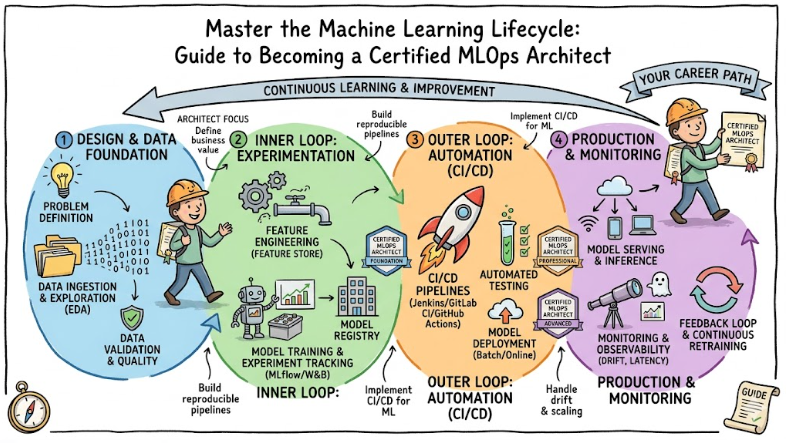
This certification represents a deep understanding of how to integrate data engineering, machine learning, and CI/CD practices into a unified workflow. It prioritizes production-readiness, teaching architects how to handle model drift, automated retraining, and infrastructure as code specifically for AI workloads. In a modern enterprise, an MLOps Architect is the person who ensures that AI investments actually deliver business value through reliable, repeatable delivery systems.
Who Should Pursue Certified MLOps Architect?
This certification is ideal for senior DevOps engineers and Site Reliability Engineers (SREs) who are increasingly tasked with managing AI-driven applications. It is also highly beneficial for Data Engineers who want to move into the deployment side of the pipeline and Machine Learning Engineers who need to understand the operational rigors of the cloud. For these roles, the program provides a standardized way to handle the “hidden technical debt” in machine learning systems.
Cloud architects and security professionals will also find immense value here, as they learn to govern AI models and secure data pipelines across hybrid and multi-cloud environments. Even engineering managers and technical leaders should consider this path to better understand the resources and team structures required for successful AI initiatives. Globally, and particularly in the growing tech hubs of India, this role is becoming a cornerstone of digital transformation strategies.
Why Certified MLOps Architect is Valuable Today and Beyond
The demand for AI is skyrocketing, but the success rate of AI projects remains lower than desired due to operational failures. Enterprises are moving away from manual “hand-offs” between data scientists and engineers toward a unified MLOps approach. This shift ensures that professionals with MLOps expertise have high job security and longevity, as their skills are tied to the core revenue-generating AI systems of the future.
Earning this certification allows you to stay relevant regardless of which specific tools or frameworks gain popularity. It teaches the foundational principles of pipeline orchestration and model governance that apply across any cloud provider. This investment in your career provides a significant return by positioning you as a high-value specialist who can solve the most difficult problems in the modern software stack.
Certified MLOps Architect Certification Overview
The program is delivered via the Certified MLOps Architect official URL and is hosted on AIOps School. It is structured to provide a comprehensive learning path that moves from fundamental principles to complex architectural design. The certification assessment is not just a multiple-choice test; it is designed to evaluate your ability to think like an architect and solve real-world operational challenges.
The structure involves a combination of theoretical knowledge and practical application, ensuring that candidates can demonstrate their ability to design end-to-end ML systems. Ownership of this certification marks you as a professional who understands the full lifecycle of a model, from data ingestion and training to monitoring and decommissioning. It provides a structured hierarchy of learning that caters to various stages of professional experience.
Certified MLOps Architect Certification Tracks & Levels
The certification is divided into distinct levels to support career progression. The Foundation level focuses on the basics of ML pipelines and containerization. It is intended for those new to the field who need to understand how ML differs from traditional software. It establishes a common language and set of practices for teams to follow.
The Professional level dives deeper into automation, testing, and monitoring of ML systems. It is aimed at active practitioners who are responsible for maintaining production environments. Finally, the Advanced level is designed for those aiming for Architect roles, focusing on enterprise-wide strategy, multi-tenancy, and advanced security protocols for AI systems. Each level builds upon the previous one to create a well-rounded expert.
Complete Certified MLOps Architect Certification Table
| Track | Level | Who it’s for | Prerequisites | Skills Covered | Recommended Order |
| Core MLOps | Foundation | Beginners, Junior DevOps | Basic Cloud/DevOps | ML Lifecycle, Docker, Git | 1 |
| Core MLOps | Professional | Mid-level Engineers | Foundation Cert | CI/CD for ML, Monitoring | 2 |
| Architecture | Advanced | Senior Engineers, Architects | Professional Cert | Governance, Scalability | 3 |
| Specialization | DataOps Integration | Data Engineers | Foundation Cert | Feature Stores, Pipelines | Optional |
| Specialization | Security / DevSecOps | Security Engineers | Foundation Cert | Model Security, Privacy | Optional |
Detailed Guide for Each Certified MLOps Architect Certification
Certified MLOps Architect – Foundation Level
What it is
This certification validates a professional’s understanding of the basic terminology and components of a machine learning lifecycle. It confirms that the candidate knows how to support data scientists in a collaborative environment.
Who should take it
It is suitable for entry-level cloud engineers, system administrators, or software developers who are just starting their journey into machine learning operations and want a solid theoretical base.
Skills you’ll gain
- Understanding the difference between DevOps and MLOps.
- Mastery of basic containerization for ML models.
- Knowledge of model versioning and data tracking.
- Familiarity with common ML frameworks and deployment strategies.
Real-world projects you should be able to do
- Containerize a simple Python-based ML model for deployment.
- Set up a basic version control system for datasets.
- Deploy a model using a standard REST API endpoint.
Preparation plan
- 7-14 Days: Focus on the core definitions of MLOps and the 12-factor app principles for ML.
- 30 Days: Complete hands-on labs involving Docker and basic CI/CD pipelines.
- 60 Days: Review case studies of failed ML projects to understand operational pitfalls.
Common mistakes
- Treating ML models exactly like static software code.
- Ignoring the importance of data versioning.
- Focusing too much on model training and not enough on deployment.
Best next certification after this
- Same-track option: Certified MLOps Architect – Professional Level.
- Cross-track option: DataOps Foundation.
- Leadership option: Technical Team Lead Fundamentals.
Certified MLOps Architect – Professional Level
What it is
This certification proves that an engineer can build and maintain automated pipelines for machine learning. It validates the ability to handle continuous integration and continuous deployment specifically for models.
Who should take it
Mid-level DevOps engineers or ML engineers who are actively working in production environments and need to automate their manual workflows.
Skills you’ll gain
- Implementing automated testing for ML code and data.
- Configuring monitoring systems for model and data drift.
- Setting up automated retraining loops.
- Managing feature stores and model registries.
Real-world projects you should be able to do
- Build a full CI/CD pipeline that triggers on model performance degradation.
- Implement a monitoring dashboard using Prometheus and Grafana for model metrics.
- Create a centralized feature store for shared data assets.
Preparation plan
- 7-14 Days: Master advanced CI/CD tools and orchestration engines like Kubeflow or Airflow.
- 30 Days: Work on real-time monitoring and alerting for non-deterministic systems.
- 60 Days: Finalize a capstone project involving a complex automated pipeline.
Common mistakes
- Over-engineering the pipeline for simple models.
- Forgetting to monitor for data drift alongside model drift.
- Inadequate logging of model predictions and inputs.
Best next certification after this
- Same-track option: Certified MLOps Architect – Advanced Level.
- Cross-track option: SRE Professional.
- Leadership option: Engineering Manager Certification.
Certified MLOps Architect – Advanced Level
What it is
This is the pinnacle of the program, validating that a professional can design enterprise-scale ML systems. It focuses on the strategic alignment of AI infrastructure with business goals.
Who should take it
Principal engineers, technical architects, and senior leaders who are responsible for the overall technical direction of AI platforms in large organizations.
Skills you’ll gain
- Designing multi-cloud and hybrid MLOps architectures.
- Implementing advanced model governance and compliance frameworks.
- Optimizing cost and performance for large-scale AI clusters.
- Architecting security for sensitive data and proprietary models.
Real-world projects you should be able to do
- Design a globally distributed ML deployment architecture.
- Develop a compliance framework for GDPR/CCPA in AI systems.
- Create a cost-optimization strategy for GPU-intensive workloads.
Preparation plan
- 7-14 Days: Study enterprise architecture patterns and organizational design for MLOps.
- 30 Days: Focus on security, encryption, and data privacy in AI.
- 60 Days: Develop a comprehensive architectural whitepaper or design document.
Common mistakes
- Ignoring the cost implications of high-frequency model retraining.
- Failing to account for organizational silos in architectural design.
- Designing for a single cloud provider without considering portability.
Best next certification after this
- Same-track option: None (Highest level).
- Cross-track option: FinOps Certified Professional.
- Leadership option: Chief Technology Officer (CTO) Program.
Choose Your Learning Path
DevOps Path
This path focuses on extending existing software delivery skills to accommodate machine learning. Engineers starting here will learn how to integrate ML pipelines into Jenkins, GitLab, or GitHub Actions. The goal is to make the ML model feel like just another microservice while respecting its unique data-driven requirements. Professionals will move from managing simple binaries to managing complex data artifacts.
DevSecOps Path
The security path focuses on the unique vulnerabilities of machine learning, such as adversarial attacks or data poisoning. Engineers will learn how to integrate security scanning into the ML pipeline and ensure that models are compliant with industry regulations. This path is essential for organizations in the financial or healthcare sectors where data privacy is paramount. It bridges the gap between AI innovation and corporate risk management.
SRE Path
Site Reliability Engineers will focus on the availability and performance of ML models in production. This path emphasizes observability, incident response for AI failures, and maintaining service level objectives (SLOs) for prediction latency. SREs learn how to handle “silent failures” where a model is technically online but providing incorrect results. It is about ensuring that AI systems are as reliable as traditional web services.
AIOps Path
This path is for those who want to use artificial intelligence to improve IT operations themselves. It focuses on using ML to predict system failures, automate root cause analysis, and optimize infrastructure. While related to MLOps, AIOps is more about the application of AI to the DevOps domain. This path is ideal for those who want to build the next generation of self-healing infrastructure.
MLOps Path
The pure MLOps path is the most direct route to becoming an architect. It focuses exclusively on the lifecycle of machine learning models, from experimentation to production. This path covers everything from experiment tracking and model registries to deployment patterns like canary and blue-green releases. It is the most comprehensive path for someone dedicated to the AI infrastructure space.
DataOps Path
Data is the foundation of any ML model, and this path focuses on the pipelines that feed the models. Engineers will learn how to manage data quality, handle large-scale data ingestion, and ensure data lineage. By mastering DataOps, professionals ensure that the inputs to their MLOps pipelines are clean, reliable, and versioned. This is a critical prerequisite for advanced MLOps success.
FinOps Path
Managing the cost of AI can be incredibly difficult due to the high price of compute resources like GPUs. The FinOps path teaches architects how to track, manage, and optimize the costs associated with machine learning. This involves choosing the right instance types, using spot instances effectively, and ensuring that AI projects stay within budget. It is essential for engineers who want to prove the ROI of their systems.
Role → Recommended Certified MLOps Architect Certifications
| Role | Recommended Certifications |
| DevOps Engineer | MLOps Foundation, MLOps Professional |
| SRE | MLOps Professional, SRE Specialized Track |
| Platform Engineer | MLOps Advanced Architect |
| Cloud Engineer | MLOps Foundation, Cloud-Specific ML Certs |
| Security Engineer | MLOps Foundation, DevSecOps Specialized Track |
| Data Engineer | DataOps Foundation, MLOps Professional |
| FinOps Practitioner | MLOps Foundation, FinOps Specialized Track |
| Engineering Manager | MLOps Foundation, MLOps Architect (Strategic Focus) |
Next Certifications to Take After Certified MLOps Architect
Same Track Progression
Once you have completed the advanced architect level, the next step is often to specialize in specific industrial applications or niche technologies. This might include deep-diving into specific orchestration tools like Kubeflow or Ray. Staying within the same track allows you to become a recognized subject matter expert who can handle the most complex technical challenges. It is about depth of knowledge and staying at the absolute cutting edge of AI deployment.
Cross-Track Expansion
Broadening your skills into adjacent fields like SRE or FinOps can make you a more versatile professional. For an MLOps architect, understanding the financial implications of their designs (FinOps) or the operational reliability (SRE) adds immense value. This cross-pollination of skills allows you to speak the language of different departments and lead cross-functional teams. It turns a technical specialist into a strategic business asset.
Leadership & Management Track
For those looking to move away from hands-on keyboard work, a transition into technical leadership is a natural progression. This involves taking certifications in engineering management or product management for AI. As an architect, you already understand the “how”; the leadership track teaches you the “why” and the “who.” This allows you to build and lead the teams that will implement the architectures you design.
Training & Certification Support Providers for Certified MLOps Architect
DevOpsSchool
DevOpsSchool provides an extensive array of resources for engineers looking to master MLOps. Their curriculum is built on years of experience in the DevOps space, ensuring that their MLOps training is grounded in solid operational principles. They offer a mix of live instructor-led sessions and self-paced content that caters to various learning styles. The platform is known for its focus on practical tools and real-world scenarios, helping students prepare for both certification exams and daily job responsibilities. Their community support is a major benefit for those seeking long-term growth.
Cotocus
Cotocus is a specialized training provider that focuses on high-end engineering roles. Their approach to MLOps training is centered around architectural design and enterprise-level deployments. They provide deep-dive sessions into cloud-native technologies and how they intersect with machine learning. Cotocus is often preferred by senior professionals who are looking for advanced insights rather than basic introductory content. Their training modules are updated frequently to reflect the rapidly changing landscape of the AI industry, ensuring that students are always learning the most relevant skills for the market.
Scmgalaxy
Scmgalaxy serves as a comprehensive hub for software configuration management and DevOps knowledge. Their contribution to MLOps training is significant, offering a wealth of tutorials, blogs, and community forums. They focus on the integration aspects of MLOps, showing how machine learning can be woven into existing software delivery pipelines. The platform is an excellent resource for engineers who need to solve specific technical problems or stay updated on the latest toolsets. Their focus on the broader ecosystem makes them a valuable companion for any aspiring MLOps architect.
BestDevOps
BestDevOps focuses on providing curated learning paths for engineers who want to excel in modern operational roles. Their MLOps training is designed to be streamlined and efficient, focusing on the most impactful skills. They emphasize hands-on labs and project-based learning, ensuring that students can demonstrate their expertise through practical application. This provider is ideal for busy professionals who need to gain new skills quickly without sacrificing quality. Their curriculum covers everything from basic automation to complex model orchestration, providing a well-rounded educational experience.
devsecopsschool.com
As the name suggests, devsecopsschool.com is the primary destination for learning how to secure the modern software pipeline. Their MLOps offerings are uniquely focused on the security and compliance aspects of machine learning. They teach students how to build “secure by design” AI systems, covering topics like data encryption, model privacy, and threat modeling for ML. This is a critical niche for any architect working in a regulated industry. Their training helps professionals ensure that their AI innovations do not come at the cost of organizational security.
sreschool.com
sreschool.com is dedicated to the principles of site reliability engineering, and their MLOps curriculum reflects this focus. They teach students how to apply SRE concepts like error budgets, SLIs, and SLOs to machine learning systems. This training is essential for anyone responsible for the uptime and performance of AI models in a production environment. By focusing on observability and reliability, sreschool.com prepares engineers to handle the unique challenges of maintaining non-deterministic systems. Their approach ensures that AI models are as stable as any other mission-critical service.
aiopsschool.com
aiopsschool.com is a leader in the field of AI-driven operations and machine learning lifecycle management. Their training programs are specifically designed for the MLOps architect role, providing a deep dive into the intersection of data science and engineering. They offer comprehensive certification prep that covers the entire spectrum of MLOps, from foundation to advanced levels. The school is known for its high-quality content and its focus on helping professionals achieve recognized certifications. It is a go-to resource for anyone serious about a career in AI infrastructure.
dataopsschool.com
dataopsschool.com focuses on the critical foundation of all AI: the data pipeline. Their training programs teach engineers how to manage data as a first-class citizen in the MLOps lifecycle. They cover topics like data quality, data lineage, and the implementation of feature stores. By mastering DataOps through this provider, engineers ensure that their MLOps pipelines are fed by high-quality, reliable data. This training is an essential building block for any architect who wants to ensure the long-term accuracy and performance of their machine learning models.
finopsschool.com
finopsschool.com addresses one of the most pressing challenges in modern AI: cost management. Their MLOps-related content focuses on the financial operations of machine learning, teaching students how to optimize compute costs and manage budgets. This is vital for architects who need to prove the economic viability of their AI initiatives. The school provides practical strategies for tracking GPU usage, choosing cost-effective cloud resources, and implementing financial governance. Their training helps engineers balance technical excellence with fiscal responsibility in the cloud.
Frequently Asked Questions (General)
- How difficult is the MLOps certification for someone with no ML background?
While a background in machine learning is helpful, it is not strictly required for the foundation level. However, a strong understanding of DevOps and cloud infrastructure is essential. The program is designed to teach you the operational side of ML, but you will need to learn the basics of how models are trained to be successful. - How long does it typically take to prepare for the architect exam?
For most working professionals, a period of 2 to 3 months is recommended. This allows enough time to go through the theoretical material and complete the necessary hands-on labs. Those with existing DevOps experience may find they can move through the foundation material more quickly. - What are the key prerequisites for the professional level?
You should have a solid grasp of containerization, CI/CD pipelines, and basic Python programming. Familiarity with at least one major cloud provider (AWS, Azure, or GCP) is also highly recommended, as most MLOps workflows are cloud-resident. - Is there a significant ROI for this certification?
Yes, the demand for MLOps specialists far outstrips the supply. Professionals with this certification often see significant salary increases and have access to high-impact roles in top-tier technology companies and enterprises. - Should I take a DevOps certification before MLOps?
It is highly recommended. MLOps is built on the foundations of DevOps. Understanding version control, automated testing, and deployment before moving into the specific complexities of machine learning will make your learning journey much smoother. - Are the exams more theoretical or practical?
The certification is designed to be highly practical. While there are theoretical components, the focus is on your ability to design and implement real-world architectures. You will likely be tested on your problem-solving skills in simulated production environments. - How often do I need to recertify?
Typically, certifications in this space are valid for two to three years. Given the rapid pace of change in the AI industry, recertification ensures that your skills remain current with the latest tools and best practices. - Can I skip the foundation level if I have years of experience?
While some programs allow you to jump straight to the professional level, it is usually recommended to review the foundation material. This ensures that you have no gaps in your understanding of the specific MLOps terminology and framework used by the provider. - What tools will I need to learn?
You should become familiar with orchestration tools like Kubeflow or MLflow, container tools like Docker and Kubernetes, and versioning tools like DVC. Cloud-specific tools like SageMaker or Vertex AI are also important. - Is this certification recognized globally?
Yes, the frameworks taught in this program are based on industry-standard practices used by major technology firms worldwide. It is a valuable asset whether you are working in India, the US, or Europe. - Does the certification help with job placement?
While no certification guarantees a job, it provides significant leverage. It serves as a verified signal to recruiters that you possess the specialized skills required for MLOps roles, often moving your resume to the top of the pile. - What is the most challenging part of the MLOps lifecycle to learn?
Most engineers find that monitoring and handling “model drift” is the most difficult aspect. Unlike traditional software that either works or crashes, models can stay online while providing increasingly poor results, requiring a different approach to observability.
FAQs on Certified MLOps Architect
- What makes the architect level different from the engineer level?
The engineer focuses on implementing the pipeline, while the architect focuses on the overall design, scalability, and integration with the business. Architects must consider cost, security, and long-term maintenance. - How does this program handle multi-cloud strategies?
The curriculum emphasizes tool-agnostic patterns that can be applied across different cloud providers. This ensures that an architect can design systems that are portable and not locked into a single vendor’s ecosystem. - Is coding a major part of the architect certification?
While you don’t need to be a data scientist, you do need to be comfortable with scripting (primarily Python) and configuration languages (YAML, Terraform) to build the infrastructure and automation scripts. - What is the focus on governance in this certification?
Governance is a key pillar of the advanced level. It covers how to track model lineage, ensure ethical AI practices, and maintain compliance with legal frameworks like the AI Act. - How does the program address the scaling of ML models?
It covers the use of Kubernetes and distributed computing frameworks to handle high-load prediction requests and large-scale model training sessions efficiently. - Are there any community resources available for students?
Yes, candidates usually get access to forums, study groups, and alumni networks where they can discuss challenges and share best practices with other professionals. - Does the program cover Generative AI and LLMs?
Modern MLOps programs, including this one, have updated their curricula to include the operational challenges specific to Large Language Models, such as fine-tuning pipelines and vector database management. - How does the assessment handle real-world architectural design?
Candidates are often required to analyze a business case study and propose a complete architectural solution, which is then reviewed for technical viability, cost-effectiveness, and security.
Final Thoughts: Is Certified MLOps Architect Worth It?
As a mentor who has watched the evolution of the industry from physical servers to the cloud, I can say with confidence that MLOps is not a fad. It is the necessary industrialization of artificial intelligence. If you are an engineer looking for the next big challenge, or if you want to ensure that your skills remain in high demand as AI becomes integrated into every piece of software, this certification is a logical and highly valuable step.
The Certified MLOps Architect designation doesn’t just teach you how to use a tool; it teaches you how to think about the entire lifecycle of a complex, evolving system. It prepares you to lead teams and design platforms that will define the next decade of technology. My advice is simple: don’t wait for your company to ask for these skills. Be the person who brings this expertise to the table and leads the transition to a more reliable, AI-driven future.
