Limited Time Offer!
For Less Than the Cost of a Starbucks Coffee, Access All DevOpsSchool Videos on YouTube Unlimitedly.
Master DevOps, SRE, DevSecOps Skills!
Introduction
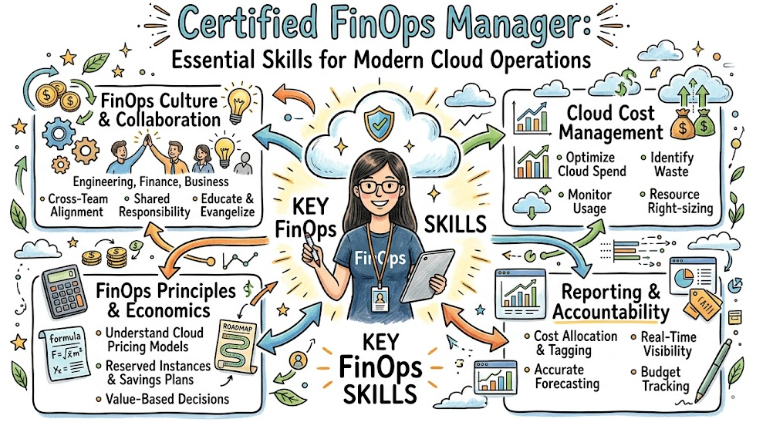
The Certified FinOps Manager certification is designed for professionals who want to manage cloud cost, usage, accountability, forecasting, and business value in modern cloud environments. This guide is useful for DevOps engineers, cloud engineers, SREs, platform teams, finance-aware engineering leaders, and managers who want to connect technical decisions with business outcomes. In cloud-native and platform engineering careers, FinOps has become important because organizations need better visibility, governance, and ownership of cloud spending. The program is hosted by finopsschool and helps professionals understand whether this certification fits their role, learning path, and long-term career direction.
What is the Certified FinOps Manager?
Certified FinOps Manager represents a structured learning and certification path for professionals who want to manage cloud financial operations in practical enterprise environments. It focuses on cloud cost planning, budget control, reporting, optimization, accountability, and collaboration between engineering, finance, and business teams.
This certification exists because cloud usage is no longer only a technical matter. Engineering decisions directly affect monthly bills, product margins, infrastructure efficiency, and business planning. A FinOps Manager must understand both cloud architecture and financial responsibility.
The learning is production-focused rather than theory-only. It helps professionals understand how to read cloud bills, identify waste, define cost ownership, create showback or chargeback models, and guide teams toward better cloud decisions.
Who Should Pursue Certified FinOps Manager?
Certified FinOps Manager is useful for cloud engineers, DevOps engineers, SREs, platform engineers, FinOps practitioners, technical managers, and finance teams working with cloud platforms. It is also valuable for professionals who want to move from purely technical roles into cloud governance or cloud cost leadership.
Beginners can use this certification to understand cloud cost fundamentals and business-aware engineering. Experienced engineers can use it to build stronger visibility into cost optimization, forecasting, budgeting, and stakeholder communication.
Managers and team leads can benefit because FinOps is not only about saving money. It is about making cloud usage transparent, measurable, and aligned with product value.
For India and global markets, this certification is relevant because organizations of all sizes are adopting cloud platforms and need people who can balance performance, reliability, security, and cost.
Why Certified FinOps Manager is Valuable and Beyond
Certified FinOps Manager is valuable because cloud cost management has become a serious enterprise need. Companies want professionals who can explain why cloud bills increase, where waste exists, and how teams can improve usage without harming performance.
The certification also has long-term value because cloud tools may change, but financial accountability, forecasting, optimization, and ownership will remain important. A good FinOps professional understands principles, not only dashboards.
It helps engineers stay relevant by connecting technical execution with business impact. This is useful for career growth because many senior roles expect professionals to understand cost, risk, performance, and delivery together.
The return on learning time is strong for professionals who already work with cloud infrastructure, DevOps, SRE, or platform teams and want to move into higher-responsibility roles.
Certified FinOps Manager Certification Overview
The Certified FinOps Manager program is delivered via Certified FinOps Manager and hosted on finopsschool.com. It is designed to help learners understand FinOps concepts, cloud cost governance, reporting, accountability, and management practices.
The certification structure can be understood as a practical career-focused program. It validates whether a learner can apply FinOps thinking in real cloud environments where engineering, finance, operations, and leadership teams must work together.
The assessment approach is generally focused on concepts, scenarios, practical decision-making, and applied understanding. Candidates should prepare by learning cloud cost models, cost allocation, budgeting, optimization, and stakeholder communication.
Ownership of the learning path belongs to the candidate. The certification can support career growth, but real value comes when the professional applies the learning in projects, dashboards, reviews, and team-level cloud governance.
Certified FinOps Manager Certification Tracks & Levels
Certified FinOps Manager can be understood across foundation, professional, and advanced levels. The foundation level builds awareness of cloud cost, usage, billing, and FinOps principles. It is suitable for learners who are new to cloud finance.
The professional level focuses on practical cloud cost management, reporting, cost allocation, forecasting, and optimization planning. This level is useful for professionals already working with cloud teams or infrastructure.
The advanced level supports leadership-oriented responsibilities such as governance design, executive reporting, business alignment, multi-team ownership, and FinOps operating models.
Specialization tracks may align with DevOps, SRE, FinOps, platform engineering, security, and data teams. Each path helps learners apply FinOps practices in the context of their daily work.
Complete Certified FinOps Manager Certification Table
| Track | Level | Who it’s for | Prerequisites | Skills Covered | Recommended Order |
|---|---|---|---|---|---|
| FinOps Foundation | Foundation | Beginners, junior cloud engineers, finance-aware IT professionals | Basic cloud knowledge | Cloud billing basics, cost visibility, tagging, budgeting basics | First |
| FinOps Practitioner | Professional | DevOps engineers, cloud engineers, platform engineers | Cloud operations experience | Cost allocation, reporting, forecasting, optimization | Second |
| Certified FinOps Manager | Professional | FinOps practitioners, engineering leads, cloud managers | Cloud cost and operations awareness | FinOps governance, stakeholder management, cost control, reporting | Third |
| FinOps Leadership | Advanced | Engineering managers, cloud leaders, finance leaders | Experience managing teams or cloud budgets | Strategy, accountability, executive reporting, operating models | Fourth |
| DevOps FinOps Track | Professional | DevOps engineers managing cloud pipelines and infrastructure | DevOps and cloud basics | Pipeline cost awareness, environment optimization, automation | After foundation |
| SRE FinOps Track | Professional | SREs and reliability engineers | SRE or operations experience | Reliability-cost balance, capacity planning, incident-cost analysis | After foundation |
| Platform FinOps Track | Professional | Platform engineers and internal cloud teams | Platform engineering experience | Shared platform cost models, chargeback, service ownership | After practitioner |
| Security FinOps Track | Professional | DevSecOps and security engineers | Security and cloud basics | Security tooling cost control, compliance-aware budgeting | After foundation |
| Data FinOps Track | Professional | Data engineers and analytics teams | Data platform knowledge | Storage optimization, compute planning, workload cost control | After foundation |
| Management Track | Advanced | Managers and leaders | Team or budget responsibility | Governance, reporting, stakeholder alignment, cost culture | Final stage |
Detailed Guide for Each Certified FinOps Manager Certification
Certified FinOps Manager – FinOps Foundation
What it is
This level validates basic understanding of cloud cost, billing, usage visibility, and FinOps principles. It helps learners understand why cloud financial operations matter in real engineering teams.
It is the right starting point for professionals who want to build confidence before handling budgets, reports, or optimization plans.
Who should take it
This level is suitable for beginners, junior cloud engineers, DevOps learners, finance professionals working with cloud teams, and managers who need basic cloud cost literacy.
It is also useful for professionals shifting from traditional infrastructure to cloud-native environments.
Skills you’ll gain
- Understand cloud billing and usage patterns
- Read basic cloud cost reports
- Identify common sources of waste
- Understand tagging and cost allocation
- Communicate basic cost insights to teams
Real-world projects you should be able to do
- Create a basic cloud cost visibility report
- Identify unused or underused cloud resources
- Build a simple tagging plan for cloud accounts
- Prepare a monthly cloud cost summary
- Explain cost drivers to engineering teams
Preparation plan
For 7–14 days, focus on cloud billing basics, pricing models, tagging, and common cost drivers. For 30 days, practice reading cloud usage reports and understanding how teams consume cloud resources. For 60 days, build a small cost dashboard, study optimization examples, and document cost-saving recommendations.
Common mistakes
- Learning definitions without understanding real usage
- Ignoring tagging and ownership
- Focusing only on cost reduction
- Not understanding engineering trade-offs
- Treating FinOps as only a finance topic
Best next certification after this
Same-track option: Certified FinOps Manager Practitioner
Cross-track option: DevOps FinOps Track
Leadership option: FinOps Leadership Foundation
Certified FinOps Manager – FinOps Practitioner
What it is
This certification validates practical FinOps skills used in real cloud environments. It focuses on reporting, forecasting, cost allocation, optimization planning, and team accountability.
It is suitable for professionals who need to work directly with cloud bills, engineering teams, and management stakeholders.
Who should take it
DevOps engineers, cloud engineers, SREs, platform engineers, and FinOps analysts should consider this level. It is best for people who already understand cloud infrastructure and want to manage cost more effectively.
Managers who work with cloud budgets can also benefit from this level.
Skills you’ll gain
- Build cost allocation models
- Create showback and chargeback reports
- Plan cloud budgets and forecasts
- Identify optimization opportunities
- Support engineering teams with cost insights
Real-world projects you should be able to do
- Build a monthly cloud cost review process
- Design a tagging and ownership framework
- Recommend rightsizing actions
- Create a budget alerting process
- Prepare cost reports for technical and business teams
Preparation plan
For 7–14 days, review cloud billing reports and learn cost allocation methods. For 30 days, practice forecasting, budgeting, and optimization planning. For 60 days, build a FinOps operating model for a sample organization, including dashboards, reports, ownership rules, and review meetings.
Common mistakes
- Looking only at total bill instead of unit cost
- Not involving engineering teams
- Ignoring business context
- Over-optimizing and hurting performance
- Poor documentation of cost ownership
Best next certification after this
Same-track option: Certified FinOps Manager
Cross-track option: SRE FinOps Track
Leadership option: FinOps Leadership Track
Certified FinOps Manager – Manager Level
What it is
This level validates the ability to manage FinOps practices across teams, projects, and business units. It focuses on governance, communication, reporting, accountability, and decision-making.
It is designed for professionals who want to lead cloud cost management initiatives rather than only analyze reports.
Who should take it
FinOps practitioners, cloud managers, platform leads, DevOps leads, engineering managers, and finance-aware technical leaders should take this certification.
It is especially useful for professionals responsible for budgets, cost reviews, optimization programs, or cloud governance.
Skills you’ll gain
- Design a FinOps governance model
- Lead cost review meetings
- Build stakeholder reporting
- Define team-level accountability
- Balance cost, performance, security, and reliability
Real-world projects you should be able to do
- Create a cloud cost governance framework
- Build executive cost reporting
- Define cost ownership across teams
- Lead monthly FinOps review meetings
- Create a cost optimization roadmap
Preparation plan
For 7–14 days, study FinOps principles, ownership models, and governance basics. For 30 days, practice building reports, budgets, and cost review templates. For 60 days, design a complete FinOps management program with roles, review cycles, KPIs, and improvement plans.
Common mistakes
- Treating FinOps as only cost cutting
- Not connecting cost to business value
- Ignoring team accountability
- Using reports without action plans
- Failing to communicate clearly with non-technical teams
Best next certification after this
Same-track option: FinOps Leadership
Cross-track option: Platform FinOps Track
Leadership option: Engineering Management and Cloud Governance Track
Certified FinOps Manager – Advanced Leadership Level
What it is
This level validates leadership capability in cloud financial operations. It focuses on strategy, enterprise governance, multi-team accountability, executive reporting, and long-term cost culture.
It is best for professionals who want to lead FinOps transformation across departments.
Who should take it
Engineering managers, cloud leaders, finance leaders, platform heads, and senior FinOps professionals should pursue this level.
It is most useful for people who already understand cloud cost operations and want to influence decision-making at a larger scale.
Skills you’ll gain
- Build enterprise FinOps strategy
- Create leadership-level reporting
- Align cost with business outcomes
- Define FinOps roles and responsibilities
- Improve long-term cloud cost culture
Real-world projects you should be able to do
- Design a company-wide FinOps operating model
- Build executive dashboards
- Define unit cost metrics
- Lead cross-functional cost reviews
- Establish cloud financial governance policies
Preparation plan
For 7–14 days, review leadership concepts, governance models, and reporting structures. For 30 days, study enterprise cloud cost scenarios and stakeholder communication. For 60 days, create a full FinOps transformation plan with governance, roles, metrics, reporting, and adoption stages.
Common mistakes
- Focusing only on tools instead of operating model
- Not defining clear ownership
- Poor communication with business leaders
- Ignoring cultural change
- Measuring savings without measuring value
Best next certification after this
Same-track option: Advanced FinOps Strategy
Cross-track option: Cloud Governance Track
Leadership option: Technology Leadership Track
Choose Your Learning Path
DevOps Path
The DevOps path is suitable for engineers who manage CI/CD pipelines, cloud infrastructure, automation, and deployment environments. Certified FinOps Manager helps DevOps professionals understand how pipeline decisions, test environments, storage, and compute usage affect cost. This path is useful for teams that want faster delivery without uncontrolled cloud spending. DevOps professionals should focus on automation, environment cleanup, tagging, and cost-aware deployment practices.
DevSecOps Path
The DevSecOps path is useful for professionals who manage security controls, scanning tools, compliance systems, and secure cloud environments. Certified FinOps Manager helps them understand the cost impact of security tooling, logs, monitoring, compliance workloads, and policy enforcement. This path is important because secure systems must also remain financially sustainable. DevSecOps professionals should learn how to balance risk, compliance, visibility, and cost.
SRE Path
The SRE path is best for reliability engineers who manage uptime, capacity, observability, and incident response. Certified FinOps Manager helps SREs understand how reliability choices influence cloud cost. High availability, redundancy, logging, monitoring, and scaling all have financial impact. SRE professionals should focus on capacity planning, service-level objectives, cost-aware reliability, and incident-related cost analysis.
AIOps Path
The AIOps path is suitable for professionals working with intelligent operations, event correlation, automation, monitoring, and incident prediction. Certified FinOps Manager helps AIOps teams understand how observability data, automation platforms, logs, and cloud workloads affect cost. This path is useful because AIOps tools can create value, but they also need strong cost governance. AIOps professionals should focus on tool efficiency, automation value, and measurable operational outcomes.
MLOps Path
The MLOps path is useful for professionals managing machine learning pipelines, model training, inference, data processing, and GPU-heavy workloads. Certified FinOps Manager helps MLOps professionals understand compute planning, storage cost, experiment tracking, and workload optimization. This path is important because ML systems can become expensive quickly without governance. MLOps teams should focus on workload scheduling, resource utilization, and cost visibility across experiments.
DataOps Path
The DataOps path is useful for data engineers, analytics teams, and data platform professionals. Certified FinOps Manager helps them understand the cost impact of storage, pipelines, queries, data movement, and analytics workloads. Data platforms often grow quietly and become expensive when ownership is unclear. DataOps professionals should focus on workload optimization, storage lifecycle policies, query efficiency, and team-level cost reporting.
FinOps Path
The FinOps path is the most direct learning path for professionals who want to specialize in cloud financial operations. Certified FinOps Manager helps learners move from cost awareness to cost leadership. This path includes billing analysis, forecasting, budgeting, governance, reporting, optimization, and stakeholder communication. FinOps professionals should focus on practical operating models, cost ownership, cloud unit economics, and business-aligned decision-making.
Role → Recommended Certified FinOps Manager Certifications
| Role | Recommended Certifications |
|---|---|
| DevOps Engineer | FinOps Foundation, DevOps FinOps Track, Certified FinOps Manager |
| SRE | FinOps Foundation, SRE FinOps Track, Certified FinOps Manager |
| Platform Engineer | FinOps Practitioner, Platform FinOps Track, Certified FinOps Manager |
| Cloud Engineer | FinOps Foundation, FinOps Practitioner, Certified FinOps Manager |
| Security Engineer | FinOps Foundation, Security FinOps Track, Certified FinOps Manager |
| Data Engineer | FinOps Foundation, Data FinOps Track, Certified FinOps Manager |
| FinOps Practitioner | FinOps Practitioner, Certified FinOps Manager, FinOps Leadership |
| Engineering Manager | Certified FinOps Manager, FinOps Leadership, Cloud Governance Track |
Next Certifications to Take After Certified FinOps Manager
Same Track Progression
Same-track progression is best for professionals who want to build deep expertise in FinOps. After Certified FinOps Manager, learners can move toward advanced FinOps leadership, cloud governance, budgeting, forecasting, and unit economics. This path is useful for people who want to become FinOps leads, cloud cost managers, or cloud governance specialists. Deep specialization helps professionals become trusted advisors for engineering and finance teams.
Cross-Track Expansion
Cross-track expansion is useful for professionals who want broader technical strength. A DevOps engineer can move into SRE or platform engineering. A data engineer can move into DataOps and cloud cost optimization. A security engineer can learn DevSecOps cost governance. This approach helps professionals understand how cloud cost connects with delivery, reliability, security, data, and automation.
Leadership & Management Track
The leadership track is suitable for professionals who want to move from execution to decision-making. This includes engineering managers, platform leaders, cloud leaders, and FinOps heads. The focus should be on communication, governance, stakeholder alignment, reporting, and business value. This path is not only about technical knowledge. It is about helping teams make better cloud decisions together.
Training & Certification Support Providers for Certified FinOps Manager
DevOpsSchool
DevOpsSchool is known for structured training programs across DevOps, DevSecOps, SRE, cloud, automation, and related engineering practices. For Certified FinOps Manager learners, DevOpsSchool can be helpful because FinOps is strongly connected with DevOps workflows, CI/CD environments, cloud infrastructure, and platform operations. Learners can benefit from practical explanations, guided learning, and career-oriented training support. The value is stronger for professionals who want to understand how cloud cost connects with real engineering work. DevOpsSchool is suitable for engineers, managers, and teams who prefer organized learning rather than random self-study.
Cotocus
Cotocus supports technology consulting, engineering practices, automation, DevOps, cloud, and enterprise transformation services. For Certified FinOps Manager learners, Cotocus can provide a practical industry viewpoint because FinOps is not only a certification topic. It is a real operating model that must work across engineering, finance, and leadership teams. Learners can use Cotocus-style consulting exposure to understand how cost governance fits into business outcomes. This is useful for professionals who want to see FinOps from an enterprise implementation angle, especially where cloud usage, automation, and operational efficiency must be improved together.
Scmgalaxy
Scmgalaxy is associated with software configuration management, DevOps practices, build and release engineering, cloud, and automation learning. For Certified FinOps Manager preparation, Scmgalaxy can be useful for professionals who come from release engineering, SCM, DevOps, or automation backgrounds. These professionals often manage environments, pipelines, cloud resources, and deployment systems that directly affect cloud cost. A strong SCM and DevOps foundation helps learners understand why unused environments, poor automation, and weak ownership increase expenses. Scmgalaxy can support learners who want practical engineering context along with FinOps concepts.
BestDevOps
BestDevOps focuses on DevOps-related knowledge, tools, practices, and learning support. For Certified FinOps Manager learners, BestDevOps can help build awareness around how modern delivery systems influence cloud spending. DevOps teams often create test environments, staging systems, build infrastructure, monitoring tools, and automation workflows. Without cost visibility, these systems can become expensive. BestDevOps is useful for learners who want to connect FinOps with delivery speed, automation quality, and infrastructure governance. It can support professionals who want a simple and practical understanding of cost-aware DevOps practices.
devsecopsschool.com
devsecopsschool.com is useful for professionals who want to connect FinOps with security, compliance, and DevSecOps practices. Security tools, vulnerability scanners, log systems, compliance platforms, and monitoring pipelines can create significant cloud and tooling costs. Certified FinOps Manager learners from a security background should understand how to maintain strong controls while managing cost responsibly. This provider context is helpful for security engineers, DevSecOps professionals, and compliance-focused teams. It supports learning around secure, cost-aware, and policy-driven cloud operations without treating cost and security as separate concerns.
sreschool.com
sreschool.com is relevant for SREs, operations professionals, and reliability-focused engineers preparing for Certified FinOps Manager. SRE teams often make decisions around redundancy, observability, capacity, scaling, incident response, and resilience. All these decisions affect cloud cost. A reliability engineer who understands FinOps can make better decisions about service-level objectives, resource planning, monitoring depth, and failover design. sreschool.com can support learners who want to balance reliability and cost in production systems. This is especially useful for professionals responsible for uptime, performance, and operational efficiency.
aiopsschool.com
aiopsschool.com is useful for professionals working in intelligent operations, automation, monitoring, event correlation, and incident prediction. AIOps platforms can improve operational efficiency, but they also need strong cost management. Certified FinOps Manager learners from an AIOps background should understand how observability pipelines, automation tools, data ingestion, and analytics workloads affect cloud spending. aiopsschool.com can support professionals who want to connect AI-driven operations with measurable business value. This is helpful for teams trying to reduce noise, improve incident response, and justify operational investments.
dataopsschool.com
dataopsschool.com is relevant for data engineers, analytics professionals, and platform teams preparing for Certified FinOps Manager. Data workloads can create large cloud costs through storage, processing, queries, movement, backups, and analytics platforms. FinOps knowledge helps data teams understand cost ownership and workload optimization. dataopsschool.com can support learners who want to connect DataOps practices with cloud financial accountability. This is useful for professionals managing pipelines, warehouses, lakes, analytics systems, and data governance. It helps learners think beyond performance and also consider cost, value, and sustainability.
finopsschool.com
finopsschool.com is the most directly aligned provider for Certified FinOps Manager because the certification topic itself focuses on cloud financial operations. Learners can use this platform to understand FinOps concepts, cloud cost governance, optimization, budgeting, forecasting, and stakeholder alignment. It is suitable for cloud engineers, DevOps teams, finance-aware technical professionals, and managers who want structured learning. The key value is its direct focus on FinOps as a career skill and enterprise practice. Professionals who want to move into FinOps roles or cloud cost leadership can treat this as a focused learning path.
Frequently Asked Questions
1. Is Certified FinOps Manager difficult?
Certified FinOps Manager is moderately difficult for beginners but manageable with structured preparation. The difficulty depends on your cloud experience, billing knowledge, and ability to understand both technical and business concepts. If you already work with cloud infrastructure, DevOps, SRE, or platform engineering, the learning curve will be easier. The main challenge is learning to think beyond tools and connect cloud usage with business value.
2. How much time is needed to prepare for Certified FinOps Manager?
A learner with cloud experience may prepare in 30 days with regular study and practice. Beginners may need 45–60 days because they must first understand cloud billing, cost allocation, pricing, and basic governance. The best preparation method is to combine reading, dashboard practice, reporting exercises, and real cloud cost examples. Avoid rushing because FinOps requires practical judgment.
3. Do I need cloud experience before taking Certified FinOps Manager?
Cloud experience is helpful but not always mandatory. However, you should understand basic cloud services, billing models, compute, storage, networking, and common deployment patterns. Without this foundation, FinOps concepts may feel abstract. If you are from finance or management, spend extra time learning how engineering teams use cloud resources before focusing on cost governance.
4. Is Certified FinOps Manager useful for DevOps engineers?
Yes, it is useful for DevOps engineers because DevOps teams directly influence cloud cost through infrastructure, pipelines, environments, automation, and deployment practices. A DevOps engineer with FinOps knowledge can help reduce waste, improve ownership, and build cost-aware automation. This skill also supports career growth toward platform engineering, cloud governance, and technical leadership roles.
5. Is Certified FinOps Manager useful for managers?
Yes, managers can benefit strongly from this certification. Engineering managers, cloud managers, and platform leads need to understand cloud cost, ownership, reporting, and business alignment. Certified FinOps Manager helps managers ask better questions, review cloud spend properly, and guide teams without forcing blind cost cutting. It supports better decision-making across engineering and finance.
6. What is the career value of Certified FinOps Manager?
The career value comes from combining technical cloud knowledge with financial responsibility. Many professionals understand cloud tools, but fewer can explain cost drivers, optimization trade-offs, and business impact. Certified FinOps Manager can help professionals move toward FinOps practitioner, cloud cost manager, platform lead, cloud governance, or engineering management roles.
7. Can beginners pursue Certified FinOps Manager?
Yes, beginners can pursue it, but they should first learn cloud basics. A beginner should understand compute, storage, networking, billing, tagging, and account structures before moving into governance and forecasting. The certification can be a good starting point for people who want to enter cloud cost management, but practical exercises are important.
8. Does Certified FinOps Manager focus only on saving money?
No, FinOps is not only about saving money. It is about improving cloud value. Sometimes spending more is acceptable if it supports reliability, performance, security, or business growth. The real goal is to make cloud usage visible, accountable, and aligned with outcomes. Certified FinOps Manager helps professionals understand this balanced approach.
9. Which certification should I take before Certified FinOps Manager?
If you are new to cloud cost management, start with a foundation-level FinOps certification or basic cloud training. If you already work in cloud, DevOps, SRE, or platform engineering, you can move directly into Certified FinOps Manager preparation. The right starting point depends on your current experience and confidence with cloud billing.
10. Is Certified FinOps Manager relevant for India-based professionals?
Yes, it is relevant for India-based professionals because many Indian companies, global capability centers, startups, and service providers use cloud platforms at scale. Cloud cost control is becoming important for both product companies and service-based organizations. Professionals with FinOps skills can support better delivery, governance, and business value.
11. What roles can I target after Certified FinOps Manager?
You can target roles such as FinOps practitioner, cloud cost analyst, cloud governance specialist, platform engineer, DevOps lead, cloud operations manager, or engineering manager with FinOps responsibility. The certification is especially useful when combined with practical cloud experience and reporting skills.
12. What is the best way to prepare effectively?
The best way is to study concepts and apply them in practical scenarios. Learn cloud billing, tagging, cost allocation, budgeting, forecasting, rightsizing, and stakeholder reporting. Build sample reports, review real or demo cloud bills, and practice explaining recommendations clearly. FinOps is a practical discipline, so hands-on thinking matters more than memorizing terms.
FAQs on Certified FinOps Manager
1. What does Certified FinOps Manager mainly validate?
Certified FinOps Manager mainly validates your ability to manage cloud financial operations in a practical way. It shows that you understand cloud cost visibility, budgeting, forecasting, cost allocation, optimization, governance, and stakeholder communication. It is not only a finance certification and not only a cloud technical certification. It sits between engineering, finance, operations, and business leadership. The certification is useful because modern cloud teams need professionals who can explain cost clearly, identify waste, support better planning, and help teams take ownership of cloud usage without damaging performance or reliability.
2. Is Certified FinOps Manager better for engineers or finance professionals?
Certified FinOps Manager can help both engineers and finance professionals, but the learning value is different for each group. Engineers learn how their infrastructure and architecture decisions affect business cost. Finance professionals learn how cloud systems work and why usage changes over time. The strongest FinOps professionals usually understand both sides. For engineers, this certification supports cloud governance and leadership growth. For finance professionals, it improves technical awareness and collaboration with engineering teams. The best candidates are those willing to think across departments rather than stay inside one function.
3. Does Certified FinOps Manager require coding knowledge?
Certified FinOps Manager does not mainly require coding knowledge, but basic technical awareness is helpful. You do not need to be a software developer to understand FinOps, but you should know how cloud services are used by applications, teams, and environments. Some automation knowledge can help when dealing with cost reports, alerts, tagging, and governance workflows. The certification focuses more on cost management, reporting, forecasting, optimization, ownership, and communication. Coding is useful, but practical cloud understanding and business thinking are more important for this certification.
4. How does Certified FinOps Manager help cloud engineers?
Certified FinOps Manager helps cloud engineers become more business-aware and decision-ready. Cloud engineers often manage compute, storage, networking, databases, containers, and deployment environments. All these resources affect cloud cost. With FinOps knowledge, a cloud engineer can identify unused resources, recommend rightsizing, improve tagging, support budget alerts, and explain cost patterns to leadership. This improves credibility because the engineer is no longer focused only on technical delivery. They can also support cost governance, platform efficiency, and better collaboration between engineering and finance teams.
5. How does Certified FinOps Manager support leadership growth?
Certified FinOps Manager supports leadership growth by helping professionals move from task execution to ownership and decision-making. Leaders must understand cost, risk, reliability, performance, delivery speed, and business value together. This certification teaches professionals how to manage cloud cost conversations, build accountability models, and guide teams with practical reporting. It also improves communication with finance, product, and executive stakeholders. For professionals who want to become team leads, platform managers, cloud managers, or FinOps leaders, this certification provides a useful management-oriented skill set.
6. Can Certified FinOps Manager improve salary opportunities?
Certified FinOps Manager can improve career and salary opportunities when combined with practical cloud experience. The certification alone is not a guarantee, but it can strengthen your profile for roles involving cloud cost governance, platform operations, DevOps leadership, and FinOps management. Employers value people who can reduce waste, improve visibility, and help teams make better cloud decisions. If you can show real examples such as cost dashboards, tagging frameworks, budget reports, and optimization plans, the certification becomes more valuable during interviews and internal promotions.
7. What should I practice before attempting Certified FinOps Manager?
Before attempting Certified FinOps Manager, practice reading cloud bills, understanding pricing models, reviewing usage trends, creating basic budgets, and identifying waste. You should also learn tagging, cost allocation, forecasting, rightsizing, and reporting. Try to create a sample monthly cost review report and explain it to both technical and non-technical audiences. This type of practice builds confidence because FinOps work is highly collaborative. You should also understand how engineering teams make cloud decisions and why cost optimization must not harm performance or reliability.
8. Is Certified FinOps Manager worth it for experienced professionals?
Yes, Certified FinOps Manager is worth considering for experienced professionals who already work in cloud, DevOps, SRE, platform engineering, or technical leadership. Experienced professionals often understand infrastructure, but they may not have formal knowledge of cost governance, forecasting, accountability, and stakeholder reporting. This certification helps fill that gap. It is especially useful for people moving into leadership, cloud governance, or FinOps roles. The value is highest when the learner applies the concepts directly in real projects, cost reviews, and team-level cloud planning.
Final Thoughts: Is Certified FinOps Manager Worth It?
Certified FinOps Manager is worth it for professionals who want to understand cloud cost beyond simple billing reports. It is especially useful if your work touches cloud infrastructure, DevOps, SRE, platform engineering, data platforms, security tools, or engineering management. The certification can help you build a practical mindset around visibility, accountability, optimization, forecasting, and business value. It is not a shortcut to senior roles, but it can make your profile stronger when supported by real practice. If you want to grow into cloud governance, FinOps leadership, or cost-aware engineering, this certification is a sensible and practical learning step.
