Limited Time Offer!
For Less Than the Cost of a Starbucks Coffee, Access All DevOpsSchool Videos on YouTube Unlimitedly.
Master DevOps, SRE, DevSecOps Skills!
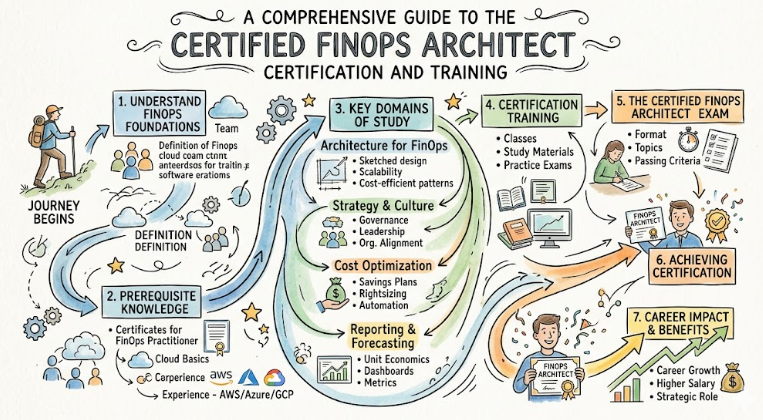
Introduction
The Certified FinOps Architect is a premier credential designed for senior technical leaders who need to bridge the gap between cloud engineering and financial accountability. As organizations scale their cloud footprint, the “spend-and-hope” model is no longer sustainable, making the role of an architect who understands unit economics critical. This guide is written for cloud engineers, SREs, and platform leads who want to move beyond simple cost-cutting and into the realm of value-driven engineering. By following this path, professionals can learn how to design systems that are not only high-performing but also economically efficient.
Today’s cloud landscape demands a shift from reactive monitoring to proactive architectural design, and this certification provides the blueprint for that transition. This guide will help you understand the curriculum, the professional impact, and the long-term career benefits of mastering FinOps at an architectural level through finopsschool.
What is the Certified FinOps Architect?
The Certified FinOps Architect represents the highest level of technical mastery in the cloud financial management domain. It exists to solve the fundamental conflict between the speed of engineering and the constraints of corporate finance. Rather than focusing on theory or high-level management jargon, this certification emphasizes production-focused learning, requiring candidates to understand how infrastructure decisions directly impact the bottom line.
It represents a paradigm shift where cost is treated as a first-class engineering metric, similar to latency or uptime. For an enterprise, having a certified architect means having someone who can design multi-cloud strategies that align with business goals. It aligns perfectly with modern engineering workflows by integrating financial feedback loops directly into the CI/CD pipeline and architectural review processes.
Who Should Pursue Certified FinOps Architect?
This certification is primarily built for senior engineers, SREs, and Cloud Architects who already possess a strong understanding of infrastructure-as-code and cloud native services. It is equally valuable for Platform Engineers who are building internal developer platforms where cost transparency is a key feature. Security and Data professionals will also find value here, as data egress and storage costs often become the most volatile part of a modern enterprise budget.
In the Indian market and global tech hubs, engineering managers and technical leaders are increasingly pursuing this certification to gain the vocabulary needed to communicate with CFOs and stakeholders. While a beginner can start with the foundation level, the Architect level is designed for those with 5+ years of experience who are ready to take ownership of large-scale cloud budgets and technical strategy.
Why Certified FinOps Architect is Valuable and Beyond
The demand for cloud financial expertise is skyrocketing as enterprises realize that moving to the cloud does not automatically save money. Adoption of FinOps practices has moved from a “nice-to-have” to a mandatory requirement for any company spending over a million dollars annually on cloud services. This certification ensures longevity in a professional’s career because it teaches principles that remain relevant even as tools like AWS, Azure, or GCP change their interfaces.
By becoming a Certified FinOps Architect, you provide a high return on investment for your employer by identifying waste that automated tools often miss. It helps professionals stay relevant by shifting their focus from simple resource provisioning to strategic value engineering. In an era of economic tightening, an engineer who can prove they saved the company seven figures through architectural optimization is indispensable.
Certified FinOps Architect Certification Overview
The program is delivered via the official portal and is hosted on the primary website. It is structured as a comprehensive journey that moves from basic terminology to complex architectural patterns. Unlike standard certifications that rely solely on multiple-choice questions, this program emphasizes a practitioner’s approach to solving real-world financial leaks in cloud infrastructure.
The certification ownership lies with an organization dedicated to the evolution of cloud financial management, ensuring the content is updated frequently to reflect new cloud billing models. The assessment approach is rigorous, testing your ability to apply unit economics, manage commitment-based discounts, and lead a cultural transformation within a technical organization. It is a structured path that validates your ability to lead FinOps initiatives at scale.
Certified FinOps Architect Certification Tracks & Levels
The certification path is divided into Foundation, Professional, and Advanced levels to cater to different career stages. The Foundation level introduces the core pillars of Inform, Optimize, and Operate, while the Professional level dives into the technical implementation of tagging, automation, and reporting. The Advanced/Architect level focuses on strategy, governance, and organizational change.
Specialization tracks allow SREs to focus on performance-cost trade-offs, while DevOps professionals can focus on integrating cost metrics into deployment pipelines. These levels are designed to align with career progression, taking a junior engineer from a cost-aware contributor to a strategic lead who manages the entire cloud economic lifecycle of an enterprise.
Complete Certified FinOps Architect Certification Table
| Track | Level | Who it’s for | Prerequisites | Skills Covered | Recommended Order |
| Core FinOps | Foundation | Beginners, Managers | Basic Cloud Knowledge | Terminology, Lifecycle | 1 |
| Engineering | Professional | SREs, DevOps Engineers | 2+ Years Cloud Exp | Automation, Tagging | 2 |
| Architectural | Advanced | Senior Architects | Professional Level | Unit Economics, Strategy | 3 |
| Leadership | Executive | CTOs, Finance Leads | Foundation Level | Governance, Culture | Optional |
Detailed Guide for Each Certified FinOps Architect Certification
Certified FinOps Architect – Foundation
What it is
This certification validates a candidate’s understanding of the basic FinOps framework and the standard vocabulary used in cloud financial management. It ensures that everyone in the organization, from finance to engineering, speaks the same language.
Who should take it
It is suitable for entry-level cloud engineers, finance analysts, and project managers who need to understand how cloud billing differs from traditional data center procurement. No deep technical experience is required.
Skills you’ll gain
- Understanding the three phases: Inform, Optimize, and Operate.
- Knowledge of cloud pricing models (On-demand vs. Reserved).
- Ability to identify common sources of cloud waste.
- Understanding the FinOps personas and their responsibilities.
Real-world projects you should be able to do
- Create a basic cloud cost report for a specific department.
- Identify unattached storage volumes and idle instances.
- Map cloud resources to specific business units using basic tags.
Preparation plan
- 7-14 Days: Review the official glossary and take practice quizzes to familiarize yourself with the core pillars.
- 30 Days: Read case studies on cloud migration and attend a foundation-level webinar.
- 60 Days: Not typically required for this level unless you have zero cloud experience.
Common mistakes
- Ignoring the cultural aspect of FinOps and focusing only on the numbers.
- Confusing FinOps with traditional IT asset management.
Best next certification after this
- Same-track option: FinOps Professional
- Cross-track option: Cloud Digital Leader
- Leadership option: ITIL 4 Foundation
Certified FinOps Architect – Professional
What it is
This level validates the technical ability to implement FinOps at a departmental or project level. It focuses on the “how” of cost optimization, including technical automation and granular reporting.
Who should take it
Ideal for DevOps engineers and SREs who are tasked with managing the day-to-day cloud operations and need to build automated cost-saving scripts.
Skills you’ll gain
- Implementing complex tagging and labeling strategies.
- Automating the shutdown of non-production environments.
- Analyzing commitment coverage for RIs and Savings Plans.
- Building real-time cost dashboards for engineering teams.
Real-world projects you should be able to do
- Design an automated cleanup bot for orphaned cloud resources.
- Configure budget alerts and anomaly detection in a multi-account setup.
- Perform a “Right-sizing” exercise for a large Kubernetes cluster.
Preparation plan
- 7-14 Days: Deep dive into cloud provider billing APIs and export tools.
- 30 Days: Practice writing scripts that interface with cost management tools.
- 60 Days: Implement a pilot FinOps project in a sandbox environment.
Common mistakes
- Implementing aggressive cost-cutting that hurts system performance.
- Failing to automate the reporting process, leading to stale data.
Best next certification after this
- Same-track option: Certified FinOps Architect
- Cross-track option: CKA (Certified Kubernetes Administrator)
- Leadership option: PMP
Certified FinOps Architect – Architect (Advanced)
What it is
This is the pinnacle of the program, validating the ability to design cost-efficient architectures and lead global FinOps strategies. It is about architectural patterns that minimize spend while maximizing performance.
Who should take it
Principal Engineers and Chief Architects who have oversight over massive cloud estates and need to align technology choices with financial goals.
Skills you’ll gain
- Designing multi-cloud architectures for cost portability.
- Advanced unit economics modeling (Cost per transaction/user).
- Leading cultural change across large engineering organizations.
- Negotiating enterprise-scale agreements with cloud vendors.
Real-world projects you should be able to do
- Architect a serverless migration plan to reduce baseline infrastructure costs.
- Establish a FinOps Center of Excellence (CoE) for a global enterprise.
- Design a chargeback/showback system for a multi-tenant platform.
Preparation plan
- 7-14 Days: Review advanced whitepapers on cloud financial management.
- 30 Days: Analyze existing architectural patterns for potential cost optimization.
- 60 Days: Develop a comprehensive FinOps strategy document for an organization.
Common mistakes
- Over-engineering the FinOps toolchain instead of focusing on cultural adoption.
- Failing to involve the finance team in architectural discussions early enough.
Best next certification after this
- Same-track option: Executive Leadership in Cloud
- Cross-track option: TOGAF
- Leadership option: MBA or Executive Management Certification
Choose Your Learning Path
DevOps Path
In this path, the focus is on integrating cost metrics into the developer experience. Engineers learn to treat “cost” as a build failure if a deployment exceeds a predefined budget. You will focus on CI/CD integration where every pull request can estimate the potential cost increase of a change. This path ensures that developers are empowered with data to make cost-effective choices without slowing down the release cycle.
DevSecOps Path
The DevSecOps path emphasizes the intersection of security compliance and financial waste. Security scanning often uncovers unused or shadow IT resources that are both a security risk and a financial drain. Professionals in this path learn how to use security tools to identify unoptimized resources and ensure that cost-saving measures do not introduce vulnerabilities into the infrastructure.
SRE Path
For SREs, the goal is balancing the “Error Budget” with the “Financial Budget.” This path teaches how to optimize for performance while maintaining cost efficiency, particularly in autoscaling and high-availability configurations. You will learn to use observability tools to correlate system load with spend, ensuring that you are only paying for the resources that are actively contributing to the user experience.
AIOps Path
The AIOps path focuses on using machine learning and artificial intelligence to predict cloud spend and detect anomalies automatically. Engineers learn to build or deploy models that can forecast future costs based on historical trends and seasonal spikes. This path is critical for organizations with highly variable workloads that require automated, intelligent intervention to prevent budget overruns.
MLOps Path
MLOps professionals deal with the massive costs associated with GPU usage and data processing for model training. This path teaches how to manage the lifecycle of machine learning experiments economically, including the use of spot instances for training and optimizing model serving infrastructure. It ensures that the innovation of AI does not lead to unsustainable cloud bills that stall projects.
DataOps Path
Data is often the most expensive part of the cloud due to storage and egress fees. This path focuses on the lifecycle of data, from ingestion to archiving, ensuring that storage tiers are used correctly. You will learn how to architect data pipelines that minimize data movement across regions and providers, which is often the silent killer of cloud budgets.
FinOps Path
This is the dedicated path for those who want to specialize entirely in cloud financial management. It covers the full spectrum from accounting principles to technical cloud architecture. It is designed for those who want to lead the FinOps movement within their organization, acting as the bridge between the technical teams, the finance department, and the executive leadership.
Role → Recommended Certified FinOps Architect Certifications
| Role | Recommended Certifications |
| DevOps Engineer | FinOps Professional, CKAD |
| SRE | FinOps Architect, CKA |
| Platform Engineer | FinOps Architect, Terraform Associate |
| Cloud Engineer | FinOps Foundation, Professional |
| Security Engineer | FinOps Foundation, Cloud Security Professional |
| Data Engineer | FinOps Professional, Data Engineering Professional |
| FinOps Practitioner | FinOps Foundation, Professional, Architect |
| Engineering Manager | FinOps Foundation, Architect |
Next Certifications to Take After Certified FinOps Architect
Same Track Progression
Once you have achieved the Architect level, the next logical step is to dive deeper into specialized cloud provider cost tools. Certifications like the AWS Certified Solutions Architect – Professional or the Google Professional Cloud Architect provide deeper context into specific service optimizations. This allows you to apply the general FinOps principles to the specific nuances of each cloud vendor’s billing engine and service catalog.
Cross-Track Expansion
Broadening your skills into the realm of Platform Engineering or Kubernetes is highly recommended. Certifications like the Certified Kubernetes Administrator (CKA) are essential because containers often obscure cost visibility. Understanding how to manage resource requests and limits in Kubernetes is a vital technical skill that complements the strategic knowledge gained in the FinOps Architect program.
Leadership & Management Track
For those looking to move into executive roles, certifications like TOGAF for enterprise architecture or the PMP for project management are valuable. Transitioning into leadership requires a blend of technical strategy and people management. Understanding how to manage large-scale organizational change is the final piece of the puzzle for a FinOps leader who wants to drive a culture of accountability.
Training & Certification Support Providers for Certified FinOps Architect
DevOpsSchool
DevOpsSchool provides an extensive range of training programs that focus on the practical implementation of FinOps within a DevOps framework. Their curriculum is designed by industry experts who bring years of hands-on experience to the classroom. They offer both self-paced and instructor-led sessions that cover everything from basic cloud billing to advanced automation. Their focus on real-world labs ensures that students do not just learn the theory but can actually apply the concepts to their production environments immediately. This makes them a top choice for engineers looking for a career boost.
Cotocus
Cotocus is known for its specialized consulting and training services that cater to high-end enterprise requirements. Their approach to FinOps training is deeply rooted in architectural best practices and strategic cost management. They provide customized training modules that can be tailored to the specific cloud stack used by an organization. Cotocus emphasizes the importance of unit economics and helps senior professionals understand how to communicate technical value in financial terms. Their instructors are often active consultants, providing students with insights into the latest trends and challenges in the cloud financial management space.
Scmgalaxy
Scmgalaxy is a community-driven platform that offers a wealth of resources for those pursuing FinOps and DevOps certifications. They provide comprehensive study guides, mock exams, and video tutorials that are designed to help candidates pass their certification exams on the first attempt. Their training programs are highly accessible and focus on the core technical skills needed to manage cloud costs effectively. Scmgalaxy also hosts a variety of webinars and forums where professionals can share their experiences and learn from their peers, making it a great place for continuous learning and networking.
BestDevOps
BestDevOps offers a streamlined and highly focused training experience for professionals who want to master FinOps quickly. Their courses are designed to be intensive and practical, focusing on the most high-impact cost-saving strategies used in the industry today. They provide a clear roadmap for certification, moving from foundation to advanced levels with ease. The training includes a variety of hands-on projects that simulate real-world cloud waste scenarios, allowing students to practice their optimization skills in a safe environment. Their commitment to student success is reflected in their high certification pass rates.
devsecopsschool.com
This provider specializes in the intersection of security and operations, offering a unique perspective on FinOps. Their training emphasizes that a secure cloud is often a cost-efficient cloud. By integrating cost management into the security lifecycle, they help professionals identify risks that are also financial drains. Their courses cover advanced topics like automated compliance and secure resource provisioning, ensuring that students can build robust and economical cloud infrastructures. This is an ideal choice for professionals who are looking to broaden their skills in both security and financial management simultaneously.
sreschool.com
SRE School focuses on the reliability and performance aspects of cloud engineering, making it a perfect fit for those looking to balance cost with uptime. Their FinOps training is integrated with SRE principles like SLIs, SLOs, and error budgets. They teach students how to treat cost as a performance metric, using observability tools to drive financial decisions. Their curriculum is highly technical and aimed at senior SREs who need to manage the trade-offs between system resilience and infrastructure spend. The training includes deep dives into autoscaling, load balancing, and high-availability cost models.
aiopsschool.com
As artificial intelligence becomes a central part of cloud management, AI Ops School provides the training needed to use AI for financial optimization. Their courses focus on the implementation of machine learning models for cost forecasting and anomaly detection. Students learn how to automate the response to budget spikes and use predictive analytics to plan for future cloud capacity. This training is essential for organizations that have complex, dynamic workloads where manual cost management is no longer feasible. It prepares professionals for the future of automated, intelligent cloud financial operations.
dataopsschool.com
DataOps School addresses the unique financial challenges associated with big data and analytics in the cloud. Their training covers the entire data lifecycle, from ingestion and processing to storage and egress. They teach professionals how to architect data pipelines that are both performant and cost-effective, focusing on data compression, partitioning, and cold storage strategies. Given that data costs are often the most volatile part of a cloud bill, this training is invaluable for data engineers and architects who want to keep their projects within budget while delivering high-value insights.
finopsschool.com
FinOps School is the primary authority on cloud financial management training, offering a comprehensive suite of certifications. Their programs are designed to cater to all levels of expertise, from beginners to advanced architects. They provide a structured learning path that is recognized globally by leading enterprises. Their curriculum is constantly updated to reflect the latest changes in cloud billing models and industry best practices. With a focus on cultural transformation and technical mastery, FinOps School is the go-to destination for anyone looking to build a career in this rapidly growing field.
Frequently Asked Questions (General)
- How difficult is the Certified FinOps Architect exam?
The exam is considered advanced and requires a deep understanding of both cloud architecture and financial principles. It is designed for experienced practitioners. - How much time does it take to prepare for this certification?
Depending on your experience level, it can take anywhere from 30 to 60 days of focused study to master the architectural concepts. - Are there any prerequisites for the Architect level?
While not always mandatory, it is highly recommended to complete the Foundation and Professional levels first to build a solid knowledge base. - What is the ROI of getting this certification?
Professionals often see a significant salary increase and are eligible for senior leadership roles after becoming a certified architect. - Is this certification recognized globally?
Yes, the FinOps framework is the industry standard for cloud financial management used by Fortune 500 companies worldwide. - Do I need to be an expert in all cloud providers?
You should have a strong grasp of at least one major provider (AWS, Azure, or GCP) and a general understanding of how multi-cloud billing works. - How often do I need to recertify?
Typically, certifications are valid for two to three years, after which you may need to pass a renewal exam to stay current with new cloud models. - Can a manager benefit from the Architect level?
Yes, engineering managers find it useful for strategic planning and aligning their department’s budget with technical roadmaps. - Does the certification focus more on tools or culture?
It balances both. While technical tools are covered, the certification emphasizes that FinOps is primarily a cultural shift within an organization. - Are there practical labs in the training?
Most reputable training providers include hands-on labs where you can practice cost optimization in a simulated cloud environment. - Is the exam proctored online?
Yes, most certifications in this domain offer the convenience of online proctored exams that can be taken from your home or office. - How does this differ from a standard Cloud Architect certification?
A standard architect cert focuses on how to build systems, while the FinOps Architect cert focuses on how to build them economically.
FAQs on Certified FinOps Architect
- What specifically makes the “Architect” level different from “Professional”?
The Architect level moves from day-to-day optimization tasks to high-level strategy, governance, and long-term architectural decision-making. - How does this certification handle Kubernetes and container costs?
It includes specific modules on container cost allocation, showing you how to break down shared cluster costs among different teams and applications. - Will I learn about unit economics in this program?
Yes, mastering unit economics—such as cost per customer or cost per transaction—is a core component of the Architect level curriculum. - Is multi-cloud strategy covered?
Absolutely. The certification teaches you how to manage costs across multiple vendors and how to architect for portability to avoid vendor lock-in. - Does the program cover commitment-based discounts like RIs?
It provides advanced strategies for managing Reserved Instances and Savings Plans across a large-scale, multi-account enterprise environment. - How much coding is required for the Architect level?
While you don’t need to be a full-stack developer, you should be comfortable with scripting and using APIs to automate financial reporting and actions. - Is this certification relevant for startups?
Yes, startups benefit from FinOps by ensuring their limited capital is spent efficiently as they scale their cloud infrastructure rapidly. - What kind of career support is available after certification?
Many training providers offer job placement assistance and access to exclusive professional networks for certified FinOps Architects.
Final Thoughts: Is Certified FinOps Architect Worth It?
In the modern world of cloud-native engineering, being “just an engineer” is no longer enough. The most successful professionals are those who can prove the financial impact of their technical decisions. The Certified FinOps Architect is not just another badge; it is a signal to the industry that you possess the rare ability to build scalable, high-performing systems that are also fiscally responsible.
If you are looking to move into a principal role or a leadership position, this certification provides the strategic framework you need. It forces you to think beyond the console and consider the long-term business value of every server, database, and network connection you deploy. For any serious professional in the DevOps or Cloud space, this is a career-defining investment.
