
Limited Time Offer!
For Less Than the Cost of a Starbucks Coffee, Access All DevOpsSchool Videos on YouTube Unlimitedly.
Master DevOps, SRE, DevSecOps Skills!
Introduction
The software development ecosystem has undergone a massive transformation over the past decade. Engineering teams have transitioned from shipping software updates once or twice a year to deploying code alterations multiple times a day. While this unprecedented speed has unlocked massive business value, it has also introduced a critical vulnerability: security is frequently treated as an afterthought.
Traditionally, security evaluations were conducted at the very end of the software development lifecycle. Code was written, packages were bundled, systems were tested for functionality, and then the entire application was handed over to an isolated security team for validation. This outdated approach created severe friction. Security teams would find critical vulnerabilities, send the code back to developers, and halt deployments, causing major project delays. In the modern landscape, this approach is completely broken.
Many engineers, system administrators, and security specialists recognize the urgency of merging software operations with security principles. However, trying to find a clear path forward often leads to complete overwhelm. The internet is flooded with unstructured, chaotic roadmaps that recommend learning fifty different open-source tools simultaneously. This chaotic approach leaves aspiring engineers trapped in tutorial hell, knowing how to run a basic software scan but lacking any true understanding of how enterprise security posture functions at scale.
A structured roadmap matters because real enterprise environments do not hire professionals based on their ability to memorize random command-line tools. Modern tech companies require individuals who understand security philosophy, automation architectures, and systemic risk mitigation. Organizations need professionals who can bridge the gap between engineering velocity and compliance mandates.
Whether you are a traditional quality assurance analyst looking to upgrade your automation skill set, a systems administrator wanting to master cloud-native infrastructure protection, or a software engineer aiming to specialize in secure code delivery, you need a realistic path forward. Organizations like DevOpsSchool emphasize structured, hands-on methodology rather than conceptual memorization, proving that long-term career growth requires a deliberate, step-by-step approach to the discipline. To build an effective roadmap, you must first understand the structural errors that cause most learning paths to fail.
What Is a DevSecOps Roadmap?
A practical DevSecOps roadmap is a structured blueprint that outlines the progression of technical competencies, process methodologies, and cultural practices required to integrate security validation directly into every stage of the automated software delivery cycle. It serves as both a learning guide and an operational strategy for your career development.
To grasp this concept, imagine building a high-speed automotive assembly line. If you assemble an entire vehicle at breakneck speed and only check the integrity of the brakes at the very end of the track, you will inevitably have to dismantle completed cars to fix core structural errors.
A DevSecOps approach is equivalent to installing automated testing sensors at every single station along that assembly line. The moment a faulty bolt or structural weakness is detected, the line identifies the issue instantly, allowing for an immediate fix before the vehicle moves to the next phase.
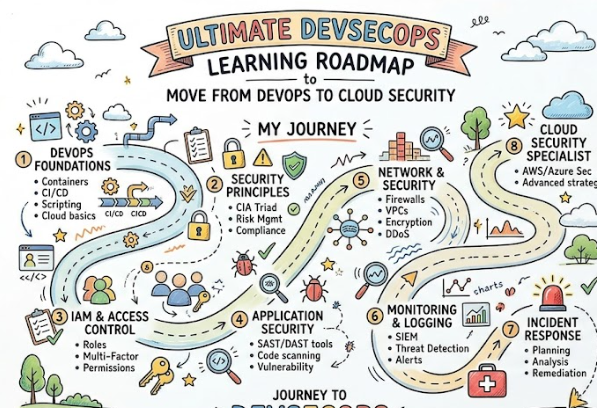
A genuine DevSecOps skills roadmap does not just teach you how to use software scanners. It outlines a logical progression that begins with core infrastructure management, moves through automated continuous integration and continuous delivery, establishes security feedback mechanisms, and culminates in continuous monitoring and runtime defense. It maps out your progression from a foundational engineer to a specialist capable of designing self-healing, secure cloud architectures.
Why Most DevSecOps Roadmaps Fail
The failure rate for self-taught engineers and enterprise implementation teams attempting to master DevSecOps is exceptionally high. This failure is rarely caused by a lack of effort. Instead, it stems from a flawed learning methodology that focuses on superficial metrics rather than deep engineering principles.
The Trap of Tool Fetishism
The most common mistake is attempting to learn twenty separate security and infrastructure tools right at the start. Aspiring engineers often believe that listing Jenkins, GitHub Actions, GitLab CI, SonarQube, Snyk, Aqua Security, Trivy, and Checkmarx on their resume makes them competitive candidates. In reality, tools change constantly. If you learn how to click buttons in a user interface without understanding why a specific security policy is being enforced, you will fail the moment the enterprise switches to a different technology vendor.
Lack of Foundational Computing Knowledge
You cannot secure an ecosystem that you do not understand. Many learners jump straight into advanced continuous integration security scanning while lacking a clear grasp of how a Linux operating system manages file permissions, how a container isolates processes, or how network packets move across a virtual private cloud. Without these fundamental building blocks, debugging a failed security pipeline becomes impossible.
Relying on Fragmented, Non-Production Projects
Following basic documentation tutorials that scan an empty public repository does not prepare you for real-world scenarios. True enterprise applications feature complex dependency trees, legacy code structures, broken authentication models, and intricate compliance demands. When a learner is confronted with thousands of complex, real-world vulnerability alerts after only practicing on trivial projects, they struggle to filter through the noise and prioritize remediation.
Completely Overlooking the Cultural Shift
DevSecOps is not merely a collection of software applications; it is an organizational philosophy. If an engineer approaches the discipline with a rigid, old-school mindset—treating security as an authoritarian gatekeeper that stops deployments without helping developers fix the underlying code—they will face massive resistance from software engineering teams. Roadmaps fail when they teach the mechanics of scanning but ignore the communication strategies needed to integrate security practices seamlessly into the developer workflow.
Core Foundations You Must Learn First
Before configuring automated pipelines or executing vulnerability scans, you must establish a resilient foundational layer. Skipping these core computing domains guarantees that you will struggle when managing complex cloud-native architectures.
| Foundation Skill | Why It Matters |
| Linux Operating System Basics | The vast majority of cloud-native infrastructure, containers, and deployment servers run on Linux distributions. You must know how to navigate the operating system securely. |
| Networking Fundamentals | Modern security breaches frequently exploit misconfigured network perimeters. Understanding data transport is non-negotiable for protecting APIs and clusters. |
| Git Version Control Mastery | In modern infrastructure management, everything is treated as code. Git serves as the single source of truth for both software builds and infrastructure configurations. |
| Cloud Computing Core Pillars | Modern software deployments live inside virtualized environments. You must understand how resources are provisioned, isolated, and access-controlled. |
| Practical Scripting and Automation | Manual security audits are slow and prone to errors. You must be capable of writing scripts to automatically parse log files and link disconnected APIs. |
Deep Dive into Foundations
Linux Operating System Basics
You need to move beyond simple directory navigation. Focus your attention on learning the Linux filesystem hierarchy, understanding how user management functions, and configuring file permissions using access control lists. Master the ability to analyze running processes using tools like top, htop, and ps.
Learn how to manage system services via systemd and become comfortable reading core system logs located inside the /var/log directory. A secure pipeline relies on hardened operating system images, which requires a firm understanding of the underlying OS behavior.
Networking Fundamentals
You must thoroughly understand how computers communicate across distributed networks. Dedicate time to mastering the OSI model, with a heavy emphasis on the network, transport, and application layers. You must understand IPv4 addressing, subnetting, and how routing tables direct traffic across networks.
Learn the specific mechanics of protocols like TCP/IP, UDP, DNS, and HTTP/HTTPS. Finally, study how firewalls, network address translation (NAT), and secure socket layer/transport layer security (SSL/TLS) certificates encrypt data in transit.
Git Version Control Mastery
Git is the foundation for all modern infrastructure automation and application delivery. You must master branch management strategies, understand how to perform clean merges, resolve complex merge conflicts, and utilize rebase workflows.
Learn how to leverage advanced features such as Git hooks, which allow you to execute local validation scripts automatically before any code leaves a developer’s workstation. Understanding how to manage cryptographic commit signing with GPG keys is also essential for maintaining chain-of-custody verification for software assets.
Cloud Computing Core Pillars
Select a major cloud service vendor—such as Amazon Web Services (AWS), Microsoft Azure, or Google Cloud Platform (GCP)—and break down their primary architecture components. You must master Identity and Access Management (IAM), learning how to enforce the principle of least privilege through granular policies, roles, and groups.
Understand how to configure virtual private networks, public and private subnets, security groups, and network access control lists to build multi-layered network barriers around your workloads.
Practical Scripting and Automation
You do not need to be an expert software engineer, but you must be a proficient automation writer. Start by mastering Bash/Shell scripting to automate repetitive command-line workflows inside Linux host machines.
Following that, learn Python, which has become the industry standard for cloud automation, security analysis, and API integration. Focus your Python studies on data structures, file operations, error handling, and interacting with external services via libraries like requests and cloud vendor SDKs.
Step 1: DevOps Fundamentals
Once your foundations are solid, you can transition into the core patterns of the DevOps paradigm. The goal here is to understand how code moves rapidly from a developer’s local workspace into a live production system without manual human intervention.
+---------------+     +---------------+     +---------------+     +---------------+
|   Developer   | --> |  Git/Version  | --> |  CI Platform  | --> | Artifact Repo |
| Write & Commit|     |  Control Repo |     | Compile & Test|     | Store Images  |
+---------------+     +---------------+     +---------------+     +---------------+
Continuous Integration and Continuous Delivery Concepts
At its core, Continuous Integration (CI) is the practice of automating the integration of code changes from multiple contributors into a single software project repository. Continuous Delivery (CD) ensures that the integrated code is automatically built, tested, and prepared for a release to production environments.
You must study the automated triggers that run these pipelines, such as code pushes, pull requests, and tag creations. Your objective is to learn how to structure an automated sequence that guarantees no broken or uncompiled code can ever find its way into an environment.
The Automation Mindset
DevOps relies heavily on treating infrastructure exactly like software application code. This model is known as Infrastructure as Code (IaC). You must learn how to define virtual machines, network configurations, database instances, and storage buckets using declarative configuration files rather than clicking around a cloud console user interface.
By defining your environments via text files, you can track changes using version control, perform code reviews on your infrastructure modifications, and ensure your environments remain identical across development, staging, and production.
Practical Workflow Example
Consider a standard development workflow. A software engineer writes a feature modification on their local laptop. They commit the file and push it up to a central repository system like GitHub.
The moment that code arrives, a webhook notifies a continuous integration platform. The integration tool spins up an isolated virtual environment, checks out the newly committed code, downloads the required dependencies, compiles the binary application, and runs a battery of functional unit tests.
If any test fails, the pipeline immediately halts, notifies the developer, and prevents the broken code from moving forward. This predictable, automated cycle provides the baseline framework into which security checks will be woven.
Step 2: Security Fundamentals
With an understanding of how automated pipelines operate, you must now master the foundational security frameworks that you will eventually inject into those automated systems. You cannot build automated security checks until you know exactly what vulnerabilities and risks you are actively hunting for.
Core Security Concepts
Begin your security education by deeply understanding the CIA Triad:
- Confidentiality: Ensuring that sensitive data is accessible only to authorized entities.
- Integrity: Guaranteeing that information is accurate, complete, and protected against unauthorized modification.
- Availability: Ensuring that systems, networks, and data remain reliably accessible to authorized users when needed.
Study risk management strategies, threat modeling frameworks, and data classification structures. You must understand how to view an application through the eyes of an adversary, identifying weak points and potential attack paths before writing a single line of defense automation.
Authentication vs. Authorization
Many engineering systems suffer from a severe confusion between identification validation and access control tracking. You must master the architectural differences between these two concepts:
- Authentication (AuthN): The technical process of verifying that an entity is exactly who or what they claim to be. This involves mechanisms such as multi-factor authentication, cryptographic tokens, and identity federation.
- Authorization (AuthZ): The process of verifying what specific resources an authenticated identity is permitted to access or modify.
You must learn how to design, evaluate, and audit role-based access control models and attribute-based access control structures to prevent unauthorized privilege escalation across enterprise tools.
Vulnerability Basics
Familiarize yourself with the OWASP Top 10, which documents the most critical security risks facing modern web applications, including injection flaws, broken authentication components, and cryptographic failures.
Learn how the security industry classifies and tracks system flaws using Common Vulnerabilities and Exposures (CVE) identification codes. Understand the Common Vulnerability Scoring System (CVSS) matrix, which allows organizations to calculate the true severity and real-world business impact of security vulnerabilities based on their exploitability and scope.
Step 3: CI/CD Pipeline Understanding
With both DevOps pipeline mechanics and fundamental security concepts under your belt, your next step is discovering how to merge these two worlds. This phase focuses on learning how to inject security guardrails seamlessly into an active software deployment pipeline without breaking the workflow velocity.
   [ Code Commit ]
          |
          v
+-------------------+
| Pre-Commit Hooks  | --> (Linting, Secrets Detection)
+-------------------+
          |
          v
+-------------------+
|  Build Stage (CI) | --> (SAST Scanning, Software Component Analysis)
+-------------------+
          |
          v
+-------------------+
| Artifact Creation | --> (Container Image Scanning, Sign Assets)
+-------------------+
          |
          v
+-------------------+
| Deployment (CD)   | --> (DAST Scanning, Infrastructure Verification)
+-------------------+
Pipeline Architecture Mechanics
An enterprise automated delivery pipeline is structured as a series of sequential phases. It starts with the source control stage, proceeds to the compilation and dependency resolution stage, moves to artifact creation, transitions into an automated testing phase, and concludes with deployment orchestration.
To introduce security into this structure, you must master the art of configuring pipeline exit codes. If an automated security scanner discovers a critical, highly exploitable risk, it must issue a non-zero exit command that deliberately breaks the pipeline, blocking the build from moving any further down the line.
Strategic Security Hooks
Security cannot be implemented as a single, resource-heavy check at the very end of your pipeline. That approach re-creates the exact bottlenecks we are trying to solve. Instead, you must learn to distribute specific security tests strategically across the entire lifecycle:
- Pre-Commit Phase: Run lightweight linters and signature scanners locally on developer machines to catch clear formatting mistakes and exposed API keys before code is pushed to Git.
- Build Phase: Execute static code scanners that examine the raw text of the application source files for logical vulnerabilities.
- Artifact Assembly Phase: Run dependency scanners that check open-source packages for known vulnerability signatures.
- Staging Phase: Run dynamic scanners against a running instance of the application to discover runtime security issues that static analysis tools miss.
Step 4: DevSecOps Core Practices
This phase is where the core methodologies of modern security engineering are put into practice. Mastering these steps is what transforms a traditional operations professional into a true cloud-native security specialist.
| Practice | Purpose |
| Shift-Left Security Implementation | Moving security evaluations and validation processes to the earliest possible phases of the software creation lifecycle. |
| Static Application Security Testing | Analyzing raw source code files automatically to uncover architectural flaws without executing the application. |
| Dynamic Application Security Testing | Evaluating a live, running application instance from the outside to uncover functional vulnerabilities and misconfigurations. |
| Automated Secrets Management | Eliminating plaintext passwords, database credentials, and cryptographic tokens from version control systems. |
| Compliance as Code Auditing | Translating human-readable regulatory compliance rules into automated software testing scripts. |
Deep Dive into Core Practices
Shift-Left Security Implementation
The philosophy of shift-left is simple: the earlier a software bug or security vulnerability is discovered, the cheaper, faster, and easier it is to fix. If an engineer catches an SQL injection vulnerability while writing code on their laptop, fixing it takes seconds.
If that same injection vulnerability bypasses testing, slips into production, and is subsequently exploited by an external threat actor, it can result in millions of dollars in damages, legal penalties, and severe brand degradation. Your job is to design pipelines that provide developers with rapid feedback loops right at the point of creation.
Static Application Security Testing (SAST)
SAST tools scan the internal architecture of an application from the inside out, looking at source code, configuration files, and structural dependencies. These scanners utilize predefined rule sets to identify dangerous coding patterns, such as insecure cryptographic functions, unvalidated user inputs, or improper error handling routines.
You must learn how to fine-tune these tools. Because SAST tools can generate a high volume of false positives, you must know how to customize rule sets to ensure your development teams are not constantly distracted by inaccurate security alerts.
Dynamic Application Security Testing (DAST)
Unlike SAST, DAST tools examine your application from the outside in, behaving exactly like an external attacker who has zero inside knowledge of the code structure. When a DAST scan runs, it interacts directly with the exposed user interfaces, forms, endpoints, and APIs of a live, running instance of your software.
It attempts to inject malicious payloads, fuzz inputs, manipulate headers, and exploit session tracking bugs. Learning DAST helps you uncover complex infrastructure configuration problems, flawed deployment parameters, and authentication weaknesses that are impossible to spot by looking at raw source files alone.
Automated Secrets Management
One of the most common causes of modern corporate data breaches is developers accidentally committing sensitive passwords, API keys, or cloud access tokens directly into public Git repositories. You must learn how to implement automated mechanisms that intercept these security oversights.
This requires deploying tools that actively scan codebases for credential signatures, combined with centralized, encrypted secrets management vaults. Applications should be architected to dynamically retrieve security credentials at runtime via secure APIs, ensuring no raw passwords ever sit exposed inside static config files.
Compliance as Code Auditing
Modern enterprise systems must conform to strict regulatory legal requirements such as PCI-DSS for credit card processing, HIPAA for healthcare information isolation, or SOC 2 for overall data organizational handling. Historically, proving compliance required manual, paper-driven audits that took weeks to complete.
In a DevSecOps framework, you learn to translate these complex human laws into machine-readable configuration files. By utilizing automated policy scanning engines, you can evaluate your cloud infrastructure setups against compliance baselines on every single build, turning compliance checking into an automated, continuous process.
Step 5: Essential DevSecOps Tools
Once you understand the core practices, you must select the appropriate software tools to implement those practices across your pipeline infrastructure. Remember, your goal is to understand the category of the tool and its role within the pipeline ecosystem, rather than simply memorizing its interface buttons.
| Tool Category | Examples |
| CI/CD Platform Orchestrators | Jenkins, GitHub Actions, GitLab CI, Azure DevOps Pipelines |
| Static & Dependency Security Analysis | SonarQube, Snyk, Checkmarx, Semgrep, OWASP Dependency-Check |
| Container Image & Registry Scanners | Trivy, Clair, Aqua Security, Anchore Engine |
| Runtime Observability & Security Monitoring | Prometheus, Grafana, ELK Stack, Falco, Jaeger |
Deep Dive into Tooling Implementation
CI/CD Platform Orchestrators
These technologies serve as the central backbone of your automation efforts. Jenkins remains a widely utilized open-source staple in enterprise settings due to its extensive plugin ecosystem and deep customization options. However, cloud-native platforms like GitHub Actions and GitLab CI have gained massive popularity because they allow engineers to define pipelines cleanly via YAML files stored right alongside the application code.
You must focus on learning how to write modular pipeline scripts, manage runner pools securely, isolate execution variables, and handle job dependencies effectively within these orchestration engines.
Static & Dependency Security Analysis
For general source code analysis, tools like SonarQube provide excellent quality gate mechanisms that evaluate both code cleanliness and foundational security risks. Semgrep has emerged as an industry favorite because it allows security teams to easily write custom, lightning-fast matching rules using simple syntax.
When it comes to analyzing third-party open-source libraries, platforms like Snyk and OWASP Dependency-Check scan your application dependency trees against global vulnerability databases to flag outdated or compromised external packages.
Container Image & Registry Scanners
As modern applications shift toward containerized deployments using Docker, securing container base layers becomes paramount. Trivy is a highly effective tool for this stage; it is fast, simple to integrate into CI pipelines, and scans container images, filesystems, and Git repositories for vulnerabilities and misconfigurations.
More advanced enterprise platforms, like Aqua Security and Anchore Engine, offer deep deep-dive analysis, allowing you to intercept vulnerabilities at the container registry layer before images are pulled down into production environments.
Runtime Observability & Security Monitoring
Once an application is successfully deployed, your security responsibilities do not end. You need observability infrastructure to track how your workloads behave in production. Prometheus is excellent for scraping and aggregating systems metrics, which can then be visualized via clean dashboard interfaces in Grafana.
For logs management, the ELK Stack (Elasticsearch, Logstash, Kibana) collects and indexes system outputs for security auditing. At the kernel level, toolsets like Falco monitor system calls inside container environments in real time, alerting you instantly to unexpected behaviors—such as a container suddenly attempting to spawn a root shell or modify sensitive system host files.
Step 6: Hands-On DevSecOps Projects
Theoretical knowledge is largely ineffective in engineering interviews and production environments. To prove your capabilities, you must build functional, end-to-end automated pipelines that demonstrate your practical security skills. Here are three project blueprints you can build to build out your portfolio.
Project 1: The Secure CI Pipeline Integration
Build an automated pipeline from scratch using a simple application, such as a basic Node.js or Python web application hosted on GitHub. Configure GitHub Actions or GitLab CI to orchestrate the lifecycle.
The pipeline must execute a linter check to ensure clean code formatting, pass the source files through Semgrep to look for structural vulnerabilities, run an OWASP Dependency-Check to analyze external libraries, and enforce strict quality gates. If any critical vulnerabilities are uncovered during these steps, configure the pipeline to break automatically and send an alert notification to a mock communication channel.
Project 2: Automated Container Hardening and Scanning
Create an intentionally unhardened Dockerfile that uses an outdated base image, runs processes as the root user, and contains hardcoded dummy API credentials. Configure an automated build pipeline that runs Trivy or Aqua Security against this container image.
Once you analyze the initial vulnerability reports, systematically refactor the project: switch to a minimal, hardened Alpine or Distroless base image, implement non-root execution permissions, and migrate the hardcoded credentials into environment variables. Finally, re-run your scanning pipeline to verify that your optimizations successfully brought the open vulnerability count down to zero.
Project 3: Cloud Infrastructure Security Audit Pipeline
Write a set of Terraform configuration files designed to spin up a mock cloud infrastructure environment, deliberately including common security misconfigurations—such as an open AWS S3 storage bucket or a security group that allows unrestricted SSH traffic from any IP address on the internet.
Integrate a static analysis tool like Checkov or Tfsec directly into your deployment pipeline. Configure the pipeline to parse your Terraform files, identify the infrastructure security flaws, and block the automated deployment from executing until you update the configurations to adhere to secure cloud architectures.
Step 7: Advanced DevSecOps Skills
As you master the core steps of the roadmap, you can begin transitioning into advanced cloud-native architecture engineering. This phase focuses on managing large-scale, highly distributed enterprise environments.
+-------------------------------------------------------------------+
|                     Advanced Cloud Protection                     |
+-------------------------------------------------------------------+
|                                                                   |
|  [Kubernetes Security]     [Policy as Code]    [Runtime Defense]  |
|  - Network Policies        - Open Policy Agent - Falco Monitoring |
|  - Secrets Encryption      - Rego Policies     - Kernel Auditing  |
|                                                                   |
+-------------------------------------------------------------------+
Kubernetes Security Isolation
Kubernetes has become the operating system of the modern cloud, but its default configurations are often highly permissive. Advanced DevSecOps engineering requires learning how to secure these orchestration clusters. You must master Kubernetes Role-Based Access Control to restrict cluster modifications, configure internal Network Policies to prevent unauthorized pods from communicating across namespaces, and utilize Pod Security Standards to restrict root privileges.
Additionally, learn how to secure the control plane, encrypt secrets at rest within the etcd database, and deploy admission controllers that block non-compliant container deployments from entering your cluster.
Cloud Security Posture Management (CSPM)
In large enterprise settings, organizations manage thousands of distinct cloud accounts across multiple geographic regions, making configuration drift inevitable. You must learn how to implement automated Cloud Security Posture Management.
This involves deploying systems that continuously monitor your live cloud assets against security baselines (such as the CIS Benchmarks), automatically flagging drifting compliance postures, and triggering automated remediation workflows to isolate non-compliant infrastructure assets instantly.
Enterprise Policy as Code
As engineering ecosystems grow, manually reviewing every security policy becomes an operational impossibility. Advanced roadmap progression requires mastering Policy as Code platforms like Open Policy Agent (OPA).
By learning to write declarative policies using languages like Rego, you can define uniform security guardrails that apply across your entire organization. These policies can evaluate anything from Kubernetes manifest parameters to cloud provider API calls, enabling you to programmatically enforce compliance across your entire enterprise footprint.
Real-World DevSecOps Workflow
To fully grasp how these separate tools and practices function together, let us walk through a complete, step-by-step security workflow inside a mature enterprise environment.
1. Developer Commits Code
A software engineer updates an API endpoint on a local development branch. Before the code ever leaves their machine, a local Git pre-commit hook runs a lightweight scanner (like GitLeaks) to verify that no cryptographic tokens or internal passwords have been accidentally dropped into the code text.
2. CI Pipeline Trigger
The developer pushes the verified code branch to the central enterprise repository, automatically opening a pull request. This action triggers the continuous integration orchestrator, which creates an isolated runner environment to evaluate the code changes.
3. Static Security Scans Run
The orchestrator compiles the application code and runs concurrent static scanners. A SAST tool evaluates the newly modified code syntax for software flaws, while a Software Component Analysis (SCA) scanner checks the application dependency tree to ensure no newly imported open-source libraries contain unpatched vulnerabilities.
4. Container Build and Hardening Check
Once the source code passes inspection, the pipeline builds a new Docker container image. Before this image is pushed to the central company registry, a container scanner runs an analysis on the image layers, checking for OS-level vulnerabilities and confirming that the container is configured to run under a non-root system account.
5. Staging Deployment and Dynamic Testing
The validated container image is deployed into an isolated staging environment that mirrors production. Once live, an automated DAST scanner targets the staging endpoints, performing input fuzzing and configuration testing against the running application to catch any dynamic runtime security flaws.
6. Production Release with Cryptographic Signing
If all quality gates are successfully cleared, the container image is cryptographically signed using a tool like Cosign to verify its authenticity. The continuous delivery system then deploys the signed image to the production Kubernetes cluster, while admission controllers verify the signature to ensure only approved assets can enter production.
7. Runtime Observability and Alerting
The application is now live for end users. In the background, runtime security tools (like Falco and the ELK stack) continuously monitor system call activity and log outputs. If an unexpected binary execution occurs or anomalous traffic pattern emerges, the system generates real-time telemetry alerts, allowing security teams to respond immediately to live threats.
Common Mistakes in DevSecOps Learning Roadmaps
When executing this learning roadmap, you must actively protect yourself against common learning mistakes that can derail your progress. Use this checklist to keep your studies grounded and realistic.
- [ ] Jumping into Advanced Tooling Without Linux Basics: Attempting to configure complex container security tools before understanding how Linux processes, filesystems, and network stacks function.
- [ ] Memorizing Commands Instead of Architectures: Learning the exact CLI syntax of a single tool rather than understanding the underlying security concepts and pipeline workflows.
- [ ] Allowing Scanners to Output Unfiltered Alerts: Failing to customize scanner rules, resulting in a mountain of false positives that leads to alert fatigue and causes teams to ignore real risks.
- [ ] Treating Security as an Isolated Gatekeeper: Designing automated guardrails that block developer deployments without providing actionable, clear remediation guidance on how to fix the underlying code.
- [ ] Ignoring Cloud Identity and Access Management Fundamentals: Building highly automated delivery pipelines while leaving your underlying cloud provider accounts exposed with weak authentication rules or over-permissive IAM roles.
Best Practices for a Working DevSecOps Roadmap
To ensure your learning roadmap delivers tangible career results, structure your daily study habits and engineering projects around these core execution guidelines.
Start Small and Iterate Gradually
Do not attempt to build a massive, complex enterprise pipeline on day one. Begin by setting up a basic continuous integration build that simply checks code syntax compilation.
Once that functions reliably, layer in a basic static code scanner. After that runs smoothly, introduce dependency scanning. Building your automation step-by-step prevents configuration confusion and keeps your projects maintainable.
Prioritize Deep Understanding Over Broad Tool Lists
Mastering two core security tools deeply—understanding how their rule engines function, how to minimize false positives, and how to write custom policies—is infinitely more valuable than having a superficial familiarity with fifteen different vendor platforms. Focus on the core engineering patterns; once you master the foundational principles, adapting to a new tool vendor takes only a few days.
Focus heavily on Actionable Remediation
A skilled DevSecOps engineer does not simply point out flaws and block deployments; they provide clear paths to a fix. When you configure security scanners in your projects, focus on how the tool outputs its reports.
Structure your pipelines to provide developers with clear, contextual feedback loops that explain exactly what the vulnerability is, where it sits within the file, and how to rewrite the code safely.
Maintain an End-to-End Project Portfolio
Document your engineering projects clearly inside a public Git repository. Include thorough README.md files that walk through your architectural designs, outline the security challenges you faced, detail the scanning tools you integrated, and explain how you resolved configuration issues. A well-documented, clean GitHub portfolio is a highly effective way to demonstrate your practical engineering capabilities to hiring teams.
Role of DevOpsSchool in DevSecOps Learning Journey
Navigating the transition into DevSecOps can be highly challenging when attempting to piece together fragmented tutorials from disconnected online forums. This is where a structured, platform-driven educational methodology becomes valuable.
Organizations like DevOpsSchool focus on addressing the gaps left by traditional, purely theoretical training models. Their training curriculum is built around hands-on, mentor-led pipelines designed to replicate true enterprise cloud challenges. Instead of simply explaining what a container security scanner is in a presentation slide, their learning paths require students to actively configure multi-layered continuous integration environments, manage container vulnerabilities, and debug real-world policy blocks.
This experience-driven approach focuses heavily on helping students understand the why behind security automation. By guiding engineers through the process of building, breaking, and refactoring production-grade pipelines, they help learners build the problem-solving mindsets required in modern enterprise architectures.
For beginners looking to avoid information overload and career switchers wanting a direct, practical route to industry readiness, utilizing a structured learning track helps transform scattered tool competencies into a cohesive engineering skillset.
Career Opportunities After DevSecOps Roadmap
Completing a structured learning roadmap opens up a variety of specialized professional career tracks across the global technology ecosystem.
DevSecOps Engineer
In this role, you serve as the primary bridge between software development, system operations, and security teams. You are responsible for designing, building, maintaining, and optimizing automated secure deployment pipelines, managing secrets infrastructure, and establishing organizational quality gates.
Cloud Security Engineer
Professionals in this track focus heavily on protecting virtualized infrastructure footprints. Your daily tasks involve designing secure virtual private networks, auditing identity access management models, configuring cloud firewall architectures, and monitoring cloud assets for compliance drift.
DevOps Engineer (with Security Specialization)
Many organizations do not hire isolated security pipeline teams; instead, they seek traditional DevOps infrastructure specialists who possess deep security mindsets. In this role, you build out highly scalable continuous delivery systems, ensuring that security validation remains integrated into every automated step you design.
Site Reliability Engineer (SRE)
SRE roles focus on maintaining system uptime, scalability, and performance optimization for large-scale applications. A security-focused SRE looks at reliability through the lens of defense—ensuring that systems are resilient against distributed denial-of-service (DDoS) attacks, managing secure failover configurations, and analyzing system logs to spot malicious execution anomalies.
Application Security Automation Engineer
This role focuses on helping software engineering teams write safe code. You collaborate directly with application architects, conduct threat modeling sessions, customize static and dynamic scanner rule sets, and help developers remediate complex application vulnerabilities.
Industries Hiring DevSecOps Professionals
As cyber threats scale globally, the demand for security-focused infrastructure automation engineers spans across almost every sector of the modern economy.
+-----------------------------------------------------------------+
|                    High-Demand Job Sectors                      |
+-----------------------------------------------------------------+
|                                                                 |
|  [Banking & Finance]  [Healthcare Tech]   [SaaS & Cloud Core]   |
|  - PCI-DSS Audits     - HIPAA Data Isolation- Multi-Tenant Security|
|  - FinTech Security   - Patient Privacy   - Continuous Delivery |
|                                                                 |
+-----------------------------------------------------------------+
Banking & Finance (FinTech)
Financial institutions operate under strict regulatory oversight and face constant probing from sophisticated threat actors. They require robust DevSecOps practices to safeguard monetary transactions, protect sensitive user accounts, and maintain continuous PCI-DSS compliance verification across every single software update.
Healthcare Technology
Modern medical platforms manage confidential patient records, diagnostic data, and critical health applications. Healthcare providers hire DevSecOps engineers to ensure their cloud environments maintain rigid HIPAA compliance, encrypt patient information both at rest and in transit, and secure medical web APIs against unauthorized data exposure.
SaaS (Software as a Service) Companies
SaaS enterprises deploy rapid software updates directly to multi-tenant cloud architectures serving millions of global users. They require automated security engineering to prevent cross-tenant data leakage, secure public-facing endpoints, and maintain continuous delivery pipelines without introducing structural vulnerabilities.
E-Commerce Platforms
Digital retail systems process massive volumes of consumer credit card transactions, track user behaviors, and manage complex supply-chain logistics integrations. They look for professionals who can build resilient architectures capable of mitigating holiday traffic surges while shielding checkout paths from injection attacks and credential stuffing threats.
Future of DevSecOps Careers
The discipline of secure software delivery is not static. As cloud-native technologies mature, several key architectural shifts are actively shaping the future of the profession.
AI-Driven Security Automation
The integration of Artificial Intelligence and Machine Learning engines into continuous integration pipelines is fundamentally changing vulnerability remediation. Future DevSecOps workflows will move beyond simply flagging code errors; intelligent automation engines will analyze identified flaws, automatically generate secure refactored code patches, and present developers with pre-verified fixes to accelerate remediation.
The Rise of GitOps and Cloud-Native Architectures
As enterprise infrastructures move increasingly toward containerized orchestration, traditional imperative deployment scripts are being replaced by declarative GitOps patterns.
Using tools like ArgoCD, the desired state of both infrastructure and security configurations is maintained inside version control repositories. Continuous reconciliation loops automatically correct any live production deviations, making environments more predictable and secure.
Shift-Left Identity and Policy as Code Acceleration
The future of cloud governance belongs to unified Policy as Code standards. Organizations are moving away from manual security reviews, choosing instead to write universal compliance policies that evaluate code models, deployment manifests, and IAM rules programmatically.
Mastering languages like Rego and open evaluation frameworks will be a core differentiator for top-tier cloud security talent over the coming decade.
FAQs (15 Questions)
What is a DevSecOps roadmap?
A DevSecOps roadmap is a structured learning blueprint and operational strategy that outlines the progression of technical skills, tools, and cultural methodologies required to integrate automated security validation into every single phase of the DevOps software delivery lifecycle.
Is DevSecOps difficult to learn?
It can be challenging if you attempt to memorize dozens of disconnected security tools simultaneously. However, if you follow a logical, structured progression—mastering core computing foundations first before advancing to automation tooling—it becomes a highly achievable and rewarding engineering discipline to master.
What should I learn first?
You must master core computing foundations before touching any automated security tools. Start by learning Linux operating system navigation, networking basics, Git version control workflows, and the fundamental pillars of cloud computing platforms.
Do I need coding skills for DevSecOps?
Yes, you need practical automation scripting capabilities. You do not need to be an expert software developer, but you must be comfortable writing Bash scripts to handle OS workflows and Python automation scripts to interact with cloud provider APIs and parse security log data.
Is DevSecOps a good career choice?
It is an exceptional career choice with high market demand and competitive compensation. As organizations accelerate their migrations to cloud infrastructure while facing increasingly sophisticated cyber threats, the demand for specialists who can build secure, automated delivery systems continues to outpace available talent.
How long does it take to learn DevSecOps?
For an individual who already possesses a solid foundational background in system administration or software development, it typically takes six to nine months of consistent, hands-on practice to achieve production readiness. For complete technical beginners, it generally requires twelve to eighteen months of dedicated study to master the complete pipeline lifecycle.
What tools should I start with?
Begin with core infrastructure and automation orchestrators. Master Git for version control, learn Docker for basic containerization, and use GitHub Actions or Jenkins to build simple automated pipelines. Once those run smoothly, layer in fundamental security tools like Semgrep for code scanning and Trivy for container image evaluation.
Can beginners learn DevSecOps directly?
Yes, provided you utilize a structured learning roadmap that intentionally starts with core computing foundations. Trying to jump straight into advanced security practices like Kubernetes orchestration protection without knowing basic Linux commands or networking will lead to severe frustration and failure.
What is the difference between DevOps and DevSecOps?
Traditional DevOps focuses on breaking down organizational silos to optimize deployment speed, automation efficiency, and infrastructure agility. DevSecOps takes that foundational framework and integrates automated security validation into every single phase of the delivery pipeline, ensuring speed and security are achieved concurrently.
What is shift-left security?
Shift-left security is the operational practice of moving security evaluations, code scanning, and structural testing to the earliest possible phases of the software development lifecycle—allowing teams to identify and remediate vulnerabilities when they are fast and inexpensive to fix.
What are SAST and DAST?
SAST (Static Application Security Testing) analyzes an application’s raw source code from the inside out to uncover logical flaws without running the application. DAST (Dynamic Application Security Testing) evaluates a live, running application from the outside in by simulating attack vectors against its active endpoints and interfaces.
How do I handle secrets in a secure pipeline?
You must never hardcode passwords, API tokens, or database credentials into application source files or configuration files. Instead, use automated tools to scan your codebases for exposed signatures, store credentials inside an encrypted secrets manager, and configure applications to retrieve those secrets dynamically at runtime.
What is Policy as Code?
Policy as Code is the practice of writing organizational security governance, access control compliance parameters, and infrastructure mandates in declarative text configuration files. These files can then be automatically evaluated by policy engines across your pipelines to programmatically block non-compliant deployments.
Do I need cloud certifications to get a DevSecOps job?
While certifications from major cloud vendors can help validate your foundational knowledge on a resume, they are secondary to practical execution. Real-world hiring teams prioritize your ability to demonstrate a clean portfolio of functional, end-to-end automated security pipelines and secure infrastructure projects.
How can I practice DevSecOps for free?
You can build a complete, production-grade learning lab using entirely open-source tools. Use free-tier accounts on GitHub to host your repositories and run your pipelines via GitHub Actions. Leverage open-source scanners like Semgrep, Trivy, and OWASP Dependency-Check to build and test your secure pipeline integrations without spending any money.
Final Thoughts
Building a practical DevSecOps career path requires moving past the industry hype and avoiding the trap of chasing endless lists of software applications. A working roadmap is not defined by how many tool interfaces you can navigate; it is rooted in your understanding of core computing principles, security logic, and pipeline feedback loops.
Tools and cloud vendor platforms will inevitably evolve over your career. The software scanner you use today will likely be replaced by an AI-assisted automation platform tomorrow. However, the foundational concepts—least-privilege access rules, structured network defense-in-depth, clear dependency mapping, and actionable developer feedback loops—remain constant across all iterations of technology.
Focus your energy on building strong fundamentals, mastering automation workflows, and creating genuine, end-to-end portfolios that solve real-world architectural problems. Be consistent, take your learning journey one deliberate phase at a time, and approach security as a collaborative engineering discipline designed to empower deployment speed rather than block it.