
Limited Time Offer!
For Less Than the Cost of a Starbucks Coffee, Access All DevOpsSchool Videos on YouTube Unlimitedly.
Master DevOps, SRE, DevSecOps Skills!
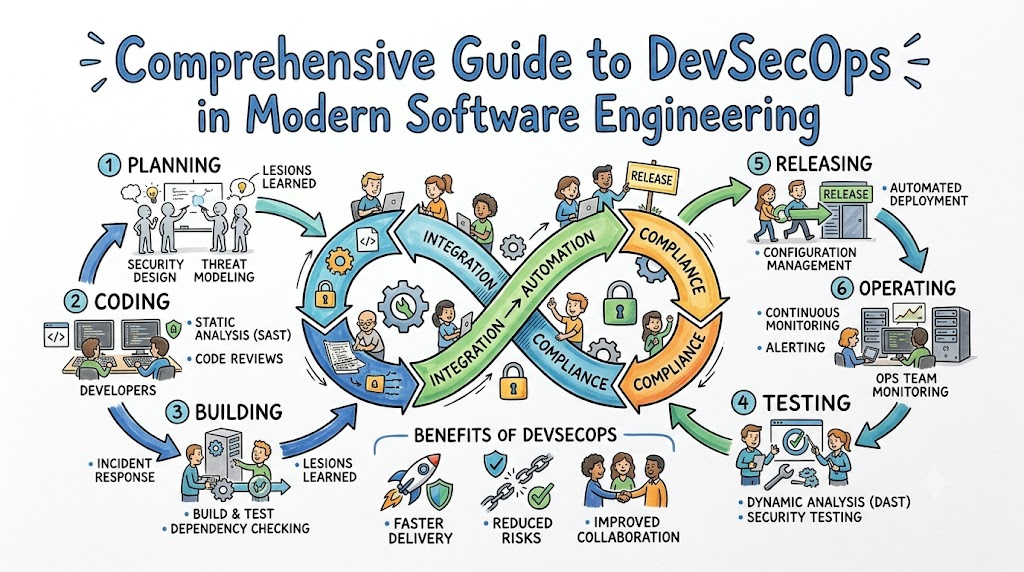
Introduction
The landscape of software engineering has shifted dramatically over the past decade. Engineering teams used to measure deployment frequencies in quarters and months. Today, cloud architectures, microservices, and automated pipelines allow organizations to push updates to production multiple times a day.
While this acceleration drives rapid business innovation, it simultaneously creates massive security challenges. The speed of code production has outpaced the capacity of traditional security review protocols. This mismatch frequently leaves modern distributed environments vulnerable to complex cyber threats.
Historically, security testing occurred at the very end of the software development lifecycle. Software engineers completed their builds, operations teams prepared the infrastructure, and security professionals ran isolated audits.
This siloed approach created severe bottlenecks. Vulnerabilities discovered right before a launch forced teams to choose between delaying releases or launching insecure software.
To bridge this gap, modern engineering organizations are moving away from reactive workflows. They are shifting toward integrated, automated systems where security is treated as a core feature of the product.
This structural shift requires a profound evolution in how teams build software. Professionals looking to master these technical strategies turn to platforms like DevOpsSchool to build real-world capabilities. Implementing DevSecOps in Modern Software Engineering ensures security is treated as a continuous, shared responsibility throughout the lifecycle.
What Is DevSecOps?
DevSecOps stands for Development, Security, and Operations. It is an engineering methodology that integrates security practices directly into every stage of the software delivery lifecycle. Rather than treating security as an external review gate, DevSecOps embeds automated compliance checks and vulnerability scanning directly into the engineering workflow.
To understand this concept clearly, consider a automotive manufacturing analogy. In a traditional manufacturing setup, an automobile is fully assembled before it undergoes safety and crash testing. If engineers discover a fundamental structural flaw in the chassis during the final inspection, fixing it requires dismantling the entire vehicle. This late-stage intervention incurs massive financial costs and causes significant production delays.
A DevSecOps approach mirrors a modern automated assembly line equipped with real-time sensors at every single station. The metallurgy of the frame is analyzed the moment it is cast. Laser systems check the weld points before the engine block is installed. The braking mechanics are simulated and validated while the electronic systems are wired.
By the time the vehicle reaches the end of the line, safety is already built directly into its core design. In software development, DevSecOps ensures that code is continuously analyzed, dependencies are verified, and infrastructure configurations are validated from the very first line written by a developer.
Why Traditional Security No Longer Works Well
Traditional software security systems rely heavily on perimeter defenses and point-in-time assessments. This approach was designed for an era when applications were hosted on static, on-premises physical servers with predictable network boundaries. Security teams could run a comprehensive vulnerability scan once every six months and reasonably protect the infrastructure.
Modern software engineering environments render this perimeter-based model obsolete. Applications now run inside dynamic, ephemeral containerized environments that scale up and down automatically across multi-cloud networks.
When code changes occur multiple times a day, a semi-annual penetration test only secures a snapshot of code that may become outdated within twenty-four hours.
Furthermore, traditional security models create deep cultural and operational friction. When a security audit happens at the end of a development cycle, the engineering team has already moved on to new feature branches. Re-learning old code to patch vulnerabilities discovered weeks prior creates significant cognitive drain.
This operational lag delays bug remediation, increases engineering costs, and creates adversarial relationships between development groups and security auditors.
Why DevSecOps Is Critical for Modern Software Engineering
The rapid adoption of distributed cloud architectures demands an integrated approach to application security. Security can no longer function as an external checkpoint. It must operate as an automated, continuous service woven into the fabric of deployment workflows.
| DevSecOps Area | Why It Matters |
| Shift-Left Security | Identifies and remediates software vulnerabilities during early design and coding phases to minimize development friction. |
| Faster Vulnerability Detection | Employs automated scanning mechanisms directly within code repositories to provide immediate feedback loops to engineers. |
| Secure CI/CD Pipelines | Validates artifacts, checks code dependencies, and ensures zero-trust controls before software reaches production environments. |
| Cloud-Native Application Security | Scans container configurations, tracks microservice interactions, and hardens underlying infrastructure layers dynamically. |
| Faster Incident Response | Connects application monitoring with automated alerting to isolate and remediate live security events rapidly. |
| Better Collaboration | Eliminates organizational silos by establishing unified, shared ownership of security metrics across Dev, Ops, and Sec teams. |
| Compliance and Governance | Implements automated policy enforcement to maintain continuous audit readiness for global data protection standards. |
Reason #1: Shift-Left Security
The principle of shift-left security centers on moving vulnerability detection to the absolute earliest stages of the software development lifecycle. In older development frameworks, security assessments were pushed far to the right, occurring just before production delivery or post-deployment. Shift-left security re-engineers this approach by running security evaluations directly on developer workstations and inside local feature branches.
Consider an engineering team building a financial transaction API. In a shift-left workflow, the developer installs local code analysis plugins directly into their Integrated Development Environment (IDE).
As the developer writes an SQL query, the IDE instantly flags potential SQL injection patterns before the code is even committed to git. This immediate feedback loop turns security into a proactive design habit rather than a reactive fix phase.
Reason #2: Faster Vulnerability Detection
Automating code analysis eliminates the human bottlenecks associated with legacy security reviews. The importance of DevSecOps is highly evident in how automated systems execute continuous checks without slowing down development velocities. By running automated engines against every single code commit, engineering teams maintain constant visibility over their risk posture.
[Developer Commit]
       │
       ▼
[Static Application Security Testing (SAST)] ──► Flags Hardcoded Secrets
       │
       ▼
[Software Composition Analysis (SCA)] ─────────► Flags Outdated Open-Source Libraries
       │
       ▼
[Container Image Scan] ────────────────────────► Flags Base OS Vulnerabilities
This multi-layered scanning workflow guarantees that bad code patterns or compromised dependencies are flagged within minutes. Engineers receive clear reports detailing exactly which line of code or software package introduced the risk, allowing them to fix bugs immediately.
Reason #3: Secure CI/CD Pipelines
A continuous integration and continuous deployment (CI/CD) pipeline acts as the automated engine for modern software delivery. If this pipeline lacks automated guardrails, it risks functioning as a highly efficient distribution system for insecure code. Building a secure CI/CD pipeline requires embedding rigorous, multi-stage automated validation gates into the build process.
For instance, when a build job triggers, the pipeline automatically checks for hardcoded API tokens, scans external software dependencies for known CVEs, and validates infrastructure configurations.
If any check violates pre-configured organizational risk tolerances, the pipeline automatically fails the build. This automated intervention stops flawed software from ever reaching staging or production infrastructure.
Reason #4: Cloud-Native Application Security
Modern systems are built using microservices, Docker containers, and Kubernetes clusters deployed across globally distributed cloud infrastructure. This architectural shift expands the potential attack surface. Security teams must protect more than just the application source code; they must secure the entire deployment artifact and execution environment.
Consider a microservice running inside a Linux container container. A secure cloud-native architecture requires regular scans of the container’s base image to detect outdated system libraries.
It also requires checking Kubernetes manifest files for misconfigured root privileges and verifying cloud IAM roles to prevent overly permissive access. DevSecOps handles these structural checks automatically, ensuring that cloud infrastructure configurations remain secure at scale.
Reason #5: Faster Incident Response
Security does not stop once software is successfully deployed to production. Continuous monitoring and observability form the operational baseline of effective DevSecOps practices. When live systems face real-world traffic, security tooling must actively track system behavior to detect anomalies and unauthorized activities.
For example, if a web application encounters a zero-day exploit attempt, runtime security tools flag the anomalous system calls or unusual outbound network traffic.
The observability system immediately sends structured alerts to the engineering on-call rotation through integration channels. Because the deployment history is fully tracked in the git history, engineers can quickly roll back to the last known secure build state or apply a hotfix pipeline within minutes.
Reason #6: Better Collaboration
Traditional development structures often breed systemic friction. Developers are measured on how fast they ship features, operations teams are measured on system stability, and security teams are tasked with minimizing organizational risk. These competing priorities frequently lead to internal conflict and finger-pointing when security incidents occur.
DevSecOps reorganizes these team dynamics by introducing a culture of shared responsibility. Security engineers stop acting as external gatekeepers who simply hand down lists of issues. Instead, they pivot to building automated tooling, internal plugins, and reliable CI/CD security templates that empower developers.
This collaborative shift aligns all three teams around a shared goal: shipping highly reliable, resilient software fast.
Reason #7: Compliance and Governance
Modern software systems must adhere to strict international regulatory compliance frameworks, such as SOC 2, ISO 27001, GDPR, and HIPAA. Historically, proving compliance required manual compilation of logs, configurations, and change tickets right before an external audit. This manual documentation process was error-prone and highly labor-intensive.
DevSecOps addresses this challenge through Policy as Code (PaC). Compliance rules are written as declarative code files and verified automatically within the deployment pipeline.
If an infrastructure template attempts to spin up a public, unencrypted storage bucket, the pipeline blocks the deployment based on compliance code violations. This automated process generates a clear, tamper-proof audit trail for every deployment, ensuring continuous compliance.
Real-World Example: Team Without DevSecOps
To understand the practical impact of these workflows, let us analyze a mid-sized enterprise software company operating without integrated security practices. The team uses an agile development methodology, shipping code updates to a staging environment every two weeks.
[2 Weeks of Feature Dev] ──► [Code Freeze] ──► [Manual Security Review] ──► [Critical Bugs Found] ──► [Release Delayed 3 Weeks]
The Broken Security Workflow
- Developers work for fourteen days on a high-priority customer portal feature.
- On day fifteen, the code enters a strict code freeze, and a third-party vendor runs an automated penetration scan against the staging environment.
- Three days later, the report arrives showing thirty critical vulnerabilities, including severe cross-site scripting (XSS) errors and outdated open-source cryptography packages.
The Operational Impact
- The scheduled production launch is abruptly canceled, causing friction with product stakeholders and customers.
- Developers must stop working on their current feature sprints to dig back into code written weeks ago.
- Patching the outdated open-source packages breaks several downstream system components, forcing engineers to spend an additional week rewriting core modules.
- The company incurs unexpected consulting expenses, engineering velocity drops, and team morale suffers due to high-stress emergency patching cycles.
Real-World Example: Team Using DevSecOps
Now let us look at the same mid-sized enterprise software company after re-architecting their engineering processes around modern DevSecOps frameworks.
[Code Commit] ──► [Auto SAST/SCA Scan] ──► [Auto Container Scan] ──► [Green Build] ──► [Automated Production Release]
The Optimized Security Workflow
- A developer writes code for the customer portal feature on their local system.
- The moment they push their code changes to the central repository, the automated CI/CD pipeline triggers an execution block.
- Within three minutes, an automated Software Composition Analysis (SCA) tool detects that a freshly imported logging package contains a known high-severity vulnerability.
- The pipeline immediately halts the build job and leaves a structured comment directly inside the developer’s pull request, pointing to the exact line of code and recommending a secure, updated version of the package.
The Engineering Benefits
- The developer updates the package version immediately on their local branch and repushes the code.
- The pipeline checks pass completely, the container image is built securely, and the feature deploys automatically to production on schedule.
- Security risks are identified and resolved within minutes without delaying the release or requiring emergency meetings.
Benefits of DevSecOps in Software Engineering
Transitioning to an integrated security engineering model delivers measurable operational advantages across the entire organization. These DevSecOps benefits extend far beyond simple risk mitigation, directly improving software quality and delivery efficiency.
- Enhanced Threat Mitigation Posture: Continuous scanning ensures vulnerabilities are closed long before they can be discovered and exploited by external malicious actors.
- Accelerated Time-to-Market: Automated security guardrails eliminate manual review phases, allowing teams to maintain high-velocity deployment pipelines safely.
- Significant Engineering Cost Reductions: Finding and fixing a software flaw during initial development is significantly less expensive than attempting to patch a live, breached production environment.
- Minimized Human Error: Automating security checks ensures that compliance rules, access configurations, and vulnerability tracking are applied consistently to every single build.
- Improved System Resilience: End-to-end telemetry and modern monitoring loops give operations teams deep visibility into system health, minimizing the impact of production incidents.
Challenges of DevSecOps Adoption
While the structural benefits of DevSecOps are clear, shifting an enterprise engineering organization toward this model requires overcoming real operational hurdles. Organizations must approach these challenges with a clear, realistic implementation strategy.
Specialized Skill Shortages
There is a significant shortage of engineering professionals who possess deep expertise in both software development and cloud security operations. Traditional security analysts often lack the programming background required to design automated CI/CD pipelines.
At the same time, traditional software developers may not understand advanced network threat vectors or cloud isolation models. Bridging this skills gap requires continuous organizational investment in structured engineering education programs.
Tool Overload and Alert Fatigue
When engineering teams rush to adopt security automation, they often configure multiple scanning tools all at once without fine-tuning the alerting rules. This approach frequently generates thousands of daily notifications, many of which turn out to be low-priority issues or false positives.
When developers are flooded with irrelevant alerts, they develop alert fatigue and begin ignoring build warnings. Teams must carefully calibrate their security tools to ensure notifications are highly accurate and actionable.
Cultural and Institutional Resistance
The largest obstacle to successful DevSecOps adoption is cultural rather than technical. Developers often view security checks as arbitrary rules that slow down feature shipping.
Concurrently, traditional security teams may worry that automation will reduce their control over code quality. Overcoming this cultural inertia requires clear alignment from engineering leadership, along with an organizational commitment to shared ownership of product safety metrics.
Common DevSecOps Mistakes Teams Make
Many engineering groups encounter predictable mistakes during their initial transition to automated security models. Reviewing this checklist helps organizations avoid common implementation traps.
- Treating Security as an Isolated Function: Simply purchasing advanced security tools and assigning them to a separate team fails to create an authentic DevSecOps culture. True success requires embedding security tooling directly into the daily developer workflow.
- Deploying Excessive Tooling Too Fast: Enabling SAST, DAST, container scanning, and cloud compliance metrics all in the same week overwhelms engineering workflows. This aggressive rollout bogs down build speeds and frustrates development teams.
- Neglecting Runtime Observability and Monitoring: Focusing security automation entirely on pre-production build pipelines leaves the runtime environment vulnerable. Teams must deploy equal protection to active production workloads using live telemetry and anomaly detection.
- Overlooking Continuous Developer Training: Forcing engineers to use complex security compliance tools without providing structured foundational training leads to friction and misconfigured setups. Developers must understand why a security check matters and how to fix it independently.
Best Practices for Implementing DevSecOps
Successfully embedding security into modern engineering workflows requires a systematic, iterative implementation plan. Teams can use this actionable checklist to guide their transition smoothly.
- [ ] Automate Security Evaluations: Integrate lightweight Static Application Security Testing (SAST) and Software Composition Analysis (SCA) engines directly into central code repositories.
- [ ] Enforce Pre-Commit and Pre-Push Guardrails: Provide developers with local linting engines and pre-commit hooks to catch secrets and syntax issues before code is committed to version control.
- [ ] Break Down Large Scans into Modular Gates: Run rapid, lightweight scans during daily feature branch commits. Save deep, time-intensive dynamic analyses for nightly or staging pipeline builds to preserve development velocity.
- [ ] Adopt Policy as Code (PaC) Standards: Define cloud access permissions, network boundaries, and compliance rules using declarative code configurations that undergo automated validation checks.
- [ ] Cultivate Security Champions: Appoint and train a dedicated developer within each feature team to act as the primary security point-of-contact and advocate for secure coding practices.
- [ ] Establish Iterative, Small-Scale Pilots: Begin by automating security checks on a single, non-critical microservice pipeline. Refine the alerting thresholds and workflows based on developer feedback before scaling the framework across the enterprise.
Role of DevOpsSchool in Learning DevSecOps
Building a secure, scalable software system requires engineers who understand how code, cloud infrastructure, and security automation intersect. Organizations cannot transform their cultures without updating their baseline technical capabilities.
Educational institutions like DevOpsSchool play a key role here by providing practical, structured learning pathways designed for modern technology landscapes.
Their educational ecosystem focuses heavily on real-world application, steering clear of purely theoretical instruction. Engineers learn how to configure automated security gates within active CI/CD pipelines, execute automated container scans, and manage cloud access controls using infrastructure as code.
By teaching security as a core software engineering skill, they help developers, cloud architects, and IT operations professionals build the practical capabilities needed to run modern DevSecOps environments.
Career Importance of DevSecOps Skills
The systemic shift toward automated software delivery has fundamentally changed the technology job market. Companies across the globe are prioritizing hiring engineering talent that understands how to ship secure code from day one.
                  [DevSecOps Core Capability]
                               │
       ┌───────────────────────┼───────────────────────┐
       ▼                       ▼                       ▼
[DevSecOps Engineer]   [Cloud Security Architect]   [SRE / DevOps Leader]
DevSecOps Engineer
These specialists focus on building, maintaining, and scaling the automation infrastructure that secures the development lifecycle. They bridge the gap between development and security teams by writing custom pipeline extensions, maintaining scanning engines, and defining Policy as Code standards.
Security Engineer
Modern security engineers are moving away from manual compliance auditing and shifting toward engineering-driven workflows. They need a strong grasp of software engineering principles to build automated threat-modeling platforms, evaluate source code patterns, and collaborate effectively with development sprints.
Cloud Security Engineer
These experts specialize in securing ephemeral, distributed cloud environments. They focus on microservices protection, Kubernetes cluster hardening, IAM roles, and ensuring that containerized workloads remain isolated and resilient against runtime attacks.
SRE and DevOps Engineer
Site Reliability Engineers and DevOps specialists are increasingly expected to treat security as a fundamental pillar of system reliability. A modern operational platform cannot be considered reliable if it is vulnerable to service disruptions or data breaches due to easily preventable configuration errors.
Industries Where DevSecOps Is Critical
While secure software practices benefit every technology company, certain highly regulated sectors find integrated security automation absolutely essential to their business survival.
Banking and Finance
Financial institutions handle highly sensitive transactional metadata and personal information under strict global regulations. A single security breach can result in severe regulatory fines, legal liabilities, and permanent loss of consumer trust.
Implementing automated security pipelines ensures that financial platforms can launch digital features quickly while maintaining continuous compliance with strict data protection standards.
Healthcare Technologies
Modern healthcare platforms rely on cloud environments to process protected health information. Ensuring application security is critical for preventing data leakage and protecting patient safety.
DevSecOps frameworks automate the validation of data encryption protocols, access logs, and network isolation boundaries across every deployment.
SaaS Platforms
Software-as-a-Service organizations operate under constant pressure to deliver new feature iterations to stay competitive. Because SaaS products are exposed directly to the public web and host data for thousands of corporate tenants, multi-layer security validation is non-negotiable.
Automated security gates allow SaaS engineering groups to ship rapid feature updates multiple times a day without introducing regression vulnerabilities.
[Traditional Lifecycle] ──► Isolated Silos ──► Late Stage Failures ──► High Risk

[DevSecOps Lifecycle]   ──► Continuous Loops ──► Real-Time Feedback ──► Resilient Software
Future of DevSecOps in Software Engineering
As software systems grow more complex, the methods we use to secure them must evolve in tandem. The future of software engineering will see security deeply woven into every layer of the delivery framework, powered by automated systems.
Policy as Code Ubiquity
The manual configuration of cloud security rules will continue to disappear. In modern development shops, all compliance protocols, network access rules, and infrastructure boundaries are defined as declarative code files. These configurations are managed through standard version control and verified automatically by deployment engines before any resource is provisioned in the cloud.
Advanced Observability and Adaptive Runtime Protection
Pre-production scanning pipelines will increasingly connect with live production monitoring systems. Future runtimes will feature adaptive security layers that continuously analyze application behavior.
If an active microservice exhibits anomalous behavior, the runtime environment can isolate the container automatically and trigger a secure, automated rolling patch pipeline.
Automated Compliance Auditing
The era of compiling spreadsheets and logs right before an external compliance audit is coming to an end. Automated governance systems track every single code change, pipeline execution, and container scan in real-time. This continuous tracking generates a reliable, permanent audit record, allowing engineering organizations to demonstrate compliance instantly at any given moment.
FAQs
What is the core difference between DevOps and DevSecOps?
DevOps focus primarily on breaking down operational silos to increase software delivery velocity and system stability. DevSecOps builds directly on top of this model by integrating automated security validation gates into every single phase of that high-velocity pipeline, making security a shared team responsibility.
Does implementing DevSecOps slow down the software development lifecycle?
When implemented correctly, it actually accelerates long-term software delivery velocity. While adding automated scans introduces a few minutes to initial build jobs, it prevents major late-stage security flaws that can stall production releases for weeks at a time.
What is the meaning of shifting left in software engineering?
Shifting left refers to moving security testing, code analysis, and compliance checks to the earliest possible phases of the software development lifecycle—such as initial application design and local feature branch creation.
What is Software Composition Analysis (SCA)?
SCA is an automated scanning method that analyzes an application’s open-source dependencies and third-party libraries. It flags known security vulnerabilities, outdated packages, and potential software licensing non-compliance issues.
What is Static Application Security Testing (SAST)?
SAST is a code analysis method that evaluates an application’s source files while the code is at rest, before compilation. It scans the source code to find insecure programming patterns, hardcoded secrets, and syntax vulnerabilities.
What is Dynamic Application Security Testing (DAST)?
DAST is a security evaluation method that analyzes a running application from the outside, mimicking how an external attacker would interact with it. It tests active network interfaces, API endpoints, and live state behaviors to uncover runtime flaws.
Can beginners transition directly into learning DevSecOps?
Yes, beginners can certainly learn these methodologies. However, they should first build a solid foundation in core DevOps concepts, basic scripting, version control systems, and fundamental cloud computing architectures.
What are some common open-source tools used in DevSecOps pipelines?
Common open-source tools include SonarQube for static application security testing, Trivy and Grype for container image scanning, OWASP ZAP for dynamic application testing, and Checkov for infrastructure as code linting.
How does Policy as Code help engineering teams?
Policy as Code translates security and compliance rules into clear, declarative code files. This allows teams to automate rule enforcement within CI/CD pipelines, preventing misconfigured or non-compliant infrastructure setups from being deployed.
Who is responsible for security in a DevSecOps model?
Security becomes a shared responsibility across the entire technical organization. Developers own secure coding practices, operations teams maintain secure environments, and security professionals provide the automated tools and compliance templates that empower everyone else.
Is DevSecOps only valuable for large technology enterprises?
No. Startups and mid-sized businesses benefit significantly from these practices. Automating security early on helps smaller engineering groups protect their limited resources and build secure, scalable software foundations without needing large, manual auditing teams.
How do you handle alert fatigue within development teams?
Teams should start by enabling only the most critical security rules, ensuring that every alert requires direct action. You can gradually turn on additional scanning rules as the team resolves baseline issues and fine-tunes tool thresholds.
What role does container scanning play in modern application security?
Container scanning automatically checks base operating system images and package layers for known vulnerabilities. This ensures that containerized applications are built on safe foundations before deployment to staging or production environments.
How often should automated security scans run?
Lightweight scans like SAST and dependency checks should run on every code push or pull request. More intensive scans, such as full DAST runs or deep compliance audits, can be scheduled nightly or executed within staging deployment tracks.
How can professionals build practical DevSecOps skills?
Engineers can build these capabilities by working on hands-on deployment projects, automating local pipelines, studying cloud security architectures, and taking structured training courses through platforms like DevOpsSchool.
Final Thoughts
The rapid evolution of cloud-native systems has made it clear that traditional, late-stage security models can no longer protect modern applications. Treating security as an afterthought creates severe deployment bottlenecks, increases engineering costs, and introduces unnecessary operational risks.
Adopting DevSecOps in Modern Software Engineering provides an effective path forward. It shifts security away from manual, reactive reviews and turns it into a continuous, automated service woven into the entire lifecycle.
Building a successful DevSecOps practice is not about deploying as many security tools as possible. It requires a fundamental shift in engineering culture, where development, operations, and security teams share ownership of system safety.
By automating vulnerability checks early, enforcing policies as code, and maintaining clear runtime visibility, organizations can ship innovative features quickly without compromising their security posture.