Limited Time Offer!
For Less Than the Cost of a Starbucks Coffee, Access All DevOpsSchool Videos on YouTube Unlimitedly.
Master DevOps, SRE, DevSecOps Skills!
Introduction
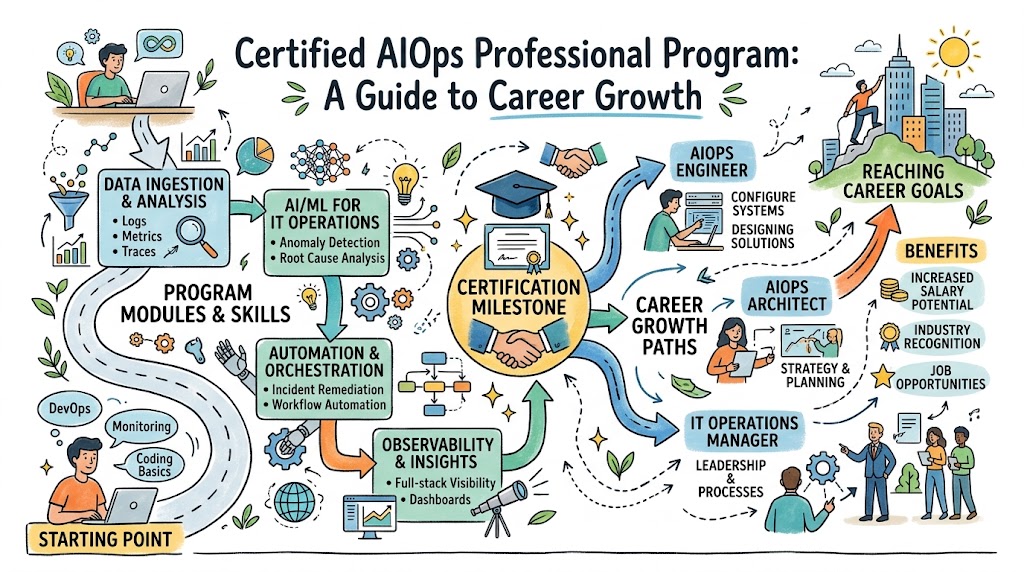
In the modern IT world, managing complex systems requires more than just manual effort. The Certified AIOps Professional program is designed to help engineers use artificial intelligence and machine learning to improve IT operations. This guide is built for software engineers, SREs, and IT managers who want to understand how to move from traditional monitoring to proactive, AI-driven management. AIOps School provides this roadmap to help you stay ahead in a competitive market.
As systems grow in size and complexity, the number of alerts and logs becomes impossible for humans to handle alone. This guide helps you decide if this certification is the right step for your career path and how it fits into the broader ecosystem of DevOps and platform engineering. By following this structured path, professionals can make better decisions about their learning investments and career trajectory.
What is the Certified AIOps Professional?
The Certified AIOps Professional is a designation that proves an engineer can apply AI and machine learning techniques to automate and improve IT operations. It represents a shift from reactive troubleshooting to a proactive approach where data tells the story of system health before a failure occurs. This certification exists because modern enterprise environments generate too much telemetry data for standard tools to process effectively.
Instead of focusing only on theoretical concepts, this program emphasizes real-world, production-focused learning. It aligns with modern engineering workflows by teaching professionals how to integrate AI models into existing CI/CD pipelines and monitoring stacks. For enterprises, having a certified professional means they can reduce mean time to resolution (MTTR) and improve system availability through intelligent automation.
Who Should Pursue Certified AIOps Professional?
This certification is highly beneficial for Site Reliability Engineers (SREs) and DevOps professionals who are tired of manual alert handling. Cloud architects and platform engineers who manage large-scale infrastructure will find the techniques taught here essential for maintaining performance at scale. Security and data professionals can also benefit by understanding how anomaly detection can identify threats or data inconsistencies in real-time.
Beginners in the field can use this as a foundational pillar to enter the high-growth area of intelligent automation. Experienced engineers and managers can use it to validate their strategic understanding of how AI transforms operational costs. In both the Indian market and the global tech industry, there is a massive demand for professionals who can bridge the gap between data science and system operations.
Why Certified AIOps Professional is Valuable and Beyond
The demand for AIOps skills is growing because traditional monitoring is no longer enough for cloud-native architectures. Enterprise adoption of AI in operations is increasing as companies seek to reduce operational expenses while increasing uptime. This certification provides longevity because it teaches the underlying principles of data-driven operations rather than just specific, fleeting tools.
By earning this credential, professionals stay relevant even as specific cloud providers or monitoring tools change over time. The return on time and career investment is high, as companies are willing to pay a premium for engineers who can implement predictive maintenance and automated root cause analysis. It positions you as a forward-thinking leader who understands the future of autonomous infrastructure management.
Certified AIOps Professional Certification Overview
The program is delivered via the official portal at Certified AIOps Professional and is hosted on the AIOps School website. The certification process involves different levels of assessment, moving from fundamental knowledge to practical, hands-on implementation. The structure is designed to be practical, ensuring that candidates can actually perform the tasks required in a production environment.
Ownership of the certification lies with the industry-recognized body that maintains the curriculum according to current market trends. The assessment approach typically includes both multiple-choice questions to test theoretical knowledge and lab-based tasks to test technical skills. This ensures that a certified professional is ready to handle real-world challenges immediately upon completion of the course.
Certified AIOps Professional Certification Tracks & Levels
The certification is divided into foundation, professional, and advanced levels to cater to different stages of a professional’s career. The foundation level focuses on understanding the core concepts of machine learning in the context of IT operations and telemetry data. The professional level dives deeper into building automation scripts and integrating AI models with existing monitoring tools like Prometheus or ELK.
The advanced level is designed for architects and leads who need to design entire AIOps strategies for large organizations. Specialization tracks allow professionals to align their AIOps knowledge with other domains like SRE, FinOps, or DevSecOps. This modular approach ensures that your learning path is directly relevant to your daily job responsibilities and long-term career goals.
Complete Certified AIOps Professional Certification Table
| Track | Level | Who it’s for | Prerequisites | Skills Covered | Recommended Order |
| Operations | Foundation | Junior Engineers | Basic Linux/Cloud | Monitoring, ML Basics | 1st |
| Engineering | Professional | SREs, DevOps | Foundation Level | Automation, Data Ops | 2nd |
| Architecture | Advanced | Tech Leads, Managers | Professional Level | Strategy, Scaling AI | 3rd |
| Security | Specialist | Security Engineers | Basic Security | Anomaly Detection | Optional |
| Financial | Specialist | FinOps Leads | Basic Cloud Billing | Predictive Costing | Optional |
Detailed Guide for Each Certified AIOps Professional Certification
Certified AIOps Professional – Foundation
What it is
This certification validates a candidate’s basic understanding of how artificial intelligence can be applied to standard IT operations. It ensures you know the difference between traditional monitoring and AI-based observability.
Who should take it
This is suitable for junior systems administrators, fresh graduates, or manual QA engineers looking to move into automated operations. It requires no prior AI experience.
Skills you’ll gain
- Understanding telemetry data (logs, metrics, traces)
- Basics of machine learning algorithms for operations
- Identifying noise in alerting systems
- Core concepts of incident management automation
Real-world projects you should be able to do
- Configure a basic dashboard that uses trend analysis
- Categorize different types of system logs for ML processing
- Identify and reduce redundant alerts in a staging environment
Preparation plan
- 7-14 Days: Focus on terminology and the core pillars of AIOps through official documentation.
- 30 Days: Practice with small datasets and understand basic visualization tools.
- 60 Days: Complete all practice exams and review real-world case studies of AI implementation.
Common mistakes
- Focusing too much on complex math instead of operational logic.
- Ignoring the importance of clean data before applying AI models.
Best next certification after this
- Same-track option: Certified AIOps Professional – Professional
- Cross-track option: Cloud Practitioner
- Leadership option: ITIL Foundation
Certified AIOps Professional – Professional
What it is
The Professional level validates the ability to implement and manage AIOps tools in a live production environment. It focuses on technical execution and integration of AI models into the DevOps lifecycle.
Who should take it
This is meant for mid-level SREs, DevOps engineers, and Platform engineers with at least 2 years of experience. You should be comfortable with scripting and cloud infrastructure.
Skills you’ll gain
- Developing Python scripts for data extraction
- Implementing automated root cause analysis (RCA)
- Integrating AIOps tools with CI/CD pipelines
- Managing predictive scaling in cloud environments
Real-world projects you should be able to do
- Build a script that triggers an auto-scaling event based on predictive traffic patterns.
- Set up an automated remediation workflow that fixes common disk space issues.
- Create a correlation engine that links different alerts to a single incident.
Preparation plan
- 7-14 Days: Review Python scripting and API integration basics.
- 30 Days: Work on lab environments to set up data pipelines from scratch.
- 60 Days: Focus on performance tuning of AI models and advanced troubleshooting.
Common mistakes
- Over-automating processes without proper manual fallback mechanisms.
- Failing to monitor the performance of the AI models themselves.
Best next certification after this
- Same-track option: Certified AIOps Professional – Advanced
- Cross-track option: CKA (Certified Kubernetes Administrator)
- Leadership option: Project Management Professional (PMP)
Certified AIOps Professional – Advanced
What it is
This advanced credential validates the expertise needed to design and lead an organizational shift toward autonomous operations. It covers governance, scaling, and high-level architecture.
Who should take it
Senior architects, Engineering Managers, and CTOs should pursue this level. It is for those who decide which tools to buy and how to structure engineering teams.
Skills you’ll gain
- Designing multi-cloud AIOps architectures
- Establishing data governance for operational AI
- Calculating ROI for AIOps initiatives
- Leading cultural change in engineering organizations
Real-world projects you should be able to do
- Design a 3-year roadmap for moving a company to “NoOps” or autonomous operations.
- Evaluate and select an enterprise-grade AIOps platform for a global firm.
- Create a governance framework for the ethical use of AI in infrastructure.
Preparation plan
- 7-14 Days: Study enterprise architecture frameworks and AIOps market reports.
- 30 Days: Analyze financial models for IT cost reduction and efficiency gains.
- 60 Days: Develop a comprehensive strategy document and practice defending it.
Common mistakes
- Ignoring the “people” aspect of the transition to AI-driven operations.
- Looking for a “silver bullet” tool rather than a strategic process change.
Best next certification after this
- Same-track option: Expert Level Specialist
- Cross-track option: Certified Information Systems Security Professional (CISSP)
- Leadership option: MBA in Technology Management
Choose Your Learning Path
DevOps Path
The DevOps path focuses on integrating AI into the software development lifecycle to improve speed and quality. Engineers on this path will learn how to use AI to predict build failures and optimize deployment frequencies. The goal is to move from manual CI/CD management to a self-healing pipeline where the system learns from previous deployment errors. It is a great choice for those who want to focus on the intersection of code and infrastructure.
DevSecOps Path
In this path, the focus is on using AIOps to enhance security posture and automate threat response. You will learn how to use anomaly detection to find unauthorized access patterns that traditional rules might miss. This path is essential for organizations that handle sensitive data and need to respond to security incidents in seconds. It bridges the gap between infrastructure automation and proactive security monitoring.
SRE Path
The SRE path is perhaps the most natural fit for AIOps, focusing on reliability and uptime through intelligent data analysis. Engineers learn how to automate the “toil” of manual incident response by using machine learning for pattern recognition. This path teaches you how to manage Service Level Objectives (SLOs) using predictive analytics to warn you before a breach occurs. It is ideal for those managing large-scale, high-traffic production environments.
AIOps Path
This dedicated path dives deep into the core mechanics of artificial intelligence specifically for IT systems. You will learn about various data models, neural networks, and how they apply to time-series data found in logs and metrics. This is for the specialist who wants to be the primary expert in the company’s AIOps platform. It focuses on the technical nuances of fine-tuning AI models for maximum operational accuracy.
MLOps Path
The MLOps path is for those who want to bridge the gap between data science teams and operations teams. It focuses on the lifecycle of machine learning models, ensuring they are deployed, monitored, and retrained efficiently. You will learn how to build pipelines that treat ML models with the same rigor as traditional software code. This is a critical role as more enterprises begin to bake AI into their core product offerings.
DataOps Path
DataOps focuses on the quality and flow of data that feeds into AI and operational systems. This path teaches you how to ensure that the telemetry data being used for AIOps is accurate, timely, and properly structured. Without good data, AI models fail, making this path vital for the success of any AIOps strategy. It is perfect for professionals who enjoy working with big data technologies and data engineering pipelines.
FinOps Path
The FinOps path uses AIOps to solve the complex problem of cloud cost management and optimization. By using predictive analytics, you can forecast future cloud spend and identify waste before it becomes a financial burden. This path is highly valued by management as it directly impacts the company’s bottom line. It combines technical cloud knowledge with financial accountability and automated cost-control measures.
Role → Recommended Certified AIOps Professional Certifications
| Role | Recommended Certifications |
| DevOps Engineer | Foundation, Professional |
| SRE | Professional, Advanced |
| Platform Engineer | Professional, Advanced |
| Cloud Engineer | Foundation, Professional |
| Security Engineer | Foundation, Security Specialist |
| Data Engineer | Professional, DataOps Specialist |
| FinOps Practitioner | Foundation, FinOps Specialist |
| Engineering Manager | Foundation, Advanced |
Next Certifications to Take After Certified AIOps Professional
Same Track Progression
Once you complete the initial levels, you should look for expert-level workshops or niche specializations in AIOps. Deepening your knowledge in specific areas like deep learning for systems or autonomous remediation can set you apart. This progression ensures you remain the go-to expert for any AI-related infrastructure challenges within your organization.
Cross-Track Expansion
Broadening your skills is essential for a well-rounded career in modern IT. Consider certifications in Kubernetes (CKA/CKAD) or specific cloud provider professional certs (AWS/Azure/GCP). Understanding the underlying infrastructure at a deep level makes your AIOps implementations much more effective. It allows you to see the “why” behind the data patterns your AI models are identifying.
Leadership & Management Track
If you wish to move into management, certifications like ITIL or PMP can complement your technical AIOps background. AIOps involves a lot of process change, and having the skills to lead teams through these transitions is highly valuable. This track prepares you for roles like Director of Infrastructure or VP of Engineering, where you oversee broad technical strategies.
Training & Certification Support Providers for Certified AIOps Professional
DevOpsSchool
DevOpsSchool is a leading provider of technical training that focuses on the entire DevOps ecosystem, including the latest AIOps methodologies. They offer comprehensive courses that are designed by industry experts with years of experience in the field. The curriculum is updated regularly to ensure it reflects the latest trends and toolsets used by top tech companies. Students benefit from hands-on labs and real-world projects that prepare them for the challenges of a modern production environment. Their support system is robust, providing guidance throughout the learning journey and helping professionals achieve their certification goals with confidence and practical skill.
Cotocus
Cotocus provides specialized consulting and training services that help organizations and individuals master the complexities of cloud-native technologies and AIOps. Their approach is highly practical, focusing on the actual implementation of tools and strategies rather than just theoretical knowledge. They work closely with enterprise clients to understand their unique challenges and tailor their training programs accordingly. This real-world perspective is invaluable for students who want to understand how AIOps fits into a larger corporate strategy. Cotocus is known for its high-quality instructors and its commitment to helping students achieve long-term career success through continuous learning and support.
Scmgalaxy
Scmgalaxy is a well-known community and training platform that has been supporting IT professionals for over a decade. They offer a wide range of resources, including tutorials, forums, and structured courses on AIOps and related technologies. Their focus is on building a strong foundation of knowledge and providing a platform for professionals to share their experiences and learn from one another. The training programs are designed to be accessible and easy to follow, making them ideal for both beginners and experienced engineers. Scmgalaxy remains a trusted source for staying updated on the latest developments in the world of software configuration management and operations.
BestDevOps
BestDevOps focuses on providing top-tier training for engineers who want to excel in the competitive world of DevOps and AIOps. Their courses are designed to be intensive and results-oriented, ensuring that students gain the skills they need to land high-paying roles. They place a strong emphasis on automation and the use of AI to solve complex operational problems. The instructors at BestDevOps are active practitioners who bring their daily experiences into the classroom, providing students with unique insights that cannot be found in textbooks. Their commitment to excellence has made them a preferred choice for many aspiring AIOps professionals.
devsecopsschool.com
devsecopsschool.com is the go-to destination for professionals who want to specialize in the intersection of security and operations. Their AIOps training includes specific modules on how artificial intelligence can be used to identify and mitigate security risks in real-time. The curriculum covers everything from automated compliance checking to advanced anomaly detection. By focusing on the security aspects of AIOps, they provide a unique perspective that is highly relevant in today’s threat-filled digital world. Their courses are designed to be practical and hands-on, ensuring that students can immediately apply what they learn to secure their own organizations’ infrastructure.
sreschool.com
sreschool.com is dedicated to the principles of Site Reliability Engineering and how AIOps can be used to achieve maximum system reliability. Their training programs are built around the core SRE concepts of SLOs, SLIs, and error budgets, showing how AI can help manage these metrics more effectively. Students learn how to build self-healing systems and automate the response to common production incidents. The school provides a supportive learning environment with access to expert mentors and a community of like-minded professionals. For anyone looking to advance their career as an SRE, this school offers the specialized knowledge needed to succeed with AIOps.
aiopsschool.com
aiopsschool.com is the primary authority and official hosting site for the Certified AIOps Professional program. They offer the most comprehensive and direct training for this specific certification, ensuring that students have all the resources they need to pass the exam. Their platform features interactive labs, detailed video tutorials, and extensive documentation that covers every aspect of the AIOps lifecycle. Because they own the certification program, their curriculum is always perfectly aligned with the latest exam requirements. It is the ideal starting point for anyone serious about becoming a recognized expert in the field of artificial intelligence for IT operations.
dataopsschool.com
dataopsschool.com focuses on the critical data layer that powers all AIOps initiatives. They teach professionals how to manage the flow of telemetry data, ensuring that it is clean, reliable, and properly formatted for AI models. Their courses cover a wide range of data engineering topics, including data pipelines, storage solutions, and real-time processing frameworks. By mastering DataOps, students ensure that their AIOps implementations are built on a solid foundation of high-quality data. This school is essential for those who want to understand the “behind the scenes” work that makes intelligent automation possible in a modern enterprise environment.
finopsschool.com
finopsschool.com addresses the financial side of cloud operations, teaching students how to use AIOps to optimize cloud spending. Their curriculum focuses on the intersection of cloud architecture and financial management, showing how AI can predict costs and identify savings opportunities. Students learn how to implement automated cost-control measures and build reports that provide clear visibility into cloud expenses. This training is highly valued by businesses looking to reduce their operational costs without sacrificing performance. Finopsschool.com provides the specialized tools and knowledge needed to become a leader in the growing field of cloud financial management and optimization.
Frequently Asked Questions (General)
- How hard is the Certified AIOps Professional exam?
The exam is moderately difficult as it requires a mix of theoretical knowledge and practical scripting skills. If you have a background in Linux and basic automation, you will find it manageable with proper study. - How much time do I need to prepare for the certification?
Most professionals find that 30 to 60 days of consistent study is enough to feel confident. This includes watching the training videos and completing the hands-on lab exercises. - Are there any prerequisites for taking this course?
There are no formal prerequisites for the foundation level, but a basic understanding of cloud computing and command-line interfaces is highly recommended. - What is the return on investment (ROI) for this certification?
The ROI is significant, as AIOps professionals often command higher salaries and have access to more senior roles in SRE and Platform Engineering. - In what order should I take the certification levels?
It is strictly recommended to follow the order from Foundation to Professional, and finally to Advanced, to build a solid knowledge base. - Can I take the exam online?
Yes, the certification is designed to be accessible globally through the official portal, allowing you to take the exam from your home or office. - How long is the certification valid?
The certification is typically valid for two to three years, after which you may need to recertify or move to a higher level to stay current. - Does this certification cover specific tools like Moogsoft or Splunk?
The program focuses on the principles and logic of AIOps, which can be applied to any tool, though some specific industry-standard tools are used in labs. - Is Python knowledge required for this certification?
While not strictly required for the foundation level, basic Python or shell scripting is very helpful for the professional level. - Does this certification help in getting a job in India?
Yes, many Indian tech hubs like Bangalore, Hyderabad, and Pune have a high demand for engineers who can manage AI-driven infrastructure. - Will this certification help me move into a management role?
Yes, the Advanced level specifically focuses on strategy and ROI, which are key skills for engineering leadership and management positions. - Is there a community or forum for students?
Yes, providers like AIOps School and Scmgalaxy offer forums where you can interact with other students and industry experts.
FAQs on Certified AIOps Professional
- How does Certified AIOps Professional differ from a standard DevOps cert?
Standard DevOps certs focus on the CI/CD pipeline and tool integration, while this certification focuses specifically on using AI to analyze data and automate operational responses. - What kind of data will I learn to analyze?
You will work with “MELT” data, which stands for Metrics, Events, Logs, and Traces, the four pillars of modern system observability. - Can I use these skills on any cloud platform?
Yes, the techniques taught are platform-agnostic and can be used on AWS, Azure, Google Cloud, or even on-premise private clouds. - What is the most important skill I will learn?
The most important skill is learning how to reduce “alert fatigue” by using AI to correlate different events into a single, actionable incident. - Does the program include hands-on labs?
Yes, the professional and advanced levels include practical lab environments where you can test your skills on real datasets and simulated infrastructure. - Is this certification recognized by major tech companies?
Yes, AIOps is a top priority for enterprise organizations, and this certification proves you have the skills they are actively looking for. - How does this certification help with SRE practices?
It helps SREs manage their error budgets more effectively by providing predictive warnings before a system failure impacts the user experience. - What is the cost of the certification?
Pricing can vary based on regional discounts and training bundles; it is best to check the official AIOps School website for current rates.
Final Thoughts: Is Certified AIOps Professional Worth It?
If you are looking to advance your career in IT operations, the answer is a clear yes. The industry is moving away from manual, reactive work and toward intelligent, autonomous systems. Being one of the first in your organization to master these skills will make you an invaluable asset. It is not about chasing a trend; it is about learning a more efficient way to manage the massive scale of modern technology.
Take the time to assess your current skills and decide which path is right for you. Whether you start at the foundation level or aim for the professional track, the knowledge you gain will pay off in the long run. Stay focused on the practical applications of what you learn, and you will find yourself leading the charge in the future of IT operations. Focus on the data, trust the logic, and keep building your expertise.
