Limited Time Offer!
For Less Than the Cost of a Starbucks Coffee, Access All DevOpsSchool Videos on YouTube Unlimitedly.
Master DevOps, SRE, DevSecOps Skills!
Introduction
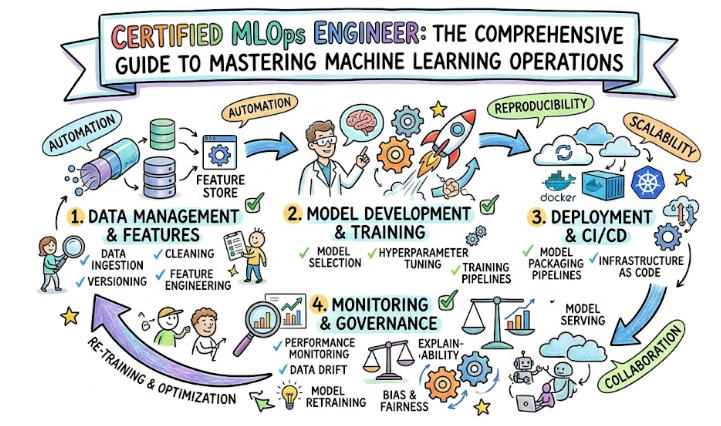
The transition of machine learning from experimental notebooks to scalable production environments has created a critical skills gap in the technology industry. This guide focuses on the Certified MLOps Engineer program, a specialized track designed to bridge the divide between data science and traditional software engineering. Whether you are a DevOps professional looking to diversify or a data engineer aiming for operational excellence, this roadmap provides the necessary clarity for your career progression.
As organizations scale their artificial intelligence initiatives, the need for standardized practices in model deployment, monitoring, and governance becomes paramount. This certification guide, supported by AIOps School, is crafted to help engineers and managers navigate the complexities of the MLOps ecosystem. By the end of this article, you will understand how this credential impacts your professional trajectory and provides a structured approach to mastering production-grade AI systems.
In the current landscape of platform engineering and cloud-native development, MLOps is no longer an optional skill but a core requirement for high-performing technical teams. This guide serves as a mentor-driven resource to help you decide if this path aligns with your long-term goals. We will break down the technical requirements, the investment of time needed, and the real-world application of the skills you will acquire through this certification.
What is the Certified MLOps Engineer?
The Certified MLOps Engineer designation represents a professional standard for individuals capable of managing the entire lifecycle of machine learning models. It is not merely a theoretical exercise but a validation of an engineer’s ability to automate and standardize the processes of model training, deployment, and maintenance. It exists to solve the “it works on my machine” problem that frequently plagues data science teams.
This program emphasizes real-world applications over abstract mathematics, focusing on how to build robust pipelines using industry-standard tools. It aligns with modern engineering workflows by incorporating CI/CD principles, infrastructure as code, and automated testing into the machine learning lifecycle. By achieving this certification, professionals demonstrate their ability to handle enterprise-level challenges in AI production.
Modern enterprise practices require machine learning models to be as reliable as microservices. The Certified MLOps Engineer framework teaches you how to treat models as first-class citizens in a software delivery pipeline. This ensures that models are not just accurate upon creation but remain performant and compliant throughout their operational lifespan in a production environment.
Who Should Pursue Certified MLOps Engineer?
This certification is primarily designed for DevOps engineers, SREs, and cloud architects who are increasingly tasked with supporting data science workloads. These professionals already understand infrastructure but need the specific domain knowledge required to handle the unique volatility of machine learning data and models. It provides a structured bridge to transition into the rapidly growing field of AI operations.
Data engineers and data scientists who want to move beyond model development and into the realm of production delivery will also find immense value here. By understanding the operational side of the house, data professionals can ensure their work reaches end-users faster and with fewer errors. It empowers them to speak the language of the platform teams and contribute to the overall stability of the system.
For engineering managers and technical leaders, this certification offers a framework for building and scaling specialized MLOps teams. Understanding the complexities involved in the machine learning lifecycle allows leaders to make better hiring decisions and resource allocations. It is particularly relevant for the Indian market and global tech hubs where AI adoption is outpacing the supply of qualified operational talent.
Why Certified MLOps Engineer is Valuable in the Current Era and Beyond
The demand for MLOps expertise is driven by the massive enterprise shift toward integrating AI into core business products. As companies move past the initial hype of AI, they are discovering that maintaining these systems is significantly harder than building them. Professionals who hold this certification are positioned as the solution to this technical debt, ensuring long-term career longevity.
The certification focuses on fundamental principles of automation, monitoring, and governance, which remain constant even as specific tools and frameworks evolve. This allows engineers to stay relevant despite the rapid pace of change in the AI landscape. It moves the focus from “learning a tool” to “mastering a methodology,” which is a far more sustainable approach to career growth.
From a business perspective, the return on investment for this certification is realized through faster deployment cycles and reduced operational costs. Organizations value engineers who can prevent model drift and ensure high availability of AI services. For the individual, it translates into higher compensation, greater job security, and the opportunity to work on the most innovative projects in the industry.
Certified MLOps Engineer Certification Overview
The Certified MLOps Engineer program is delivered via the official portal at aiopsschool.com and is hosted on the AIOps School platform. The program is designed to be rigorous and outcome-oriented, focusing on the practical skills required to manage machine learning systems at scale. It utilizes a combination of performance-based assessments and practical scenarios to validate candidate expertise.
The certification ownership rests with a body of industry experts who continuously update the curriculum to reflect current production standards. The structure is modular, allowing learners to progress through different stages of complexity while maintaining a focus on hands-on labs. This approach ensures that the credential remains a credible signal of competency to employers and peers alike.
Certified MLOps Engineer Certification Tracks & Levels
The certification is structured into three primary levels: Foundation, Professional, and Advanced. The Foundation level introduces the core concepts of the ML lifecycle and the basic tooling required for automation. It is intended to build a common language between engineers and data scientists, ensuring that everyone understands the high-level objectives of MLOps.
The Professional level dives deep into implementation, covering orchestration, containerization, and automated scaling of ML workloads. At this stage, candidates are expected to build and maintain complex pipelines that can handle real-time and batch processing. This level is where most practitioners find the immediate technical skills needed for their day-to-day responsibilities in production environments.
The Advanced level focuses on specialization tracks such as MLOps for Security, FinOps for AI, and large-scale model governance. This level is designed for architects and lead engineers who are responsible for the overall strategy and cost-efficiency of AI platforms. These levels align with a natural career progression from an individual contributor to a strategic technical leader.
Complete Certified MLOps Engineer Certification Table
| Track | Level | Who it’s for | Prerequisites | Skills Covered | Recommended Order |
| MLOps Core | Foundation | Beginners & Managers | Basic Linux & Python | ML Lifecycle, Tooling, CI/CD basics | 1st |
| MLOps Engineering | Professional | DevOps & Data Engineers | Foundation Cert, Docker | Kubernetes, Pipeline Orchestration | 2nd |
| ML Platform Architecture | Advanced | Senior Architects | Professional Cert, K8s exp | Scalability, Multi-cloud ML, Governance | 3rd |
| MLOps Security | Specialization | DevSecOps Engineers | Professional Cert | Model Security, Data Privacy, RBAC | 4th (Optional) |
| MLOps FinOps | Specialization | FinOps Practitioners | Professional Cert | Cloud Costs, Model Optimization | 5th (Optional) |
Detailed Guide for Each Certified MLOps Engineer Certification
Certified MLOps Engineer – Foundation
What it is
This entry-level certification validates a fundamental understanding of the Machine Learning Operations lifecycle. it ensures that the candidate can differentiate between traditional software DevOps and the specific requirements of machine learning systems.
Who should take it
It is suitable for junior developers, aspiring data engineers, and technical project managers. Professionals looking to switch their career path into AI infrastructure find this to be the perfect starting point.
Skills you’ll gain
- Understanding the stages of the ML lifecycle.
- Basic knowledge of version control for data and models.
- Familiarity with CI/CD concepts specifically for ML pipelines.
- Knowledge of the MLOps tool ecosystem.
Real-world projects you should be able to do
- Setting up a basic automated training pipeline using GitHub Actions.
- Creating a version-controlled data repository for a small ML project.
Preparation plan
- 7–14 days: Review official study guides and complete introductory video modules.
- 30 days: Focus on understanding the differences between ML and traditional software deployment.
- 60 days: Not typically required for Foundation level unless the candidate is entirely new to IT.
Common mistakes
- Over-focusing on the mathematical theory of machine learning algorithms.
- Ignoring the importance of data versioning in the pipeline.
Best next certification after this
- Same-track option: Certified MLOps Engineer – Professional.
- Cross-track option: Certified DataOps Associate.
- Leadership option: AI Product Management Certification.
Certified MLOps Engineer – Professional
What it is
The Professional level validates the candidate’s ability to design, build, and maintain production-grade MLOps pipelines. It focuses on the integration of various tools to create a seamless flow from data ingestion to model monitoring.
Who should take it
This is aimed at mid-level DevOps engineers, SREs, and Data Engineers with at least one year of experience. It is for those who are actively responsible for maintaining production environments.
Skills you’ll gain
- Containerization of ML models using Docker and Kubernetes.
- Implementation of Feature Stores for reusable data assets.
- Automated model deployment and A/B testing strategies.
- Monitoring for model drift and performance degradation.
Real-world projects you should be able to do
- Deploying an ML model as a scalable microservice on a Kubernetes cluster.
- Building an automated pipeline that triggers re-training when data drift is detected.
Preparation plan
- 7–14 days: Intensive lab sessions focusing on Kubernetes and Docker for ML.
- 30 days: Practical implementation of CI/CD pipelines using tools like Kubeflow or MLflow.
- 60 days: Full project-based learning, building an end-to-end MLOps architecture from scratch.
Common mistakes
- Treating model deployment as a one-time event rather than a continuous process.
- Neglecting the monitoring and logging aspects of the production model.
Best next certification after this
- Same-track option: Certified MLOps Engineer – Advanced.
- Cross-track option: Certified SRE Professional.
- Leadership option: Technical Lead – Platform Engineering.
Certified MLOps Engineer – Advanced (Specialist)
What it is
This certification validates the ability to architect enterprise-scale ML platforms that are cost-effective, secure, and compliant. It covers the strategic aspects of managing hundreds of models across diverse environments.
Who should take it
Senior engineers, Principal Architects, and Tech Leads should pursue this track. It is for those who make high-level decisions regarding the organization’s AI infrastructure and strategy.
Skills you’ll gain
- Designing multi-cloud and hybrid-cloud ML architectures.
- Implementing advanced security protocols for AI models and data.
- Optimizing cloud spend for large-scale GPU and TPU workloads.
- Establishing governance frameworks for responsible AI.
Real-world projects you should be able to do
- Architecting a global ML platform that complies with GDPR and regional data laws.
- Developing a FinOps strategy to reduce model inference costs by 30%.
Preparation plan
- 7–14 days: Reviewing case studies of enterprise ML failures and successes.
- 30 days: Deep dive into cloud-native scaling and cost management tools.
- 60 days: Developing a comprehensive architecture blueprint for a hypothetical enterprise scenario.
Common mistakes
- Designing overly complex architectures that are difficult for the team to maintain.
- Failing to account for the long-term storage costs of massive datasets.
Best next certification after this
- Same-track option: Specialized niche certs in Generative AI Operations.
- Cross-track option: Certified FinOps Professional.
- Leadership option: CTO / Head of Engineering tracks.
Choose Your Learning Path
DevOps Path
Professionals coming from a DevOps background should focus on how ML workloads differ from traditional stateless applications. You should leverage your existing knowledge of CI/CD and Infrastructure as Code while learning the nuances of data versioning and model tracking. Your goal is to apply the same rigor of software delivery to the unpredictable world of data science. This path emphasizes the automation of the feedback loop between production and the development environment.
DevSecOps Path
The security path focuses on the unique vulnerabilities of machine learning, such as model poisoning and adversarial attacks. You will learn how to integrate security scanning into the ML pipeline and ensure that data privacy is maintained during the training process. This path is critical for engineers working in regulated industries like finance or healthcare. It bridges the gap between infrastructure security and data science ethics.
SRE Path
Site Reliability Engineers will focus on the observability and reliability of ML services in production. This involves setting up Service Level Objectives (SLOs) specifically for model performance and ensuring that inference services can handle high traffic. You will learn to manage the “black box” nature of models through robust logging and alerting systems. The focus here is on preventing downtime and ensuring consistent user experiences for AI-driven features.
AIOps Path
The AIOps path is for engineers who want to use machine learning to improve IT operations themselves. You will learn how to build models that predict system failures, automate incident response, and optimize resource allocation. This path is about applying MLOps principles to the tools and systems that keep the business running. It is a specialized intersection of machine learning and traditional systems engineering.
MLOps Path
This is the core path dedicated to the end-to-end lifecycle management of machine learning models. It covers everything from data ingestion and feature engineering to model serving and retraining. This path is ideal for those who want to be the primary facilitators of AI value within an organization. You will become the vital link that ensures data science research translates into tangible business outcomes.
DataOps Path
DataOps focuses on the quality and reliability of the data pipelines that feed the machine learning models. In this path, you will learn to apply DevOps principles to data management, ensuring that “garbage in, garbage out” does not compromise the ML system. You will work on data orchestration, quality testing, and metadata management. This is the foundation upon which all successful MLOps initiatives are built.
FinOps Path
The FinOps path addresses the soaring costs associated with training and running large machine learning models. You will learn to analyze GPU utilization, optimize cloud resource selection, and implement cost-allocation strategies. This path is essential for organizations looking to scale their AI initiatives without breaking their budget. It combines financial accountability with technical optimization to ensure sustainable AI growth.
Role → Recommended Certified MLOps Engineer Certifications
| Role | Recommended Certifications |
| DevOps Engineer | Certified MLOps Engineer (Professional) |
| SRE | Certified MLOps Engineer (Professional) + SRE Specialist |
| Platform Engineer | Certified MLOps Engineer (Advanced) |
| Cloud Engineer | Certified MLOps Engineer (Foundation + Professional) |
| Security Engineer | Certified MLOps Engineer (MLOps Security Track) |
| Data Engineer | Certified MLOps Engineer (Professional) + DataOps |
| FinOps Practitioner | Certified MLOps Engineer (MLOps FinOps Track) |
| Engineering Manager | Certified MLOps Engineer (Foundation) |
Next Certifications to Take After Certified MLOps Engineer
Same Track Progression
Once you have mastered the Professional level, the natural progression is to move into deep specialization. This might involve focusing on Large Language Model Operations (LLMOps) or Edge AI, where models are deployed on constrained devices. Staying within the same track allows you to become a subject matter expert who can handle the most complex technical challenges. Deepening your expertise ensures you remain at the top of the technical individual contributor ladder.
Cross-Track Expansion
Broadening your skills into adjacent areas like DataOps or DevSecOps can make you a more versatile architect. Understanding how data quality impacts model performance or how security vulnerabilities can be introduced into a model provides a holistic view of the system. This expansion is highly valued in smaller organizations where engineers are expected to wear multiple hats. It also prepares you for senior roles that require oversight of multiple engineering domains.
Leadership & Management Track
For those looking to move away from day-to-day coding, transitioning into leadership is a viable next step. Certifications in AI Strategy or Technical Product Management can help you leverage your MLOps knowledge to drive business value. You will be well-equipped to lead teams of engineers and data scientists, as you understand the practical realities of their work. This track leads to roles like VP of Engineering, Head of AI, or Chief Technology Officer.
Training & Certification Support Providers for Certified MLOps Engineer
DevOpsSchool
DevOpsSchool provides a robust ecosystem for professionals aiming to master the intersection of development and operations. Their curriculum is known for being comprehensive, covering the latest tools and methodologies in the DevOps space. They offer structured training programs that are designed to take a student from a beginner to an expert level through hands-on labs and real-world scenarios. With a strong focus on community and mentorship, they help students navigate the complexities of modern software delivery. Their instructors are typically industry veterans who bring a wealth of practical experience to the classroom, ensuring that the training is relevant to current job market demands.
Cotocus
Cotocus specializes in providing high-end technical training and consulting services with a focus on cloud-native technologies. They are recognized for their deep expertise in containerization, orchestration, and infrastructure as code. Their training programs for the Certified MLOps Engineer program are designed to be intensive and practical, catering to engineers who need to deploy and manage complex systems at scale. Cotocus emphasizes a “learning by doing” approach, which is essential for mastering the intricate details of MLOps. Their commitment to staying updated with the latest industry trends makes them a reliable partner for professionals looking to stay ahead in their careers.
Scmgalaxy
Scmgalaxy is a well-established platform that offers a wide range of resources and training for software configuration management and DevOps. They have built a vast community of professionals who share knowledge and best practices through blogs, forums, and specialized courses. Their training for MLOps is geared toward providing a solid foundation in the tools and processes required for automated model delivery. By focusing on the integration of various components of the software lifecycle, Scmgalaxy helps engineers understand the bigger picture of platform engineering. Their extensive library of tutorials and guides serves as an excellent reference for both students and experienced practitioners.
BestDevOps
BestDevOps focuses on delivering high-quality training that is directly aligned with industry standards and certifications. They pride themselves on their ability to simplify complex topics, making them accessible to a broader audience of engineers and managers. Their programs are structured to provide a clear roadmap for career progression, emphasizing the skills that are most in demand by employers. For those pursuing the Certified MLOps Engineer designation, BestDevOps offers targeted modules that cover the critical aspects of model deployment and monitoring. Their focus on practical outcomes ensures that students are not just certified but are actually capable of performing the roles they are trained for.
devsecopsschool.com
DevSecOpsSchool is a specialized training provider that focuses on integrating security into every stage of the software development lifecycle. They recognize that in the modern era, security cannot be an afterthought, especially in the context of sensitive data and machine learning models. Their training programs provide a deep dive into the security aspects of MLOps, including data privacy, model integrity, and compliance. By teaching engineers how to build “security by design,” they empower them to protect their organizations from evolving threats. Their curriculum is essential for any professional who wants to specialize in the increasingly important field of secure AI operations.
sreschool.com
SRESchool is dedicated to the principles of Site Reliability Engineering, focusing on the stability, scalability, and performance of production systems. Their training for MLOps engineers is particularly valuable because it applies the rigorous standards of SRE to the unique challenges of machine learning. They teach candidates how to define meaningful SLOs, manage error budgets, and implement automated incident response for ML workloads. SRESchool provides the tools and techniques needed to ensure that AI services are as reliable as any other core business application. This focus on operational excellence makes their graduates highly sought after by top-tier technology companies.
aiopsschool.com
AIOpsSchool is the primary authority for training in the field of Artificial Intelligence for IT Operations and MLOps. They offer a comprehensive suite of certifications and courses designed to help engineers master the lifecycle of AI models. Their curriculum is built by industry leaders who have firsthand experience in managing large-scale AI platforms. By providing a structured path for learning, AIOpsSchool ensures that professionals can transition into AI-focused roles with confidence. Their focus on both the technical and strategic aspects of AIOps makes them a unique and invaluable resource for the modern engineering community.
dataopsschool.com
DataOpsSchool addresses the critical need for reliable data pipelines in the machine learning ecosystem. Their training programs focus on the methodologies and tools required to automate data management, ensuring that data is always high-quality and available. By applying DevOps principles to data, they help organizations reduce the time it takes to get insights from their AI models. For MLOps engineers, the training provided by DataOpsSchool is foundational, as it covers the “data” part of the machine learning equation. Their emphasis on collaboration and automation helps break down the silos between data teams and engineering teams.
finopsschool.com
FinOpsSchool is the leading provider of training for managing the financial aspects of cloud computing and AI. As the cost of training and running machine learning models continues to rise, the skills taught by FinOpsSchool are becoming essential for every engineering leader. They provide a framework for balancing cost, speed, and quality, ensuring that AI initiatives remain economically viable. Their training covers everything from cloud billing analysis to resource optimization strategies specifically for AI workloads. By mastering FinOps, engineers can prove the value of their projects to the business and ensure long-term support for their initiatives.
Frequently Asked Questions (General)
- How difficult is the Certified MLOps Engineer exam?
The difficulty is moderate to high, as it requires a blend of DevOps knowledge and an understanding of data science workflows. It is designed to be a practical challenge rather than a simple multiple-choice test. - How much time does it take to get certified?
Depending on your background, it typically takes 30 to 60 days of focused study and hands-on practice. Experienced DevOps engineers may be able to complete it faster. - Are there any prerequisites for the Foundation level?
There are no formal prerequisites, but a basic understanding of Linux, Python, and the general software development lifecycle is highly recommended. - What is the return on investment for this certification?
The ROI is significant, often leading to salary increases of 20-30% and access to higher-level roles in platform engineering and AI operations. - Should I learn Data Science before MLOps?
You don’t need to be a data scientist, but you should understand the basic concepts of how models are trained and evaluated to be effective in MLOps. - Is this certification recognized globally?
Yes, the Certified MLOps Engineer credential is recognized by major technology firms and enterprises across the globe as a standard for operational excellence. - How often do I need to recertify?
Certifications are generally valid for two to three years, after which you may need to take an update exam to ensure your skills remain current with the latest tools. - Can I take the exam online?
Yes, the exam is typically offered through a proctored online platform, allowing you to take it from the comfort of your home or office. - Does the certification cover specific cloud providers like AWS or Azure?
While the principles are cloud-agnostic, the training often includes labs on major cloud platforms to provide a realistic experience. - How does this differ from a standard DevOps certification?
This certification specifically addresses the unique challenges of machine learning, such as data drift, model versioning, and specialized compute hardware like GPUs. - Is there a community for certified professionals?
Yes, holders of the certification gain access to exclusive forums and networking groups where they can share insights and job opportunities. - Are study materials included in the certification fee?
This depends on the package you choose, but most options include a comprehensive set of study guides and lab access.
FAQs on Certified MLOps Engineer
- What specific MLOps tools are covered in the curriculum?
The curriculum covers industry standards such as MLflow, Kubeflow, Docker, Kubernetes, and various CI/CD tools, ensuring you are proficient in the current market-leading ecosystem. - How does the certification handle the concept of Model Drift?
It provides practical training on setting up monitoring systems that detect changes in input data and model accuracy, triggering automated retraining or alerts as needed. - Is coding a major part of the Certified MLOps Engineer role?
Yes, you will need to be comfortable with Python for scripting and automation, as well as YAML for configuration and infrastructure management. - Does the program cover Generative AI and LLMs?
The advanced levels include specific modules on LLMOps, focusing on the unique challenges of deploying and scaling large language models in a production environment. - How is the practical lab portion of the exam structured?
Candidates are given access to a live environment where they must solve specific operational tasks, such as fixing a broken pipeline or deploying a new model version. - What is the focus on data privacy and security?
The certification includes modules on securing the ML pipeline, managing access controls, and ensuring compliance with data protection regulations during the model lifecycle. - Can this certification help me move into a Lead Architect role?
Absolutely, as it provides the technical depth and strategic overview required to design enterprise-grade AI platforms and lead high-performing engineering teams. - How does MLOps integrate with existing Agile practices?
The certification teaches you how to adapt Agile methodologies to the iterative and sometimes unpredictable nature of machine learning development and deployment.
Final Thoughts: Is Certified MLOps Engineer Worth It?
From a mentor’s perspective, the decision to pursue the Certified MLOps Engineer credential should be based on your long-term career goals rather than short-term hype. If you enjoy the challenge of building robust, scalable systems and want to be at the forefront of the AI revolution, then this path is undeniably valuable. The industry is moving toward a future where AI is embedded in everything, and the people who can manage that infrastructure will be the most critical assets in any organization.
This certification provides a structured and disciplined approach to a field that can often feel chaotic. It gives you the “battle-tested” knowledge that usually takes years of trial and error to acquire in a production setting. While the exam and the learning process are rigorous, the clarity and confidence you gain are well worth the effort. It is a solid investment in your professional identity that will pay dividends as the technology landscape continues to evolve.
