Limited Time Offer!
For Less Than the Cost of a Starbucks Coffee, Access All DevOpsSchool Videos on YouTube Unlimitedly.
Master DevOps, SRE, DevSecOps Skills!
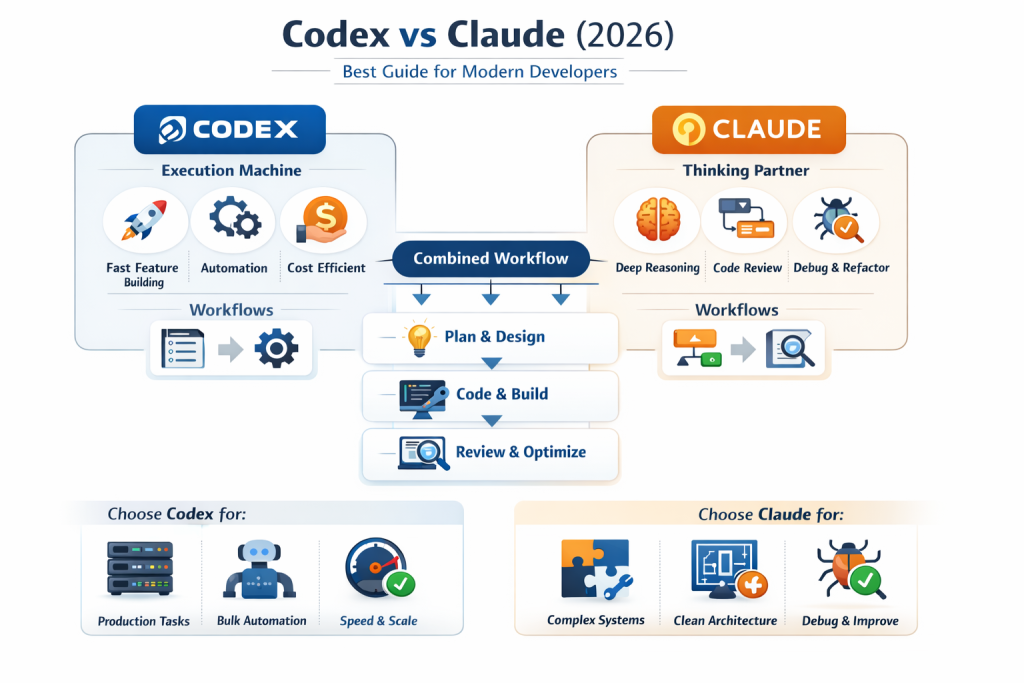
Artificial Intelligence has moved beyond simple assistance and is now actively shaping how software is designed, developed, and maintained. Among the most impactful tools in this space are OpenAI Codex and Claude Code.
While both tools are powerful, they serve different purposes and operate with different philosophies. Understanding these differences is critical for making the right decision in a professional environment.
This guide provides a deep, practical comparison to help developers, architects, and engineering teams choose the right approach.
Understanding the Core Philosophy
OpenAI Codex: Execution-Oriented System
Codex is designed to act as an autonomous development assistant. Its primary focus is:
- Executing tasks end-to-end
- Writing and modifying code independently
- Completing workflows with minimal supervision
It behaves like an engineer who focuses on getting things done quickly and efficiently.
Claude Code: Reasoning-Oriented System
Claude is designed as a collaborative AI with strong reasoning capabilities. Its focus includes:
- Understanding complex problems deeply
- Explaining decisions clearly
- Working interactively with developers
It behaves like a senior engineer who focuses on thinking before implementing.
Detailed Comparison Table
Below is a structured comparison covering real-world engineering aspects:
| Category | Codex | Claude |
|---|---|---|
| Core Approach | Execution-focused | Reasoning-focused |
| Working Style | Autonomous task execution | Interactive collaboration |
| Speed | Faster for implementation tasks | Slightly slower due to deeper analysis |
| Code Quality | Functional and efficient | Clean, structured, maintainable |
| Context Handling | Good for task-level context | Excellent for large codebases |
| Automation Capability | Strong (multi-step workflows) | Limited automation |
| Debugging Ability | Moderate | Strong root-cause analysis |
| Architecture Design | Basic support | Advanced design thinking |
| Token Efficiency | More cost-efficient | Higher usage due to explanations |
| Learning Curve | Easier for quick tasks | Better for guided development |
| Best Fit | Production coding, automation | Debugging, system design |
| Environment Preference | Cloud-based execution workflows | Local and interactive workflows |
| Scalability | High for repetitive tasks | High for complex systems |
| Developer Control | Lower (more autonomous) | Higher (more interactive control) |
Deep Technical Comparison
Task Execution
Codex performs best when tasks are clearly defined. It can:
- Generate complete features
- Automate repetitive coding
- Execute multi-step instructions
Claude, in contrast, focuses on:
- Breaking down tasks
- Validating logic
- Suggesting improvements before implementation
Code Understanding
In smaller tasks, both tools perform well. However, in large systems:
- Claude excels at understanding relationships across multiple files
- Codex focuses more on completing individual tasks efficiently
This makes Claude more suitable for large-scale applications and legacy systems.
Debugging and Problem Solving
Codex can suggest quick fixes, but it may not always identify deeper issues.
Claude, on the other hand:
- Analyzes logs and behavior
- Identifies root causes
- Suggests long-term solutions
This makes it significantly stronger for production debugging.
Cost and Efficiency
From a cost perspective:
- Codex is more efficient because it generates direct outputs
- Claude consumes more tokens due to detailed explanations and reasoning
For large teams, this difference can impact operational cost.
Practical Use Cases
When to Use Codex
Codex is ideal for:
- Rapid feature development
- Writing APIs and services
- Automating workflows
- Generating repetitive code
Example:
Building multiple microservices with similar patterns.
When to Use Claude
Claude is ideal for:
- Debugging complex issues
- Reviewing code quality
- Designing system architecture
- Refactoring legacy applications
Example:
Improving performance in a distributed system.
Real Development Scenarios
Feature Development
Codex:
- Quickly generates working code
- Requires minimal input
Claude:
- Suggests design improvements
- Helps refine implementation
Debugging
Codex:
- Provides quick fixes
Claude:
- Explains root causes
- Suggests robust solutions
Large System Design
Codex:
- Works effectively on isolated components
Claude:
- Understands full system architecture
- Suggests scalable designs
Enterprise-Level Strategy
For professional environments, the best approach is to combine both tools.
Recommended Workflow
- Use Claude for planning
- Define architecture
- Validate logic
- Identify risks
- Use Codex for execution
- Generate code
- Implement features
- Automate tasks
- Use Claude for review
- Improve code quality
- Debug issues
- Optimize performance
This approach balances speed and quality effectively.
Final Perspective
The comparison between Codex and Claude is not about choosing a winner. It is about understanding their strengths.
- Codex is best viewed as an efficient executor
- Claude is best viewed as a thoughtful problem solver
In modern engineering environments, especially those involving microservices, authentication systems, and complex workflows, using both tools together provides the best results.