Skip to content
Menu
DevSecOps Now!!!
  • About
  • Certifications
  • Contact
  • Courses
  • DevSecOps Consulting
  • DevSecOps Tools
  • Training
  • Tutorials
DevSecOps Now!!!

How to Enable Google Login in Laravel project?

Posted on December 27, 2024

Limited Time Offer!

For Less Than the Cost of a Starbucks Coffee, Access All DevOpsSchool Videos on YouTube Unlimitedly.
Master DevOps, SRE, DevSecOps Skills!
Enroll Now

Enabling Google Login in a Laravel project is a great way to simplify the authentication process for users. Here’s a step-by-step, humanized guide to integrate Google Login in your Laravel application.


Step 1: Install Laravel Socialite

Laravel Socialite provides an elegant and simple interface for OAuth authentication, including Google login.

  1. Run the following command in your terminal to install Socialite: composer require laravel/socialite
  2. Open the config/app.php file and ensure the Socialite service provider is added (for Laravel 5.x, this is required): 'providers' => [ Laravel\Socialite\SocialiteServiceProvider::class, ], 'aliases' => [ 'Socialite' => Laravel\Socialite\Facades\Socialite::class, ],

Step 2: Set Up Google API Credentials

You need to create Google API credentials to connect your Laravel app with Google’s OAuth services.

  1. Visit the Google Cloud Console.
  2. Create a new project or select an existing one.
  3. Navigate to APIs & Services > Credentials and click Create Credentials > OAuth Client ID.
  4. Configure the consent screen:
    • Provide an App Name and email.
    • Add scopes (e.g., email, profile).
  5. Create the credentials:
    • Select Web Application.
    • Add your authorized redirect URL (e.g., http://your-domain.com/auth/google/callback).
  6. Copy the Client ID and Client Secret.

Step 3: Configure Your Laravel Environment

Add the Google API credentials to your .env file:

GOOGLE_CLIENT_ID=your-google-client-id
GOOGLE_CLIENT_SECRET=your-google-client-secret
GOOGLE_REDIRECT_URL=http://your-domain.com/auth/google/callback

Step 4: Configure Laravel Socialite

Update the config/services.php file to include Google as a provider:

'google' => [
    'client_id' => env('GOOGLE_CLIENT_ID'),
    'client_secret' => env('GOOGLE_CLIENT_SECRET'),
    'redirect' => env('GOOGLE_REDIRECT_URL'),
],

Step 5: Create Routes

Define routes for redirecting to Google and handling the callback:

use Laravel\Socialite\Facades\Socialite;
use App\Http\Controllers\GoogleController;

Route::get('auth/google', [GoogleController::class, 'redirectToGoogle'])->name('google.login');
Route::get('auth/google/callback', [GoogleController::class, 'handleGoogleCallback'])->name('google.callback');

Step 6: Create the Controller
Generate a controller to handle the logic:

php artisan make:controller GoogleController

In the GoogleController, add the following methods:

namespace App\Http\Controllers;

use Illuminate\Http\Request;
use Laravel\Socialite\Facades\Socialite;
use App\Models\User;
use Auth;

class GoogleController extends Controller
{
    public function redirectToGoogle()
    {
        return Socialite::driver('google')->redirect();
    }

    public function handleGoogleCallback()
    {
        try {
            $user = Socialite::driver('google')->stateless()->user();

            $findUser = User::where('email', $user->getEmail())->first();

            if ($findUser) {
                Auth::login($findUser);
                return redirect()->intended('dashboard');
            } else {
                $newUser = User::create([
                    'name' => $user->getName(),
                    'email' => $user->getEmail(),
                    'google_id' => $user->getId(),
                    'password' => encrypt('password') // You can use a better approach
                ]);

                Auth::login($newUser);
                return redirect()->intended('dashboard');
            }
        } catch (\Exception $e) {
            return redirect('/')->with('error', 'Something went wrong!');
        }
    }
}

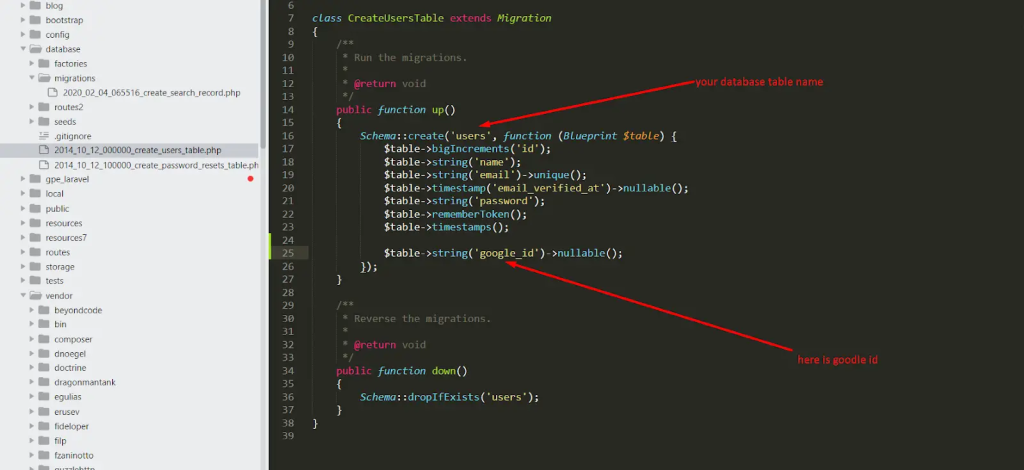
Step 7: Update User Model

Make sure your User model has a google_id field. If it doesn’t, create a migration to add it:

php artisan make:migration add_google_id_to_users_table --table=users

In the migration file:

public function up()
{
    Schema::table('users', function (Blueprint $table) {
        $table->string('google_id')->nullable();
    });
}

Run the migration:

php artisan migrate

Step 8: Add a Login Button

Add a Google Login button to your frontend, e.g., in resources/views/auth/login.blade.php:

<a href="{{ route('google.login') }}" class="btn btn-danger">Login with Google</a>

Step 9: Test Your Integration

  • Start your server: php artisan serve
  • Visit the login page and click “Login with Google”.
  • After successful login, you should be redirected to your dashboard or intended URL.

Why Use Google Login?

  1. Simplified Registration: No need for users to remember another password.
  2. Increased Security: Users rely on Google’s authentication, reducing the risk of security issues.
  3. Enhanced UX: Users can log in quickly and easily.

This humanized guide ensures a smooth and comprehensive Google Login setup for your Laravel project. Let me know if you need further assistance or adjustments!

Post Views: 1,002
  • Enable Google Login
  • Enable Google Login in Laravel
  • google
  • Google Login
  • How to Enable Google Login
  • Install Laravel Socialite
  • laravel
Subscribe
Login
Notify of
guest
guest
0 Comments
Oldest
Newest Most Voted
Inline Feedbacks
View all comments
  • Linux Server Diagnostic Commands: Complete Guide for Performance, Network & System Troubleshooting
  • The Ultimate Guide to CDOM โ€“ Certified DataOps Manager Certification
  • The Practical Path to AI Reliability: A Guide to the Certified MLOps Manager
  • Master the Machine Learning Lifecycle:Guide to Becoming a Certified MLOps Architect
  • How to Build a Project-Level AI Memory System That Works Across Codex, Claude, and Other AI Coding Tools
  • Certified MLOps Professional: A Deep Dive into the Certified MLOps Professional Certification
  • Certified MLOps Engineer : The Comprehensive Guide to Mastering Machine Learning Operations
  • Codex vs Claude: A Complete Practical Guide for Modern Developers (2026)
  • Certified AIOps Professional Program A Guide to Career Growth
  • Keycloak Multi-Client Architecture with Project-Based Email Validation (Student, Trainer, Company, Consulting)
  • Incorrect definition of table mysql.column_stats
  • Mautic and PHP 8.3 Compatibility Guide (2026)
  • Certified AIOps Engineer: The Complete Career Path and Certification Guide
  • How to Rename Apache Virtual Host Files Safely (Step-by-Step Guide for Linux)
  • AIOps Foundation Certification: Everything You Need to Know to Get Certified
  • DevOps to Certified Site Reliability Professional: A Senior Mentorโ€™s Guide
  • Certified Site Reliability Manager Training, Preparation, and Career Mapping
  • Certified Site Reliability Architect: The Complete Career Guide
  • What Is a VPN? A Complete Beginner-to-Advanced Tutorial
  • How to Install, Secure, and Tune MySQL 8.4 on Ubuntu 24.04 for Apache Event MPM and PHP-FPM
  • Complete Guide to Certified Site Reliability Engineer Career
  • Certified DevSecOps Professional Step by Step
  • Certified DevSecOps Manager: Complete Career Guide
  • Certified DevSecOps Engineer: Skills, Career Path and Certification Guide
  • Step-by-Step: Become a Certified DevSecOps Architect
  • Tuning PHP 8.3 for Apache Event MPM and PHP-FPM on Ubuntu: A Complete Step-by-Step Production Guide
  • Complete Step-by-Step Guide to Configure Apache Event MPM, Create index.php, Set Up VirtualHost, and Fix Ubuntu Default Page
  • Convert XAMPP Apache to Event MPM + System PHP-FPM
  • The Gateway to System Observability Engineering (MOE)
  • How to Finetune Apache and Prove It Works: A Real-World Guide to Testing Performance, Concurrency, HTTP/2, Memory, CPU, and Security

Recent Comments

  1. emmy day on SQLSTATE[42S22]: Column not found: 1054 Unknown column ‘provider’ in ‘field list’
  2. digital banking on Complete Tutorial: Setting Up Laravel Telescope Correctly (Windows + XAMPP + Custom Domain)
  3. SAHIL DHINGRA on How to Uninstall Xampp from your machine when it is not visible in Control panel programs & Feature ?
  4. Abhishek on MySQL: List of Comprehensive List of approach to secure MySQL servers.
  5. Kristina on Best practices to followed in .httacess to avoid DDOS attack?

Archives

  • April 2026
  • March 2026
  • February 2026
  • January 2026
  • December 2025
  • November 2025
  • October 2025
  • September 2025
  • August 2025
  • July 2025
  • June 2025
  • May 2025
  • April 2025
  • March 2025
  • February 2025
  • January 2025
  • December 2024
  • November 2024
  • October 2024
  • September 2024
  • August 2024
  • July 2024
  • June 2024
  • May 2024
  • April 2024
  • March 2024
  • February 2024
  • January 2024
  • December 2023
  • November 2023
  • October 2023
  • September 2023
  • August 2023
  • July 2023
  • May 2023
  • April 2023
  • March 2023
  • February 2023
  • January 2023
  • December 2022

Categories

  • Ai
  • AI Blogging
  • AiOps
  • ajax
  • Android Studio
  • Antimalware
  • Antivirus
  • Apache
  • Api
  • API Security
  • Api Testing
  • APK
  • Aws
  • Bike Rental Services
  • ChatGPT
  • Code Linting
  • Composer
  • cPanel
  • Cyber Threat Intelligence
  • Cybersecurity
  • Data Loss Prevention
  • Database
  • dataops
  • Deception Technology
  • DeepSeek
  • Devops
  • DevSecOps
  • DevTools
  • Digital Asset Management
  • Digital Certificates
  • Docker
  • Drupal
  • emulator
  • Encryption Tools
  • Endpoint Security Tools
  • Error
  • facebook
  • Firewalls
  • Flutter
  • git
  • GITHUB
  • Google Antigravity
  • Google play console
  • Google reCAPTCHA
  • Gradle
  • Guest posting
  • health and fitness
  • IDE
  • Identity and Access Management
  • Incident Response
  • Instagram
  • Intrusion Detection and Prevention Systems
  • jobs
  • Joomla
  • Keycloak
  • Laravel
  • Law News
  • Lawyer Discussion
  • Legal Advice
  • Linkedin
  • Linkedin Api
  • Linux
  • Livewire
  • Mautic
  • Medical Tourism
  • MlOps
  • MobaXterm
  • Mobile Device Management
  • Multi-Factor Authentication
  • MySql
  • Network Traffic Analysis tools
  • Paytm
  • Penetration Testing
  • php
  • PHPMyAdmin
  • Pinterest Api
  • Quora
  • SAST
  • SecOps
  • Secure File Transfer Protocol
  • Security Analytics Tools
  • Security Auditing Tools
  • Security Information and Event Management
  • Seo
  • Server Management Tools
  • Single Sign-On
  • Site Reliability Engineering
  • soft 404
  • software
  • SuiteCRM
  • SysOps
  • Threat Model
  • Twitter
  • Twitter Api
  • ubuntu
  • Uncategorized
  • Virtual Host
  • Virtual Private Networks
  • VPNs
  • Vulnerability Assessment Tools
  • Web Application Firewalls
  • Windows Processor
  • Wordpress
  • WSL (Windows Subsystem for Linux)
  • X.com
  • Xampp
  • Youtube
©2026 DevSecOps Now!!! | WordPress Theme: EcoCoded
wpDiscuz