Limited Time Offer!
For Less Than the Cost of a Starbucks Coffee, Access All DevOpsSchool Videos on YouTube Unlimitedly.
Master DevOps, SRE, DevSecOps Skills!
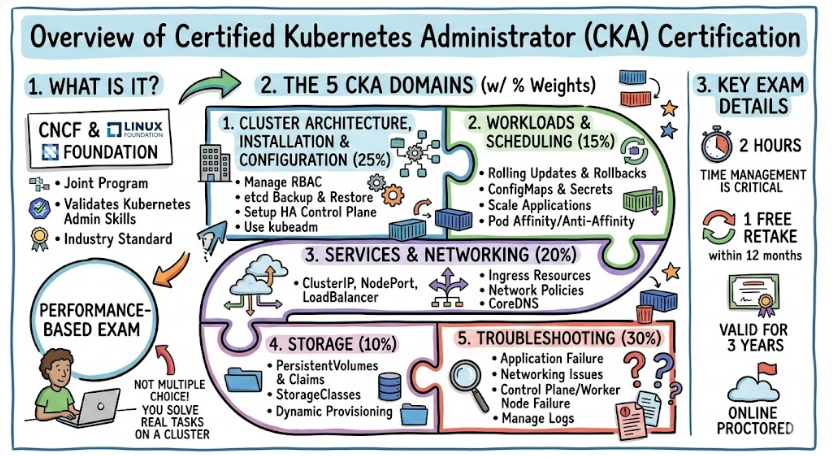
The era of manual tinkering with servers is over. In the past, we spent our days fixing individual machines and worrying about hardware failures. Today, the world has moved to a place where we manage infrastructure through code and abstraction. At the very center of this massive shift is Kubernetes. It has become the operating system of the modern cloud.
For any working engineer or manager—whether you are based in India or working with a global team—understanding Kubernetes is no longer just a “plus.” It is a requirement for survival. However, there is a big difference between reading a manual and actually managing a live system. This is why the Certified Kubernetes Administrator (CKA) Certification Training Course has become the industry standard. It proves that you don’t just know the theory; you can handle the pressure of a production environment.
I have seen the industry change many times. I have watched tools come and go. But Kubernetes is different. It is a foundational shift in how we build and run software. This guide is designed to help you navigate this certification and understand how it fits into your long-term career as a technical professional.
Navigating the Modern Professional Certification Matrix
Before we focus specifically on Kubernetes, it is important to understand the broader ecosystem. As an engineer or a manager, you need to know which path leads to which goal. Some certifications focus on speed, others on security, and some on the business side of the cloud.
The table below provides a high-level comparison of the top tracks available today. This will help you see where the Certified Kubernetes Administrator (CKA) Certification Training Course sits in relation to other specialized domains like DevSecOps, SRE, and FinOps.
Master Certification Comparison Table
| Track | Certification Name | Level | Who is it for? | Prerequisites | Key Skills | Recommended Order |
| Kubernetes | Certified Kubernetes Administrator (CKA) | Associate/Intermediate | SysAdmins, DevOps, SREs | Basic Linux & Containers | Cluster Setup, Storage, Networking, Troubleshooting | Start Here |
| DevOps | Certified DevOps Engineer (CDE) | Professional | Software Engineers, Ops | 2+ Years IT Exp | CI/CD, Pipelines, Automation, IaC | After CKA |
| DevSecOps | DevSecOps Certified Professional | Advanced | Security Engineers, Leads | DevOps Basics | Security Auditing, Hardening, Compliance | Specialized |
| SRE | SRE Certified Professional | Professional | SREs, Reliability Leads | Ops Background | SLOs, Error Budgets, Incident Response | After CKA |
| MLOps | MLOps Certified Professional | Advanced | ML Engineers, Data Scientists | Python, ML basics | Model Scaling, AI Pipelines | Specialized |
| DataOps | DataOps Certified Professional | Intermediate | Data Engineers | Data Basics | Data Agility, Flow Management | Specialized |
| FinOps | FinOps Certified Practitioner | Management | Managers, Cloud Leads | Cloud Basics | Cost Control, Cloud Budgeting | For Leads |
The Professional Standard: Certified Kubernetes Administrator (CKA)
The Certified Kubernetes Administrator (CKA) Certification Training Course is unique because it is a performance-based program. It doesn’t use multiple-choice questions. Instead, it places you in front of a live terminal. This is why it carries so much weight. When I see a CKA on a resume, I know that the person has the hands-on skills to keep a cluster healthy.
What it is
The Certified Kubernetes Administrator (CKA) Certification Training Course is a rigorous validation of your ability to perform the duties of a Kubernetes administrator. It covers everything from installing a cluster to managing its networking and security. The training culminates in an exam where you must solve real-world tasks in a command-line environment within a strict time limit. It is the most practical way to prove your competence in container orchestration.
Who should take it
This course is built for the people who are the backbone of modern software infrastructure.
- Software Engineers: Who need to understand the environment where their code is running.
- Working Engineers: Who are transitioning from traditional system administration to cloud-native roles.
- IT Managers: Who need a deep technical understanding to lead their engineering teams effectively.
- Site Reliability Engineers (SREs): Who are responsible for the uptime and performance of global systems.
Skills you’ll gain
By the end of this training, you will have moved from a basic user to a master of the cluster. You will understand the “why” behind every component and how to fix them when they fail. This knowledge gives you a massive advantage in any technical interview or project planning meeting.
- Cluster Bootstrapping: You will learn how to build a production-grade cluster from scratch using tools like
kubeadm. - Operational Networking: You will master how pods communicate and how to manage external access through Services and Ingress.
- Storage Strategies: You will understand how to manage persistent data so that your applications don’t lose information during restarts.
- Governance and Security: You will learn to use RBAC to ensure that teams have exactly the access they need and nothing more.
- Advanced Troubleshooting: You will gain the ability to look at logs and system states to quickly find and fix failures.
Real-world projects you should be able to do
The real test of training is what you can do on Monday morning at the office. After this course, you should be able to handle these high-value tasks with confidence.
- Design a High-Availability Cluster: You will be able to set up a cluster that can survive the loss of multiple nodes without dropping traffic.
- Implement Zero-Trust Networking: You can use Network Policies to ensure that different parts of your application are isolated from each other.
- Design a Recovery Plan: You will know how to back up the cluster’s brain (etcd) and restore it to a new location in minutes.
- Optimize Application Traffic: You can set up Ingress controllers to manage SSL/TLS and route traffic to the correct microservices.
Preparation plan (7–14 days / 30 days / 60 days)
The time you need to spend depends on your starting point. Don’t rush the process; the goal is mastery, not just a certificate.
- 7–14 Days (The Sprint): This is for professionals who already use
kubectldaily. Spend your time on the areas you don’t touch often, like cluster upgrades or manual etcd backups. Use timed mock exams to get your speed up. - 30 Days (The Professional Path): This is the best choice for most working engineers. Spend the first two weeks on installation, networking, and storage. Spend the final two weeks on security, troubleshooting, and repeated lab practice.
- 60 Days (The Foundation Path): If you are new to Linux and containers, take your time. Spend the first month getting very comfortable with the Linux command line and Docker. Spend the second month following the standard CKA training path.
Common mistakes
I have seen many brilliant engineers fail the CKA because they weren’t prepared for the format. It is a race against the clock.
- Manual YAML Writing: Do not try to write files from scratch. Use
kubectl create --dry-run=client -o yamlto generate your templates. - Ignoring the Context: Always check which cluster you are working in. The exam uses multiple clusters, and doing the right work in the wrong place gets you zero points.
- Getting Stuck: If a question is taking more than 10 minutes, skip it. You need to finish the easy questions first to ensure you have enough points to pass.
- Not Learning the Docs: You can use the official Kubernetes documentation. You must know exactly where the snippets are so you can copy and paste them quickly.
Strategic Career Pathing
Earning your CKA is a milestone, not a destination. To stay ahead in your career, you need to think about how you will specialize.
Best next certification after this
Once you have your CKA, you should choose your next step based on your desired role.
- Same Track (Specialization): Certified Kubernetes Security Specialist (CKS). This is the most logical next step. It builds on the CKA and focuses purely on securing the environment.
- Cross-Track (Automation): Certified DevOps Engineer. This helps you master the pipelines that feed into the Kubernetes cluster.
- Leadership (Management): FinOps Certified Practitioner. If you are moving into a management role, this is essential for understanding how to control the costs of your infrastructure.
Choose your path: 6 Specialized Domains
- DevOps Path: Focus on the speed and automation of software delivery.
- DevSecOps Path: Focus on integrating security into every single layer of the stack.
- SRE Path: Focus on the reliability, uptime, and performance of large systems.
- AIOps/MLOps Path: Learn how to run and scale AI and Machine Learning models on top of Kubernetes.
- DataOps Path: Focus on the agility and flow of data across the organization.
- FinOps Path: Focus on the intersection of finance and engineering to optimize cloud spend.
Role → Recommended certifications mapping
- DevOps Engineer: CKA, Certified DevOps Engineer, Terraform Associate.
- SRE: CKA, CKS, SRE Certified Professional.
- Platform Engineer: CKA, CKS, CKAD.
- Cloud Engineer: CKA, Cloud Solutions Architect (AWS/Azure/GCP).
- Security Engineer: CKS, DevSecOps Professional.
- Data Engineer: DataOps Professional, CKA.
- FinOps Practitioner: FinOps Practitioner, CKA.
- Engineering Manager: FinOps Practitioner, SRE Foundation.
Top Training Institutions for CKA
Choosing the right partner for your training is critical. You need an institution that provides hands-on labs and expert mentorship. Here are the top schools that help with the Certified Kubernetes Administrator (CKA) Certification Training Course.
- DevOpsSchool: This is a leading institution that provides deep, practical training. They focus on making sure you are ready for the real world, not just the exam. Their labs are designed to mimic production issues.
- Cotocus: Known for high-quality technical consulting and training. They provide expert-led sessions that cover complex enterprise setups, making them a great choice for working professionals.
- Scmgalaxy: This institution has a very large community and provide many resources for learning. Their training is built around the modern software lifecycle and focuses on automation.
- BestDevOps: They provide clear, simple, and effective training modules. Their goal is to take you from a beginner level to a professional standard through structured learning.
- devsecopsschool: If you want to learn Kubernetes with a security mindset, this is the place. They integrate security best practices into every part of their administration training.
- sreschool: Their focus is on the reliability of systems. They teach you how to manage Kubernetes in a way that ensures maximum uptime and performance.
- aiopsschool: Perfect for those moving into the AI space. They show you how to use Kubernetes as a foundation for running complex machine learning workloads.
- dataopsschool: They specialize in data-driven infrastructure. Their CKA course includes insights into managing large-scale data processing on container platforms.
- finopsschool: Great for those interested in the financial side of technology. They help you understand how to manage Kubernetes while keeping cloud bills under control.
FAQ : Career and Outcomes
1. Is the CKA certification worth it in today’s market?
Yes. It is one of the most respected certifications because it proves practical skills. It often leads to better job opportunities and higher salaries.
2. How long does the CKA certification stay valid?
It is valid for three years. This ensures that certified professionals stay current with the fast-moving Kubernetes ecosystem.
3. Do I need to be a developer to pass the CKA?
No. This is an administration exam. You need to be comfortable with the Linux command line, but you don’t need to write application code.
4. Can I take the exam from home?
Yes, the exam is proctored online. You just need a quiet room, a webcam, and a stable internet connection.
5. What is the difference between CKA and CKAD?
CKA is for the people who manage the cluster itself (the admins). CKAD is for the people who build and run applications on the cluster (the developers).
6. Does CKA help with salary growth in India?
Absolutely. Many Indian and global firms prioritize CKA-certified candidates for senior DevOps and SRE roles, often offering significant pay jumps.
7. Is there a specific sequence I should follow for these certs?
Most engineers start with CKA because it gives you the best overall understanding of how Kubernetes works from the inside out.
8. Can I use the documentation during the test?
Yes, you are allowed to open one tab for the official Kubernetes documentation website.
9. What if I fail the first time?
Most exam vouchers include one free retake, so you can learn from your mistakes and try again.
10. How much hands-on practice do I need?
I recommend at least 50-60 hours of pure lab practice to feel confident and fast enough for the exam.
11. Will this certification help me move into an SRE role?
Yes. CKA is a core requirement for almost every Site Reliability Engineering position at major tech companies today.
12. How does CKA help a manager?
It allows a manager to speak the same language as their engineers and make more realistic estimates for infrastructure projects.
FAQ : Training and Exam Details
1. What version of Kubernetes is used in the exam?
It usually uses the most recent stable version. Training providers like DevOpsSchool update their labs regularly to match this.
2. What is the format of the CKA exam?
It is 100% practical. You will have about 15 to 20 tasks to complete in a live terminal environment.
3. How long is the CKA exam?
You have exactly two hours to complete all the tasks. This is why being fast with the command line is so important.
4. What is a passing score for the CKA?
You need to score 66% or higher to earn your certification.
5. Are there multiple-choice questions?
No. There are zero multiple-choice questions. Every point is earned by running the correct commands.
6. Does the training cover etcd backup and restore?
Yes, this is a major part of the curriculum and a very common task in the actual exam.
7. Do I need to learn Helm for the CKA?
Basic knowledge of Helm is now part of the syllabus, so the training will cover how to install and manage packages.
8. Can I use my own notes during the exam?
No. You are only allowed to use the official documentation. You cannot have any papers or digital notes with you.
Conclusion
The Certified Kubernetes Administrator (CKA) Certification Training Course is a life-changing step for any engineer. It marks the transition from being a technician to being a specialist who can handle the world’s most complex infrastructure. In my years of watching the industry evolve, I have seen many tools come and go, but Kubernetes has become the foundation of everything we do. By earning this certification, you aren’t just getting a piece of paper; you are gaining the confidence to manage global systems. It requires hard work, late nights in the lab, and a lot of practice, but the reward is a career that is both secure and exciting. Start your journey today, stay consistent with your labs, and you will see how many doors this expertise opens for you in the modern tech world. Every long career begins with a single command on the terminal.
