Limited Time Offer!
For Less Than the Cost of a Starbucks Coffee, Access All DevOpsSchool Videos on YouTube Unlimitedly.
Master DevOps, SRE, DevSecOps Skills!
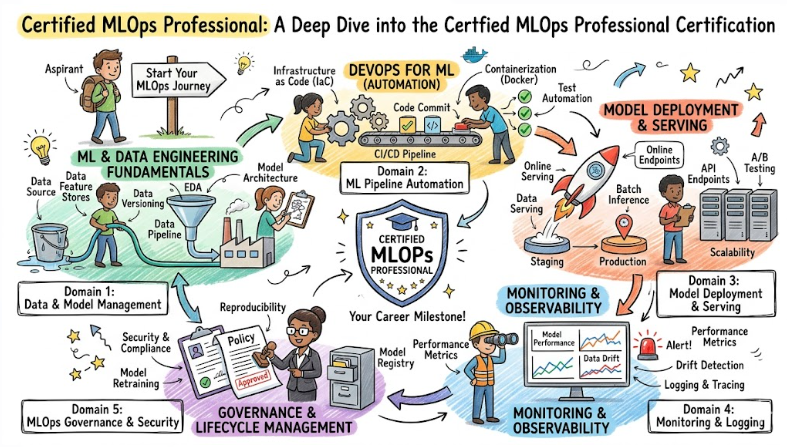
Introduction
The Certified MLOps Professional is a comprehensive program designed to bridge the gap between machine learning development and production-grade engineering. This guide is crafted for professionals who want to move beyond building models in notebooks and instead focus on the lifecycle management of those models within a scalable environment. Whether you are a DevOps engineer looking to support data science teams or a data scientist aiming to understand deployment, this resource serves as a roadmap.
By exploring this certification, you will understand how to integrate machine learning workflows into standard CI/CD pipelines, ensuring that your models are reliable and maintainable. In today’s landscape, where AI is becoming a core component of enterprise software, understanding the operational side is no longer optional. This guide helps technical leaders and practitioners make informed decisions about their career paths by highlighting the specific skills and roles influenced by AIOps School.
What is the Certified MLOps Professional?
The Certified MLOps Professional represents a standard of excellence for engineers who manage the intersection of data, code, and infrastructure. It exists to solve the primary challenge in modern AI: the fact that most experimental models never make it to production due to a lack of operational rigor. This certification emphasizes the creation of automated, reproducible, and monitorable machine learning systems.
Unlike theoretical courses that focus on mathematics and algorithm design, this program is rooted in production-focused learning. It aligns with modern engineering workflows by applying DevOps principles—such as version control, automated testing, and continuous monitoring—to the unique requirements of machine learning. It ensures that enterprises can deploy AI solutions with the same confidence they have in their traditional software services.
Who Should Pursue Certified MLOps Professional?
This certification is ideal for DevOps engineers, Site Reliability Engineers (SREs), and cloud architects who are increasingly tasked with managing ML infrastructure. Software engineers looking to specialize in the AI domain will find it provides the necessary technical vocabulary and toolset. Additionally, Data Engineers and Data Scientists who want to understand the deployment side of their work will benefit significantly from this structured learning path.
From a management perspective, technical leaders and engineering managers can use this certification to better understand the resources and team structures required for successful AI initiatives. In both the Indian and global markets, there is a massive shortage of professionals who can “operationalize” AI. This certification caters to both beginners in the field and experienced veterans looking to formalize their expertise in a high-demand niche.
Why Certified MLOps Professional is Valuable and Beyond
The demand for MLOps is driven by the rapid enterprise adoption of artificial intelligence and the subsequent need for longevity in these systems. Companies are realizing that the initial model build is just a small fraction of the total cost; the real effort lies in maintaining that model over time. This certification prepares you for the long term by teaching principles that remain relevant even as specific tools and frameworks evolve.
Furthermore, the return on time and career investment is significant because it positions you at the center of the most important technological shift of the decade. As organizations move away from “AI experiments” toward “AI-driven business,” the ability to manage model drift, data quality, and automated retraining becomes essential. Obtaining this certification proves you can handle the complexities of scale and governance required by modern enterprises.
Certified MLOps Professional Certification Overview
The program is delivered via the official portal at Certified MLOps Professional and is hosted on the AIOps School website. It is structured to provide a logical progression from foundational concepts to complex, enterprise-level orchestration. The certification ownership lies with industry practitioners who ensure the assessment approach remains practical rather than just academic.
The structure is divided into distinct levels that validate different tiers of expertise. Assessments are designed to test your ability to solve real-world problems, such as handling pipeline failures or managing resource allocation for training jobs. By focusing on practical application, the certification ensures that holders are ready to contribute to production environments immediately upon completion.
Certified MLOps Professional Certification Tracks & Levels
The certification is organized into Foundation, Professional, and Advanced levels to cater to different career stages. The Foundation level introduces the core vocabulary and the concept of the ML lifecycle. It ensures that all stakeholders, regardless of their technical depth, have a shared understanding of how MLOps differs from traditional software engineering.
The Professional level dives deep into the implementation of automated pipelines and monitoring systems. The Advanced level focuses on architectural decisions, security in ML pipelines, and cost optimization at scale. These levels align with career progression, moving from individual contributors to senior architects and technical leads who define the organization’s AI strategy.
Complete Certified MLOps Professional Certification Table
| Track | Level | Who it’s for | Prerequisites | Skills Covered | Recommended Order |
| Core MLOps | Foundation | Beginners, Managers | Basic IT knowledge | ML Lifecycle, DevOps Basics | 1st |
| Implementation | Professional | Engineers, SREs | Python, Cloud basics | CI/CD for ML, Model Registry | 2nd |
| Architecture | Advanced | Lead Engineers, Architects | Professional level cert | Orchestration, Security, Scaling | 3rd |
| Data Focus | Specialty | Data Engineers | SQL, Data Pipeline knowledge | Feature Stores, Data Versioning | Optional |
| Ops Focus | Specialty | Platform Engineers | K8s, Infrastructure as Code | Model Monitoring, Resource Mgmt | Optional |
Detailed Guide for Each Certified MLOps Professional Certification
Certified MLOps Professional – Foundation
What it is
This level validates your understanding of the basic components of a machine learning system and the necessity of operationalizing AI. It serves as the entry point for anyone entering the field.
Who should take it
It is suitable for project managers, junior engineers, and business analysts who need to understand the workflow of an ML project. No deep coding experience is required at this stage.
Skills you’ll gain
- Understanding the MLOps lifecycle from data ingestion to model deployment.
- Identifying the differences between DevOps and MLOps.
- Knowledge of model versioning and experiment tracking concepts.
- Familiarity with the role of feature stores in production.
Real-world projects you should be able to do
- Design a conceptual workflow for a basic image classification model.
- Identify bottlenecks in a manual ML deployment process.
Preparation plan
- 7-14 days: Review official course materials and terminology.
- 30 days: Explore basic case studies and attend introductory webinars.
- 60 days: Not typically required for Foundation level unless starting from zero technical background.
Common mistakes
- Focusing too much on the math of algorithms instead of the operational workflow.
- Underestimating the importance of data quality in the pipeline.
Best next certification after this
- Same-track option: Certified MLOps Professional – Implementation Level.
- Cross-track option: Certified AIOps Professional Foundation.
- Leadership option: AI Strategy for Managers.
Certified MLOps Professional – Professional
What it is
This certification validates the ability to build and maintain automated ML pipelines. It focuses on the “how-to” of integrating tools like Jenkins, GitLab CI, or GitHub Actions with ML frameworks.
Who should take it
This is for mid-level DevOps engineers, Data Engineers, and ML Engineers who are responsible for deploying models to production. It requires a solid grasp of scripting and cloud environments.
Skills you’ll gain
- Automating model training and evaluation using CI/CD.
- Implementing model registries and metadata tracking.
- Setting up basic monitoring for model performance and data drift.
- Containerizing ML models using Docker and Kubernetes.
Real-world projects you should be able to do
- Build an automated pipeline that triggers model retraining when new data arrives.
- Deploy a REST API for a model using a containerized microservice.
Preparation plan
- 7-14 days: Intensive review of containerization and orchestration tools.
- 30 days: Hands-on practice with pipeline automation tools.
- 60 days: Complete a full end-to-end MLOps project from data to deployment.
Common mistakes
- Neglecting security protocols within the automation scripts.
- Failing to implement proper logging for debugging failed training jobs.
Best next certification after this
- Same-track option: Certified MLOps Professional – Advanced/Architect Level.
- Cross-track option: Certified FinOps Practitioner for Cloud Cost Management.
- Leadership option: Principal MLOps Engineer Path.
Certified MLOps Professional – Advanced/Expert
What it is
The Advanced level validates your expertise in designing large-scale, distributed ML systems that are secure, compliant, and cost-effective. It focuses on high-level architecture and organizational strategy.
Who should take it
This is intended for senior architects and staff engineers who design the underlying platforms that support multiple data science teams. It requires significant experience in cloud-native technologies.
Skills you’ll gain
- Designing distributed training architectures for massive datasets.
- Implementing advanced security and governance for AI models.
- Optimizing cloud resources to reduce the cost of ML experiments.
- Managing multi-tenant ML platforms in enterprise environments.
Real-world projects you should be able to do
- Architect a global model deployment strategy that ensures low latency for users.
- Implement a governance framework that tracks model lineage and compliance audits.
Preparation plan
- 7-14 days: Review complex architecture patterns and case studies.
- 30 days: Deep dive into specialized orchestration tools like Kubeflow or MLflow at scale.
- 60 days: Lead or simulate a large-scale migration of a legacy ML system to a modern MLOps platform.
Common mistakes
- Over-engineering the solution for small-scale projects.
- Ignoring the organizational cultural shifts required for MLOps adoption.
Best next certification after this
- Same-track option: Specialized niche certifications in Deep Learning Ops.
- Cross-track option: Certified Cloud Security Professional (CCSP).
- Leadership option: CTO/VP of Engineering specialized tracks.
Choose Your Learning Path
DevOps Path
The DevOps path focuses on the seamless integration of ML code into existing software delivery pipelines. Professionals here focus on making ML deployments as routine and reliable as web application deployments. They prioritize automation, testing, and continuous delivery, ensuring that the infrastructure remains stable regardless of the model’s complexity.
DevSecOps Path
The DevSecOps path emphasizes the security of the ML pipeline, including the integrity of the training data and the security of the model endpoints. Engineers in this path work on protecting models against adversarial attacks and ensuring that sensitive data is handled according to compliance standards. They integrate security scanning directly into the MLOps lifecycle.
SRE Path
Site Reliability Engineers focusing on MLOps prioritize the uptime and performance of model serving infrastructure. Their goal is to ensure that models respond quickly and that the system can handle traffic spikes during inference. They focus on observability, error budgets, and post-mortems for ML system failures.
AIOps Path
The AIOps path is distinct from MLOps as it focuses on using AI and ML to improve traditional IT operations. Professionals in this track use algorithms to predict system outages, automate root cause analysis, and manage logs more efficiently. It is about applying ML to the “Ops” side of the house rather than operationalizing ML models themselves.
MLOps Path
The MLOps path is the core journey of taking data science experiments and turning them into robust production services. It involves managing the unique “third dimension” of ML—data—alongside code and infrastructure. This path is dedicated to the lifecycle of the model, from feature engineering to decommissioning.
DataOps Path
DataOps focuses on the automated, policy-based management of data to improve its quality and reduce the cycle time of data analytics. Within the MLOps ecosystem, DataOps ensures that the data being fed into the models is clean, versioned, and delivered consistently. It treats data pipelines with the same rigor as code pipelines.
FinOps Path
The FinOps path in the context of MLOps deals with the often-high costs of training and serving machine learning models. Professionals here focus on cost-visibility, resource optimization, and ensuring that the business gets a positive return on its AI investments. They manage the financial impact of GPU usage and cloud storage.
Role → Recommended Certified MLOps Professional Certifications
| Role | Recommended Certifications |
| DevOps Engineer | Certified MLOps Professional (Foundation + Professional) |
| SRE | Certified MLOps Professional (Professional) + SRE Foundation |
| Platform Engineer | Certified MLOps Professional (Advanced) |
| Cloud Engineer | Certified MLOps Professional (Professional) |
| Security Engineer | Certified MLOps Professional + DevSecOps Foundation |
| Data Engineer | Certified MLOps Professional + DataOps Core |
| FinOps Practitioner | Certified MLOps Professional (Foundation) + FinOps Core |
| Engineering Manager | Certified MLOps Professional (Foundation) |
Next Certifications to Take After Certified MLOps Professional
Same Track Progression
Once you have mastered the Certified MLOps Professional levels, you should look toward deep specialization. This might include certifications focused on specific cloud providers’ ML offerings or specialized orchestration platforms. Moving from a general professional level to a specialized expert level allows you to command higher authority in specific technical environments.
Cross-Track Expansion
To become a more versatile engineer, consider expanding into adjacent fields like SRE or DevSecOps. Understanding how your ML pipelines affect overall system reliability or how to secure your models against modern threats makes you a much more valuable asset to any organization. This broadening of skills prevents you from being siloed into a single domain.
Leadership & Management Track
For those looking to move into people or project management, transitioning to leadership certifications is the logical next step. These certifications focus on the strategic implementation of AI, managing multi-disciplinary teams, and aligning technical capabilities with business goals. It shifts the focus from “how to build” to “what to build and why.”
Training & Certification Support Providers for Certified MLOps Professional
DevOpsSchool
DevOpsSchool is a leading provider of technical training that focuses heavily on the practical aspects of automation and culture. Their curriculum is designed to help professionals master the tools and mindsets required for modern software delivery. With a vast library of resources and experienced instructors, they provide a solid foundation for anyone looking to enter the DevOps or MLOps space. Their approach combines theoretical knowledge with rigorous hands-on labs, ensuring that students can apply what they learn in real-world scenarios immediately.
Cotocus
Cotocus specializes in providing high-end technical consulting and training services focused on cloud-native technologies. They are known for their deep expertise in containerization, orchestration, and infrastructure as code. Their training programs are often tailored to meet the specific needs of enterprises looking to upskill their workforce in MLOps and SRE practices. By focusing on the latest industry trends and tools, Cotocus ensures that their students are always at the forefront of technological innovation and are ready to tackle complex architectural challenges.
Scmgalaxy
Scmgalaxy is a comprehensive community and training platform dedicated to Software Configuration Management and DevOps. They offer a wealth of information, tutorials, and certification paths that help engineers understand the intricacies of version control, build automation, and release management. For MLOps professionals, Scmgalaxy provides the essential background in managing code and data lineage. Their community-driven approach means that learners have access to a wide network of experts and peers who are solving similar problems in the industry every day.
BestDevOps
BestDevOps focuses on providing curated training content and certification paths that represent the “best practices” in the industry. They emphasize the importance of choosing the right tool for the right job and avoiding common pitfalls in the automation journey. Their MLOps-related content is particularly useful for those who want a clear, streamlined path to mastery without getting bogged down in unnecessary details. They provide a balanced view of the technical and cultural aspects of DevOps and its specialized branches.
devsecopsschool.com
DevSecOpsSchool is dedicated to the integration of security into the DevOps and MLOps lifecycles. They recognize that in a world of increasing cyber threats, security cannot be an afterthought. Their training programs teach engineers how to automate security checks, manage vulnerabilities in containers, and ensure compliance within automated pipelines. For an MLOps professional, this school provides the critical knowledge needed to protect sensitive training data and secure model endpoints from unauthorized access or manipulation.
sreschool.com
SRESchool focuses on the principles of Site Reliability Engineering, teaching professionals how to build scalable and highly reliable systems. Their curriculum covers essential topics like service level objectives, error budgets, and automated incident response. Since MLOps relies heavily on the reliability of the underlying serving infrastructure, the lessons from SRESchool are invaluable. They help engineers move from a reactive “firefighting” mode to a proactive, data-driven approach to system health and performance management.
aiopsschool.com
AIOpsSchool is the primary hub for certifications related to Artificial Intelligence for Operations. They focus on the intersection of AI and IT management, providing specialized tracks like the Certified MLOps Professional. Their programs are designed by industry veterans who understand the practical challenges of deploying and managing ML at scale. By focusing on production-grade skills, AIOpsSchool ensures that its graduates are among the most capable and sought-after professionals in the modern technology landscape.
dataopsschool.com
DataOpsSchool addresses the growing need for better data management practices within the engineering and analytics fields. They teach the principles of automating data delivery, ensuring data quality, and fostering collaboration between data providers and data consumers. In the context of MLOps, DataOpsSchool provides the essential framework for managing the data pipelines that feed machine learning models. Their training helps organizations reduce the time it takes to get from raw data to actionable insights through robust automation.
finopsschool.com
FinOpsSchool is dedicated to the discipline of cloud financial management. They provide the tools and knowledge required for organizations to get the most value out of every dollar spent in the cloud. As ML workloads can be incredibly expensive due to high compute requirements, the skills taught here are essential for MLOps professionals. They focus on cost-visibility, optimization strategies, and the cultural shift required to make every engineer accountable for the financial impact of their infrastructure choices.
Frequently Asked Questions (General)
- What is the primary difference between MLOps and traditional DevOps?
MLOps adds a “third dimension” to DevOps, which is data. While DevOps manages code and infrastructure, MLOps must also handle data versioning, model drift, and retraining cycles. - Is coding knowledge required for these certifications?
For the Foundation level, minimal coding is needed. However, the Professional and Advanced levels require a strong grasp of Python and scripting. - How long does it take to get certified?
Depending on your background, it can take anywhere from 30 to 90 days of dedicated study and hands-on practice. - Are these certifications recognized globally?
Yes, the principles taught are based on industry standards used by major tech companies worldwide. - Do I need a background in Data Science?
A basic understanding of ML concepts is helpful, but you do not need to be a Ph.D.-level data scientist to excel in MLOps. - Can I take the exams online?
Yes, the certifications are typically hosted on digital platforms allowing for remote assessment. - What is the ROI of an MLOps certification?
Professionals with these skills often see significant salary increases and access to more senior roles in high-growth companies. - Is there a renewal requirement for these certifications?
Most certifications recommend a refresher or advanced track every two to three years to stay current with evolving tools. - Which cloud provider should I focus on?
While the certifications are often platform-agnostic, having experience in AWS, Azure, or GCP is highly recommended. - How do I start if I am a complete beginner?
Start with the Foundation level to understand the terminology and then move into basic Python and Linux skills. - Are labs included in the training?
Most reputable providers include hands-on labs to ensure you can apply the concepts in a simulated environment. - Is MLOps a stable career path?
Given the increasing reliance on AI in every sector, MLOps is currently one of the most stable and fastest-growing niches in tech.
FAQs on Certified MLOps Professional
- What specific tools are covered in the Certified MLOps Professional program?
The program covers a range of industry-standard tools including Docker, Kubernetes, MLflow, and various CI/CD platforms like Jenkins and GitLab. - Does the certification focus more on the model or the infrastructure?
The focus is heavily on the infrastructure and the automation pipelines that support the model throughout its lifecycle. - How does this certification help with career growth in India?
With India becoming a major hub for AI development, there is a massive demand for engineers who can manage production-grade ML systems. - Are there any prerequisites for the Professional level exam?
While not always mandatory, having the Foundation certification or equivalent industry experience is highly recommended. - Does the course cover model monitoring for data drift?
Yes, monitoring for performance and data drift is a core component of the Professional and Advanced tracks. - Is the certification exam performance-based?
The assessments are designed to test practical knowledge, often involving scenario-based questions that mimic real-world challenges. - Can I move from DevOps to MLOps easily with this certification?
Yes, this is one of the most common career paths, and the certification is specifically designed to facilitate this transition. - Does the program cover the ethical and governance aspects of AI?
The Advanced level includes modules on model governance, lineage tracking, and compliance to ensure responsible AI deployment.
Final Thoughts: Is Certified MLOps Professional Worth It?
As a mentor who has seen the industry evolve through several cycles of hype and reality, I can tell you that MLOps is not a passing trend. It is the natural maturation of the AI field. If you are looking for a way to future-proof your career, gaining expertise in how to operationalize machine learning is a very sound strategy.
This certification is worth it if you are willing to put in the effort to move beyond the surface-level buzzwords and actually learn how to build resilient systems. It provides a structured path that saves you time compared to trying to piece together a curriculum from random online tutorials. If your goal is to be the person who makes AI work in the real world, this is where you start.
