Limited Time Offer!
For Less Than the Cost of a Starbucks Coffee, Access All DevOpsSchool Videos on YouTube Unlimitedly.
Master DevOps, SRE, DevSecOps Skills!
Introduction
In the modern landscape of software development, the speed of delivery has become a primary competitive advantage. However, as organizations sprint toward faster deployment cycles, the risk of embedding vulnerabilities into the foundation of their applications has skyrocketed. Traditional approaches, where security was treated as a final “gate” or checkpoint before release, are no longer viable. Waiting until the end of the lifecycle to identify critical flaws leads to costly delays, broken production environments, and compromised data.
True software security is not an isolated task; it is a shared responsibility that must be woven into the very fabric of the engineering process. By adopting a holistic approach, teams can identify risks early, minimize technical debt, and ensure that software is resilient by design. Organizations looking to master these skills often turn to resources like DevOpsSchool to bridge the gap between theory and execution. Integrating security into your SDLC is about shifting from a reactive posture to a proactive culture where security is synonymous with quality code.
What Does Security in SDLC Mean?
At its core, security in SDLC is the practice of embedding security controls, processes, and awareness into every stage of the software creation process. Think of it like building a house. If you decide to add a security system, locks, and reinforced windows only after the house is built and the roof is on, you will likely have to tear down walls and redo plumbing to make it fit.
Conversely, if you plan for security when drawing the blueprints, you can embed those features seamlessly into the walls and doors during construction. Security in SDLC treats the application development process as a continuous journey rather than a single event. It means that from the moment a feature is conceived until it is retired, security is considered alongside performance, usability, and functionality.
Why Holistic Security Integration Matters
When security is siloed, it creates a friction-heavy environment where developers and security teams often work at cross-purposes. Holistic integration changes this dynamic.
- Early Risk Identification: Flaws identified during the design phase cost significantly less to fix than those found in production.
- Reduced Remediation Costs: Addressing a missing input validation during coding takes minutes; patching a SQL injection vulnerability after a breach requires emergency hotfixes and potential downtime.
- Improved Quality: Secure code is generally cleaner, more maintainable code.
- Team Empowerment: When developers are trained to recognize risks, they become the first line of defense rather than the source of the problem.
For example, a team that ignores security until the testing phase may discover that their authentication framework is fundamentally incompatible with their database design. A holistic approach would have flagged this during the requirements or design phase, saving weeks of rework.
Understanding the SDLC Security Lifecycle
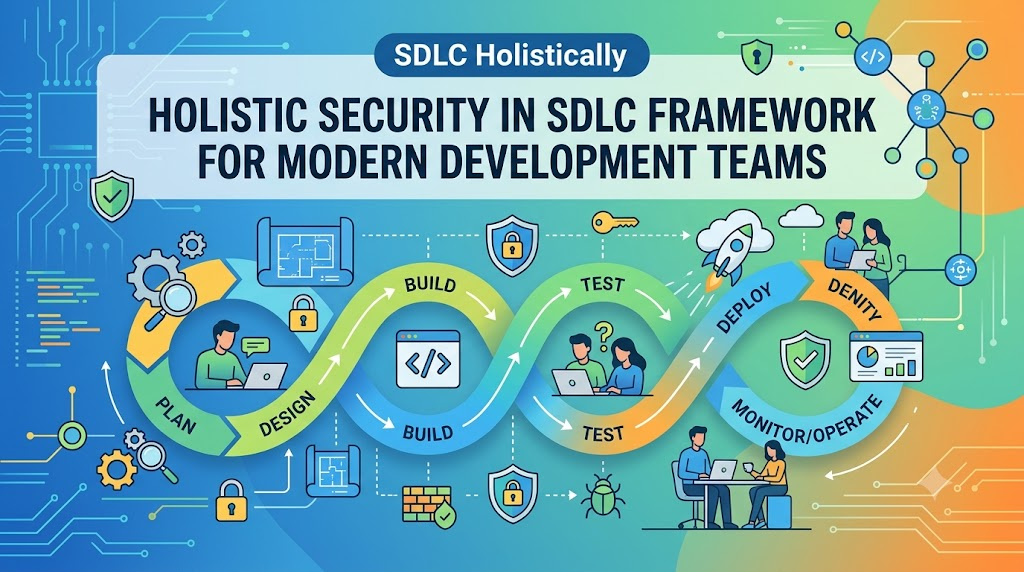
To implement security effectively, we must map specific activities to the standard phases of the development lifecycle.
| SDLC Phase | Security Activities |
| Requirements | Security risk assessment, compliance mapping, privacy impact analysis. |
| Design | Threat modeling, architecture review, selecting secure libraries. |
| Development | Static analysis, secure coding training, code peer reviews. |
| Testing | Dynamic analysis, fuzz testing, dependency vulnerability scanning. |
| Deployment | Hardened configurations, container security, secret management. |
| Maintenance | Continuous monitoring, incident response, patching cycles. |
Security During Requirements Gathering
Before a single line of code is written, security starts with requirements. This phase involves identifying what assets the application will handle—such as user data, financial records, or intellectual property—and determining the appropriate level of protection. Compliance requirements, such as GDPR or PCI-DSS, should also be defined here.
Practical Example: If you are building a payment module, the security requirements should explicitly mandate tokenization of card data, ensuring that sensitive information never touches your internal application servers.
Security in the Design Phase
The design phase is your greatest opportunity to prevent systemic vulnerabilities. This is where threat modeling becomes essential. Threat modeling is a structured approach to identifying potential threats to the system, such as unauthorized access, data leakage, or denial-of-service attacks.
Practical Example: During an architecture review, an engineer might realize that exposing an internal microservice directly to the public internet is a risk. By designing an API Gateway to handle authentication before traffic hits the internal service, the team addresses the security flaw before any code is written.
Secure Coding During Development
Development is where the rubber meets the road. Secure coding standards provide developers with a clear roadmap of “do’s and don’ts,” such as avoiding hardcoded credentials or using parameterized queries to prevent injection attacks.
Practical Workflow:
- Peer Review: Every pull request should include a review focused not just on functionality, but on potential security pitfalls.
- IDE Plugins: Utilize tools that alert developers to insecure coding patterns in real-time as they type.
- Local Scanning: Run lightweight security checks on the local machine before pushing code to the repository.
Security Testing in the SDLC
Testing should move beyond functional verification. It should include automated security testing tools that provide fast feedback.
- SAST (Static Application Security Testing): Analyzes the source code for known vulnerability patterns without executing the program.
- DAST (Dynamic Application Security Testing): Interacts with the running application to find vulnerabilities like cross-site scripting (XSS) or misconfigured headers.
- Dependency Scanning: Automatically checks third-party libraries for known vulnerabilities (CVEs).
Security During Deployment
When moving code to production, the focus shifts to infrastructure security. This involves ensuring that servers, containers, and cloud environments are hardened.
Practical Scenario: Never store database passwords or API keys in code repositories. Use secret management tools like HashiCorp Vault or cloud-native solutions to inject credentials at runtime, ensuring that if your source code is leaked, your production environment remains protected.
Continuous Security After Deployment
Security does not end at deployment. The threat landscape is constantly evolving, and new vulnerabilities are discovered daily.
- Continuous Monitoring: Use logging and alerting to detect abnormal behavior, such as a surge in failed login attempts.
- Vulnerability Management: Maintain a schedule for scanning production environments and updating dependencies.
- Incident Response: Have a well-rehearsed plan for how to contain, eradicate, and recover from a security incident.
How DevSecOps Supports Secure SDLC
DevSecOps is the cultural and technical marriage of development, security, and operations. It relies on Shift-Left Security, which pushes security activities as early into the development process as possible. By integrating security automation directly into the CI/CD pipeline, security checks become a non-negotiable part of the automated build process, providing immediate feedback to the developer who committed the code.
Real-World Example: Security Added Late in the SDLC
A company develops a new customer portal. The team focuses entirely on features and speed. One week before the scheduled release, a manual security audit reveals that the password reset mechanism is susceptible to account takeover. The launch is delayed by a month, the team faces intense pressure, and the cost of remediation is five times higher than it would have been if caught during the design phase.
Real-World Example: Security Integrated Throughout the SDLC
A team building a similar portal uses automated SAST and dependency scanning in their CI/CD pipeline. When a developer imports a library with a known vulnerability, the build automatically fails. The developer is alerted, sees the specific fix, updates the library, and pushes the code again within an hour. The security risk is eliminated without ever reaching the production environment.
Common Mistakes Organizations Make
- Treating security as a “security team” problem rather than an engineering problem.
- Relying solely on manual penetration testing right before release.
- Failing to update third-party dependencies regularly.
- Skipping threat modeling due to time constraints.
- Ignoring security logs and monitoring alerts.
Best Practices for Holistic SDLC Security
- Start Early: Security is cheapest and most effective during the design phase.
- Automate Everything: Make security testing a part of the automated build pipeline.
- Continuous Training: Keep development teams updated on the latest security threats and coding standards.
- Foster Collaboration: Break down the walls between developers, operations, and security teams.
- Adopt a Security-First Mindset: Encourage a culture where security is viewed as a hallmark of high-quality engineering.
Role of DevOpsSchool in Learning Secure SDLC Practices
Achieving a holistic security posture requires practical knowledge that goes beyond textbooks. DevOpsSchool provides an environment for professionals to gain hands-on experience with the tools and mindsets necessary for a secure software development lifecycle. Through curated learning paths, students can understand how to integrate security tools into CI/CD pipelines, learn the intricacies of DevSecOps awareness, and apply secure coding principles in real-world scenarios. Learning these skills in a structured, practical environment is often the missing piece for organizations transitioning to a more mature security culture.
Career Importance of Secure SDLC Knowledge
As the industry moves toward cloud-native and highly distributed systems, the demand for professionals who understand how to build secure systems is at an all-time high. Roles such as DevSecOps Engineer, Application Security Engineer, and Security Architect are critical for modern enterprises. Mastering the integration of security into the SDLC provides a clear career advantage, positioning engineers as strategic assets who can balance speed of innovation with the necessity of robust protection.
Industries Where Secure SDLC Is Critical
- Banking & Finance: Handling sensitive transactions and personal financial data requires stringent security at every step.
- Healthcare: Protecting patient privacy and electronic health records is both a legal and ethical imperative.
- E-Commerce: Ensuring the integrity of payment gateways and customer account protection is essential for maintaining trust.
- Government: Securing national infrastructure and citizen data against sophisticated threats.
- SaaS Companies: Protecting the multi-tenant environments where customer data resides is a core business survival requirement.
Future of Security in SDLC
The future of secure development lies in intelligent automation. We are seeing a move toward AI-assisted security reviews that can scan code for logic errors that traditional tools miss. Automated threat detection will become more predictive, and compliance will shift from a periodic “check-the-box” activity to continuous compliance, where the state of the system is automatically validated against security policies in real-time.
FAQs
- What is security in SDLC? It is the practice of embedding security processes into every phase of software development.
- Why is shift-left security important? It identifies vulnerabilities early, reducing costs and preventing production issues.
- What is threat modeling? A process of identifying potential security threats during the design phase.
- How does DevSecOps support SDLC security? By automating security testing and fostering collaboration between teams.
- What is SAST? Static Application Security Testing, which scans source code for vulnerabilities.
- What is DAST? Dynamic Application Security Testing, which scans the running application for vulnerabilities.
- Why is continuous monitoring necessary? To detect and respond to threats in real-time after deployment.
- Can small teams implement secure SDLC? Yes, by using automated tools and focusing on high-impact security practices.
- What is the difference between security and compliance? Security is the technical protection of systems, while compliance is meeting regulatory standards.
- How often should we perform security testing? It should be a continuous part of the CI/CD process.
- Do I need to be a security expert to write secure code? No, but you do need to understand secure coding practices and be security-conscious.
- Is penetration testing enough? No, it should be one part of a multi-layered security strategy.
- How do I start with threat modeling? Begin by mapping your data flow and asking “what could go wrong?” at each point.
- What is a secure coding standard? A set of guidelines that helps developers avoid common vulnerabilities like injection or broken authentication.
- Does security slow down development? Initially, it may require adjustments, but it eventually speeds up delivery by reducing rework and emergency patches.
Final Thoughts
Integrating security into your SDLC is not about slowing down innovation or adding layers of bureaucracy. It is about building a foundation that allows you to move faster with confidence. When security is embedded early, automated, and practiced by everyone on the team, it becomes an invisible but powerful force that elevates the quality of your software. Start small, focus on building the right habits, and prioritize collaboration. Security is not a product you buy; it is a discipline you practice every single day.
