Limited Time Offer!
For Less Than the Cost of a Starbucks Coffee, Access All DevOpsSchool Videos on YouTube Unlimitedly.
Master DevOps, SRE, DevSecOps Skills!
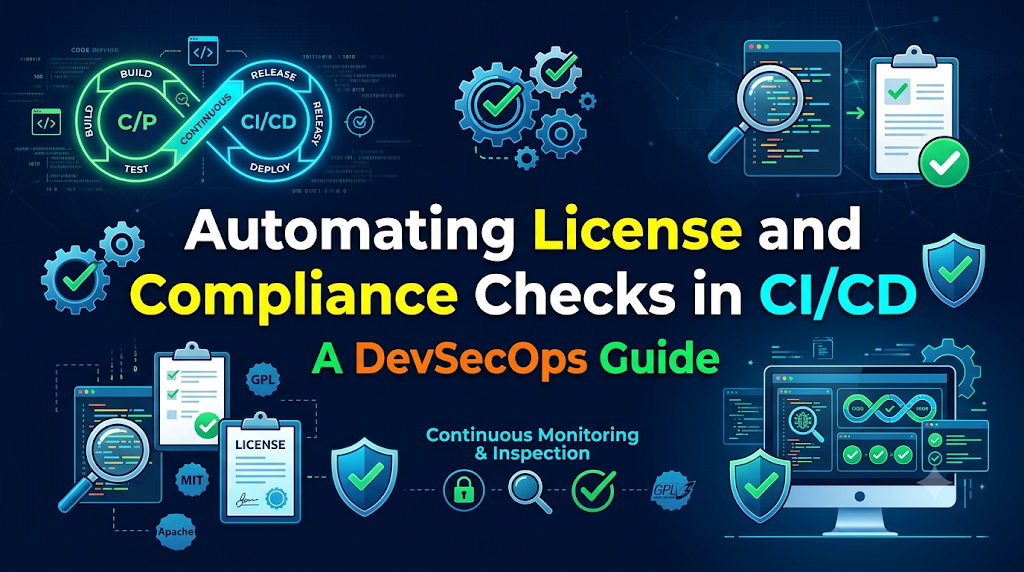
Modern software delivery depends heavily on open-source packages to assemble features rapidly, but importing third-party code without verifying its underlying terms exposes organizations to significant legal, financial, and operational risks. A single unvetted library carrying reciprocal terms can jeopardize an entire proprietary product if caught after release. As software engineering teams shift toward integrated DevSecOps practices—supported by knowledge-sharing communities like DevOpsSchool that champion continuous pipeline automation—shifting license checks left becomes an operational necessity. Embedding automated policy verification directly into delivery pipelines transforms software governance from a tedious manual barrier into an invisible, continuous guardrail that validates dependencies before code ever leaves development branches.
A Dependency Is Ready for Release, but Is It Compliant?
Imagine a typical Friday release cycle. A feature branch completes testing, unit tests pass with green checkmarks, integration tests report zero regressions, and container image builds succeed without a single memory leak. The team triggers the production release pipeline.
Inside that release sits a newly introduced third-party package—pulled in to generate PDF reports or format datetime strings. While the package functions flawlessly, it carries a reciprocal copyleft license requiring the entire proprietary codebase linking to it to be made publicly accessible under identical open terms.
Because nobody reviewed the package’s licensing terms before merge, this component travels straight to production.
+------------------+      +-------------------+      +----------------------+
| Feature Code     | ---> | Build & Unit Test | ---> |  Manual Audit Wait   |
| & New Dependency |      | (Tests Pass: 100%)|      | (2-3 Weeks / Ignored)|
+------------------+      +-------------------+      +----------------------+
                                                                |
                                                                v
                                                     [ Production Delivery ]
                                                     *High Risk: Undetected
                                                      Copyleft / Non-Compliant
                                                      Licenses Deployed*
This scenario repeats across industries. In modern architectures, third-party and open-source software (OSS) accounts for anywhere from 70% to 90% of an application’s total codebase. When teams delay license and compliance checks until after software is packaged, packaged artifacts carry operational, contractual, and legal risks.
Relying entirely on manual audits introduces three major failure points:
- Velocity Bottlenecks: Manual legal and security reviews take days or weeks. Developers grow frustrated, pipelines stall, and teams inevitably bypass manual sign-offs to meet delivery commitments.
- Human Error and Blind Spots: Complex projects contain transitive dependencies—libraries required by your direct dependencies. A project with 20 declared dependencies can easily pull in 600 transitive libraries. No manual reviewer can accurately parse every sub-dependency’s license manually.
- Late-Stage Remediation Costs: Discovering an incompatible license hours before a major product release forces frantic rollbacks, emergency architectural rewrites, or delayed contracts.
License checks must happen early in the pipeline, evaluating every direct and transitive component before artifacts reach staging or production registries.
Understanding the Difference Between License Management and Compliance
Engineering discussions often conflate license management, software compliance, and security vulnerability scanning. While they intersect, each concept addresses a distinct dimension of risk.
+-----------------------------------------------------------------------------+
|                            SOFTWARE GOVERNANCE                              |
+------------------------------------+----------------------------------------+
|       Vulnerability Security       |      License & Legal Compliance        |
+------------------------------------+----------------------------------------+
| Focus: Exploitability & Flaws     | Focus: Legal Rights & Obligations      |
| Goal:  Prevent CVEs, Breaches, RCE | Goal:  Adhere to Author Terms, IP Safe |
| Fix:   Upgrade patch, apply WAF    | Fix:   Replace library, obtain license |
+------------------------------------+----------------------------------------+
- Software Licensing: A software license is a legal instrument governing the use, modification, and redistribution of software. Open-source licenses grant developers permission to utilize third-party code under explicit obligations defined by the author.
- Software Compliance: Software compliance is the operational practice of ensuring that the organization honors all legal, regulatory, organizational, and contractual obligations associated with every line of code deployed.
- Security vs. License Obligations: A component can be completely secure (zero Common Vulnerabilities and Exposures, or CVEs) while being legally non-compliant for commercial distribution. Conversely, a package with a fully permissive MIT license might harbor critical remote code execution flaws. Both aspects must be checked, but their evaluation criteria differ.
- Visibility Across Assets: Organizations must track internally developed business logic, direct dependencies, transitive packages, and third-party binaries to establish full supply chain transparency.
Common Open-Source License Categories
To manage risk systematically, compliance teams categorize licenses based on the obligations they impose:
| License Category | Characteristics | Key Obligations | Common Examples |
| Permissive | Minimal restrictions on reuse, modification, and distribution. Highly commercial-friendly. | Retain copyright notice and license text in distributions. | MIT, Apache 2.0, BSD (2-Clause / 3-Clause), ISC |
| Weak Copyleft | Requires modified source code of the specific library to remain open, but permits proprietary linking. | Share modifications to the library; maintain notices. | LGPL (2.1 / 3.0), MPL 2.0, EPL 2.0 |
| Strong Copyleft | Reciprocal terms apply to derivative works and statically/dynamically linked codebases. | Entire distributed application source must be made available under the same license. | GPL v2, GPL v3, AGPL v3 |
| Proprietary / Commercial | Closed-source licenses with custom usage fees, seat limits, or redistribution limits. | Payment, seat tracking, redistribution prohibitions. | Commercial vendor SDKs |
Note: These descriptions provide practical engineering context and do not constitute formal legal advice. Organizations should consult qualified legal counsel to define their official corporate license policies.
How a CI/CD Pipeline Can Verify Compliance Automatically
Automated compliance verifies that every commit, pull request, and build artifact adheres to policy rules without requiring human sign-off for standard, approved packages.
+----------------------------------------------------------------------------------------------------+
|                                    CI/CD PIPELINE STAGES                                           |
+--------------+     +--------------+     +--------------+     +--------------+     +--------------+ |
| 1. Source    | --> | 2. Package   | --> | 3. SCA &     | --> | 4. Policy    | --> | 5. Gate &    | |
|    Checkout  |     |    Discovery |     |    License ID|     |    Evaluation|     |    Reporting | |
+--------------+     +--------------+     +--------------+     +--------------+     +--------------+ |
       |                    |                    |                    |                    |         |
       v                    v                    v                    v                    v         |
 Fetch Commit        Parse Lockfiles      Identify Dual/       Pass / Warn /        Export SBOM    |
 & Manifests         (npm, Maven, Go)     Ambiguous Licenses   Block Build          & Audit Logs   |
+----------------------------------------------------------------------------------------------------+
The Step-by-Step CI/CD Verification Workflow
- Source Code Checkout: The runner pulls the exact commit, branch, or release tag alongside its manifests and lockfiles.
- Dependency and Package Discovery: The pipeline resolves the complete dependency tree, capturing direct, transitive, build-time, and runtime dependencies.
- Software Composition Analysis (SCA): The SCA engine unpacks archives, inspects package declarations, scans license file headers, and resolves ambiguous metadata.
- License Identification: The tool identifies the specific SPDX (Software Package Data Exchange) identifier (e.g.,
Apache-2.0,MIT,GPL-3.0-only) for each package. - Policy Evaluation: The pipeline engine matches identified licenses against organizational policy rules (approved, conditional, prohibited).
- Compliance Report Generation: The system outputs structured formats (JSON, CSV, PDF) listing component names, versions, detected licenses, and compliance states.
- Approval, Warning, or Pipeline Failure:
- Approved: Build proceeds directly to artifact publishing.
- Warning: Non-blocking notice posted to pull request for review.
- Failure: Pipeline aborts, blocking deployment due to policy breach.
- Audit Record Storage: Signed compliance reports and generated metadata are pushed to secure artifact repositories or compliance registries for historical verification.
Designing License Policies That Developers Can Follow
Automated checks are only as effective as the policies driving them. If compliance teams define vague or overly restrictive rules, developers encounter friction and seek workarounds. Policies must be explicit, transparent, and encoded directly into configuration files.
+------------------------------------------------------------------------------+
|                        TIERED LICENSE POLICY STRUCTURE                       |
+------------------------------------------------------------------------------+
|  [GREEN TIER]  Approved: MIT, Apache-2.0, BSD-2/3-Clause, ISC                |
|                -> Pipeline passes automatically; no review needed.           |
+------------------------------------------------------------------------------+
|  [AMBER TIER]  Conditional: LGPL-3.0 (Dynamic only), MPL-2.0                 |
|                -> Requires automated linking validation or lead approval.     |
+------------------------------------------------------------------------------+
|  [RED TIER]    Prohibited: GPL-2.0, GPL-3.0, AGPL-3.0, SSPL, Unknown         |
|                -> Pipeline breaks immediately; pull request blocked.         |
+------------------------------------------------------------------------------+
Key Components of an Engineering-Ready License Policy
- Approved License Lists (Green Tier): Permissive licenses permitted across all microservices and distributed binaries without prior review. Typical members: MIT, Apache 2.0, BSD 2-Clause/3-Clause.
- Restricted and Prohibited Licenses (Red Tier): Licenses that expose the organization’s proprietary codebase to unacceptable redistribution obligations. Examples often include AGPL 3.0, SSPL, or GPL 3.0 in proprietary SaaS and client-side applications.
- Conditional Approval Rules (Amber Tier): Licenses permitted under strict operational conditions. For instance, LGPL may be approved only if dynamically linked via shared libraries (
.so/.dll), but prohibited if statically compiled into an executable binary. - Attribution and Notice Requirements: Permissive licenses mandate that the original author’s copyright notice and license text accompany distributed binaries. The pipeline should collect and bundle these notices into a generated
NOTICEorTHIRD-PARTY-LICENSESfile automatically during build packaging. - License Exception Processes: A documented mechanism allowing development teams to request temporary waivers for business-critical packages while alternative implementations are developed.
- Clear Ownership and Responsibilities: Identifying who manages approvals—DevSecOps engineers handle scanner rules, engineering leads approve package substitutions, and legal teams handle exception reviews.
Turning Compliance Rules Into Pipeline Checks
To see compliance automation in practice, examine how policy rules can be declared as code and enforced directly within a continuous delivery pipeline.
Below is an example declarative pipeline configuration illustrating how an SCA scanning stage integrates into a standard CI/CD workflow (such as GitHub Actions or GitLab CI) using open-source tools like Trivy, Syft, or FOSSA CLI.
Pipeline Configuration (GitHub Actions Example)
YAML
name: Continuous Integration & Compliance Gate

on:
  pull_request:
    branches: [ "main" ]
  push:
    branches: [ "main" ]

jobs:
  build-and-verify:
    runs-on: ubuntu-latest
    steps:
      - name: Checkout Source Code
        uses: actions/checkout@v4

      - name: Set up Application Runtime
        uses: actions/setup-node@v4
        with:
          node-version: '20'
          cache: 'npm'

      - name: Install Project Dependencies
        run: npm ci

      - name: Run Unit and Integration Tests
        run: npm test

      # Step 1: Scan for Software Composition and License Compliance
      - name: Run Automated License Compliance Scanner
        uses: aquasecurity/trivy-action@master
        with:
          scan-type: 'fs'
          scan-ref: '.'
          scanners: 'license'
          severity: 'HIGH,CRITICAL'
          exit-code: '1' # Fail pipeline on prohibited license detection
          ignore-unfixed: true
          output: 'license-report.json'
          format: 'json'

      # Step 2: Generate CycloneDX SBOM for Auditing
      - name: Generate CycloneDX SBOM
        uses: CycloneDX/gh-node-module-action@v1
        with:
          output: 'bom.json'

      # Step 3: Archive Reports and Compliance Artifacts
      - name: Archive Compliance Reports
        if: always()
        uses: actions/upload-artifact@v4
        with:
          name: compliance-audit-package
          path: |
            license-report.json
            bom.json
Explaining the Pipeline Mechanics
- Lockfile Enforcement (
npm ci): The workflow enforces clean dependency installations based strictly onpackage-lock.json. This prevents transient version drifts from introducing unverified licenses during build execution. - Dedicated License Scanner Execution: The compliance scanner inspects the filesystem, resolving the declared dependencies against a centralized policy database. Setting
exit-code: '1'converts policy non-compliance into an immediate pipeline exit signal, halting deployment before downstream containerization or publishing happens. - Automated SBOM Generation: Generating a CycloneDX SBOM during build time guarantees that an immutable, standardized inventory of all components travels alongside the artifact.
- Artifact Retention: Even if the build fails, the pipeline archives the generated
license-report.jsonandbom.json, providing developers and security engineers with immediate debugging data.
What Should Happen When a License Violation Is Detected?
When automated compliance checks fail a build, clear operational workflows ensure that the finding is addressed efficiently without disrupting project timelines.
[ License Violation Triggered in CI ]
                  |
                  v
[ Pull Request Comment Posted With Context ]
 (Offending Package, License Type, Policy Rule)
                  |
                  v
       < Can Dependency Be Swapped? >
         /                          \
       YES                           NO
       /                              \
[ Replace with Permissive     [ Open Formal Exception Request ]
  Alternative & Re-run CI ]            |
                                       v
                              [ Legal / Security Triage ]
                                /                     \
                            APPROVED                REJECTED
                              /                         \
                   [ Add Temporary Hash      [ Rewrite Functionality or
                     to Exception File ]       Source Proprietary Lib ]
                              |
                              v
                   [ Pipeline Passes via Exception ]
The Resolution Lifecycle
- Actionable Developer Feedback: The scanner comments directly on the pull request, identifying the offending package, its location in the dependency tree, the violated policy rule (e.g.,
GPL-3.0 detected in runtime production build), and links to approved alternatives. - Triage and Investigation: The developer and security lead determine whether the package is a direct dependency or pulled in transitively.
- Evaluating Alternatives: The simplest path is swapping the non-compliant library for one that carries an approved permissive license (e.g., replacing an AGPL-licensed parsing library with an MIT-licensed alternative).
- Formal Exception Routing: If no direct replacement exists and the component is critical, the team initiates an exception request. Legal counsel evaluates the distribution pattern (e.g., internal-only tooling vs. distributed commercial binary).
- Documenting the Waiver: Approved exceptions are recorded in an encrypted policy file (e.g.,
.compliance-allowlist.json) specifying package name, version, expiration date, and approving ticket ID. - Pipeline Re-execution: The developer commits the fix or the recorded waiver, and the CI/CD pipeline runs again, verifying compliance and clearing the release gate.
Compliance Checks Across Different Delivery Environments
Modern software delivery spans multiple architectures, each introducing distinct compliance challenges.
+-------------------------------------------------------------------------------+
|                       DELIVERY ENVIRONMENT COMPLEXITY                         |
+----------------------+--------------------------------+-----------------------+
| Environment          | Key Compliance Challenge       | Automation Focus      |
+----------------------+--------------------------------+-----------------------+
| Containers           | Layer bloat; OS-level packages | Image base layer scan |
| Microservices        | Distributed, polyglot repos    | Centralized policies  |
| Cloud-Native / FaaS  | Bundled ephemeral libraries    | Build-time packaging  |
| Mobile / Client-Side | Binaries leave the organization| Strict copyleft check |
| Internal Registries  | Upstream transitive poisoning  | Registry ingest gates |
+----------------------+--------------------------------+-----------------------+
Containers and Multi-Stage Builds
In containerized deployments, dependencies exist at two levels: application dependencies (e.g., Python wheels, Node.js modules) and operating system packages (e.g., apt, apk, rpm).
A minimal container image might inherit an unapproved library installed through an OS-level package manager. Multi-stage Docker builds isolate build-time tools from production runtimes. Scanning container images post-build ensures that the final production base layer remains free of prohibited packages.
Dockerfile
# Build Stage: Compiles code and downloads build dependencies
FROM node:20-alpine AS builder
WORKDIR /app
COPY package*.json ./
RUN npm ci
COPY . .
RUN npm run build

# Production Stage: Only runtime dependencies and verified artifacts
FROM node:20-alpine
WORKDIR /app
COPY package*.json ./
RUN npm ci --only=production
COPY --from=builder /app/dist ./dist
# Compliance scanner evaluates this final image
USER node
CMD ["node", "dist/index.js"]
Microservices and Distributed Architectures
Microservices architectures distribute code across dozens of repositories written in different languages (Go, Java, Python, Rust). Compliance policies cannot be managed manually across hundreds of individual build scripts.
Instead, organizations maintain centralized, shared pipeline templates (e.g., reusable GitHub Actions or GitLab CI includes) that pull rules from a central policy repository, ensuring consistent compliance standards across every microservice.
Client-Side and Mobile Applications vs. SaaS
License obligations often hinge on distribution. Strong copyleft licenses such as the GPL trigger reciprocal release obligations when software binaries are distributed to external devices (e.g., desktop clients, embedded firmware, iOS/Android apps).
For internal SaaS platforms that run entirely on cloud infrastructure, standard GPL obligations may not trigger, whereas AGPL (Affero GPL) specifically addresses network-hosted software. Pipelines must apply distinct policy sets depending on whether the target build produces a distributed client binary or an internal backend service.
Connecting Compliance Automation With SBOM and Software Supply Chain Security
A Software Bill of Materials (SBOM) is an immutable, machine-readable inventory of all components, libraries, modules, and dependencies included in an application, along with their hierarchical relationships and license details.
+--------------------+      +-------------------------------------------------------+
|  Application Code  | ---> |                   SBOM GENERATION                     |
+--------------------+      |                                                       |
| Direct Packages    | ---> |  [CycloneDX / SPDX Standard File]                     |
+--------------------+      |  - Component Names & Exact Versions                  |
| Transitive Libs    | ---> |  - Cryptographic Hashes (SHA-256)                     |
+--------------------+      |  - Extracted SPDX License Identifiers                 |
| OS Base Packages   | ---> |  - Dependency Tree & Parentage                        |
+--------------------+      +-------------------------------------------------------+
                                                        |
                                                        v
                                         [ Continuous Compliance Ledger ]
                                         - Instant Search for At-Risk Licenses
                                         - Cross-referencing against new CVEs
                                         - Regulatory & Client Audits
Open Standards: SPDX and CycloneDX
Two primary open standards govern modern SBOM generation:
- SPDX (Software Package Data Exchange): An international standard (ISO/IEC 5230:2020) designed to communicate open-source licenses, copyrights, component metadata, and security references.
- CycloneDX: An industry standard developed by the OWASP community, engineered explicitly for application security contexts, software supply chain verification, and dependency analysis.
Embedding SBOM Generation Into the Release Pipeline
Integrating automated SBOM generation into CI/CD transforms release governance:
- Audit Readiness on Demand: Rather than spending weeks assembling component spreadsheets during regulatory audits, compliance teams can export cryptographic SBOMs generated directly by the build pipeline.
- Continuous Monitoring Beyond Deployment: When an open-source author changes an upstream license from MIT to a restrictive license on an existing version, organizations can query their centralized SBOM repository to instantly locate all affected deployed microservices.
- Unified Supply Chain Defense: Software Composition Analysis, SBOM generation, container scanning, and cryptographic signing (using tools such as Sigstore/Cosign) operate synergistically. The pipeline verifies what goes into the artifact, validates its licensing, generates the inventory, and cryptographically signs the final build.
Selecting Tools for Automated License Compliance
Selecting the right tooling determines whether compliance checks enhance velocity or introduce friction. Organizations should evaluate tools across technical and operational capabilities.
+--------------------------------------------------------------------------------+
|                        TOOL EVALUATION MATRIX CRITERIA                         |
+-------------------------+------------------------------------------------------+
| Capability              | What to Look For                                     |
+-------------------------+------------------------------------------------------+
| License Detection       | Deep file-header parsing, dual-license handling,     |
|                         | and transitive resolution (beyond top-level manifests|
+-------------------------+------------------------------------------------------+
| Ecosystem Coverage      | Native support for your tech stack (npm, PyPI, Maven,|
|                         | Go, NuGet, Cargo, Linux OS packages)                 |
+-------------------------+------------------------------------------------------+
| Policy Engine           | Flexible policy rules (allow, deny, conditional,     |
|                         | path-based exceptions, environment-specific filters) |
+-------------------------+------------------------------------------------------+
| CI/CD Integration       | Native CLI, zero-friction runners, PR feedback,      |
|                         | deterministic exit codes for pipeline gates          |
+-------------------------+------------------------------------------------------+
| Output & SBOM Support   | Industry standard exports (SPDX, CycloneDX, JSON)     |
+-------------------------+------------------------------------------------------+
Representative Tool Categories
- Open-Source Command-Line Tools: Tools such as Trivy (Aqua Security), Syft (Anchore), and License-Checker provide lightweight, CLI-first scanning suitable for direct integration into GitHub Actions, GitLab CI, and Jenkins without external server dependencies.
- Enterprise DevSecOps Platforms: Solutions such as Snyk, FOSSA, Sonatype Nexus Lifecycle, Checkmarx SCA, and Mend offer centralized policy engines, automated remediation pull requests, deep legal workflows, and enterprise compliance reporting.
- Specialized Compliance Frameworks: Open-source projects such as ScanCode Toolkit and FOSSology provide deep forensic license extraction, ideal for comprehensive compliance verification of embedded firmware and commercial distributed installers.
When selecting an approach, prioritize tools that integrate directly into developer workflows (providing clear terminal outputs and pull-request comments) rather than standalone web dashboards that isolate compliance from day-to-day coding.
Measuring Whether the Automation Is Working
Automating compliance is an ongoing operational capability, not a one-time project. Teams should track measurable indicators to verify that automated checks reduce risk without harming developer productivity.
+------------------------------------------------------------------------------+
|                     KEY COMPLIANCE HEALTH INDICATORS                         |
+------------------------------------------------------------------------------+
| [ Coverage ]        Percentage of CI/CD pipelines enforcing license scans   |
| [ Visibility ]      Ratio of resolved dependencies with confirmed licenses   |
| [ Velocity ]        Mean Time to Remediate (MTTR) compliance findings        |
| [ Friction ]        Pipeline false-positive failure rate                     |
| [ Governance ]      Active non-expired exceptions vs. total dependencies     |
+------------------------------------------------------------------------------+
Meaningful Metrics to Monitor
- License Identification Coverage: The percentage of declared and transitive dependencies with resolved licenses. An effective scanner should maintain an identification rate above 98%, leaving minimal “unknown” licenses.
- Active Policy Violations: The total number of unaddressed license violations in active feature branches and mainline branches. This number should trend toward zero.
- Mean Time to Remediate (MTTR) Compliance Findings: The time elapsed from when an unapproved license is detected in a pull request to when the developer swaps the package or receives a validated exception.
- Pipeline Scan Adoption Rate: The percentage of active repositories within the organization that have incorporated automated compliance gates into their primary delivery branches.
- Exception Volume and Longevity: Tracking how many exceptions are requested, approved, and allowed to expire. A healthy governance process prevents temporary exceptions from becoming permanent technical debt.
Common Implementation Problems and How to Avoid Them
Implementing compliance automation surfaces several operational hurdles. Recognizing these pitfalls helps teams build a smoother rollout.
+------------------------------------+-----------------------------------------+
| Common Challenge                   | Practical Engineering Solution          |
+------------------------------------+-----------------------------------------+
| Incomplete / Missing Metadata      | Enforce secondary file-header scanners  |
| False Positives Halt Pipelines     | Support non-blocking warning thresholds |
| Multi-License Declarations (Dual)  | Configure choice-rules in policy engine |
| Bypassed / Ignored Pipeline Checks | Enforce branch protection rules in SCM  |
| Stale or Unreviewed Exceptions     | Apply auto-expiring exception metadata  |
+------------------------------------+-----------------------------------------+
1. Incomplete or Missing License Metadata
Many open-source packages omit a formalized license field in their manifest, burying terms inside an unreferenced LICENSE.txt or individual source file headers. When scanners encounter this, they classify the package as “Unknown,” triggering pipeline failures.
- Solution: Use scanners capable of both manifest parsing and fuzzy file-header matching. Provide an internal directory of verified overrides for well-known open-source packages with imperfect manifests.
2. Dual-Licensed Packages
Certain widely used projects are dual-licensed (e.g., licensed under both GPL-2.0 and Apache-2.0, letting the user choose which terms to follow). Poorly configured scanners often flag the GPL term and block the build unnecessarily.
- Solution: Configure your compliance policy engine to evaluate disjunctive expressions (
ORconditions) according to corporate policy, automatically selecting the permissive alternative when available.
3. Pipeline Fatigue and False Positives
If a newly introduced scanner suddenly fails 200 existing pull requests across an active engineering organization, developers will demand that the gate be disabled.
- Solution: Adopt a phased rollout:
- Phase 1 (Audit Mode): Run scans in non-blocking mode (
exit-code: 0), logging findings and generating reports without halting builds. - Phase 2 (PR Feedback): Post informative warnings directly to pull requests so developers see findings during code reviews.
- Phase 3 (Strict Enforcement): Turn on hard pipeline breaks exclusively for high-risk violations (e.g., AGPL in distributed software) on new pull requests, while grandfathering existing legacy code under structured remediation backlogs.
- Phase 1 (Audit Mode): Run scans in non-blocking mode (
4. Bypassing Checks via Emergency Overrides
Developers under release deadlines may use flags like --no-verify or disable pipeline jobs to push critical patches.
- Solution: Enforce branch protection rules within GitHub, GitLab, or Bitbucket. Require the automated compliance gate status check to pass before merging is permitted, and restrict pipeline modification permissions to platform and security teams.
Frequently Asked Questions
Why should license checks be automated in CI/CD?
Automating license checks in CI/CD shifts compliance reviews directly into daily developer workflows. It catches incompatible or restrictive open-source licenses early, prevents manual audit bottlenecks, and ensures non-compliant dependencies never reach production environments.
Can a CI/CD pipeline detect open-source licenses accurately?
Yes. Modern Software Composition Analysis (SCA) tools evaluate package manifests, lockfiles, readme files, and source code headers. They cross-reference detected text against standard SPDX databases to identify exact license terms and obligations.
What is the difference between SCA and license compliance scanning?
License compliance scanning is a core feature of Software Composition Analysis (SCA). While SCA platforms assess security vulnerabilities (CVEs) and code health, license compliance scanning specifically extracts legal terms, copyright notices, and usage obligations.
Can a pipeline block a release because of a license violation?
Yes. By configuring the scanner CLI to return a non-zero exit code (exit 1) upon encountering a prohibited license, the CI/CD orchestrator treats the finding as a build failure, preventing artifact publishing and deployment.
How does an SBOM help with compliance audits?
An SBOM provides an up-to-date, machine-readable inventory of all direct and transitive components, their versions, cryptographic hashes, and associated licenses. This enables compliance teams to answer auditor inquiries immediately without rescanning legacy production environments.
Which open-source licenses require special attention in commercial software?
Strong copyleft licenses (such as GPL v2/v3 and AGPL v3) require careful scrutiny because they can mandate sharing the surrounding application’s source code upon distribution or network deployment. Weak copyleft licenses (like LGPL and MPL) also require validation regarding linking methods and source modification disclosure.
Should license checks run on every pull request?
Running lightweight license checks on pull requests ensures developers receive immediate feedback before merging code. It is far easier to swap an alternative package during initial development than to re-architect an application days before production release.
Can compliance automation replace legal review?
No. Automation enforces technical rules and policies established by legal professionals. While scanners handle repetitive discovery and verification across thousands of dependencies, corporate legal teams must define policies, review complex license conflicts, and approve formal exceptions.
Closing Perspective: Compliance Should Travel With Every Build
Open-source components accelerate modern software engineering, allowing organizations to deliver sophisticated capabilities quickly. However, relying on third-party software means taking responsibility for its legal obligations. Treating compliance as a sporadic, manual audit turns legal and security teams into release blockers. By encoding license policies into machine-readable rules, validating dependencies at every pull request, generating immutable SBOMs, and integrating automated compliance gates directly into CI/CD pipelines, organizations create a sustainable delivery environment. Compliance should not be an afterthought waiting at the end of a release cycle—it should travel invisibly, continuously, and reliably with every build.
