Limited Time Offer!
For Less Than the Cost of a Starbucks Coffee, Access All DevOpsSchool Videos on YouTube Unlimitedly.
Master DevOps, SRE, DevSecOps Skills!
Introduction
Modern software delivery moves at an unprecedented velocity. Automated build, test, and deployment workflows execute hundreds of times a day, pushing code from version control repositories directly into production cloud environments. However, this velocity introduces a hidden security vulnerability: the reliance on long-lived static credentials to bridge the gap between automation servers and external resources.
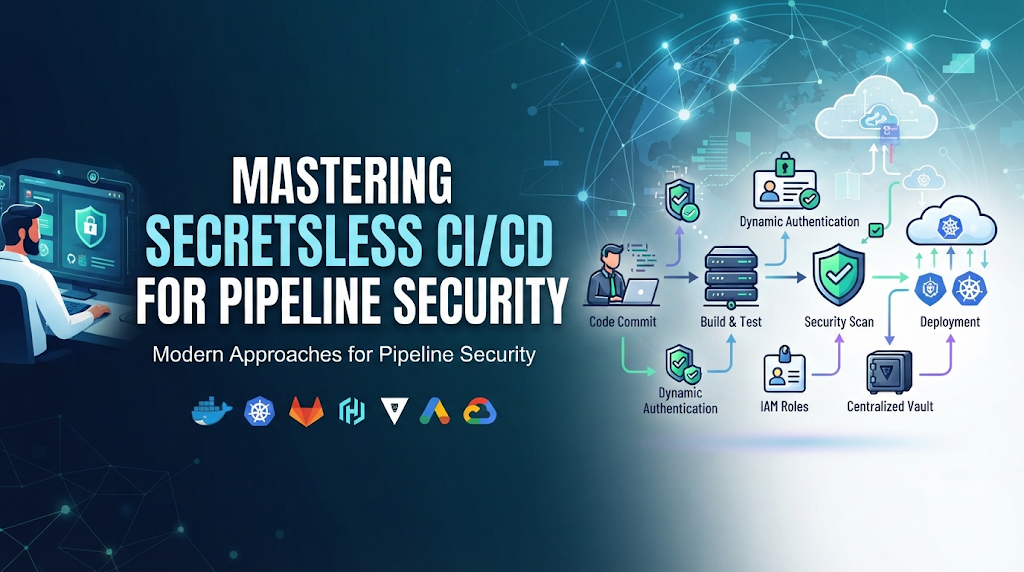
For developers, platform engineers, and security professionals looking to build robust architectures, mastering modern pipeline security is critical. Organizations seeking structured training paths often look to learning platforms like DevOpsSchool to help professionals develop comprehensive DevOps and DevSecOps skills. Building secure pipelines requires moving beyond traditional secret storage to adopt modern identity-based trust. This article explores how secretsless CI/CD uses workload identity, federated authentication, and short-lived credentials to remove static secrets from your automation ecosystems.
The Hidden Credential Problem Inside CI/CD Pipelines
Consider a typical scenario: A team configures an automated build pipeline to deploy a containerized microservice to a cloud environment. To allow the CI/CD runner to authenticate with the cloud provider, an administrator generates a long-lived cloud access key and secret access key, storing them securely within the CI/CD platform’s encrypted environment variables.
While this practice is widespread, it introduces significant risk. If an engineer accidentally prints environment variables in a build log, pushes a configuration file containing credentials to a public repository, or if a malicious actor compromises a build runner, that long-lived credential falls into unauthorized hands. Because the key does not expire automatically, attackers gain persistent access to cloud resources, infrastructure, and sensitive data until the key is manually revoked.
This introduces a central question for modern architecture: Can a pipeline securely access cloud resources and external services without keeping permanent credentials stored anywhere in the system?
What Secretsless CI/CD Actually Means
To understand how modern pipelines solve this problem, it is necessary to define the core concepts that form the foundation of secretsless automation.
Traditional Secrets-Based Authentication
In traditional setups, a pipeline authenticates using a pre-configured secret (such as a password, API key, or private key) that remains valid indefinitely until explicitly changed or revoked. The application or pipeline proves who it is by presenting this static secret.
Identity-Based Authentication
Identity-based authentication shifts the paradigm from what you know or possess (a static secret) to who you are based on cryptographic proof of identity. The system evaluates the context of the workload—such as its repository name, branch, organization, and execution environment—to verify its authenticity.
Short-Lived Credentials
Rather than using permanent keys, secretsless systems generate temporary access tokens that remain valid for only a few minutes or hours. Once the deployment task completes, the credential expires automatically, drastically reducing the window of opportunity for attackers.
Workload Identity
Workload identity treats a running CI/CD job or container as a distinct software entity with its own cryptographic identity. Instead of provisioning human-managed secrets, the cloud platform or identity provider issues a verifiable token directly to the workload.
Credential Issuance and Expired Lifecycles
In a secretsless model, credentials are not stored; they are dynamically requested, issued on-demand, used immediately for a specific operation, and left to expire.
Clarification: “Secretsless” does not mean that encryption keys, database passwords, or third-party API tokens vanish from the universe entirely. Rather, it means eliminating stored, long-lived credentials from pipeline configurations, environment variables, and static secret stores, replacing them with dynamic, identity-verified token exchanges.
Why Static Credentials Are Difficult to Secure
Organizations often rely on secret managers to store static credentials, assuming that encryption at rest solves the underlying security challenge. However, static credentials present inherent operational and architectural vulnerabilities:
- Storage and Distribution: Storing secrets in configuration files, CI/CD environment variables, or even external secret vaults requires the pipeline to read and decrypt those secrets during execution, creating opportunities for exposure.
- Manual Rotation Requirements: Long-lived keys require disciplined rotation schedules. If rotation fails or is delayed, compromised keys remain active indefinitely.
- Accidental Exposure in Logs: Misconfigured build steps, debugging flags, or verbose error logs can easily leak sensitive tokens into plain-text output streams.
- Excessive Permissions: Static credentials are often provisioned with broad, permissive access scopes to prevent build failures, violating the principle of least privilege.
- Shared Environments: When multiple pipelines share the same deployment key, isolating the blast radius of a security breach becomes extremely difficult.
- Compromised Build Agents: If an attacker executes malicious code on a shared build runner, they can harvest any static credentials loaded into the runner’s memory or environment.
- Audit Blind Spots: Tracking which specific pipeline run or developer used a static key at a given moment is often difficult with traditional access logs.
The Identity-Based Architecture Behind Secretsless Pipelines
To achieve a secretsless workflow, pipelines must establish trust dynamically. Instead of storing a permanent key, the CI/CD platform acts as an OpenID Connect (OIDC) identity provider that issues a signed JSON Web Token (JWT) attesting to the workload’s identity.
Core Architectural Components
- CI/CD Workload Identity: The specific pipeline execution context (e.g., repository, workflow file, pull request branch).
- Identity Provider (IdP): The system that verifies the workload and issues an OIDC token (such as GitHub, GitLab, or an enterprise IdP).
- OpenID Connect (OIDC) Token: A short-lived, cryptographically signed token containing claims about the running job.
- Trust Relationship: A pre-configured trust link established between the target cloud provider and the CI/CD identity provider.
- Token Exchange: The process where the cloud provider validates the OIDC token and issues temporary native cloud credentials (e.g., AWS STS temporary security credentials).
- Target Resource: The cloud service or infrastructure accessed securely using the short-lived token.
Conceptual Architecture Flow
Plaintext
+-------------------+      1. Request JWT      +-------------------+
|   CI/CD Runner    | -----------------------> |    CI/CD Platform |
| (Running Pipeline)|                          |    (OIDC Issuer)  |
+-------------------+                          +-------------------+
          |                                              |
          | 2. Returns OIDC Token                        |
          v                                              |
+-------------------+      3. Exchange for     +-------------------+
|   Cloud Provider  | <----------------------- |   Signed JWT      |
|    (IAM / STS)    |    Temporary Credentials |   (Short-lived)   |
+-------------------+                          +-------------------+
          |
          | 4. Grants Short-Lived Access
          v
+-------------------+
| Target Resources  |
| (Deploy / Storage)|
+-------------------+
Modern Authentication Approaches to Explore
Different environments and architectures leverage specific protocols to implement identity-based security.
- OIDC Federation: Allows external platforms (like CI/CD runners) to authenticate against cloud services without storing cloud keys, leveraging cryptographic identity tokens issued on the fly.
- Workload Identity: Binds native application or pipeline execution contexts directly to cloud IAM roles, ensuring permissions are scoped precisely to the running task.
- Short-Lived Credentials: Employs temporary security tokens with strict expirations, minimizing the utility of intercepted credentials.
- Managed Identities: Utilizes platform-native identity assignment where cloud-hosted runners automatically inherit authenticated access to sibling services.
- SPIFFE and SPIRE: Standards-based frameworks that provide secure, cryptographically verifiable workload identities across heterogeneous infrastructure, microservices, and hybrid cloud environments.
- Zero-Trust Access: Enforces continuous identity verification, contextual authorization, and strict least-privilege principles, assuming no network segment or runner is inherently trusted.
These approaches solve distinct layers of the security stack. For instance, OIDC federation handles initial authentication between a CI/CD platform and a cloud provider, whereas SPIFFE/SPIRE manage fine-grained service-to-service authentication inside runtime clusters.
Practical Implementation: Storing Zero Static Cloud Keys
To see how this works in practice, let us examine how a modern CI/CD workflow (such as GitHub Actions) authenticates to a cloud provider (such as AWS) using OIDC federation instead of a stored access key.
Step-by-Step Implementation Flow
- Identify the Workload Identity Claims: Determine the repository name, branch, and environment name that will form the unique signature of the pipeline.
- Configure a Trusted Identity Relationship: In the cloud provider’s IAM console, configure an Identity Provider pointing to the CI/CD platform’s issuer URL and audience.
- Define Permitted Trust Conditions: Establish strict trust policies ensuring that only the specific repository and authorized branches (e.g.,
main) can assume the role. - Assign Minimum Required Permissions: Attach an IAM policy granting only the specific permissions needed for the deployment (e.g., uploading to an S3 bucket or updating an ECS service).
- Request an Identity Token in the Pipeline: Configure the workflow file to request an OIDC token from the runner environment.
- Exchange the Token for Temporary Credentials: Use an official cloud provider action or CLI command to exchange the OIDC token for temporary STS credentials.
- Perform Deployment Operations: Execute deployment steps using the temporary session credentials.
- Verify Credential Expiry: Ensure the session automatically terminates immediately after the workflow job completes.
Illustrative Workflow Configuration Snippet
YAML
permissions:
  id-token: write
  contents: read

jobs:
  deploy:
    runs-on: ubuntu-latest
    steps:
      - name: Checkout Code
        uses: actions/checkout@v4

      - name: Authenticate to Cloud via OIDC
        uses: aws-actions/configure-aws-credentials@v4
        with:
          role-to-assume: arn:aws:iam::123456789012:role/MyCI_CD_DeploymentRole
          aws-region: us-east-1

      - name: Deploy Application
        run: |
          echo "Executing deployment securely without static keys..."
          aws s3 ls
Note: This snippet illustrates configuration logic and concepts; production deployments require robust error handling, strict audience validation, and environment-specific constraints.
Securing Access Beyond Cloud Deployment
While cloud provider authentication is a primary use case, secretsless principles apply across the entire toolchain:
- Container Registries: Use token exchange or cloud-managed authentication to push and pull container images without embedding static registry passwords in build scripts.
- Artifact Repositories: Authenticate to artifact managers (such as Nexus or Artifactory) using short-lived tokens generated via centralized identity brokers.
- Kubernetes Deployments: Leverage Kubernetes Service Account tokens and bound service account token volume projection to securely authenticate CI/CD runners interacting with cluster APIs.
- Infrastructure Provisioning: Connect Terraform or OpenTofu execution runs to infrastructure backends using ephemeral workload identities rather than master administrative keys.
- Source Code Integrations: Utilize GitHub Apps or short-lived installation access tokens instead of personal access tokens (PATs) for repository cloning and commit status updates.
Where native federation is unavailable, organizations can deploy secure identity brokers or secret management gateways that issue short-lived credentials on demand after validating the workload’s OIDC identity.
What Happens When a Pipeline Is Compromised?
A common misconception is that secretsless CI/CD makes a pipeline infallible. If an attacker manages to execute malicious code within a compromised build runner, secretsless authentication does not magically prevent all malicious actions—but it fundamentally alters the blast radius and duration of the threat.
Security Benefits During a Compromise
- Reduced Exposure Window: Because credentials are short-lived (often expiring in 15 to 60 minutes), any stolen session token becomes useless shortly after the job terminates.
- Scoped Permissions: Workload identity roles are tightly bound to least-privilege policies, preventing a compromised build agent from pivoting to unrelated cloud infrastructure.
- Auditing and Revocation: Identity providers maintain granular logs of every token issuance request, allowing security teams to trace anomalous access patterns immediately.
Limitations to Keep in Mind
- Active Execution Risk: While a token is active during a running job, a compromised container can perform any action authorized for that workload identity.
- Configuration Drift: Overly permissive trust conditions (e.g., trusting any branch in a repository) can allow attackers to inject malicious code via pull requests and abuse legitimate federation.
A Migration Plan: From Stored Secrets to Identity-Based Trust
Transitioning away from static credentials requires a structured, staged migration roadmap:
- Inventory Pipeline Credentials: Catalog all static API keys, cloud credentials, database passwords, and tokens currently utilized across your CI/CD ecosystem.
- Identify Federation Support: Review which external services, cloud providers, and internal tools natively support OIDC federation or workload identity.
- Prioritize High-Risk Assets: Target high-privilege production deployment credentials and long-lived cloud keys first.
- Establish Trust Conditions: Define precise trust policies, repository mappings, and branch restrictions for each pipeline workflow.
- Replace Static Credentials in Stages: Migrate pipelines incrementally, running parallel validation tests to ensure zero deployment disruption.
- Test Permissions and Failure Behavior: Validate that least-privilege restrictions work correctly and that unauthorized workflows fail as expected.
- Monitor Access Logs: Continuously review identity provider audit logs and cloud trail events.
- Remove Unused Credentials: Revoke and delete legacy static credentials once identity-based workflows prove stable.
For hybrid environments where legacy systems lack federation support, teams can introduce intermediate secret brokers that issue short-lived database or API credentials dynamically.
Tools and Technologies That Support Secretsless CI/CD
Modern CI/CD ecosystems offer robust native tooling to facilitate secretsless architectures:
- GitHub Actions OIDC: Integrates directly with cloud providers via native JWT issuance and configurable subject claims.
- GitLab CI/CD ID Tokens: Provides cryptographically signed JSON Web Tokens inside CI/CD job environments for secure cloud federation.
- Jenkins Integrations: Connects with enterprise identity providers and vault plugins to fetch dynamic tokens rather than reading static parameters.
- AWS IAM Roles Anywhere: Extends IAM role assumption to workloads running outside AWS using X.509 certificates or OIDC trust.
- Azure Workload Identity Federation: Enables Azure Kubernetes Service (AKS) and external CI/CD runners to access Azure resources without secrets.
- Google Cloud Workload Identity Federation: Allows external identity providers to impersonate GCP service accounts securely.
- Kubernetes Workload Identity: Maps Kubernetes service accounts directly to cloud IAM identities.
- SPIFFE and SPIRE: Open-source standards for issuing portable cryptographic identities to workloads across any environment.
Each tool addresses specific integration requirements; understanding their underlying trust models ensures proper architectural alignment.
Common Misconceptions and Implementation Mistakes
When adopting secretsless CI/CD, teams frequently encounter several pitfalls:
- Misconception: “Secretsless means there are no credentials at all.”Correction: It means no stored, long-lived credentials exist. Temporary, dynamic tokens are still used under the hood.
- Misconception: “Short-lived tokens are automatically harmless.”Correction: If permissions are overly broad, a malicious actor can cause significant damage during the token’s active lifecycle.
- Misconception: “OIDC removes the need for access control.”Correction: Identity verification proves who the workload is, but IAM policies and Role-Based Access Control (RBAC) still govern what it is allowed to do.
- Misconception: “Secret managers are obsolete.”Correction: Secret managers remain essential for storing application secrets (like database connection strings for runtime apps), but they are no longer needed for pipeline deployment credentials.
How to Measure Secretsless CI/CD Maturity
Organizations can track their transition toward robust pipeline security using measurable indicators:
- Credential Footprint: Total number of long-lived static credentials remaining in CI/CD configurations.
- Federation Coverage: Percentage of pipelines utilizing OIDC or workload identity authentication.
- Credential Lifetime: Average duration of active session tokens used during deployments.
- Least-Privilege Compliance: Frequency of excessive-permission findings in cloud IAM audit reports.
- Rotation Agility: Time required to revoke trust relationships or adjust pipeline access permissions.
Tracking these metrics helps security and platform engineering teams quantify risk reduction over time.
Frequently Asked Questions
What is Secretsless CI/CD?
Secretsless CI/CD is an approach to pipeline security that eliminates the need to store long-lived static credentials (such as API keys and passwords) in CI/CD configurations by utilizing dynamic identity verification and short-lived tokens.
How does OIDC authentication work in a CI/CD pipeline?
The CI/CD platform issues a cryptographically signed identity token (JWT) attesting to the job’s execution context. The target cloud provider validates this token against established trust policies and exchanges it for temporary access credentials.
Is secretsless authentication the same as passwordless authentication?
While both rely on identity verification rather than static secrets, passwordless authentication typically refers to human user logins (like passkeys or biometrics), whereas secretsless CI/CD focuses on machine-to-machine automated workloads.
Can GitHub Actions authenticate to cloud providers without stored access keys?
Yes. GitHub Actions supports OIDC federation, allowing workflows to request a JWT and exchange it directly for temporary credentials with AWS, Azure, GCP, and other supported platforms.
Are short-lived credentials completely secure?
No security mechanism is infallible. While short-lived credentials drastically reduce the risk window if intercepted, they must still be paired with strict least-privilege permissions and runner isolation.
Do organizations still need secret managers?
Yes. Secret managers remain critical for managing application-level runtime secrets, database credentials, and API keys required by deployed applications, even when pipeline deployment credentials are secretsless.
How can teams migrate existing pipelines to workload identity?
Teams should start by auditing existing static credentials, identifying services supporting OIDC federation, configuring cloud trust relationships, migrating pipelines in stages, and validating permissions before removing legacy keys.
Final Perspective: Make Pipeline Identity the New Security Foundation
The traditional reliance on static, long-lived credentials represents a significant vulnerability in modern software delivery pipelines. By shifting from stored secrets to identity-based trust, organizations can drastically reduce their security exposure without sacrificing deployment velocity. Successful implementation requires combining OIDC federation and workload identity with strict least-privilege permissions, robust environment isolation, and continuous monitoring, establishing a resilient foundation for secure CI/CD operations.
