Limited Time Offer!
For Less Than the Cost of a Starbucks Coffee, Access All DevOpsSchool Videos on YouTube Unlimitedly.
Master DevOps, SRE, DevSecOps Skills!
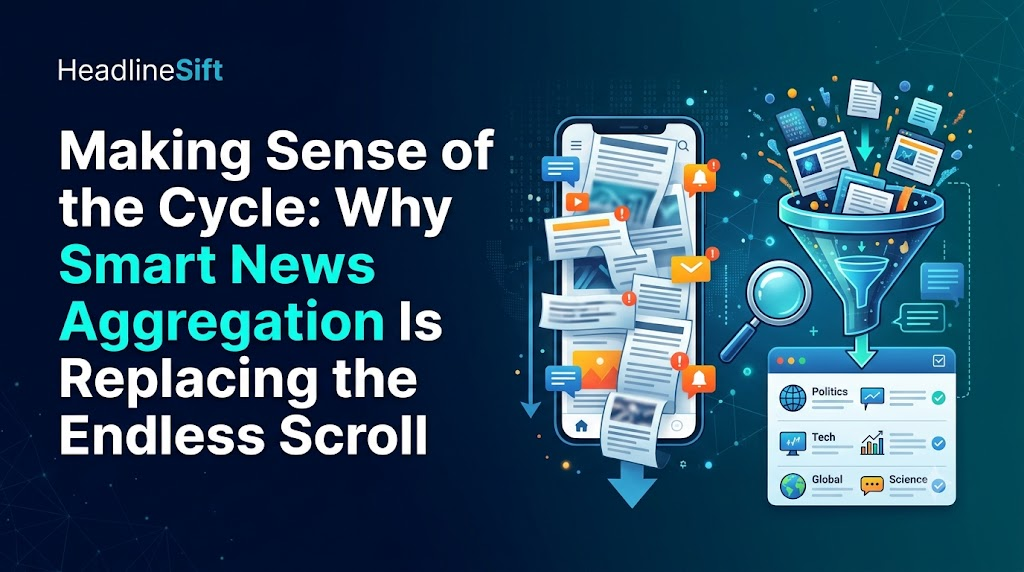
Try tracking a complicated international event across the open web, and you will run into an immediate problem: the internet does not lack journalism, but it frequently lacks cohesion. What was once an orderly habit of reading through morning dispatches has morphed into an erratic sprint across dozens of open tabs, overlapping push notifications, and syndicated write-ups that recycle the same quotes under barely altered headlines. For professionals, researchers, and everyday observers trying to follow regulatory shifts, market turns, or technological milestones, this constant churn creates real friction. You spend half an hour clicking around and close your laptop with plenty of sensory fatigue, but very little genuine context. That growing headache is why people are turning to platforms like HeadlineSift. An AI News Aggregator does not exist to dump another river of hyperlinks onto your desktop. Instead, it functions like a tireless research assistant, using machine learning to parse thousands of daily dispatches, strip out redundant wire mirrors, and assemble the reporting into an orderly, coherent picture.
1. Moving Beyond the Keyword Feed: Why Older Aggregators Stumble
To appreciate what modern language models bring to media tracking, it helps to recall how earlier tools handled the job.
For a long time, the standard solution was an RSS reader configured with explicit keyword searches. You plugged in a phrase—say, “commercial spaceflight”—and the tool gathered every published post containing those terms. The snag with that mechanical approach is that search strings know nothing about meaning. A basic reader cannot tell the difference between a launch vehicle propulsion test, an aerospace corporate earnings report, and an opinion column debating space agency budgets. Just as frustratingly, it will happily serve up forty carbon copies of the same syndicated wire dispatch without realizing they are identical.
An AI News Aggregator swaps keyword matching for semantic interpretation. Built on natural language processing (NLP), these engines analyze the actual meaning and context of sentences rather than hunting for specific letter combinations.
Older RSS Reader:
Raw Feeds ──> Exact Keyword Match ──> Repetitive Chronological Feed (High Duplication)

Intelligent Aggregator:
Continuous Ingestion ──> Semantic Extraction ──> Multi-Source Event Clustering ──> Contextual Briefs
Instead of drowning readers in unfiltered output, an intelligent system handles several heavy-lifting tasks under the hood:
- Broad-Spectrum Discovery: Keeping tabs on thousands of vetted publications, trade sheets, and independent desks without requiring manual feed maintenance.
- Semantic Story Clustering: Grouping together reporting from dozens of outlets covering the same underlying event, even when editors choose entirely different vocabulary.
- Entity and Relationship Extraction: Identifying individuals, organizations, geographic locations, and official policies while distinguishing central subjects from passing mentions.
- Significance-Based Prioritization: Organizing updates by timeliness, editorial standing, and substantive developments rather than raw sensationalism or virality.
2. From Publisher to Dashboard: How Modern News Engines Process the Wire
Seeing the pipeline behind an intelligent aggregator helps explain why these platforms are so much better at restoring order to a busy morning routine.
[ Ingestion & Cleanup ] ──> [ Vectorization & Parsing ] ──> [ Deduplication & Grouping ] ──> [ Reader Delivery ]
Phase 1: Ingestion and Page Normalization
The software monitors an extensive network of verified publications, government repositories, and specialized journals. When an article drops, the ingestion engine isolates the core reporting from page distractions—stripping out banner ads, video overlays, and unrelated sidebars—while standardizing the publication time, author byline, and publishing domain.
Phase 2: Vector Modeling and Semantic Parsing
Next, the system converts the body text into mathematical vector embeddings. These vectors map the underlying meaning of words into a high-dimensional space where conceptually related ideas sit together. This allows the system to recognize that a dispatch titled “Maritime Authorities Alter Shipping Corridors After Regional Unrest” and one headlined “Freight Operators Reroute Vessels Amid Growing Chokepoint Tension” point to the exact same event.
Phase 3: Event Merging and Redundancy Elimination
The platform continuously compares these vectors across incoming feeds to detect converging coverage as it unfolds.
Take an everyday scenario: A sovereign regulatory body issues a landmark antitrust ruling against a tech conglomerate.
- An international wire service issues a rapid, five-sentence factual bulletin.
- A legal analysis journal publishes a breakdown of the specific statutes cited in the filing.
- A market trade desk analyzes potential valuation impacts for competitor firms.
- Twenty regional digital outlets syndicate the original wire release with modified titles.
A basic RSS feed surfaces this as a wall of confusing, repetitive links. An intelligent system catches the shared vector cluster, consolidates all identical wire versions into a single entry, showcases the primary source, and files the legal and market perspectives neatly alongside it.
Phase 4: Quality Filtering and Delivery
Once stories are cross-referenced and verified against basic editorial standards, the system updates the reader’s feed with a clean, unified event cluster.
3. Practical Capabilities That Keep Information Manageable
The day-to-day value of an aggregation platform comes down to specific features that turn sprawling media coverage into a manageable reading workflow.
AI News Summarizer
Nobody has the bandwidth to read thirty separate 4,000-word investigative features or technical filings before lunch. An AI News Summarizer synthesizes extensive reporting to highlight key data points, legal arguments, and factual findings. The objective is not to replace in-depth reporting, but to provide a clear summary that helps readers determine which articles warrant their full attention.
Curated News Headlines
In an attention-driven media environment, headlines are often written to maximize clicks rather than convey clear information. Modern language models evaluate the verified body text of an article to generate Curated News Headlines that accurately reflect the facts, cutting through sensationalism and keeping readers focused on actual developments.
Systematic De-Duplication
Identical wire pieces frequently overwhelm open feeds. Smart de-duplication identifies overlapping prose instantly, highlighting the original outlet while tucking syndicated reprints out of sight.
Multilingual Synthesis
Critical stories often break in non-English speaking markets long before domestic correspondents report on them. Advanced language tools parse, translate, and index reports directly from local sources worldwide, making foreign-language coverage accessible and immediate.
Narrative Trend Detection
By analyzing the volume and frequency of coverage across disparate outlets, platforms can highlight developing patterns—such as localized industrial actions, shifts in agricultural yields, or emerging legislative trends—well before they make prime-time headlines.
4. How Specialized Desks Put Aggregation to Work
Information requirements change dramatically depending on your professional mandate. A securities analyst needs a very different set of signals than a cybersecurity architect or a foreign policy researcher.
| Sector Focus | What the System Prioritizes | Target Audience | Primary Practical Benefit |
| Technology | Framework updates, CVEs, enterprise tech, patents | Engineers, Architects, IT Leadership | Strips out corporate PR to highlight real architectural shifts |
| Business Operations | Restructuring, leadership shifts, supply chain friction | Strategists, Founders, Operations Leads | Unifies fragmented market signals into clear competitive intel |
| Financial Markets | Policy statements, balance sheets, fiscal disclosures | Analysts, Treasurers, Fund Managers | Delivers clean, time-stamped facts to track market realities |
| Global Affairs | Treaties, foreign policy, multilateral trade actions | Diplomats, Policy Advisers, Academics | Balances domestic narratives against direct international coverage |
| Breaking Incidents | Fast updates, event timelines, multi-outlet confirmation | Incident Responders, Public, Analysts | Groups fluid reporting while weeding out unvetted rumors |
Technology News Aggregator
The tech sector is notoriously saturated with product marketing and corporate hype. A dedicated Technology News Aggregator bypasses the promotional copy to prioritize engineering benchmarks, library releases, vulnerability warnings, and academic pre-prints. For engineering leads, this separation of signal from noise is essential for making informed technical decisions.
Business News Aggregator
Keeping up with market shifts requires monitoring competitors, trade disputes, executive departures, and court dockets. A purpose-built Business News Aggregator continuously parses trade publications and regulatory portals, giving corporate teams a structured briefing on changes across their sector without requiring hours of manual searching.
Financial News Headlines
Financial markets depend on speed, context, and factual precision. Market professionals look to structured Financial News Headlines to follow interest rate announcements, sovereign debt yields, macroeconomic data releases, and earnings statements. Grouping these stories systematically helps observers identify structural trends instead of reacting to momentary market panic.
Global News Aggregator
International affairs are inherently multi-sided, yet domestic news outlets frequently view events through a single national prism. A robust Global News Aggregator surfaces perspectives from multiple foreign outlets, giving readers an unvarnished look at international trade negotiations, treaty disputes, and cross-border developments.
Breaking News Aggregator
In fast-moving situations—such as severe weather crises, civic disruptions, or sudden geopolitical shifts—early reports are notoriously conflicting. A dependable Breaking News Aggregator tracks developing events chronologically, pairing verified field dispatches together while visibly isolating uncorroborated claims until they can be confirmed.
5. Automated Summaries: Balancing Speed with Context
Summarization is easily the most popular feature of modern news technology, but using it effectively requires understanding its mechanics and limits.
How Modern Abstracts Are Generated
Early summarizers simply grabbed three sentences from an article that contained frequent keywords. Today’s systems use abstractive summarization: they read the piece in its entirety, distill its primary arguments and factual points, and write a fresh, concise overview. This turns an exhaustive, 3,500-word deep dive into three focused paragraphs that capture the essence of the reporting.
Preserving Critical Context and Source Integrity
The real challenge lies in keeping critical details intact. If an environmental study states that “A company reduced direct manufacturing emissions by 20%, but overall lifecycle pollution grew due to third-party shipping expansions,” an oversimplified summary might run with “Company cuts factory emissions by 20%.” That drop in context fundamentally misrepresents the findings.
To ensure integrity, high-quality aggregators follow strict transparency rules:
- Prominent Sourcing: Every summary must plainly link to the originating publisher.
- One-Click Source Verification: Users must be able to jump directly to the original reporting with zero friction.
- Clear Caveats: The system must highlight when an article deals in preliminary estimates or speculative claims rather than established facts.
When dealing with sensitive legal verdicts, scientific findings, or geopolitical affairs, an automated abstract should never be the final word. Use it as a navigational tool to pinpoint which articles deserve a full, thorough read.
6. News Impact Analysis: Looking Beyond the Surface
Catching an event when it happens is helpful; understanding its downstream effects is where true insight lies. Modern platforms increasingly incorporate News Impact Analysis to give readers a broader view of unfolding stories.
Incoming Event: "Regional Freight Operator Halts Rail Link"
       │
       ▼
[ News Impact Analysis ]
 ├── Longitudinal Context: Connects event to 6-month rail maintenance dispute
 ├── Downstream Impact: Flags potential supply delays for regional fertilizer plants
 └── Source Balancing: Pairs carrier announcements with trade union statements
By tracking the volume, distribution, and persistence of coverage across hundreds of independent outlets over time, automated tools surface patterns that individual readers might otherwise miss:
- Long-Term Narrative Tracking: Tracking how often themes like port congestion, mineral supply pinches, or cloud hosting costs appear in trade journalism across an entire fiscal quarter.
- Cross-Perspective Juxtaposition: Placing differing viewpoints side by side. Showing an industry trade group’s reaction right next to an environmental audit gives readers an objective view of a contentious dispute.
- Early Anomaly Detection: Spotting small, concurrent regulatory challenges across multiple regions before mainstream business publications frame them as a broader trend.
A healthy dose of skepticism is essential here. Algorithms do not understand human psychology, cannot foresee political surprises, and cannot predict market swings. They are not crystal balls. Instead, they serve as powerful pattern spotters, organizing data so human beings can apply their own critical thinking more effectively.
7. Intelligent Customization Without the Trap of Echo Chambers
Many users rely on a Personalized News Digest to align their reading feeds with their day-to-day work, regional interests, or academic focus.
A renewable energy analyst might set their feed to follow grid modernization, offshore wind financing, and rare-earth supply chains, filtering out pop culture and consumer tech. Similarly, an export manager might prioritize maritime logistics, trade tariffs, and seasonal weather patterns.
       [ Comprehensive Global News Flow ]
                         │
                         ▼
        [ User Preferences & Work Profile ]
      (Industry Focus, Topics, Geographies)
                         │
        ┌────────────────┴────────────────┐
        ▼                                 ▼
[ Core Focus Feed ]            [ Broad Context Feed ]
  Specialized Industry News      Wider World Events & Differing Views
        │                                 │
        └────────────────┬────────────────┘
                         ▼
       [ The Balanced Personalized News Digest ]
Yet tailoring feeds too aggressively comes with real downsides:
The Echo Chamber Problem
When algorithms optimize purely for what a reader clicks on or agrees with, they build comfortable echo chambers. If a system only feeds you perspectives that validate your existing worldview, it defeats the entire purpose of reading the news: understanding reality as it actually is.
Building Responsible Personalization
Effective platforms implement guardrails against ideological isolation:
- Filtering by Subject, Not Stance: Allowing users to curate their feeds by topic (e.g., semiconductor policy) rather than by editorial bias or preferred political narrative.
- Deliberate Serendipity: Injecting major global developments into personal feeds, ensuring readers stay aware of critical world events beyond their immediate professional niche.
- Default Source Variety: Ensuring coverage of controversial issues draws on a healthy, diverse range of verified publications rather than leaning on a single point of view.
8. Clear Eyes on the Pros and Cons
Bringing artificial intelligence into your daily routine offers huge advantages, but it also brings unique challenges that readers need to recognize.
STRENGTHS:
[+] Drastically cuts down on daily information fatigue
[+] Surfaces niche, industry-specific coverage you might miss
[+] Sweeps away redundant, syndicated wire duplicates
[+] Keeps running storylines organized over weeks and months

WEAKNESSES:
[-] Algorithmic ranking can inadvertently favor high-volume outlets
[-] Fast-moving summaries can occasionally skip critical nuance
[-] Unverified rumors can temporarily cluster before debunking occurs
[-] Heavy reliance on summaries can hurt traffic to primary journalists
The Clear Upsides
- Reclaiming Your Morning: Turning two hours of unstructured browsing into a disciplined, 20-minute daily brief.
- Broader Awareness: Accessing insights from regional and specialized trade desks you would never have time to check manually.
- Less Digital Noise: Suppressing clickbait, syndicated clones, and repetitive wire copy.
- Structured Archiving: Following the trajectory of complex, months-long developments through clean, organized story threads.
The Inherent Pitfalls
- Algorithmic Skew: Algorithms reflect their programming and training inputs. A poorly tuned system might prioritize hyperactive publishers over patient, investigative reporting.
- Loss of Delicate Caveats: Condensing stories can buff away vital context—such as statistical sample sizes or jurisdictional details—that changes the entire meaning of a study or legal decision.
- Misinformation Surges: If an unconfirmed claim spreads across several low-tier sites at once, an automated aggregator might cluster it as an emerging story before fact-checkers can step in.
- The Health of Independent Journalism: Aggregation relies entirely on the hard, expensive, and often dangerous work done by real reporters on the ground. If readers rely purely on secondary summaries and never visit primary publishers, the financial model supporting investigative reporting suffers.
9. How to Choose and Evaluate an Aggregator
For anyone looking to bring an intelligent news platform into their daily workflow, evaluating tools requires a clear-eyed look at performance and ethics. Look for these essential standards:
[ Platform Evaluation Checklist ]
 [✓] Transparent Sourcing: Are originating publishers prominently credited and linked?
 [✓] Balanced Curation: Does the tool let you track topics without creating echo chambers?
 [✓] Faithful Summaries: Do abstracts preserve essential context, data, and caveats?
 [✓] Clean De-Duplication: Does it reliably merge identical wire copies?
 [✓] User Privacy: Is your reading profile kept confidential rather than sold to ad networks?
 [✓] Frictionless Access: Can you click straight through to read the full original story?
- Uncompromising Attribution: The platform should clearly display who did the original reporting. Steer clear of systems that scrape content without direct, prominent links to the source.
- Audit-Friendly Summaries: You should always be able to verify a summary with a single click. A trustworthy tool encourages you to inspect original sources rather than trying to trap you inside its own walled garden.
- Precise Customization Controls: You should have granular control over what you follow. You should be able to follow specific technologies, sectors, and geographies, while easily muting irrelevant noise.
- Latency Versus Accuracy: Consider whether you need real-time tracking or deeper analysis. A breaking news engine must process information within minutes, whereas a trade analysis feed should prioritize verified accuracy over raw speed.
- Respect for Reader Privacy: Pay attention to how a platform handles your data. Platforms that monetize user behavior through advertising algorithms often end up surfacing sensational, high-arousal content rather than balanced, useful reporting.
10. What Lies Ahead for News Discovery
As machine learning systems continue to mature, the tools we use to navigate current events will become more integrated, multilingual, and contextual.
True Cross-Border Synthesis
Future aggregation platforms will move beyond basic translation to synthesize coverage across multiple languages simultaneously. A reader will be able to follow industrial policy debates in Japan, agricultural developments in Brazil, or energy policy shifts in Germany with the same ease as reading a local publication, drawing directly on primary local sources.
Conversational Context Retrieval
Static headlines will increasingly sit alongside interactive, cited research assistants. Instead of digging through archives to understand how an international agreement came together, you will simply ask: “Which countries signed the original 2022 accord, and what objections were lodged over the past six months?” The system will instantly compile a referenced brief drawn entirely from verified historical reporting.
Interactive Opinion Mapping
Rather than forcing readers to cross ideological divides manually, future platforms will automatically map the broader discourse surrounding contentious issues. When a major policy change or corporate merger is announced, the system will present a balanced overview laying out the distinct arguments raised by various stakeholders.
Why Human Reporting Remains Indispensable
No matter how capable artificial intelligence becomes, it cannot replace journalists on the ground. Algorithms cannot interview sources, uncover corporate malfeasance, attend court hearings, or document humanitarian crises firsthand.
The future of informed news discovery is not a competition between technology and journalism; it is a partnership. Human reporters do the indispensable work of uncovering, verifying, and telling the stories that matter. Artificial intelligence builds the navigational framework, helping an overwhelmed public organize, synthesize, and understand those stories without drowning in the noise.
Conclusion
Using an AI News Aggregator is not about outsourcing your thinking or walking away from deep reading. Its true value lies in clearing away administrative clutter—stripping out sensationalism, deleting duplicate wire copy, and filtering out algorithmic noise so you can focus on developments that truly matter.
Platforms like HeadlineSift reflect an overdue shift in how we approach the digital news cycle: speed and scale mean nothing without transparency, source diversity, and editorial rigor. By letting automated tools handle the heavy lifting of ingestion, sorting, and initial synthesis, readers can finally take back control of their daily media consumption.
At the end of the day, any technical tool is only as good as the critical mind using it. Pairing the processing power of artificial intelligence with a healthy dose of curiosity, a habit of checking original sources, and a willingness to explore alternative viewpoints remains the best way to stay informed, make better decisions, and build a clear, grounded picture of the world around us.
