Limited Time Offer!
For Less Than the Cost of a Starbucks Coffee, Access All DevOpsSchool Videos on YouTube Unlimitedly.
Master DevOps, SRE, DevSecOps Skills!
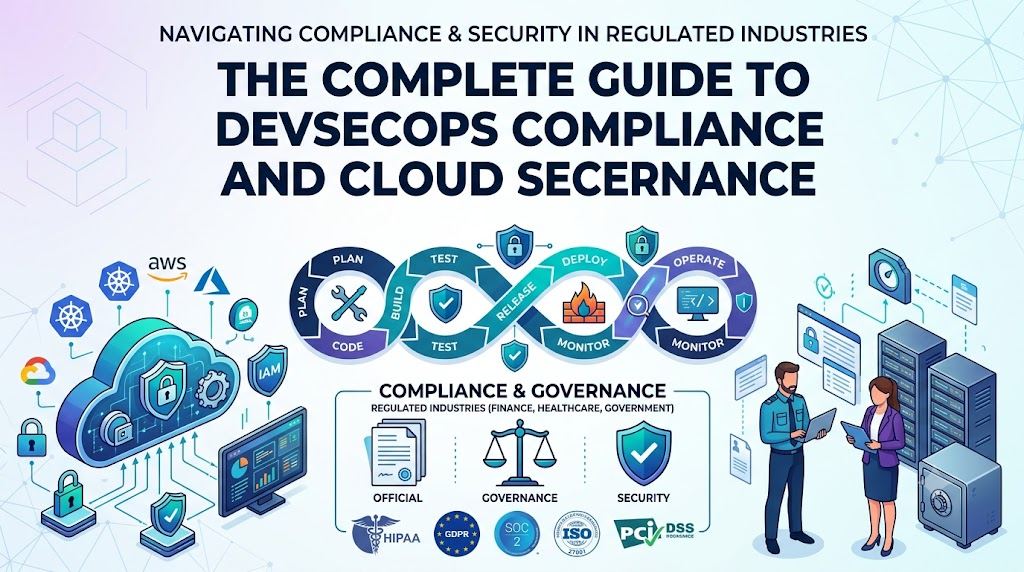
Introduction
Modern enterprise software development moves at a rapid pace, yet for organizations operating within highly regulated domains like banking, healthcare, and government, delivery speed cannot come at the expense of strict regulatory compliance. As global cybersecurity mandates expand, data privacy laws and federal standards require rigorous validation before any software reaches production, traditionally creating significant friction as development teams prioritize speed while compliance teams enforce manual assessments that delay releases by weeks or months. This operational bottleneck is no longer sustainable, and enterprises must shift toward an automated DevSecOps framework that embeds security governance directly into the software development lifecycle. For instance, instead of discovering an unencrypted database violation a week before a major digital banking launch—forcing immediate postponement, extensive code rewrites, and financial losses—organizations can leverage automated deployment pipelines to catch misconfigurations instantly, a transition increasingly supported by specialized training ecosystems like DevOpsSchool that provide engineering teams with the foundational skills required to automate continuous compliance and protect enterprise architectures.
What Is DevSecOps in Regulated Industries?
DevSecOps represents the integration of security practices, risk management, and compliance verification into the standard Development and Operations workflow. In highly regulated sectors, this methodology expands beyond simple vulnerability scanning. It becomes a system of continuous compliance where regulatory constraints are converted into automated software checks.
+-----------------------------------------------------------+
|                        DEVELOPMENT                        |
|   (Code Quality, Peer Reviews, Feature Delivery)         |
+-----------------------------+-----------------------------+
                              |
                              v
+-----------------------------+-----------------------------+
|                         SECURITY                          |
|   (Vulnerability Scanning, Secrets Detection, SAST/DAST)   |
+-----------------------------+-----------------------------+
                              |
                              v
+-----------------------------+-----------------------------+
|                        COMPLIANCE                         |
|   (Audit Trail Logging, Policy Enforcement, Governance)   |
+-----------------------------------------------------------+
Traditional DevOps focuses on collaboration, automation, and delivery speed. DevSecOps injects security directly into this loop, ensuring that software is verified at every stage of development. In regulated environments, this integration includes:
- Automated Policy Enforcement: Code cannot progress through the delivery pipeline unless it explicitly satisfies pre-defined regulatory rules.
- Continuous Risk Mitigation: Vulnerabilities, misconfigurations, and drift are identified and resolved in real time rather than during end-of-quarter reviews.
- Traceable Audit Trails: Every change to software, infrastructure, or access configurations is documented automatically, providing verifiable proof for auditors.
For example, instead of manually checking whether database storage volumes are encrypted before a release, a DevSecOps framework uses automated scanners to analyze configuration code. If encryption is missing, the build fails immediately, preventing non-compliant infrastructure from ever being deployed.
Why Compliance and Security Must Work Together
Organizations frequently mistake compliance for security, or security for compliance. While closely related, they serve distinct operational functions:
- Security focuses on defending systems, networks, and data from active threats, vulnerabilities, and unauthorized access.
- Compliance focuses on proving that systems adhere to specific legal, industry, or contractual obligations.
            SECURITY                            COMPLIANCE
   +-------------------------+         +-------------------------+
   |  Defends against risk   |         | Proves adherence to laws|
   |   Active Vulnerability  |  UNION  |   Audit-Ready Logs      |
   |        Scanning         |-------->|   Traceable History     |
   |  Real-Time Monitoring   |         |  Validated Attestation  |
   +-------------------------+         +-------------------------+
Relying on one without the other creates significant corporate risk. A system can be highly secure but fail an audit due to a lack of documentation. Conversely, a system can meet every checklist requirement of a regulation but remain vulnerable to advanced cyber attacks due to outdated static policies.
Protecting Sensitive Information
Regulated industries manage highly sensitive records, including personally identifiable information, healthcare charts, and financial transaction histories. Aligning security defenses with compliance mandates ensures this data is protected using state-of-the-art encryption, access controls, and masking techniques throughout its lifecycle.
Reducing Business Risks
Non-compliance results in severe consequences, including multi-million dollar fines, revoked operating licenses, and criminal liabilities for corporate officers. By unifying security and compliance, enterprises establish a defensive framework that minimizes the likelihood of data breaches while eliminating the risk of regulatory penalties.
Meeting Regulatory Requirements
Global regulatory landscapes are dynamic. Security teams must ensure their technical controls adapt to changing statutory rules. A unified approach allows organizations to map a single technical control, such as multi-factor authentication, across multiple regulatory frameworks simultaneously.
Supporting Continuous Software Delivery
Manual compliance verifications slow down engineering teams. When security and compliance goals are aligned and automated, compliance shifts from an obstacle to an accelerator. Engineering teams can ship new features rapidly, confident that the automated pipeline enforces all necessary guardrails.
Understanding Regulatory Compliance
Operating globally requires compliance with regional, industry-specific, and international standards. Below is an analysis of the primary regulatory frameworks that impact software development and cloud operations.
Regulatory Frameworks Comparison
| Standard | Industry | Primary Focus | Why It Matters |
| GDPR | Global (Handling EU Data) | Consumer Data Privacy & Sovereignty | Mandates strict consent, data minimization, and the right to be forgotten; violations carry severe global fines. |
| HIPAA | Healthcare (United States) | Protected Health Information (PHI) | Requires administrative, physical, and technical safeguards to secure digital medical records and patient history. |
| PCI DSS | Finance / Retail (Global) | Credit Card Data Security | Controls the processing, transmission, and storage of cardholder details; requires network segregation and encryption. |
| ISO 27001 | All Industries (Global) | Information Security Management Systems | Provides an international standard for managing risks through comprehensive administrative and technical controls. |
| SOC 2 | SaaS / Cloud Service Providers | Trust Services Criteria | Independent audit verifying security, availability, processing integrity, confidentiality, and privacy of cloud data. |
| NIST CSF | Critical Infrastructure / Enterprise | Risk Assessment & Mitigation | A framework focused on identifying, protecting, detecting, responding to, and recovering from cyber incidents. |
Understanding these standards allows security architects to convert qualitative legal text into quantitative technical rules, such as requiring TLS 1.3 for data transmission or setting precise log retention intervals.
Common Security Challenges in Regulated Industries
Building software within a regulated framework introduces distinct operational hurdles that traditional startups or unregulated firms rarely encounter.
Data Breaches
Regulated entities are prime targets for sophisticated cybercriminals due to the financial value of the data they hold. A single breach can expose millions of customer records, leading to immediate operational disruptions and long-term litigation.
Insider Threats
Security risks do not only originate from external actors. Malicious insiders or negligent employees with elevated system privileges can exfiltrate data, alter audit logs, or introduce backdoors into source code repositories.
Misconfigured Cloud Resources
Cloud environments are dynamic. A single developer mistake in an AWS IAM policy or a public Azure Blob storage bucket can instantly expose sensitive enterprise environments to the public internet.
Compliance Violations
Regulatory drift occurs when production configurations change over time without corresponding updates to compliance documentation. This variance leads to unexpected failures during formal regulatory audits.
Manual Security Processes
Many enterprise compliance teams still validate deployments using manual spreadsheets, physical sign-offs, and point-in-time screenshots. These manual efforts fail to scale, introduce human error, and delay software updates.
DevSecOps Across the Software Development Lifecycle
To build a resilient DevSecOps practice, security and compliance checks must be embedded into every step of the software development lifecycle (SDLC).
  [ PLANNING ]       --> Threat modeling, regulatory mapping
       |
       v
   [ CODING ]        --> IDE linters, pre-commit hooks, secure review
       |
       v
   [ BUILD ]         --> SAST, dependency analysis, container scanning
       |
       v
  [ TESTING ]        --> DAST, IAST, compliance policy validation
       |
       v
 [ DEPLOYMENT ]      --> GitOps verification, admission control
       |
       v
 [ MONITORING ]      --> SIEM, runtime drift detection, automated auditing
1. Planning
Security begins before the first line of code is written. During the planning phase, architects conduct threat modeling sessions to identify potential attack vectors. Compliance officers map specific regulatory requirements directly to the project’s user stories and architectural designs.
2. Coding
Developers use Integrated Development Environment (IDE) linters and pre-commit hooks to detect insecure code patterns, hardcoded secrets, and structural flaws in real time. This ensures that only clean, basic-validated code is pushed to centralized repositories.
3. Build
When code is pushed to a central repository, automated build engines compile the software and run Static Application Security Testing (SAST) tools. Simultaneously, Software Composition Analysis (SCA) scanners check third-party libraries for open-source vulnerabilities and license compliance.
4. Testing
During the testing phase, Dynamic Application Security Testing (DAST) tools evaluate the running application in a staging environment, simulating external attacks to find runtime vulnerabilities like SQL injection or cross-site scripting.
5. Deployment
Before software reaches production, automated deployment checks ensure that the target environment matches defined security baselines. Infrastructure configurations are validated, and deployment artifacts are verified for cryptographic signatures.
6. Monitoring
Once live, production environments are continuously monitored using Security Information and Event Management (SIEM) tools. Monitoring systems track behavior, detect unexpected configuration changes, and flag anomalous activities.
7. Continuous Improvement
Data gathered from production incidents, monitoring tools, and vulnerability scans is fed back into the planning stage, ensuring the system continuously adapts to new threats.
Shift-Left Security
The core philosophy of “shifting left” is moving security testing closer to the beginning of the development process. The earlier a vulnerability is discovered, the simpler and less expensive it is to fix.
TRADITIONAL MODEL:
Design --> Code --> Build --> Test --> [ MANUAL SECURITY AUDIT ] --> Production (High Fix Cost)

SHIFT-LEFT MODEL:
Design --> Code [SAST] --> Build [SCA] --> Test [DAST] --> Production (Low Fix Cost)
Secure Coding Practices
Development teams must follow secure coding baselines, such as the OWASP Top 10. These practices include validating all user inputs, escaping outputs, utilizing secure cryptography APIs, and avoiding dangerous language-specific functions.
Static Application Security Testing (SAST)
SAST tools scan the application’s raw source code without executing it. They identify structural weaknesses, tracking untrusted data from entry points to sinks to prevent vulnerabilities like buffer overflows or injection flaws.
Dependency Scanning
Modern software relies heavily on open-source packages. Dependency scanning tools analyze these external libraries, comparing them against global vulnerability databases to ensure applications do not inherit security flaws from third-party dependencies.
Secrets Detection
Hardcoding passwords, API tokens, or private cryptographic keys within source code repositories is a common cause of cloud data breaches. Secrets detection tools scan code repositories and commit histories to identify and block exposed credentials before they are pushed upstream.
Secure Code Reviews
Automated tools are balanced by human oversight. Peer code reviews remain essential for validating complex application logic, authorization workflows, and architectural decisions that automated scanners might miss.
Shift-Right Security
While shifting left minimizes code vulnerabilities, organizations must also “shift right” by protecting and monitoring applications once they run in production environments.
Runtime Monitoring
Applications face unpredictable threat environments in production. Runtime Application Self-Protection (RASP) and cloud-native monitoring agents track memory execution, system calls, and application behavior to block zero-day exploits as they occur.
Threat Detection
Advanced threat detection engines analyze patterns across network traffic, user access logs, and system events. Machine learning models help isolate abnormal activities, such as an administrative account connecting from an unauthorized location or downloading bulk database records.
Log Analysis
Centralized log analysis is a key requirement of frameworks like PCI DSS and ISO 27001. System logs, audit logs, and access records must be continuously collected, normalized, and reviewed to preserve a clear timeline of all platform events.
Incident Response
When a security event occurs, automated incident response workflows isolate compromised systems, revoke leaked credentials, and alert security operations centers. This automation minimizes attacker dwell time and limits blast radiuses.
Continuous Compliance Validation
Environments change over time due to operational needs. Shift-right security tools continuously audit the state of live production infrastructure against baseline compliance requirements, alerting administrators the moment configuration drift occurs.
Compliance Automation in CI/CD Pipelines
Continuous Integration and Continuous Deployment (CI/CD) pipelines serve as the engine room of DevSecOps. By integrating automated quality gates within these pipelines, enterprises ensure that non-compliant software cannot reach production.
[ Developer Commit ]
         |
         v
[ Pipeline Triggered ]
         |
         v
[ Run SAST & SCA Scans ] ----> (Flaws Found?) ----> YES ----> [ Fail Build & Alert ]
         |                                                      |
         | NO                                                   v
         v                                               [ Stop Pipeline ]
[ Run Policy-As-Code Checks ] -> (Violations?) ---> YES
         |
         | NO
         v
[ Sign Artifact & Deploy to Prod ]
Automated Security Testing
Every code commit triggers automated security scans. If a critical vulnerability is found, the pipeline halts immediately, preventing the defect from moving downstream.
Policy Enforcement
Compliance automation tools allow security teams to define compliance rules as code. For example, a pipeline policy can mandate that any deployment configuration missing tag identifiers or using cleartext communication protocols is rejected automatically.
Compliance Checks
Pipelines execute precise validation scripts that verify specific regulatory assertions, such as confirming that encryption libraries use approved algorithms like AES-256.
Approval Workflows
While automation handles the bulk of verification, regulated systems often require formal validation before production updates. CI/CD pipelines automate this by prompting designated security officers for cryptographic approval signatures once all automated checks pass.
Audit Trail Generation
As the pipeline runs, it generates immutable build logs. These logs capture who committed the code, which automated tests were executed, the specific test results, and who approved the final deployment. This data provides comprehensive documentation for compliance auditors.
Infrastructure as Code Security
Modern enterprise deployments rely on Infrastructure as Code (IaC) tools like Terraform, OpenTofu, Ansible, or AWS CloudFormation. Managing infrastructure via code allows organizations to apply the same secure testing methodologies to hardware environments that they apply to application software.
Terraform Scanning
Static analysis tools examine IaC files before deployment. These scanners search for misconfigurations, such as open security groups, unencrypted storage volumes, or missing access logs.
Configuration Validation
Infrastructure configurations are validated against industry baselines, such as the Center for Internet Security (CIS) Benchmarks, ensuring cloud resources match hardened infrastructure models.
Policy as Code
Using specialized policy engines, compliance rules are written in code. This allows teams to programmatically enforce governance constraints across all cloud environments, such as restricting deployments to specific geographic cloud regions to comply with data residency laws.
# Conceptual example of a Policy-as-Code block enforcing storage encryption
deny_unencrypted_storage {
    input.resource_type == "aws_ebs_volume"
    input.attributes.encrypted == false
    msg := "Operational Failure: All EBS storage volumes must be encrypted to comply with data protection regulations."
}
Infrastructure Compliance
By shifting infrastructure validation to the pre-deployment phase, organizations prevent non-compliant environments from being provisioned, avoiding costly post-deployment remediation efforts.
Cloud Governance
Automated IaC checks establish predictable guardrails across multi-cloud environments. This gives development teams the autonomy to provision required infrastructure while ensuring the organization maintains compliance.
Kubernetes and Cloud Security
As enterprises migrate to cloud-native platforms, containerized environments and orchestrators like Kubernetes present distinct security requirements.
Pod Security
Kubernetes containers must run with restricted permissions. Platforms use built-in validation or external admission controllers to block pods that attempt to run as the root user or request dangerous host privileges.
Role-Based Access Control (RBAC)
Kubernetes RBAC configurations must follow the principle of least privilege. Permissions are tightly scoped to ensure service accounts, developers, and platform components can only access the specific API resources required for their roles.
Network Policies
By default, Kubernetes allows open network communication between all pods within a cluster. In regulated environments, network policies must be established to enforce strict isolation, ensuring frontend application layers cannot communicate directly with backend database pods.
Image Scanning
Container images frequently include base operating system vulnerabilities. Build pipelines must scan container images during compilation, blocking any images that contain high or critical CVEs from entering container registries.
Secrets Management
Kubernetes has basic built-in secrets handling, but enterprise environments often require external integration. Organizations integrate clusters with external secrets management platforms to inject sensitive database credentials, API keys, and certificates into pods securely at runtime, avoiding persistent storage on disk.
Runtime Security
Cloud-native workloads require active monitoring. Runtime security engines monitor system call patterns within container kernels, detecting anomalous behaviors like unexpected shell executions or unauthorized file modifications.
Identity and Access Management (IAM)
Identity is the foundational perimeter of modern cloud security. Strong IAM control is critical to securing regulated applications and systems.
Least Privilege
Access rights must be restricted to the minimum permissions required to perform a specific function. Developers should not have permanent administrative rights over production environments; access is granted only when needed through authorized workflows.
Multi-Factor Authentication (MFA)
MFA must be enforced across all corporate accounts, identity providers, and console access points. This requirement provides defense against credential stuffing and phishing attacks.
Role-Based Access Control (RBAC)
Instead of assigning access rights to individual users, access is mapped directly to corporate roles. When employees change departments or exit the organization, their permissions automatically update based on their role alignment.
Identity Governance
Enterprises must perform regular access reviews. Automated identity governance tools audit account privileges, highlighting unused accounts, over-privileged users, or separation-of-duties violations for remediation.
Continuous Monitoring and Compliance
Point-in-time compliance assessments only prove a system was compliant at the exact moment of the audit. Continuous monitoring converts this model into a live assessment of environmental health.
Security Monitoring
Continuous security monitoring tracks configurations, file integrations, and system activities across the enterprise infrastructure, providing visibility into potential threat vectors.
Compliance Dashboards
Compliance dashboards translate raw technical metrics into real-time regulatory status views. These interfaces show compliance levels across frameworks like HIPAA or SOC 2, giving management immediate visibility into the organization’s compliance posture.
Vulnerability Management
Vulnerability management systems track discovered flaws, prioritize remediation based on risk scoring, assign tasks to engineering teams, and verify when patches are deployed.
Log Management
Enterprise systems generate substantial amounts of log data. Centralized log management platforms securely aggregate, index, and retain logs from applications, platforms, and network layers, fulfilling corporate retention and forensic requirements.
Continuous Auditing Tools
Organizations deploy open-source and commercial tools to maintain platform visibility:
- Prometheus: Collects real-time operational metrics from infrastructure components and applications.
- Grafana: Visualizes metrics data, creating operational tracking dashboards and system alerts.
- ELK Stack (Elasticsearch, Logstash, Kibana): Aggregates, parses, and provides search tools for system logs across distributed applications.
- SIEM Platforms: Correlate events across the entire enterprise to identify security incidents and generate audit compliance trails.
Governance, Risk, and Compliance (GRC)
DevSecOps bridges the technical gap between software development and enterprise Governance, Risk, and Compliance (GRC) frameworks.
       +---------------------------------------------+
       |                  GOVERNANCE                 |
       |  (Corporate Strategy, Policy Formulation)  |
       +----------------------++----------------------+
                              ||
                              \/
       +---------------------------------------------+
       |               RISK MANAGEMENT               |
       |  (Threat Analysis, Impact Quantification)   |
       +----------------------++----------------------+
                              ||
                              \/
       +---------------------------------------------+
       |            COMPLIANCE ENFORCEMENT           |
       |  (Technical Guardrails, Continuous Audits)  |
       +---------------------------------------------+
Governance Frameworks
Corporate governance defines the policies, standards, and control frameworks that guide an organization’s operations. DevSecOps translates these written rules into automated, enforceable software configurations.
Risk Assessment
Risk management teams evaluate potential operational vulnerabilities, calculating the likelihood and impact of technical failures. This data helps engineering prioritize security improvements based on actual business risks.
Policy Management
As regulatory environments adapt, corporate policy documents must update in parallel. Automated policy management platforms ensure technical deployment pipelines remain aligned with the latest corporate directives.
Audit Readiness
Traditional audits require weeks of manual document collection and technical evidence gathering. DevSecOps platforms maintain continuous state records and change logs, enabling teams to provide comprehensive audit evidence instantly.
Compliance Reporting
Automated compliance reporting systems export point-in-time documentation and architectural diagrams, validating to external regulators that the organization’s technical controls match its statutory commitments.
Real-World DevSecOps Compliance Workflow
The following step-by-step example illustrates a secure, automated workflow within a regulated enterprise deployment pipeline:
- Step 1: Code CommitA developer fixes a bug and commits the updated code to a secure corporate repository. Pre-commit hooks run local code linting to ensure no hardcoded credentials exist.
- Step 2: Pipeline ExecutionThe commit triggers the CI/CD pipeline. The build environment runs a SAST engine to check for security flaws and an SCA tool to verify that all third-party open-source components are clean and properly licensed.
- Step 3: Infrastructure EvaluationThe pipeline runs static analysis on the project’s Terraform templates, validating that the associated cloud infrastructure configuration complies with network isolation and storage encryption standards.
- Step 4: Container AnalysisThe application is packaged into a container image. An image scanner checks the application layers against vulnerability databases before pushing the artifact to a secure enterprise registry.
- Step 5: Runtime VerificationThe container is deployed to an isolated staging environment. The pipeline executes automated dynamic scans (DAST) and runs compliance verification suites to confirm proper access controls and system behaviors.
- Step 6: Production ReleaseOnce all automated quality gates pass, the pipeline applies a cryptographic signature to the deployment artifact. The production cluster verifies this signature via an admission controller and deploys the update.
- Step 7: Continuous Monitoring & AuditingThe live application is tracked by runtime security agents and log aggregation tools. Compliance metrics pass to centralized GRC dashboards, providing immutable data trails for future regulatory audits.
Benefits of DevSecOps in Regulated Industries
Adopting a mature DevSecOps architecture provides significant operational advantages to regulated enterprises.
Faster Compliance
Automating security assessments eliminates the bottleneck of manual reviews. Compliance verification is integrated directly into the release process, allowing teams to deliver updates rapidly while maintaining regulatory alignment.
Reduced Security Risks
Identifying configuration flaws and code vulnerabilities early prevents security issues from reaching production environments. This proactive approach minimizes the company’s attack surface and reduces the likelihood of data breaches.
Better Audit Readiness
Instead of scrambling to collect data before annual audits, organizations maintain an audit-ready posture. Every change, build, and deployment is automatically documented with an unalterable history trail.
Improved Software Quality
Integrating security validation into development workflows encourages cleaner code, better architectural designs, and more resilient systems, leading to more stable production environments.
Lower Operational Costs
Remediating a security vulnerability in production is significantly more expensive than fixing it during development. Shifting security left reduces engineering rework and eliminates manual auditing overhead.
Stronger Customer Confidence
Demonstrating a rigorous, automated approach to security and compliance helps enterprises build trust with clients, business partners, and regulatory authorities, creating a competitive advantage in the marketplace.
Common Challenges and Practical Solutions
Transitioning to an automated DevSecOps model requires addressing legacy challenges across systems, processes, and corporate culture.
Legacy Systems
Older core business systems often lack the APIs and native automation tools required for modern CI/CD pipelines.
- Solution: Wrap legacy environments in secure containers or place them behind microservice API gateways, allowing modern automated deployment layers to manage interactions securely.
Regulatory Complexity
Managing multiple overlapping international and regional regulatory compliance frameworks simultaneously can overwhelm engineering teams.
- Solution: Map technical controls to a unified master framework, such as the NIST Cybersecurity Framework. Satisfying a single master technical control can fulfill requirements across multiple distinct regulations at the same time.
Skill Shortages
Enterprise engineering teams frequently lack deep expertise in cloud security architecture, while traditional security teams may have limited experience with modern automation coding.
- Solution: Invest in structured education programs, such as the training tracks provided by DevOpsSchool, to upskill personnel and establish a shared technical language across departments.
Tool Integration
Deploying isolated security tools can result in fragmented dashboards, conflicting alert data, and operational fatigue for security teams.
- Solution: Standardize on integrated platforms that support open APIs, allowing vulnerability data to flow into a centralized management plane for analysis.
Cultural Resistance
Development teams may view security guardrails as impediments to delivery speed, while compliance teams may resist moving away from traditional manual sign-off processes.
- Solution: Foster a shared-responsibility model by including security goals in development key performance indicators (KPIs) and involving compliance officers directly in the design of automated pipeline controls.
Best Practices
To ensure long-term success when implementing DevSecOps in regulated environments, organizations should focus on several foundational practices:
- Automate Everything Reasonable: Eliminate manual tasks across vulnerability scanning, infrastructure checking, policy enforcement, and audit data logging to reduce human error.
- Embed Security from the Start: Include security and compliance teams during the initial design and architecture phases of a project, rather than waiting for final deployment reviews.
- Provide Continuous Engineering Training: Equip developers with the training and resources needed to write secure code natively, preventing flaws from entering code repositories.
- Implement Continuous Infrastructure Monitoring: Deploy automated tools to track production environments continuously, catching and remediating configuration drift immediately.
- Treat Infrastructure exclusively as Code: Prohibit manual configuration updates in production environments. Manage all infrastructure changes through version-controlled IaC pipelines.
- Track Clear Compliance Metrics: Monitor indicators such as mean time to remediation (MTTR), pipeline failure rates due to security blocks, and total open vulnerabilities to evaluate the health of the DevSecOps program.
Traditional Compliance vs. DevSecOps Compliance
The operational transition from traditional compliance models to modern DevSecOps architectures marks a shift in how organizations manage corporate risk.
Compliance Models Comparison
| Feature | Traditional Compliance | DevSecOps Compliance |
| Speed | Slow, point-in-time assessments that create delivery bottlenecks before releases. | Rapid, continuous validation embedded directly within the software deployment cycle. |
| Automation | Relies on manual checks, spreadsheet tracking, physical signatures, and screenshots. | Driven by automated code tools, automated policies, and system-generated validation logs. |
| Auditing | Periodic, disruptive audit processes requiring significant manual preparation and evidence gathering. | Continuous audit readiness with real-time tracking dashboards and immutable change histories. |
| Security Testing | Executed late in the development cycle, often leading to costly code rewrites. | Shifted left across development, build, testing, and production environments. |
| Continuous Monitoring | Limited visibility, often relying on occasional configuration audits and manual checks. | Real-time visibility into infrastructure health, application behavior, and configuration drift. |
| Risk Management | Reactive management focused on fixing compliance issues discovered during audits. | Proactive management that blocks non-compliant code and infrastructure automatically before deployment. |
Popular Tools Supporting DevSecOps Compliance
Building a DevSecOps architecture requires an integrated ecosystem of security and compliance tools across the delivery pipeline.
+---------------------------------------------------------------------------------+
|                                 DEVSECOPS ECOSYSTEM                             |
+---------------------------------------------------------------------------------+
|  SAST/SCA Tools        | DAST Tools            | Container Security             |
|  - SonarQube, Snyk     | - OWASP ZAP, Burp     | - Prisma Cloud, Aqua, Trivy    |
+------------------------+-----------------------+--------------------------------+
|  IaC Security          | Compliance Automation | Secrets Management             |
|  - Checkov, Tfsec      | - Open Policy Agent   | - HashiCorp Vault, CyberArk    |
+---------------------------------------------------------------------------------+
Tool Categorization and Analysis
| Tool | Purpose | Difficulty | Best Use Case |
| SonarQube | Static Application Security Testing (SAST) | Medium | Scanning source code repositories during CI builds to catch code quality flaws and security vulnerabilities. |
| Snyk | Software Composition Analysis (SCA) | Easy | Identifying open-source dependency vulnerabilities and managing open-source license compliance. |
| OWASP ZAP | Dynamic Application Security Testing (DAST) | Medium | Executing automated web application security scans within staging and QA testing pipelines. |
| Trivy | Container & Artifact Image Scanning | Easy | Rapidly scanning container base images and file systems for configuration flaws within build engines. |
| Checkov | Infrastructure as Code (IaC) Scanning | Easy | Scanning Terraform, CloudFormation, and Kubernetes manifests for security issues before deployment. |
| Open Policy Agent | Policy as Code Engine | Hard | Enforcing unified compliance governance rules across pipelines, Kubernetes clusters, and cloud platforms. |
| HashiCorp Vault | Centralized Secrets Management | Hard | Securely storing, encrypting, and dynamically distributing API tokens, passwords, and certificates. |
Industry-Specific Use Cases
Different regulated sectors face distinct compliance challenges, requiring tailored DevSecOps strategies.
Banking & Financial Services
- Challenges: Financial organizations must comply with strict PCI DSS, SOX, and local central bank mandates, which require tight transaction controls, audit histories, and clear separation of duties.
- DevSecOps Solution: Implement automated pipeline validations that verify distinct separation of duties, ensuring that the developer who writes a code change cannot approve its production deployment. All transaction-handling services are built with mandatory encryption validations enforced by Policy-as-Code engines.
Healthcare
- Challenges: Healthcare providers must secure patient records under regulations like HIPAA, which require strict access controls, data encryption at rest and in transit, and detailed audit trails for data access.
- DevSecOps Solution: Configure deployment gates that check container environments for logging agents, ensuring all interactions with patient records are captured. Storage volumes are automatically attached to KMS keys with automated rotation policies before launching.
Government
- Challenges: Federal agencies require compliance with frameworks like FedRAMP or NIST SP 800-53, demanding rigorous access control, environment isolation, and comprehensive system documentation.
- DevSecOps Solution: Utilize GitOps workflows where the entire environment state is declared in version-controlled repositories. Any changes to government platform baselines must pass automated configuration checking and require multi-party cryptographic signature validation before execution.
Insurance
- Challenges: Insurance firms handle diverse consumer profiles and financial data, requiring alignment with regional privacy rules and financial reporting standards.
- DevSecOps Solution: Implement automated data masking and field-level encryption verification within development databases, ensuring that testing environments never expose production data.
Telecommunications
- Challenges: Telecom networks manage massive data volumes across highly distributed networks, requiring high system availability, data privacy compliance, and resilience against network attacks.
- DevSecOps Solution: Integrate real-time network policy testing within container orchestration layers to maintain tenant isolation and detect anomalies across massive scale deployments.
SaaS Platforms
- Challenges: Cloud vendors must provide verified assurance to enterprise clients by maintaining SOC 2 compliance across availability, confidentiality, and processing security.
- DevSecOps Solution: Build continuous audit reporting systems that aggregate performance monitoring data, access logs, and security patch histories into centralized evidence collectors for external auditors.
Career Opportunities
The demand for professionals who understand both modern automation and enterprise regulatory governance is expanding across the global technology industry.
In-Demand Roles
- DevSecOps Engineer: Builds and maintains the security tools, quality gates, and automated scanning infrastructure within CI/CD pipelines.
- Cloud Security Engineer: Designs and secures cloud infrastructure architectures, managing IAM, encryption policies, and network isolation boundaries.
- Compliance Engineer: Bridges the gap between legal frameworks and engineering, translating regulatory text into executable policy code.
- Security Architect: Designs the high-level security frameworks, authentication protocols, and threat defense systems for the entire enterprise.
- Governance Specialist: Monitors corporate risk profiles, coordinates external audits, and ensures technical pipelines match organizational policies.
Required Skillsets
Professionals entering this field need a balanced technical background:
- Proficiency with cloud platforms (AWS, Azure, GCP) and container orchestration tools like Kubernetes.
- Experience writing and managing Infrastructure as Code using tools like Terraform or OpenTofu.
- Familiarity with CI/CD platforms like Jenkins, GitLab CI, or GitHub Actions.
- Strong understanding of secure coding principles, vulnerability scanning tools, and policy-as-code frameworks.
- Functional knowledge of core regulatory standards like GDPR, HIPAA, PCI DSS, or ISO 27001.
Career Growth and Value
As organizations transition away from manual compliance reviews, professionals who can automate these processes are highly valued. This specialty offers strong career progression, visibility within leadership teams, and excellent compensation potential due to the high business impact of compliance management.
Certifications & Learning Paths
Building expertise in DevSecOps requires structured training, hands-on project experience, and recognized professional certifications. Educational platforms like DevOpsSchool offer specialized learning tracks designed to teach the skills required to implement automated compliance and secure cloud infrastructures.
Key Certifications in the Field
| Certification | Best For | Skill Level | Focus Area |
| Certified DevSecOps Professional (CDP) | DevSecOps Pipeline Engineers | Intermediate | Building secure CI/CD pipelines, automating vulnerability scanning, and managing container security. |
| Certified Information Systems Security Professional (CISSP) | Security Architects & GRC Leaders | Advanced | Enterprise security governance, risk assessment, compliance frameworks, and operational security management. |
| Certified Cloud Security Professional (CCSP) | Cloud Security Architects | Advanced | Designing secure cloud architectures, managing data security laws, and cloud governance frameworks. |
| Certified Kubernetes Security Specialist (CKS) | Kubernetes Administrators | Advanced | Hardening container environments, cluster security, runtime defense, and cloud-native network isolation. |
Common Beginner Mistakes
Avoid these common pitfalls when beginning a DevSecOps transformation within a regulated environment:
- Treating Compliance as Documentation Only: Assuming that maintaining static compliance manuals is sufficient, without verifying that production systems match the written policies.
- Ignoring Automation Opportunities: Continuing to rely on manual pre-deployment sign-offs, creating delivery bottlenecks and introducing human error into the release process.
- Neglecting Cloud Security Fundamentals: Focusing exclusively on application code security while overlooking misconfigured IAM roles, open security groups, or unencrypted storage volumes.
- Managing Access Privileges Weakly: Granting developers permanent administrative permissions in production, which violates the principle of least privilege and increases insider threat risks.
- Delaying Security Testing in the SDLC: Running security scans only at the end of the development loop, leading to costly re-engineering work when critical flaws are discovered late.
Future of DevSecOps in Regulated Industries
The intersection of software automation, cloud-native architecture, and regulatory compliance continues to evolve.
AI-Powered Compliance
Artificial intelligence models are being integrated into compliance platforms to analyze regulatory updates, automatically map rules to technical controls, and predict potential configuration risks based on historical usage data.
Zero Trust Security Architectural Models
Enterprises are shifting away from perimeter-focused security to explicit Zero Trust architectures. Within this model, every user, device, and service interaction must be continuously verified and authenticated, regardless of its location inside the corporate network.
Ubiquitous Policy as Code
Policy as Code is becoming the standard for enterprise governance. Organizations are moving toward unified policy frameworks that govern development, deployment, and live operations within a single, machine-readable codebase.
Continuous Compliance Auditing
The traditional model of disruptive annual compliance audits is being replaced by real-time automated validation. Regulatory agencies are moving toward architectures where organizations grant auditors read-only access to automated compliance systems, allowing for continuous, passive verification.
FAQs (Frequently Asked Questions)
What is DevSecOps in regulated industries?
DevSecOps in regulated industries is the practice of embedding security verification and regulatory compliance controls directly into automated software development pipelines, ensuring applications remain continually compliant with industry laws.
Why is compliance important?
Compliance protects organizations from data breaches, avoids significant regulatory fines, ensures customer data privacy, and builds market trust by verifying that systems adhere to statutory legal obligations.
What regulations should DevSecOps teams know?
DevSecOps teams should understand the key frameworks that apply to their business domain, including GDPR for data privacy, HIPAA for healthcare, PCI DSS for financial payments, and ISO 27001 for general information security management.
How does DevSecOps improve compliance?
DevSecOps improves compliance by replacing subjective, point-in-time manual checks with objective, automated validation gates embedded in the development loop, producing immutable audit trails for every code change.
What is continuous compliance?
Continuous compliance is the real-time tracking, evaluation, and enforcement of regulatory controls across application and infrastructure layers, ensuring environments never drift from their validated security baselines.
Which tools automate compliance?
Compliance is automated using policy engines like Open Policy Agent, configuration scanners like Checkov, static analysis platforms like SonarQube, and log analytics engines like the ELK Stack.
How does Kubernetes support security?
Kubernetes supports security through architectural controls like Role-Based Access Control (RBAC), network isolation policies, secret management systems, and admission controllers that prevent unauthorized workloads from running.
Is DevSecOps a good career in regulated industries?
Yes. Organizations operating in regulated spaces face expanding security compliance demands, creating strong career opportunities and high industry demand for professionals skilled in security automation.
What is the difference between SAST and DAST?
SAST scans raw source code early in the development cycle without executing the application to find structural flaws. DAST tests the running application from the outside during runtime to discover live vulnerabilities.
What is Software Composition Analysis (SCA)?
SCA is the process of scanning an application’s third-party open-source libraries to identify known security vulnerabilities and ensure compliance with open-source licensing mandates.
What is Policy as Code?
Policy as Code is the practice of writing governance rules, security constraints, and compliance requirements in standardized programming languages, allowing them to be evaluated automatically within deployment pipelines.
How do you handle secrets securely in DevSecOps?
Secrets are managed by keeping credentials out of source code repositories and instead using dedicated secrets management platforms to inject keys encrypted into memory only at application runtime.
What is configuration drift?
Configuration drift occurs when changes are made to live production infrastructure manually or outside authorized deployment pipelines, causing the environment state to diverge from its validated compliance baseline.
How do you generate an audit trail in DevSecOps?
Audit trails are generated automatically by configuring CI/CD pipelines to log every stage of execution, recording commit histories, test results, security scan details, and approval validations into unalterable, centralized logs.
Can DevSecOps eliminate the need for external auditors?
No. DevSecOps does not replace external auditors. Instead, it simplifies the audit process by providing clear, organized, and automated technical documentation, reducing the time and effort required to complete formal reviews.
Final Thoughts
Implementing DevSecOps within highly regulated industries requires moving beyond treating compliance as a bureaucratic check-the-box exercise. True security is built by transforming static compliance guidelines into automated technical controls embedded within the daily development workflow.
Security automation minimizes corporate risk, eliminates manual delivery bottlenecks, and establishes consistent engineering practices across the enterprise. By adopting a shift-left security model and maintaining automated governance guardrails, organizations can deliver new features rapidly while ensuring strict compliance with global regulatory mandates. Continuous technical improvement, supported by a shared organizational responsibility for security, forms the basis for resilient, compliant software delivery at modern enterprise scale.
