Limited Time Offer!
For Less Than the Cost of a Starbucks Coffee, Access All DevOpsSchool Videos on YouTube Unlimitedly.
Master DevOps, SRE, DevSecOps Skills!
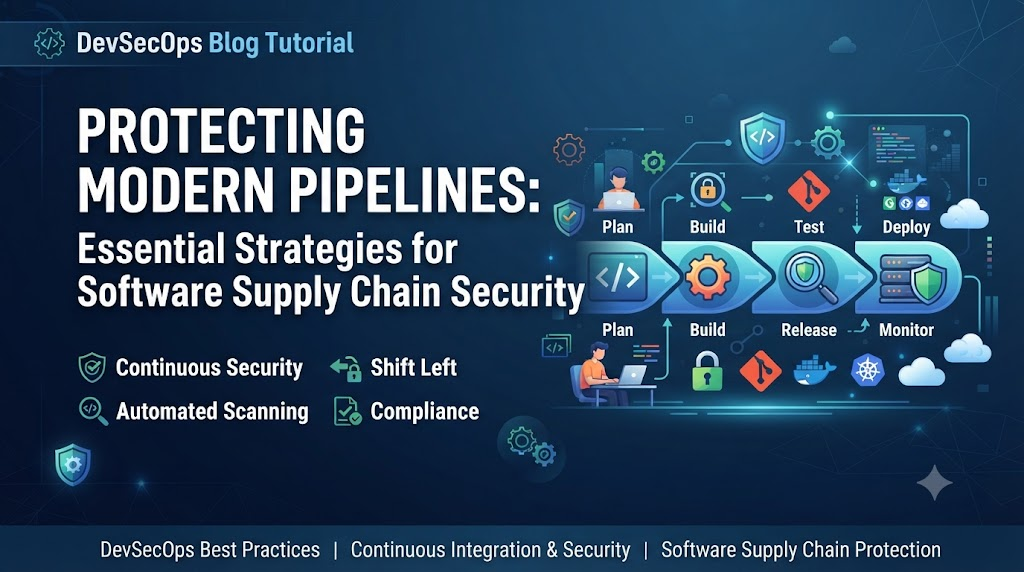
Introduction
In the modern digital landscape, the speed of delivery has become a primary competitive advantage. However, this velocity has introduced significant blind spots. Organizations are increasingly relying on a complex web of open-source libraries, third-party APIs, and cloud-native services to build their applications. While this accelerates development, it also expands the attack surface, making the software supply chain a prime target for sophisticated cyber threats. Recent years have seen high-profile supply chain attacks where attackers compromised legitimate code or build tools to distribute malicious updates to downstream users. This reality makes it imperative for organizations to shift from a reactive security posture to a proactive one. This is where DevSecOps becomes essential. By integrating security controls directly into the automated delivery pipeline, teams can ensure that protection is not a bottleneck, but a core component of development.
At DevOpsSchool, we advocate for a culture where security is a shared responsibility across the entire development lifecycle. Whether you are building cloud-native microservices or managing monolithic legacy systems, understanding how to secure the software supply chain with DevSecOps is critical to maintaining operational integrity and customer trust.
What Is the Software Supply Chain?
The software supply chain encompasses every component and process involved in creating, maintaining, and deploying software. Think of it as an assembly line for digital products.
- Source Code: The foundational building blocks written by developers.
- Dependencies: External libraries and frameworks, often open-source, that save time but introduce potential risks.
- Build Systems: Tools like Jenkins, GitHub Actions, or GitLab CI that compile code and package it into artifacts.
- Artifact Repositories: Secure storage locations (e.g., Nexus, Artifactory) for versioned binaries.
- Deployment Pipelines: The automated mechanisms that move code into staging and production environments.
- Runtime Environments: The infrastructure, whether cloud or on-premises, where the software executes.
Why Software Supply Chain Security Matters
Software supply chain security is not just a technical requirement; it is a business imperative. When a supply chain is compromised, it is not just one server that is at risk, but the entire user base of the application.
- Third-Party Risks: You are only as secure as the weakest library you include in your project.
- Open-Source Vulnerabilities: Relying on community code requires active oversight to patch known vulnerabilities.
- Compliance: Regulations like SOC2, HIPAA, and GDPR increasingly require proof of integrity throughout the software lifecycle.
- Customer Trust: A single breach can cause irreparable damage to your brand reputation.
- Business Continuity: Supply chain attacks can lead to massive downtime and costly incident response efforts.
Common Software Supply Chain Risks
| Risk | Business Impact | Recommended Mitigation |
| Vulnerable Dependencies | Exploitation of known security flaws | Software composition analysis (SCA) |
| Compromised Build Servers | Injection of malicious code into binaries | Ephemeral build environments |
| Weak Access Controls | Unauthorized code changes | Least-privilege access and MFA |
| Insecure CI/CD | Exposure of credentials and secrets | Secrets management solutions |
| Artifact Tampering | Deployment of unauthorized software | Digital signing and checksums |
| Misconfigured IaC | Exposed cloud resources | Policy-as-Code enforcement |
How DevSecOps Protects the Software Supply Chain
DevSecOps embeds security directly into the pipeline, ensuring that the software is scanned and verified at every step. This “shift-left” approach means finding bugs during development, not after a breach.
- Shift-Left Security: Moving security checks to the earliest possible stage in the IDE or commit phase.
- Continuous Scanning: Automatically checking for vulnerabilities in code, dependencies, and infrastructure configuration on every push.
- Automated Policy Enforcement: Using tools to reject builds that do not meet security standards.
- Secure CI/CD: Ensuring that build agents are isolated and that credentials are never stored in plain text.
- Continuous Monitoring: Maintaining visibility into the application even after it reaches the production environment.
Secure CI/CD Pipelines
A CI/CD pipeline should be treated as high-security infrastructure. To protect it:
- Build Verification: Ensure that only authorized commits from identified developers reach the build server.
- Automated Testing: Integrate static (SAST) and dynamic (DAST) analysis.
- Dependency Validation: Use automated tools to verify that dependencies are from trusted sources.
- Deployment Controls: Implement gated deployments where manual approval or automated security gate passes are required before production release.
Dependency Management
Modern applications are often 80% third-party code. Managing this complexity requires:
- Software Bill of Materials (SBOM): Maintaining an inventory of every component in your software.
- Dependency Scanning: Tools like Snyk or OWASP Dependency-Check to identify outdated or vulnerable packages.
- Version Control: Pinning versions of dependencies to ensure consistency and prevent “dependency confusion” attacks.
- License Compliance: Automatically checking that your project doesn’t inadvertently include code with restrictive licenses.
Artifact Integrity
If you cannot prove that your final artifact is exactly what your developers built, you have a security gap.
- Digital Signing: Sign images and binaries so that deployment tools can verify the creator and ensure the file hasn’t been altered.
- Hash Verification: Compare checksums before allowing a deployment to proceed.
- Trusted Repositories: Use private registries and ensure strict access control.
- Immutable Builds: Treat containers as disposable; never patch a running container, always rebuild and redeploy.
Infrastructure as Code (IaC) Security
Infrastructure is now software. If your Terraform or Kubernetes manifests are misconfigured, your security controls are bypassed.
- Configuration Validation: Scan IaC templates for open ports, public S3 buckets, or lack of encryption.
- Policy-as-Code: Use tools like OPA (Open Policy Agent) to enforce security rules automatically.
- Continuous Compliance: Periodically audit running infrastructure against your desired state.
Secrets Management
Hardcoding API keys, passwords, or certificates in source code is a critical failure.
- Centralized Vaults: Use HashiCorp Vault, AWS Secrets Manager, or Azure Key Vault.
- Injection at Runtime: Secrets should be injected as environment variables at the last possible moment.
- Secret Rotation: Automate the rotation of keys to minimize the blast radius if a secret is ever leaked.
Monitoring and Incident Response
Security is a process, not a state.
- Logging: Centralize logs from CI/CD, build tools, and production systems.
- Threat Detection: Use runtime security tools to detect anomalous behavior, such as unauthorized process execution in a container.
- Alerting: Set up automated notifications for security-relevant events.
- Continuous Improvement: Use post-incident reviews to identify how the pipeline failed and how to prevent recurrence.
Compliance and Governance
Security and compliance are natural partners. By automating security, you simultaneously automate the collection of evidence required for audits. Whether it is PCI-DSS or SOC2, your CI/CD pipeline can generate the reports that prove your software was built in a secure, repeatable, and verified manner.
Business Benefits of Software Supply Chain Security
| Benefit | Business Impact |
| Reduced Cyber Risk | Lower probability of data breaches and ransomware |
| Improved Software Quality | Fewer bugs and more stable releases |
| Faster Incident Response | Quicker identification and mitigation of threats |
| Better Compliance | Smoother audit processes and less regulatory friction |
| Increased Customer Trust | Stronger brand reputation and client loyalty |
| Stronger Business Resilience | Ability to recover quickly from supply chain disruptions |
Measuring Supply Chain Security Success
| Metric | Why It Matters | Business Value |
| Vulnerability Remediation Time | Measures efficiency of fixing security bugs | Lowers window of exposure |
| Dependency Health | Tracks usage of outdated packages | Reduces technical and security debt |
| Compliance Score | Measures alignment with security policies | Simplifies audit preparation |
| Build Integrity | Confirms authenticity of artifacts | Prevents unauthorized deployments |
| Deployment Success Rate | Tracks stability of the release process | Increases developer productivity |
| MTTR | Measures response speed to security events | Enhances business continuity |
Common Implementation Challenges
| Challenge | Impact | Recommended Solution |
| Legacy Applications | Difficult to retrofit security | Containerize and wrap with security proxies |
| Tool Integration | Pipeline friction | Standardize on integrated DevSecOps platforms |
| Skill Shortages | Inconsistent security implementation | Invest in specialized training and workshops |
| Budget Limitations | Delay in security tooling | Prioritize risk-based investments |
| Security Awareness | Human error | Foster a culture of “Security as a Shared Goal” |
Best Practices for Software Supply Chain Security
- Secure Repositories: Lock down access to your private container and code registries.
- Verify Dependencies: Use automated tools to validate every library added to your manifest.
- Protect CI/CD: Rotate credentials for service accounts and use short-lived tokens.
- Sign Artifacts: Use tools to sign code and images to ensure non-repudiation.
- Monitor Continuously: Implement runtime protection for your production clusters.
- Review Policies Regularly: Security is evolving; ensure your policies remain relevant.
Real-World Example: Enterprise Supply Chain Security
An enterprise e-commerce firm recently faced challenges with inconsistent patching across their microservices. By implementing a DevSecOps strategy, they introduced:
- Initial Risk: Multiple services used outdated versions of a common logging framework.
- Implementation: They automated SCA (Software Composition Analysis) in their GitLab CI pipeline. Any build containing a known vulnerability with a CVSS score above 7.0 was automatically rejected.
- Outcome: The mean time to remediate vulnerabilities dropped from 45 days to 3 days.
- Lessons Learned: Automation is useless if it isn’t coupled with a culture that allows developers to fix issues quickly.
Common Beginner Mistakes
- Trusting Dependencies Blindly: Never assume a library is safe just because it is popular.
- Ignoring Artifact Integrity: Deploying artifacts without verification is equivalent to running unsigned code.
- Weak Secrets Management: Storing secrets in environment variables in plaintext or git repositories.
- Delaying Security Automation: Treating security as a “final step” before release.
- Poor Monitoring: Assuming that if an application is running, it is secure.
Future of Software Supply Chain Security
The future lies in Intelligent Automation. We will see more AI-assisted tools that not only detect vulnerabilities but suggest or even apply the necessary patches. Zero Trust Architecture will become the norm, where every component in the pipeline must verify its identity, regardless of its location in the network. Policy-as-Code will mature, allowing security teams to define guardrails that are enforced in real-time across cloud-native environments.
Certifications & Learning Paths
| Certification | Best For | Skill Level | Focus Area |
| Certified DevOps Security Professional | Security/DevOps Engineers | Intermediate | CI/CD Security |
| Cloud Security Practitioner | Cloud Engineers | Advanced | Cloud Native/IaC |
| Kubernetes Security Specialist | Platform Engineers | Expert | Container Security |
| Linux Foundation Training | Students/Admins | Beginner | Infrastructure Security |
For those looking to build these specialized skills, the learning ecosystem at DevOpsSchool provides hands-on, industry-recognized training that bridges the gap between traditional IT and modern DevSecOps practices.
Practical Software Supply Chain Security Checklist
- Scan all dependencies in every build cycle.
- Isolate CI/CD build environments and use ephemeral agents.
- Centralize secrets management (no hardcoded credentials).
- Enable digital signing for all container images and artifacts.
- Implement infrastructure scanning to detect misconfigurations.
- Set up automated alerts for runtime anomalies.
- Regularly audit access controls for code and artifact repositories.
FAQs (15 Questions)
- What is software supply chain security? It is the practice of protecting every step of the software delivery process, from development to production.
- Why is DevSecOps important? It integrates security into the development lifecycle, preventing security from becoming a bottleneck.
- What is an SBOM? A Software Bill of Materials is a comprehensive inventory of all software components used in an application.
- How can organizations secure CI/CD pipelines? By enforcing least-privilege, using ephemeral runners, and automating security scanning.
- Why is artifact signing important? It ensures that the software running in production is exactly what was built and hasn’t been tampered with.
- How should secrets be managed? Using a dedicated vault solution to inject secrets at runtime rather than storing them in code.
- What metrics should teams monitor? Vulnerability remediation time, dependency health, and MTTR are top priorities.
- How do beginners get started? By adopting basic scanning tools and fostering a culture of security awareness.
- What is Infrastructure as Code security? Scanning code that builds infrastructure to prevent misconfigurations before they are deployed.
- How does policy-as-code help? It allows you to programmatically enforce security rules across your entire stack.
- What is a “shift-left” approach? Finding and fixing security issues early in the development phase.
- Can open-source be secure? Yes, provided you actively manage dependencies and keep them updated.
- What are the biggest risks? Vulnerable dependencies and compromised build pipelines are often the most severe.
- Is compliance the same as security? No, compliance is meeting regulations, while security is the actual protection of your assets.
- How does DevSecOps help with compliance? It provides automated audit trails for every change, simplifying compliance reporting.
Final Thoughts
Securing the software supply chain is not about creating a “perfect” system that is impossible to breach. It is about creating a resilient system that can withstand, detect, and recover from threats. As an architect, my advice is to start small. Choose one part of your pipeline, automate its security, and demonstrate the value. Build security into the development process, not around it. Prioritize resilience, maintain continuous visibility, and always foster an environment of continuous learning.
