Limited Time Offer!
For Less Than the Cost of a Starbucks Coffee, Access All DevOpsSchool Videos on YouTube Unlimitedly.
Master DevOps, SRE, DevSecOps Skills!
Introduction
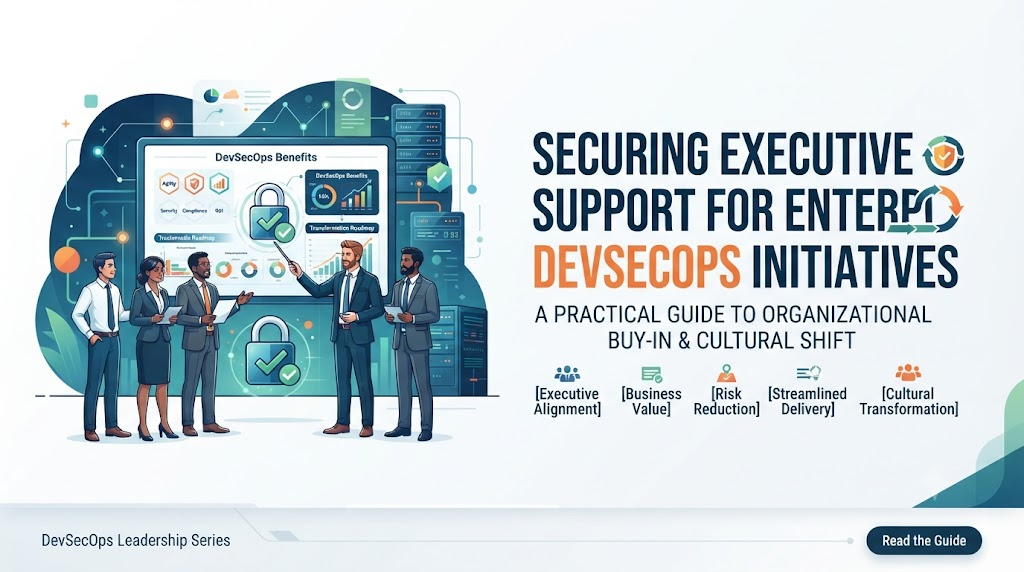
Technology initiatives often fail not because the underlying software is flawed, but because organizations attempt to roll out modern architectures without securing alignment across leadership, engineering, operations, and compliance teams. A successful DevSecOps transformation fundamentally alters traditional workplace relationships by replacing isolated department silos with a shared responsibility for security, balancing delivery speed with continuous risk mitigation. Securing early organizational buy-in from executive sponsors and cross-functional stakeholders enables enterprises to clear operational roadblocks, allocate necessary funding, and maintain focus during delivery challenges. For organizations aiming to navigate this complex cultural and technical shift, leveraging structured educational programs and professional training resources—such as the specialized learning paths provided by the DevOpsSchool ecosystem—is highly beneficial for closing skills gaps, establishing a shared technical vocabulary, and driving sustainable long-term transformation.
+-------------------------------------------------------------+
|               TRADITIONAL SILOED APPROACH                   |
|  [Engineering: Speed] -> [Ops: Stability] -> [Security: Gate]|
+-------------------------------------------------------------+
                              vs
+-------------------------------------------------------------+
|                TRANSFORMED DEVSECOPS MODEL                  |
|          [Unified Value, Shared Responsibility]            |
+-------------------------------------------------------------+
What Is Organizational Buy-In?
Organizational buy-in is the active agreement, commitment, and alignment of stakeholders across all levels of a business to support and execute a shared strategic direction. It goes far beyond passive consensus or executive approval on a budget sheet. True buy-in means that team members understand the underlying purpose of the initiative, accept the accompanying changes in their daily routines, and actively work to achieve the transformation goals.
In an enterprise environment, buy-in manifests as a shared vision where distinct departments—such as finance, legal, development, and security—view the initiative through a common lens of business value. It requires comprehensive change adoption, where teams willingly modify their legacy workflows because they see the long-term benefits of the new model.
Achieving this alignment requires sustained cultural support and a long-term commitment from leadership. It is an ongoing management effort to ensure that as priorities shift and new challenges arise, the organization remains dedicated to embedding security into the core of its software delivery lifecycle.
Why DevSecOps Transformations Need Buy-In
Shifting security accountability to the left requires a fundamental redistribution of operational ownership. In a traditional software development lifecycle, security teams assume sole responsibility for scanning applications and identifying vulnerabilities right before production release. In a modern environment, developers must take active ownership of code security during initial development. Without organizational buy-in, developers view this shift as an unfair displacement of work, leading to resistance and substandard compliance.
Furthermore, integrating security into continuous delivery pipelines introduces significant process modifications and cross-functional collaboration. Teams must learn to work together continuously rather than at defined project gates. This level of collaboration demands explicit governance updates and changes to resource allocation. If leadership does not actively champion these structural updates, engineering managers will continue to prioritize feature delivery over security remediation due to legacy performance incentives.
Traditional Model:
[Requirements] -> [Development] -> [QA] -> [Security Audit (Gate)] -> [Deploy]

DevSecOps Model:
[Continuous Feedback & Automated Security Governance]
[Plan & Secure] -> [Code & Scan] -> [Build & Test] -> [Deploy & Monitor]
From a business perspective, the drivers for securing deep organizational alignment include:
- Mitigating Systemic Risk: Minimizing the financial and operational impact of production vulnerabilities and data breaches.
- Optimizing Resource Utilization: Reducing time spent on late-stage engineering re-work by addressing security flaws early in development.
- Accelerating Secure Time-to-Market: Eliminating late-stage security bottlenecks that delay product compliance and customer delivery.
Stakeholder Alignment Framework
Successfully executing an enterprise transformation requires a structured progression that connects high-level business goals with everyday technical execution. The framework below illustrates how organizations can systematically build, scale, and sustain alignment across all business units.
  Business Objectives
          │
          ▼
 Executive Sponsorship
          │
          ▼
 Stakeholder Engagement
          │
          ▼
    Shared Vision
          │
          ▼
Training & Enablement
          │
          ▼
 Security Integration
          │
          ▼
   Process Adoption
          │
          ▼
Continuous Measurement
          │
          ▼
Organizational Support
          │
          ▼
Long-Term Transformation
1. Business Objectives
The transformation begins by identifying the core objectives of the enterprise, such as improving delivery velocity, entering highly regulated markets, or reducing operational overhead.
2. Executive Sponsorship
Securing committed leadership ensures that the transformation receives the necessary budget, resource priority, and strategic backing to overcome systemic resistance.
3. Stakeholder Engagement
This phase involves interacting with leaders across development, security, operations, and compliance to understand their concerns, workflows, and specific operational requirements.
4. Shared Vision
Establishing a clear definition of success ensures that all teams understand how security integration benefits both their individual workflows and the broader organization.
5. Training & Enablement
Providing teams with structured education, continuous learning opportunities, and practical workshops equips them with the skills required to operate modern automated pipelines.
6. Security Integration
Automated compliance checks, static analysis, and vulnerability scanning are embedded directly into the developer workflow, minimizing friction and manual intervention.
7. Process Adoption
Teams update their daily engineering routines, code review standards, and deployment protocols to naturally encompass the new automated governance models.
8. Continuous Measurement
Tracking key performance metrics provides clear visibility into transformation velocity, engineering quality, and pipeline security posture.
9. Organizational Support
Using data-driven insights to refine processes, resolve operational blockers, and reinforce the value of shared accountability across departments.
10. Long-Term Transformation
The final stage where security is no longer treated as an external check, but exists as a fundamental, self-sustaining element of the company’s operating culture.
Key Stakeholders in DevSecOps Transformation
To build true organizational alignment, you must address the specific concerns and responsibilities of each stakeholder group. The table below outlines their primary focuses and roles in driving transformation success.
| Stakeholder | Primary Concern | Role in Success |
| CIO | Total cost of ownership, operational efficiency, technology ROI, and strategic alignment. | Provides high-level funding, eliminates cross-departmental silos, and aligns the initiative with corporate goals. |
| CTO | Technical delivery speed, platform scalability, engineering innovation, and architectural modernization. | Establishes modern engineering standards, promotes automation, and champions developer platform tools. |
| CISO | Corporate risk reduction, regulatory compliance, data protection, and incident mitigation. | Redefines security policies as automated code, shifts security left, and guides risk management strategies. |
| Engineering Leaders | Sprint velocity, feature delivery timelines, team performance, and software quality. | Adjusts team capacity to prioritize security technical debt and updates engineering delivery processes. |
| Security Teams | Policy enforcement, threat modeling, vulnerability validation, and compliance auditing. | Transitions from manual gatekeepers to platform enablers, providing automated tooling and expert guidance. |
| Compliance Teams | Regulatory audit trails, legal adherence, risk documentation, and governance frameworks. | Validates automated policy configurations and ensures automated pipelines generate valid audit logs. |
| Developers | Developer velocity, tool complexity, minimal workflow friction, and clear requirements. | Writes secure code, remediates pipeline alerts early, and adopts secure design patterns. |
| Operations Teams | System uptime, environment stability, infrastructure reliability, and incident response. | Manages secure infrastructure automation, monitors runtime environments, and scales platform capabilities. |
Building a Strong Business Case
An effective transformation strategy must be articulated in terms of financial performance, operational metrics, and risk mitigation. Executives rarely approve large-scale shifts based on technical terminology alone; they require clear business justifications.
+-------------------------------------------------------------+
|               TRADITIONAL SECURE DELIVERY COST              |
| [Late Fixes] $$$$$$$$$$$$$$$$$$                            |
+-------------------------------------------------------------+
                              vs
+-------------------------------------------------------------+
|                 DEVSECOPS SHIFT-LEFT COST                   |
| [Early Fixes] $$                                            |
+-------------------------------------------------------------+
Risk Reduction and Financial Protection
The financial impact of software vulnerabilities extends far beyond immediate patch remediation. Organizations face potential regulatory fines, legal liabilities, and expensive forensic investigations. By identifying and fixing vulnerabilities during the coding phase rather than in production, enterprises prevent costly emergency updates and safeguard their operational budgets.
Automated Compliance Readiness
Traditional compliance audits require engineering and security teams to spend weeks manually gathering log files, system configurations, and code review records. A mature delivery pipeline embeds compliance requirements directly into the delivery process. This continuous compliance model ensures that every code change is automatically verified against regulatory frameworks, creating an automated, audit-ready data trail.
Operational Efficiency and Engineering Velocity
When security checks occur exclusively at the end of the development lifecycle, discovered vulnerabilities require significant engineering re-work. Developers must revisit code written weeks prior, disrupting active sprints and delaying new features. Shifting security to the left gives engineers immediate feedback within their native environments, reducing context switching and maintaining delivery momentum.
Securing Executive Sponsorship
Securing a mandate from executive leadership is essential for driving cross-departmental change and sustaining multi-year initiatives. Without an executive sponsor, the transformation risks losing funding when short-term business pressures arise.
Executive Sponsorship Functions:
├── Strategic Mandates (Clear corporate priority)
├── Capital Allocation (Dedicated tools and training budget)
├── Friction Resolution (Overriding historical department silos)
└── Governance Alignment (Redefining corporate performance metrics)
To secure and maintain executive sponsorship, change agents should apply the following practices:
- Link Initiatives Directly to Corporate Strategy: Frame the security transformation as a core enabler of key business goals, such as accelerating digital growth or entering highly regulated markets.
- Present Clear Data-Driven Risk Projections: Use historical performance data to illustrate how manual security bottlenecks impact software delivery timelines and product launch targets.
- Establish Transparent Shared Accountability: Work with leadership to update corporate governance models so that security performance metrics are evaluated alongside delivery velocity.
Creating a Security-First Culture
Tools and automated pipelines are only as effective as the people operating them. A sustainable transformation requires cultivating a corporate culture where security is viewed as a collective responsibility rather than the sole domain of an isolated department.
Culture Shift:
[Old: Blame & Silos] ──> [New: Shared Accountability & Continuous Learning]
Shared Responsibility and Empathy
Building a security-first culture requires removing the historical blame dynamic between engineering and security teams. Security professionals must understand the velocity pressures faced by developers, while engineers must recognize the systemic risks that security teams manage. This mutual understanding helps teams collaborate on practical, automated guardrails rather than debating restrictive manual policies.
Continuous Education and Skills Development
Organizations must provide engineering teams with the resources and training needed to write secure software. Rather than treating security training as an annual compliance check, companies should offer continuous learning paths, practical workshops, and accessible technical guidance. Investing in skills development enables developers to remediate vulnerabilities independently, reducing reliance on external security reviews.
Communication Strategies for Buy-In
Clear, tailored communication helps prevent organizational resistance and keeps disparate teams aligned around transformation objectives. Different stakeholder groups require distinct levels of detail and specific context to fully support the shift.
Executive Communications  ──> High-Level ROI, Risk Reduction, Market Velocity
Management Communications ──> Resource Capacity, Velocity Impact, Process Efficiency
Engineering Groups        ──> Tool Integrations, Workflow Friction, Clarity of Alerts
Executive Communications
When presenting to the board, CIOs, or CISOs, focus entirely on high-level business indicators. Avoid technical tool jargon and concentrate on risk reduction, financial efficiency, and time-to-market improvements. Use clear performance dashboards to demonstrate how the transformation supports overall corporate goals.
Engineering and Operations Management
When engaging engineering managers and team leads, focus on resource allocation, sprint capacity, and operational predictability. Show how automated testing minimizes emergency hotfixes and reduces technical debt, ultimately allowing development teams to focus more on building new features.
Individual Contributors and Engineering Groups
For developers and operations engineers, discuss tool integration, developer experience, and workflow simplicity. Explain how modern automation replaces manual security checks with real-time feedback inside their existing code repositories, reducing friction and administrative overhead.
Training and Enablement
A successful technical transformation requires a structured approach to updating workforce capabilities. Organizations must invest in continuous enablement to ensure teams can confidently operate modern security automation frameworks.
Structured Educational Programs
Providing access to structured educational ecosystems allows companies to build a baseline of technical competency across the entire organization. Professional training pathways, such as those curated by DevOpsSchool, provide engineering and security teams with the practical skills needed to design, implement, and maintain secure automated delivery pipelines.
Hands-on Workshops and Interactive Learning
Static training materials are rarely sufficient for mastering complex security practices. Teams need practical, hands-on environments where they can safely configure pipelines, analyze automated alerts, and practice remediating code vulnerabilities without impacting live corporate infrastructure.
Internal Security Champions
Establishing an internal security champions program involves identifying interested developers within standard engineering teams and providing them with advanced training. These engineers serve as embedded security advocates within their respective squads, helping peers address security concerns early and facilitating smooth collaboration between development and security departments.
Measuring Transformation Success
To validate investment and sustain organizational support, teams must track clear, objective performance metrics. The table below outlines key indicators that demonstrate both technical progress and business value.
| Metric | Why It Matters | Business Value |
| Vulnerability Remediation Time | Tracks the duration between a vulnerability’s discovery and its successful remediation. | Shortens the exposure window for vulnerabilities, significantly lowering the risk of production exploits. |
| Security Training Completion | Measures the percentage of engineering and operations personnel who complete security learning paths. | Builds a stronger baseline of security skills, reducing common coding errors across development teams. |
| Deployment Frequency | Monitors how often software is safely deployed to production environments. | Validates that incorporating automated security checks does not slow down delivery velocity. |
| Compliance Readiness Score | Evaluates pipeline compliance against internal policies and external regulatory frameworks. | Minimizes manual audit preparation time, lowering the risk of regulatory penalties. |
| Security Incident Reduction | Tracks the number of production security incidents identified year-over-year. | Provides clear evidence of the transformation’s effectiveness in protecting digital assets. |
| Automated Tool Adoption Rate | Measures the percentage of development teams actively using corporate security pipelines. | Ensures consistent adoption across the enterprise and maximizes the return on tool investments. |
Common Challenges
Large-scale transformations frequently encounter systemic hurdles. The table below details common obstacles alongside practical mitigation strategies.
| Challenge | Impact | Recommended Solution |
| Resistance to Change | Teams continue using legacy manual workflows, stalling automation progress. | Introduce change gradually, highlight early successes, and align security goals with performance incentives. |
| Skills Gaps | Engineers lack the security knowledge required to fix pipeline alerts independently. | Provide structured training, use platforms like DevOpsSchool, and launch an internal champions program. |
| Leadership Uncertainty | Inconsistent executive backing leads to sudden budget cuts or changing priorities. | Maintain clear value reporting, present regular ROI metrics, and link the initiative to corporate strategy. |
| Tool Complexity | Flooding developers with complex tools leads to alert fatigue and ignored warnings. | Optimize scanning configurations, filter out false positives, and deliver actionable alerts within existing tools. |
| Compliance Concerns | Compliance officers worry that automated pipelines lack sufficient oversight. | Involve compliance teams early, automate audit trail generation, and co-author Policy-as-Code rules. |
| Limited Resources | Teams struggle to balance daily operational demands with transformation tasks. | Roll out the transformation in phases, start with a pilot team, and secure dedicated engineering capacity. |
Best Practices
This actionable checklist helps organizations maintain focus, manage change effectively, and build long-term support across all business units.
- Align Transformation Objectives with Core Business GoalsEnsure every technical security target is directly connected to a high-level corporate objective, such as reducing operational risk or accelerating feature delivery.
- Secure Active and Visible Executive SponsorshipMaintain close communication with executive sponsors, providing them with regular progress reports so they can advocate for resources and clear organizational roadblocks.
- Establish Consistent Cross-Functional Communication ChannelsHold regular alignment meetings and share transparent progress updates to keep development, security, and operations teams working toward the same goals.
- Invest Continually in Workforce Training and Technical EnablementProvide teams with access to modern educational ecosystems, hands-on workshops, and specialized certifications to keep pace with evolving industry practices.
- Track, Analyze, and Publicize Concrete Success MetricsUse clear performance dashboards to demonstrate the business value of the transformation, sharing early wins to build momentum across departments.
- Commit to an Iterative and Continuous Improvement ProcessTreat the transformation as an ongoing journey. Regularly gather feedback from engineering teams to refine automated guardrails and reduce workflow friction.
Real-World Example: Financial Services Transformation
Initial Challenges and Context
A retail banking institution with over 800 developers faced growing pressure to accelerate its software release cycles. However, its legacy development model relied on manual end-of-lifecycle security assessments. This approach caused significant friction: software packages routinely sat in security queues for weeks, and the high volume of late-stage vulnerabilities led to missed product launch targets and rising engineering re-work costs.
Leadership Engagement and Buy-In Strategy
Change leaders initiated the transformation by engaging the C-suite directly, presenting clear data on how manual security gates delayed product rollouts and impacted revenue. They secured a committed executive sponsor by framing the transition as a vital step for both risk mitigation and business agility. The team then engaged engineering managers, promising that automated pipeline guardrails would reduce emergency hotfixes and make release cycles more predictable.
Transformation Roadmap:
[Phase 1: Pilot & Baseline] ──> [Phase 2: Scale Pipeline Automation] ──> [Phase 3: Continuous Governance]
Security Transformation Roadmap
- Phase 1 (Months 1–3): The bank established a pilot program with two core product teams. They integrated automated static application security testing (SAST) directly into their existing continuous integration pipelines and launched a baseline security training program.
- Phase 2 (Months 4–9): The team refined scanning rules to eliminate false positives and expanded the deployment to 40% of engineering applications. They also established an internal security champions program to provide localized support.
- Phase 3 (Months 10–18): Automated policy guardrails were rolled out enterprise-wide. Compliance documentation was completely automated within the pipeline, allowing teams to deliver audited updates to production multiple times per week.
Business Improvements and Lessons Learned
Within eighteen months, the institution cut its average vulnerability remediation time by 72% and increased overall deployment frequency by 300%. Automated compliance reporting eliminated hundreds of hours of manual documentation work, allowing the bank to successfully pass regulatory reviews with minimal operational disruption.
A key lesson learned was that tooling alone does not solve cultural misalignment; dedicating time to developer education and pipeline optimization was essential to preventing alert fatigue and ensuring long-term adoption.
Common Misconceptions
Clarifying common misunderstandings helps organizations avoid typical implementation pitfalls and maintain a realistic perspective throughout the transformation journey.
“DevSecOps is exclusively a security department initiative”
Many organizations assume that security initiatives belong solely to the security team. In reality, a successful transformation requires shared accountability across development, operations, and compliance teams. If security remains isolated, the delivery pipeline will continue to suffer from silos and friction.
“Executive sponsorship is optional once funding is approved”
Initial financial approval is not enough to sustain long-term change. Without ongoing, visible alignment from executive leadership, the transformation risks losing focus and resources when teams encounter short-term delivery pressures or competing business priorities.
“Training is a one-time activity completed during onboarding”
Treating training as a single checkbox exercise leaves teams unequipped for evolving challenges. Modern security practices require continuous learning, regular hands-on workshops, and accessible educational ecosystems to keep pace with changing technologies and threat landscapes.
“Deploying more security tools automatically improves adoption”
Flooding engineering environments with unoptimized security tools often backfires. Without careful tuning, tools generate high volumes of false positives, leading to developer frustration and alert fatigue. True adoption relies on clean integration, clear feedback, and practical developer workflows.
“The transformation ends completely once the pipeline is implemented”
An automated pipeline is not a static endpoint. As software architectures evolve and new threats emerge, compliance rules, automated policies, and engineering practices must be regularly reviewed and updated to remain effective.
Future of DevSecOps Transformation
As enterprise software development matures, corporate governance frameworks and security strategies must adapt to changing technology landscapes.
Future Paradigm Shifts:
├── Intelligent Automation (Context-aware risk analysis)
├── Internal Developer Platforms (Security embedded in golden paths)
├── Declarative Governance (Policy-as-Code applied globally)
└── Continuous Compliance Auditing (Real-time, zero-manual-effort tracking)
- Context-Aware Security Automation: Advanced scanning systems are moving beyond basic pattern matching to analyze code intent and runtime context. This reduces false positives, providing engineering teams with highly accurate, actionable alerts.
- Platform Engineering and Golden Paths: Modern organizations are increasingly adopting platform engineering models. By embedding automated security guardrails directly into centralized developer platforms, companies ensure that new services are secure by default without adding friction to the developer experience.
- Policy-as-Code and Automated Governance: Compliance requirements are transitioning from static text documents to version-controlled, executable code. This allows enterprises to apply consistent security rules across global hybrid-cloud environments automatically.
- Continuous Regulatory Auditing: Traditional point-in-time compliance checks are being replaced by continuous tracking systems. Automated delivery pipelines generate real-time audit logs, enabling organizations to maintain a constant state of audit readiness with minimal manual effort.
Certifications & Learning Paths
Building a highly skilled workforce requires structured professional development. The table below highlights key training focuses that support an enterprise security transformation.
| Certification Area | Best For | Skill Level | Business Relevance |
| DevSecOps Engineering | Developers, DevOps engineers, and security professionals. | Intermediate to Advanced | Teaches teams how to embed automated scanning tools directly into continuous integration and delivery pipelines. |
| Cloud Security Architecture | Cloud engineers, systems architects, and security leads. | Advanced | Focuses on securing cloud-native infrastructure, identity management, and containerized workloads. |
| Governance and Compliance | Compliance officers, risk analysts, and enterprise managers. | Intermediate | Connects regulatory requirements with automated pipeline governance and clear audit verification. |
| Platform Engineering Foundations | Platform engineers, site reliability engineers, and technical leads. | Intermediate to Advanced | Guides teams in building secure internal developer platforms that provide automated, secure-by-default workflows. |
| Transformational Leadership | CIOs, CISOs, engineering directors, and change managers. | Executive | Equips business leaders with change management methodologies and strategies for driving organizational alignment. |
Leveraging comprehensive education networks like the DevOpsSchool learning ecosystem provides enterprises with access to structured paths, practical lab environments, and industry-recognized certifications. This unified training framework helps large organizations align disparate teams, close technical skill gaps, and scale secure software delivery practices effectively.
Organizational Readiness Checklist
Use this actionable roadmap to evaluate your company’s current capabilities, identify potential gaps, and guide your transformation strategy.
- Complete a Comprehensive Security Maturity AssessmentEvaluate your current engineering workflows, automated tools, and team skills to establish a clear baseline for the transformation.
- Identify and Map All Key Stakeholders Across the BusinessDocument the specific goals, concerns, and operational requirements of leaders in development, security, operations, and compliance.
- Secure Active and Visible Executive SponsorshipConfirm that senior leadership provides explicit strategic mandates, dedicated budgets, and long-term commitment to the initiative.
- Establish a Tailored Cross-Departmental Communication StrategyDesign distinct reporting metrics and regular updates that address the unique needs of executives, managers, and engineering teams.
- Design and Fund a Continuous Training ProgramProvide teams with structured learning resources, hands-on workshops, and access to educational platforms to support ongoing skills development.
- Define Objective and Measurable Key Performance IndicatorsSelect clear metrics—such as remediation velocity, deployment frequency, and incident rates—to track and demonstrate business value.
- Integrate Automated Security Tools Cleanly Into Existing PipelinesDeploy security scanning tools directly within native developer environments, ensuring configurations are optimized to minimize false positives.
- Update Corporate Governance Policies to Support AutomationTransition traditional manual review gates into version-controlled Policy-as-Code configurations that validate compliance automatically.
- Gather Regular Feedback from Engineering Teams to Refine ProcessesConduct periodic reviews with developers and operations engineers to identify workflow friction and continuously optimize automated guardrails.
FAQs
1. Why is organizational buy-in important for DevSecOps?
Organizational buy-in ensures that all departments—development, security, operations, and compliance—are aligned around a shared vision. Without it, new security processes are often viewed as disruptive administrative burdens, leading to team resistance, fragmented adoption, and ultimately, failed initiatives.
2. How can leaders build support for a security transformation?
Leaders can build support by connecting technical changes directly to high-level business goals, such as risk reduction, faster delivery times, and improved operational efficiency. Addressing the specific concerns of each department and sharing early successes helps build momentum across the enterprise.
3. What role does executive sponsorship play in transformation success?
An executive sponsor provides the necessary strategic backing, budget allocation, and organizational authority to overcome departmental silos. Their continuous visible support ensures the initiative remains prioritized even during short-term delivery pressures.
4. How should organizations communicate these changes to different teams?
Communication must be tailored to the audience. Present high-level business value, cost savings, and risk mitigation to executives. Focus on resource planning, team capacity, and sprint predictability for managers. Discuss tool integration, workflow simplicity, and actionable alerts when engaging individual engineers.
5. How can teams overcome resistance from developers?
To reduce resistance, focus on improving the developer experience. Integrate automated security tools directly into their existing workflows, clear out false positives to prevent alert fatigue, and provide clear, actionable guidance on how to fix discovered vulnerabilities.
6. What metrics should leaders track to measure transformation success?
Key performance indicators include vulnerability remediation time, deployment frequency, security training completion rates, compliance readiness scores, and the reduction of production security incidents over time.
7. How long does an enterprise adoption path typically take?
A comprehensive enterprise transformation is a multi-year journey. While initial pilot teams can demonstrate clear progress within three to six months, scaling automated governance and cultivating a shared security culture across a large organization typically takes eighteen to thirty-six months.
8. What should organizations prioritize during the initial phase?
Prioritize securing an executive sponsor, establishing baseline performance metrics, and launching a pilot program with one or two small, collaborative product teams. Early wins from these pilots provide practical insights and help build support for broader rollout.
9. How do we keep compliance teams comfortable with automated pipelines?
Involve compliance officers early in the transformation process. Show them how automated pipelines enforce consistency and generate permanent, tamper-proof audit logs, proving that automation enhances governance rather than weakening it.
10. Does shifting left mean developers assume all security responsibilities?
No. Shifting left means embedding security checks earlier in the timeline, allowing developers to address simple flaws during coding. Security professionals transition from manual gatekeepers to platform enablers, focusing on threat modeling, advanced analysis, and tool optimization.
11. How can organizations prevent security alert fatigue?
Prevent alert fatigue by carefully tuning scanning tools before rolling them out widely. Filter out low-priority notifications, focus on high-impact vulnerabilities first, and ensure every alert provides clear context and actionable remediation steps.
12. Why do transformation initiatives fail despite having sufficient funding?
Failure often stems from cultural misalignment, lack of ongoing leadership support, or excessive workflow friction. If teams are given complex tools without proper training, clear communication, or adjusted sprint capacity, tool adoption will stall.
13. How does platform engineering support security goals?
Platform engineering teams create standardized internal developer platforms that incorporate security guardrails by default. This enables engineering teams to deploy compliant infrastructure naturally, maintaining speed without bypassing corporate security policies.
14. Should organizations mandate security training for all engineers?
Yes, but the training should be practical, continuous, and integrated into career development pathways. Providing engaging learning opportunities and hands-on environments is far more effective than relying on static, annual compliance lectures.
15. How should a company handle legacy applications during transformation?
Legacy applications should be addressed in phases. Avoid forcing legacy code into modern continuous pipelines immediately. Focus first on securing high-risk active applications, using automated runtime protection where pipeline integration is impractical, and gradually onboarding legacy workloads as they undergo modernization.
Final Thoughts
A successful DevSecOps transformation depends fundamentally on people, culture, and alignment. While modern automation, optimized pipelines, and advanced security tools are powerful enablers, they cannot overcome a fractured organizational culture or a lack of shared vision.
To achieve sustainable change, enterprises must align security goals directly with high-level business objectives, maintain clear and transparent communication across all departments, and track objective performance indicators. Leaders must remain committed to ongoing workforce education and iterative process improvements, recognizing that building a shared culture of resilience is a long-term journey rather than a one-time project.
