Limited Time Offer!
For Less Than the Cost of a Starbucks Coffee, Access All DevOpsSchool Videos on YouTube Unlimitedly.
Master DevOps, SRE, DevSecOps Skills!
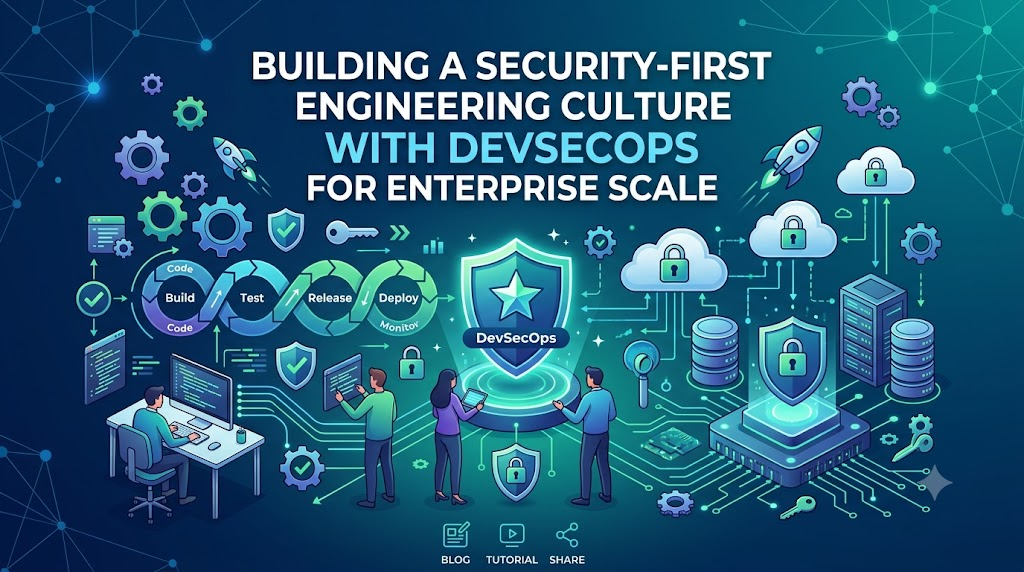
Introduction
The modern software landscape faces an unprecedented wave of cybersecurity threats, from sophisticated supply chain attacks to microservice vulnerabilities, making traditional perimeter-based security completely obsolete. True resilience cannot be achieved by tools alone; it requires a deep organizational commitment to shared responsibility where security transforms from an isolated department into a continuous habit embedded within every developer, product owner, and operations specialist. Cultivating this sustainable, secure DevOps model requires moving away from rigid manual gatekeeping and empowering teams with automated guardrails, a transformation that leading enterprises accelerate by leveraging the expert technical training tracks and organizational ecosystems provided by DevOpsSchool.
What Is a Security-First Engineering Culture?
A security-first engineering culture is an organizational environment where security considerations actively shape every phase of the software development lifecycle. In this model, security is not treated as a bureaucratic checkbox or a final hurdle before a release. Instead, it serves as a foundational design principle.
[Traditional Model] -> Code -> Build -> Test -> [Deploy Gate] -> Security Audit (Bottleneck)

[Security-First]    -> Design (Threat Model) -> Code (SAST) -> Build (SCA) -> Deploy -> Monitor
This operational model relies on five core pillars:
- Shared Ownership: Development, operations, and security teams share equal responsibility for the risk profile of the software they deploy.
- Security Awareness: Every team member understands the threat landscape, common attack vectors, and the business impact of security vulnerabilities.
- Continuous Improvement: The organization views security incidents and near-misses as educational opportunities to refine processes and tools, rather than occasions for blame.
- Accountability: Engineering teams have clear visibility into their security posture and hold themselves responsible for remediating flaws within agreed SLAs.
- Secure-by-Design Mindset: System architectures, API designs, and infrastructure configurations are built from the ground up to minimize attack surfaces and limit access privileges.
Practically, this means a developer will pause to threat-model an architecture change before writing code, rather than waiting for a penetration test to discover structural flaws months later.
Why Culture Matters in DevSecOps
Many organizations invest millions of dollars in advanced static analysis, dynamic scanning, and runtime protection tools, only to find their vulnerability backlogs growing. Tools can identify potential flaws, but they cannot fix the underlying human behaviors that introduced those flaws. Human factors—such as tight deadlines, lack of training, and misaligned incentives—remain the root cause of most enterprise data breaches.
       +---------------------------------------------+
       |   Traditional Siloed Approach               |
       |   [Dev] Project Speed vs [Sec] Risk Control  |
       +---------------------------------------------+
                              │ (Friction & Delays)
                              ▼
       +---------------------------------------------+
       |   DevSecOps Cultural Alignment             |
       |   Shared Incentives & Collaborative Goals   |
       +---------------------------------------------+
When an organization focuses heavily on DevSecOps culture, it aligns the incentives of development speed with risk management. Collaborative dynamics reduce friction between engineering and security teams. Developers no longer view security professionals as blockers, but as enablement partners.
This cultural alignment yields measurable business benefits. It leads to significantly faster remediation times, as bugs are fixed when they are cheapest and easiest to modify. Organizations minimize emergency patching overhead, experience fewer production disruptions, and build long-term, sustainable security practices that scale seamlessly alongside their codebases.
Security-First Culture Framework
Transitioning an enterprise to a secure DevOps model requires a structured, phased approach. Organizations can leverage this operational framework to guide their cultural transformation journey:
 Leadership Commitment
          │
          ▼
  Security Awareness
          │
          ▼
   Shared Ownership
          │
          ▼
  Shift-Left Practices
          │
          ▼
      Automation
          │
          ▼
Continuous Monitoring
          │
          ▼
      Governance
          │
          ▼
Continuous Improvement
1. Leadership Commitment
Executive sponsors establish clear strategic alignment, fund security initiatives, and demonstrate that risk management takes priority over reckless feature delivery.
2. Security Awareness
Teams undergo continuous learning paths to recognize vulnerabilities, understand compliance mandates, and interpret automated security signals accurately.
3. Shared Ownership
Organizations dissolve functional silos by creating cross-functional teams where developers, platform engineers, and security specialists collaborate daily.
4. Shift-Left Practices
Engineering teams embed threat modeling, architectural reviews, and secure design patterns into the earliest stages of the planning cycle.
5. Automation
CI/CD pipelines integrate automated guardrails to provide immediate, actionable feedback directly within the developer’s native workflow.
6. Continuous Monitoring
Production systems utilize deep observability, logging, and runtime protection to detect, isolate, and respond to threats in real time.
7. Governance
Compliance regulations and internal security policies are codified into reproducible infrastructure and policy configurations.
8. Continuous Improvement
The organization regularly analyzes metrics, refines guardrails, and runs blameless post-mortems to mature its overall security posture.
Leadership’s Role in Building Security Culture
Cultural change must be championed from the top down. Executive leaders, including CTOs, CISOs, and VPs of Engineering, establish the foundational parameters of an organization’s security posture. Without visible executive sponsorship, security initiatives are quickly sidelined in favor of feature delivery deadlines.
[Executive Leadership] ── Sets Objectives & Funds Programs ──> [Engineering Managers]
                                                                      │
                                                        Aligns Incentives & Backlog
                                                                      │
                                                                      ▼
                                                          [Productive Dev Teams]
Leadership must drive strategic alignment by making security a core business objective, rather than a hidden technical constraint. This requires allocating adequate resources, including dedicated budget for specialized security tools, training programs, and the engineering capacity needed to address technical debt.
Crucially, leaders must implement balanced accountability models. Instead of penalizing teams when vulnerabilities are discovered, leaders should incentivize proactive risk reduction, timely patch management, and active participation in security programs. When engineering managers see that their performance reviews depend partly on the security health of their systems, security naturally becomes a permanent priority in the product backlog.
Creating Shared Security Ownership
To move past traditional finger-pointing dynamics, organizations must reconfigure how development, operations, and security teams interact. Security can no longer function as an external audit body. It must act as an enabling partner that provides the platforms, tools, and guardrails necessary for engineering teams to build safely.
       +───────────────────────────────────────────────+
       |           Centralized Security Team           |
       |  (Builds guardrails, tools, & golden paths)   |
       +──────────────────────┬────────────────────────+
                              │
            ┌─────────────────┴─────────────────┐
            ▼                                   ▼
+───────────────────────+           +───────────────────────+
|   Development Teams   |           |   Operations Teams    |
| (Owns application risk|           | (Owns infrastructure  |
|  & safe code paths)   |           |  hardening & uptime)  |
+───────────────────────+           +───────────────────────+
Implementation strategies for shared ownership include:
- Developer Responsibility: Developers assume ownership of their application code’s risk profile. They write code using secure patterns and take responsibility for fixing vulnerabilities found in their dependencies.
- Operations Participation: Platform and operations engineers focus on infrastructure hardening, secure configuration management, and maintaining patched, verified base images for deployment containers.
- Security Team Enablement: Security professionals shift away from triaging individual alerts. Instead, they focus on building automated guardrails, providing internal consulting, and designing “golden paths” that make the secure way to build the easiest way to build.
- Cross-Functional Collaboration: Teams conduct joint post-mortems and architecture reviews, ensuring that security considerations are integrated directly into standard sprint planning sessions.
Shift-Left Security as a Cultural Practice
“Shift-Left” security means moving vulnerability detection and risk mitigation earlier in the software development lifecycle. However, shifting left is a cultural shift, not just a technical deployment. If an organization introduces complex security tools into the early development stages without changing its underlying habits, developers will simply bypass or ignore the alerts.
[Plan & Design]        [Code & Commit]       [Build & Test]        [Deploy & Monitor]
  * Threat Modeling     * SAST IDE Plugins    * SCA Dependency Scan * Runtime Observability
  * Secure Templates    * Pre-commit Hooks    * Container Scanning  * Automated Compliance
Practically, shift-left culture begins at the design phase through collaborative threat modeling sessions. Developers and security engineers sit together to analyze system designs, identify potential attack paths, and plan mitigations before a single line of code is written.
During the coding phase, engineers use IDE plugins and pre-commit hooks that scan for hardcoded secrets and structural anti-patterns in real time. By empowering developers with context-aware feedback right at their workstations, organizations resolve the vast majority of common flaws before code ever reaches a shared repository.
Security Automation and DevSecOps
Automation serves as the operational engine of a security-first culture. It converts abstract security policies into predictable, repeatable guardrails embedded directly within the CI/CD pipeline. This automation ensures consistent policy enforcement while accelerating delivery cycles.
| Automation Area | Security Benefit | Business Benefit |
| Vulnerability Scanning | Automatically identifies structural coding bugs and injection vulnerabilities during code compilation. | Reduces expensive manual code reviews and prevents production security incidents. |
| Compliance Validation | Continuously verifies infrastructure configurations against regulatory frameworks like SOC2, ISO 27001, and HIPAA. | Ensures constant audit readiness and eliminates rushed, stressful manual compliance checks. |
| Dependency Analysis | Scans open-source libraries for known vulnerabilities (CVEs) and restrictive licensing terms. | Protects supply chains from upstream vulnerabilities and mitigates legal licensing risks. |
| Infrastructure Security | Evaluates Infrastructure as Code (IaC) files for misconfigured cloud storage, open ports, and weak encryption settings. | Prevents high-risk cloud misconfigurations before resources are provisioned in live environments. |
| CI/CD Security | Hardens delivery pipelines with signed commits, strict access controls, and protected branch rules. | Prevents tampering with build artifacts and protects against supply chain attacks. |
| Monitoring & Alerting | Collects runtime security logs, anomalous behavior data, and live system events. | Accelerates incident response times and minimizes blast radiuses during active security events. |
Security Awareness and Training Programs
Generic, once-a-year compliance slide decks do little to change daily engineering habits. To build an authentic security culture, organizations must deliver contextual, continuous education tailored directly to modern development workflows. Training must move away from theoretical concepts and focus heavily on practical application security.
       +───────────────────────────────────────────────+
       |          Core Security Champion Core          |
       |  (Bridge between Security and Feature Teams)   |
       +──────────────────────┬────────────────────────+
                              │
            ┌─────────────────┴─────────────────┐
            ▼                                   ▼
+───────────────────────+           +───────────────────────+
| Role-Specific Courses |           |   Interactive Labs    |
| (IaC, Cloud Security, |           | (Live fire exercises, |
|   Secure Coding)      |           |  CTF tournaments)     |
+───────────────────────+           +───────────────────────+
A highly successful strategy for scaling security awareness is establishing a Security Champions program. Security Champions are regular software or systems engineers embedded within standard product teams who possess a strong interest in cybersecurity. They receive specialized training, act as the primary security point-of-contact for their peers, and help identify risks early within product design cycles.
Organizations support these champions with role-specific secure coding courses and hands-on, interactive learning labs. These exercises allow developers to actively exploit and patch realistic applications in a controlled sandbox environment.
Governance and Compliance Integration
Enterprise governance and compliance mandates are often viewed as significant roadblocks to engineering velocity. In a modern DevSecOps culture, compliance is transformed from an adversarial inspection process into an automated, continuous background operation. By utilizing Policy as Code (PaC), organizations translate complex legal and regulatory mandates directly into programmatic validation scripts.
[Regulatory Frameworks] -> [Policy as Code Engine] -> [Automated Pipeline Gate] -> [Continuous Compliance]
These automated policy engines evaluate infrastructure templates and deployment manifests against corporate compliance baselines at check-in. If an engineer attempts to deploy a public-facing database, the pipeline blocks the execution and provides an immediate explanation of the violated policy.
This model ensures the enterprise remains continuously audit-ready. The system automatically compiles the cryptographic verifications and log trails required by auditors, eliminating the need to halt engineering sprints for manual evidence gathering. As a result, risk management becomes a predictable byproduct of standard engineering workflows.
Measuring Security Culture Success
What gets measured gets managed. Organizations must track meaningful, behavioral telemetry that reflects the true health of their DevSecOps transformation, rather than relying on vanity metrics that encourage teams to manipulate data.
| KPI | Why It Matters | Business Value |
| Vulnerability Remediation Time | Tracks the average hours or days it takes a team to patch a vulnerability once detected. | Minimizes the time an application remains exposed to potential exploits. |
| Security Training Completion | Monitors the percentage of engineering staff actively finishing specialized, role-based learning tracks. | Ensures engineering teams maintain up-to-date knowledge of the modern threat landscape. |
| Security Incident Rate | Records the number of verified security breaches or high-severity vulnerabilities reaching production environments. | Serves as a direct indicator of software delivery quality and engineering resilience. |
| Policy Compliance Rate | Evaluates the percentage of deployments passing automated policy gates without requiring manual exceptions. | Reflects how well development practices align with corporate compliance standards. |
| Security Testing Coverage | Measures the percentage of active repositories integrated into automated SAST, SCA, and IaC pipelines. | Eliminates organizational blind spots by ensuring comprehensive asset visibility. |
| Employee Participation | Tracks developer engagement in voluntary threat modeling sessions and Security Champion meetups. | Indicates the genuine health, adoption, and growth of the internal security community. |
Common Cultural Challenges
Cultural transformation introduces natural friction as legacy processes are phased out. Identifying these organizational hurdles early allows engineering leaders to implement proactive, empathetic mitigation strategies.
| Challenge | Impact | Recommended Solution |
| Resistance to Change | Engineers bypass new pipeline tools, using custom workarounds to prioritize feature delivery speed. | Involve developers in the tool evaluation phase; ensure security tools integrate seamlessly into existing IDEs. |
| Lack of Ownership | Development teams assume security scanning and remediation remain the sole job of the security unit. | Tie security KPIs directly to engineering performance reviews; designate clear product owners for application risk. |
| Security Fatigue | Teams become desensitized by high volumes of noisy false positives, leading them to ignore alerts completely. | Fine-tune scanning tools regularly; suppress low-risk alerts and focus pipelines on high-confidence findings. |
| Skills Shortages | Software developers lack the foundational knowledge required to interpret complex vulnerability reports. | Partner with specialized training institutions; establish clear internal mentorship paths via Security Champions. |
| Communication Gaps | Security and development teams use conflicting terminology, creating mutual distrust and friction. | Embed security engineers directly into product standups; replace confrontational language with collaborative problem-solving. |
| Leadership Inconsistency | Management deprioritizes critical security patches whenever a project deadline slips behind schedule. | Establish rigid, non-negotiable compliance guardrails and align long-term business goals with risk reduction. |
Best Practices for Building a Security-First Culture
- Lead by Example: Ensure executive leaders visibly champion security initiatives and protect engineering capacity to address technical debt.
- Promote Shared Ownership: Distribute risk management responsibilities across development, platform engineering, and security units.
- Automate Security Guardrails: Embed high-confidence SAST, SCA, and compliance checks directly into standard CI/CD deployment pipelines.
- Invest in Continuous Training: Move away from annual checklist training; implement hands-on labs and specialized role-based education.
- Measure Outcome-Based Metrics: Track actionable data points like mean time to remediation (MTTR) and policy compliance rather than vanity alerts.
- Encourage Open Collaboration: Replace blame-heavy incident write-ups with empathetic, blameless post-mortems focused on systemic improvement.
Real-World Example: Financial Technology Transformation
Initial Cultural Challenges
A global financial technology enterprise with over 1,200 developers faced significant release delays. The central security team conducted manual audits at the end of quarterly release cycles, which regularly discovered hundreds of vulnerabilities. This structure resulted in confrontational patch cycles, missed market deadlines, and high rates of security exceptions.
DevSecOps Transformation Roadmap
The engineering leadership initiated a multi-year DevSecOps culture transformation strategy structured around systemic changes:
- Phase 1: They established a Security Champions program, embedding one trained developer inside each core product scrum team.
- Phase 2: The platform team integrated automated SCA and IaC scanning directly into the global Jenkins and GitHub Actions pipelines.
- Phase 3: The organization partnered with professional training platforms to deliver contextual secure coding education to all software engineers.
Performance Improvements
Within eighteen months of launching the culture program, the company recorded significant operational shifts:
[Legacy Audit Model]   -> MTTR: 45 Days  | Production Incidents: High | Release Cadence: Quarterly
[DevSecOps Framework]  -> MTTR: <3 Days | Production Incidents: -82%  | Release Cadence: Daily
- Mean Time to Remediation (MTTR): Decreased from 45 days down to less than 3 days for critical findings.
- Production Incidents: High-severity production security incidents fell by 82%.
- Pipeline Efficiency: Over 90% of basic code vulnerabilities were caught and remediated within the developer’s local IDE before code integration.
Lessons Learned
The primary takeaway was that the tool automation only succeeded because leadership adjusted engineering incentives. By freeing up 15% of sprint velocity specifically for addressing security debt and technical hardening, developers were given the practical capacity to act on pipeline feedback.
Common Misconceptions
Misconception 1: Security is only the security team’s job
A dedicated security department can never scale efficiently enough to manually audit every line of code written by modern engineering teams. Centralized teams must shift toward creating automated guardrails, transforming their role into enablement partners rather than active gatekeepers.
Misconception 2: More tools automatically improve security
Deploying multiple scanning tools without tuning their configurations generates high volumes of false positives. This noise causes alert fatigue and frustrates developers. A culture is defined by how effectively teams triage and fix vulnerabilities, not by how many tools are running in the pipeline.
Misconception 3: Compliance equals security
Meeting regulatory standards like PCI-DSS or SOC2 provides a valuable baseline, but compliance represents a point-in-time snapshot of minimum requirements. True security requires an ongoing, proactive approach to threat modeling and architectural resilience that evolves faster than regulatory updates.
Misconception 4: Developers naturally slow down security efforts
Developers generally want to write high-quality, secure code. When security tools are slow, difficult to interpret, or disruptive to standard workflows, engineers will inevitably find workarounds to meet feature deadlines. Providing actionable feedback within native tools helps maintain engineering velocity.
Misconception 5: Culture change happens quickly
Transforming how large engineering organizations perceive and manage risk is a long-term journey. It requires sustained executive commitment, iterative adjustments to team incentives, and continuous reinforcement over many months to achieve lasting behavioral change.
Security Culture Maturity Model
Organizations can evaluate their cultural progress and plan future improvements by assessing their position across these five maturity phases:
 Level 1: Reactive
   (Siloed teams, manual end-of-cycle audits, adversarial relationships)
          │
          ▼
 Level 2: Awareness
   (Basic training introduced, periodic scans, growing security champions)
          │
          ▼
 Level 3: Shared Responsibility
   (Cross-functional collaboration, threat modeling in design, aligned KPIs)
          │
          ▼
 Level 4: Automated Security
   (Ubiquitous CI/CD guardrails, Policy as Code, low false-positive noise)
          │
          ▼
 Level 5: Security-First Engineering
   (Secure-by-design defaults, continuous feedback loops, blameless culture)
Level 1 – Reactive Security
Security operates as a separate silo. Audits occur right before production releases, leading to high friction, frequent finger-pointing, and delayed deployments.
Level 2 – Security Awareness
Leadership introduces basic security training modules. Teams run occasional vulnerability scans, and the organization begins identifying potential candidates for a Security Champions program.
Level 3 – Shared Responsibility
Development and operations teams actively participate in threat modeling sessions during initial product design phases. Engineering KPIs align with risk reduction goals.
Level 4 – Automated Security
High-confidence security guardrails are integrated into all standard CI/CD pipelines. Compliance mandates are translated into Policy as Code, significantly reducing manual validation overhead.
Level 5 – Security-First Engineering
Systems use secure-by-design defaults and hardened architecture templates by default. Continuous feedback loops guide engineering decisions, and a blameless culture treats incidents as opportunities for systemic improvement.
Future of Security-First Engineering
As software architectures evolve, security culture must adapt to keep pace with changing operational environments. The integration of artificial intelligence into engineering workflows is reshaping risk management. AI-assisted security tools now analyze code repositories in real time, automatically suggesting contextual remediation patches directly within developer pull requests.
Concurrently, organizations are moving away from disconnected security scanning toward holistic security observability. This paradigm combines runtime telemetry, API traffic analysis, and pipeline data into a single operational view, allowing teams to prioritize vulnerabilities based on actual production exposure.
+─────────────────────────────+       +─────────────────────────────+
|       Legacy Testing        |       |   Modern Platform Sec       |
|  Isolated pipeline scans    |  ───> |  Embedded golden paths,     |
|  and high false positives.  |       |  continuous compliance,     |
|                             |       |  and predictive AI insights |
+─────────────────────────────+       +─────────────────────────────+
Furthermore, security is becoming a core component of the Platform Engineering movement. Organizations are embedding secure templates, identity configurations, and network policies directly into internal developer platforms (IDPs).
By providing engineers with pre-hardened infrastructure foundations, compliance becomes an automated feature of the platform. This model shifts the focus from manual enforcement toward predictive risk management, allowing organizations to simulate threat vectors and neutralize vulnerabilities before code is deployed.
Certifications & Learning Paths
To build a sustainable security culture, organizations must equip their engineering teams with verified, industry-recognized skills. Providing structured professional development paths ensures that teams can execute DevSecOps principles effectively.
| Certification Area | Best For | Skill Level | Cultural Relevance |
| DevSecOps | Software Engineers, DevOps Architects, Security Specialists | Intermediate to Advanced | Teaches the integration of automated security guardrails directly into modern delivery pipelines. |
| Cloud Security | Cloud Architects, Platform Engineers, Infrastructure Teams | Intermediate to Advanced | Focuses on cloud infrastructure hardening, identity management, and secure resource provisioning. |
| Kubernetes Security | Container Engineers, Platform Architects, Site Reliability Engineers | Advanced | Provides deep expertise in container isolation, network policies, and cluster runtime security. |
| Compliance | Systems Auditors, Security Managers, Governance Leaders | Intermediate | Bridges the gap between technical infrastructure operations and legal regulatory requirements. |
| DevOps | System Administrators, Release Managers, Software Developers | Beginner to Intermediate | Establishes the foundational culture of continuous integration, collaboration, and automated pipelines. |
| Platform Engineering | Infrastructure Developers, Internal Platform Architects | Advanced | Enables the creation of secure golden paths that simplify developer workflows by default. |
Building a robust internal education structure requires partnering with comprehensive enterprise learning systems. The DevOpsSchool learning ecosystem provides organizations with structured training tracks, hands-on lab environments, and expert-led programs designed to turn traditional development teams into security-first engineering organizations.
Security Culture Readiness Checklist
- Assess Culture Maturity: Evaluate your current organizational state against the five levels of the Security Culture Maturity Model to identify structural gaps.
- Establish Clear Ownership: Define explicit responsibilities for application security risks within product development teams and align engineering KPIs accordingly.
- Implement Shift-Left Practices: Introduce collaborative threat modeling sessions during the initial design phases of all new feature initiatives.
- Strengthen Pipeline Automation: Integrate high-confidence SAST, SCA, and IaC scanning tools directly into existing CI/CD automation pipelines.
- Monitor Core Posture Metrics: Track actionable telemetry including mean time to remediation (MTTR), pipeline pass rates, and training engagement.
- Commit to Continuous Improvement: Conduct blameless post-mortems for security incidents and routinely update security guardrails based on real-world findings.
FAQs
1. What is a security-first engineering culture?
It is an organizational environment where security is treated as a core design principle and shared responsibility across development, operations, and security teams throughout the software lifecycle.
2. Why is culture important in DevSecOps?
Tools alone cannot fix structural risks introduced by rushed deadlines or insufficient training. A strong culture aligns team incentives so that speed and risk management complement each other.
3. How can leaders influence security culture?
Leaders influence culture by securing budgets for training and automated tools, protecting engineering sprint capacity to address technical debt, and factoring security health into team performance reviews.
4. What role do developers play?
Developers take direct ownership of their application code’s risk profile. They write code using secure design patterns, resolve dependencies, and collaborate on early threat modeling.
5. How does automation support culture?
Automation removes subjective friction by embedding predictable, objective guardrails into CI/CD pipelines. This ensures consistent policy enforcement without manual gatekeeping delays.
6. What KPIs should organizations track?
Organizations should monitor mean time to remediation (MTTR), security training completion rates, production incident frequencies, and pipeline policy pass rates.
7. How long does culture transformation take?
An authentic culture transformation typically requires twelve to twenty-four months, depending on the organization’s initial size, complexity, and leadership commitment.
8. Where should organizations begin?
Begin by establishing a Security Champions program within a single product team, introducing automated dependency scanning, and conducting basic threat modeling sessions.
9. What is a Security Champion?
A Security Champion is an embedded engineer within a standard product scrum team who receives advanced training to act as the primary security advocate and advisor for their peers.
10. Does DevSecOps eliminate all security risks?
No. DevSecOps significantly reduces risk profiles and accelerates remediation times, but no process or tool combination can promise absolute immunity from evolving cyber threats.
11. How can we prevent developer security fatigue?
Fatigue is mitigated by continuously tuning scanning tools to minimize false positives, suppressing low-priority alerts, and focusing developer attention on high-confidence vulnerabilities.
12. What is Policy as Code?
Policy as Code is the practice of managing and enforcing compliance rules by writing them as programmatic scripts that can be tested and executed automatically within CI/CD pipelines.
13. How do we balance deployment speed with robust security?
By providing engineering teams with pre-hardened infrastructure templates and automated feedback loops that identify bugs immediately, allowing fast remediation during the coding process.
14. Why are traditional security audits insufficient?
Traditional manual audits occur at the end of development cycles, creating significant release bottlenecks, high patching costs, and adversarial relationships between teams.
15. What are modern “golden paths”?
Golden paths are pre-packaged, validated, and secured workflows provided by platform teams that allow developers to build and deploy applications safely by default.
Final Thoughts
Building a security-first engineering culture with DevSecOps is a continuous journey that requires balancing people, processes, and technology. Organizations must move beyond tool acquisition and invest heavily in shifting human behaviors, establishing shared ownership models, and breaking down traditional operational silos.
True security resilience is achieved when risk mitigation is treated as a fundamental element of product quality, fully aligned with long-term business objectives. By empowering engineering teams with automated guardrails, contextual training, and executive support, enterprises can deliver secure, high-quality software at speed while maintaining a strong, sustainable security posture.
