Limited Time Offer!
For Less Than the Cost of a Starbucks Coffee, Access All DevOpsSchool Videos on YouTube Unlimitedly.
Master DevOps, SRE, DevSecOps Skills!
Introduction
In the modern digital landscape, the speed of software delivery often clashes with the necessity of robust security, prompting organizations to embrace DevSecOps to bridge this gap by embedding security practices directly into the development lifecycle. While this transition promises improved resilience and a reduced attack surface, moving from traditional models to an integrated approach is rarely seamless, with many organizations encountering significant friction that stalls their progress. Understanding these common DevSecOps implementation pitfalls early—and learning how to navigate them effectively—is the most vital step toward ensuring a sustainable and successful transformation. For professionals aiming to master these complexities, DevOpsSchool provides the specialized training and consulting needed to bridge knowledge gaps, helping developers, security leads, and engineering managers avoid common traps and mature their organization’s security posture.
Understanding DevSecOps Transformation
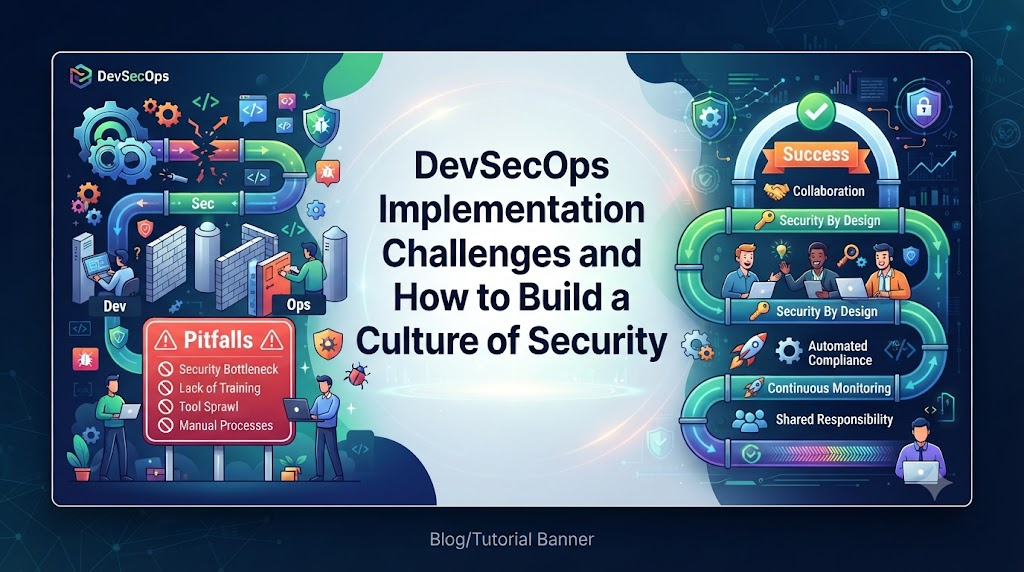
DevSecOps is not merely a collection of tools; it is a cultural and operational shift. It relies on several core pillars that redefine how technology organizations function:
- Security Integration: Security is moved to the earliest phases of development, often referred to as shifting left.
- Shared Responsibility: Security is no longer solely the domain of the security team; it is a collective duty shared by developers, operations, and security professionals.
- Automation: Manual security checks are replaced by automated guardrails in the CI/CD pipeline.
- Continuous Compliance: Compliance is treated as code, ensuring that policies are enforced automatically rather than through periodic manual audits.
- Risk Reduction: By identifying vulnerabilities early, organizations reduce the cost and technical debt associated with fixing issues post-release.
For leadership, this transformation is an investment in business continuity and brand trust. It moves the organization from reactive firefighting to proactive risk management.
Why DevSecOps Implementations Struggle
Despite the clear benefits, many organizations face significant hurdles that derail their progress. These challenges often stem from:
- Cultural Barriers: Resistance to change is common. Developers may view security as a blocker, while security teams may be hesitant to relinquish control.
- Tool Complexity: The market is flooded with security tools, leading to “tool fatigue” where teams implement software they lack the bandwidth to manage effectively.
- Skills Shortages: A lack of expertise in both modern cloud-native security and DevOps automation creates a bottleneck.
- Governance Gaps: Existing compliance frameworks are often too rigid for the fast-paced nature of modern CI/CD pipelines.
- Unrealistic Expectations: Expecting a complete transformation overnight often leads to frustration and premature abandonment of the project.
DevSecOps Challenge-Solution Framework
To successfully implement DevSecOps, organizations should follow a structured, iterative progression:
- Identify Risk: Catalog your high-value assets and the threats relevant to your specific industry.
- Assess Current State: Conduct an honest audit of your existing manual processes and silos.
- Define Security Goals: Set measurable objectives, such as reducing mean time to remediation (MTTR) for critical vulnerabilities.
- Implement Incrementally: Start with a single application or team. Do not attempt a wholesale enterprise change immediately.
- Automate Controls: Replace manual security gates with automated testing (SAST, DAST, SCA) in your pipelines.
- Measure Outcomes: Use data to validate that your controls are actually reducing risk.
- Improve Continuously: Use feedback loops to refine your processes based on real-world results.
- Scale Successfully: Gradually expand successful patterns to the rest of the organization.
Major DevSecOps Implementation Pitfalls and Solutions
| Pitfall | Impact | Recommended Solution |
| Security as a Separate Team | Creates silos and slows down development. | Embed security champions within development teams. |
| Tool-First Mindset | Results in high costs and low adoption. | Define process and culture before selecting tools. |
| Excessive Manual Processes | Creates bottlenecks and human error. | Focus on security automation in the pipeline. |
| Weak Governance | Lack of visibility into security posture. | Implement Policy as Code (PaC). |
| Poor Compliance Visibility | Difficulties during audits. | Integrate continuous compliance monitoring. |
| Unrealistic Expectations | Leads to project failure and burnout. | Use a phased approach with clear, small wins. |
Pitfall #1: Treating Security as Someone Else’s Responsibility
When security is viewed as a “policing” function, developers often bypass it to meet deadlines. This leads to friction and resentment.
Solution: Transition to a shared responsibility model. Empower developers with security training and provide them with the tools to self-remediate issues early in the lifecycle.
Pitfall #2: Focusing on Tools Instead of Processes
Purchasing expensive security scanning tools without a defined workflow leads to “alert fatigue” and ignored notifications.
Solution: Map your delivery process first. Identify where security checks fit naturally into the existing workflow, then select tools that integrate seamlessly into that process.
Pitfall #3: Inadequate Security Automation
Manual security reviews happen too late in the development cycle, causing delayed releases and costly rework.
Solution: Automate security gates. Integrate Static Application Security Testing (SAST) and Software Composition Analysis (SCA) to identify vulnerabilities as soon as code is committed.
Pitfall #4: Ignoring Security Culture
A lack of security awareness leads to poor coding practices and accidental misconfigurations.
Solution: Invest in ongoing education. Foster a culture where security is viewed as a quality attribute of the code, not a bureaucratic hurdle.
Pitfall #5: Weak Compliance and Governance Practices
Trying to maintain manual, point-in-time compliance reports is impossible in a dynamic environment.
Solution: Embrace “Compliance as Code.” Automate the enforcement of regulatory requirements within your cloud infrastructure and pipelines.
Pitfall #6: Poor Security Testing Integration
Testing only at the end of the release cycle creates “security debt.”
Solution: Perform testing throughout the pipeline. Run lightweight, fast tests during builds and deeper, more intensive scans on staging environments.
Pitfall #7: Cloud Security Misconfigurations
Cloud environments are complex, and default settings are often insecure.
Solution: Implement Cloud Security Posture Management (CSPM) to monitor for misconfigurations and enforce identity and access management (IAM) best practices.
Measuring DevSecOps Success
Success must be quantified to justify ongoing investment and improvement.
| Metric | Why It Matters | Business Value |
| Vulnerability Remediation Time | Speed of fixing security flaws. | Reduces window of exposure. |
| Security Incident Frequency | Number of actual breaches or near misses. | Measures risk reduction. |
| Security Test Coverage | Percentage of code scanned. | Ensures consistency. |
| Deployment Frequency | How often you ship code. | Shows that security isn’t slowing you down. |
| Compliance Success Rate | Audit-readiness. | Lowers legal and regulatory risk. |
| Mean Time to Recovery (MTTR) | How fast systems recover from failure/attack. | Minimizes downtime costs. |
Best Practices for Successful DevSecOps Adoption
- Build a Security Culture: Promote collaboration between teams.
- Automate Where Possible: Use automation for repeatable tasks.
- Strengthen Governance: Enforce policies through automated checks.
- Implement Policy as Code: Treat security policies like application code.
- Integrate Testing Early: Ensure security checks exist in the CI/CD pipeline.
- Monitor Continuously: Move from periodic reviews to real-time observability.
Real-World Example: An Enterprise Transformation Case Study
A mid-sized financial services company struggled with slow release cycles due to a manual security review process that took two weeks per release.
- Challenges: Developers felt excluded; security team was overwhelmed; compliance was reactive.
- Roadmap: The company implemented a pilot project with one core application.
- Automation: They integrated automated SAST tools into the Git workflow, providing developers with immediate feedback.
- Governance: They shifted to “Compliance as Code,” allowing auditors to see real-time status dashboards instead of static reports.
- Outcomes: The release cycle dropped from two weeks to three days, while the number of production vulnerabilities dropped by 40% within the first six months.
- Lessons Learned: Incremental change was key. Trying to fix the entire ecosystem at once would have caused operational collapse.
Common Misconceptions
- “DevSecOps slows down delivery”: Actually, by identifying bugs earlier, it prevents costly rollbacks and late-stage patches, ultimately increasing velocity.
- “Security automation solves everything”: Automation is only as good as the policies you define. It requires constant tuning and human oversight.
- “Compliance equals security”: Compliance is the minimum baseline. A system can be compliant but still insecure.
- “More tools mean stronger security”: Complexity often creates blind spots. Focus on depth of integration rather than breadth of tools.
- “DevSecOps is a one-time initiative”: It is a continuous lifecycle of improvement, not a destination.
Future of DevSecOps Adoption
- AI-Assisted Security: Using machine learning to detect anomalies and suggest remediation.
- Platform Engineering: Building secure, self-service platforms for developers.
- Continuous Compliance: Moving toward real-time regulatory mapping.
- Zero Trust Architecture: Assuming no network is secure and enforcing authentication for every request.
- Intelligent Automation: Automating not just the scan, but the auto-patching of non-critical vulnerabilities.
Certifications & Learning Paths
| Certification Area | Best For | Skill Level | Security Relevance |
| DevSecOps Practitioner | Developers/Security Engineers | Intermediate | High |
| Cloud Security (AWS/Azure/GCP) | Cloud Architects | Advanced | Critical |
| Kubernetes Security | Platform Engineers | Advanced | High |
| Compliance/Governance | Managers/Compliance Teams | Intermediate | Essential |
The DevOpsSchool learning ecosystem provides structured paths to master these critical domains through hands-on practice.
DevSecOps Readiness Checklist
- Does your current culture encourage shared ownership of security?
- Are your security tools integrated into the CI/CD pipeline?
- Have you defined clear, automated security policies?
- Do your developers have the training to fix common vulnerabilities?
- Are you tracking KPIs like MTTR and security coverage?
- Is there a mechanism for continuous feedback and improvement?
FAQs
- What is the biggest DevSecOps implementation challenge?The biggest challenge is cultural, specifically breaking down the silos between development, operations, and security teams.
- Why do DevSecOps initiatives fail?Most often due to a lack of executive support, unrealistic scope, and focusing on tools over culture and processes.
- How important is automation?Automation is the engine of DevSecOps. Without it, you cannot scale security checks at the speed of modern delivery.
- What role does governance play?Governance provides the guardrails. Without it, you cannot prove that your automated processes are compliant with internal and external requirements.
- How can organizations improve compliance?By adopting “Compliance as Code,” which automates the testing and verification of regulatory controls.
- What metrics should teams track?Focus on DORA metrics plus security-specific metrics like time to remediate and vulnerability density.
- Can small organizations implement DevSecOps?Yes, they have the advantage of agility, allowing them to implement DevSecOps practices more quickly than large enterprises.
- Where should teams start?Start with one application or one pipeline. Pick a low-risk project to build momentum and refine your processes.
- Do I need new tools?Not necessarily. You may already have tools that are underutilized. Focus on integration first.
- How do I measure ROI?Measure the reduction in incidents, the reduction in time spent on manual audits, and the decrease in rework cycles.
- Who is responsible for DevSecOps?Everyone involved in the software delivery process is responsible for the security of the product.
- Is DevSecOps for cloud-only environments?No, it applies to on-premises, hybrid, and cloud environments alike, though the tooling varies.
- What is “Shift Left”?It is the practice of performing security testing earlier in the development lifecycle.
- How do I handle developers resisting change?Focus on providing value. If security tools make their jobs easier—by catching bugs faster—adoption will follow.
- How long does a transition take?It is a multi-year journey. Focus on continuous improvement rather than a hard completion date.
Final Thoughts
DevSecOps is a demanding but rewarding journey. It requires a balanced focus on people, processes, and technology. You will not achieve “perfect” security, but you can build a system that is resilient, measurable, and continuously improving. Avoid the temptation to implement every tool on the market. Instead, start small, cultivate a collaborative culture, and measure your results consistently. Success in DevSecOps is found in the steady, incremental application of security practices until they become part of your organizational DNA.
