Limited Time Offer!
For Less Than the Cost of a Starbucks Coffee, Access All DevOpsSchool Videos on YouTube Unlimitedly.
Master DevOps, SRE, DevSecOps Skills!
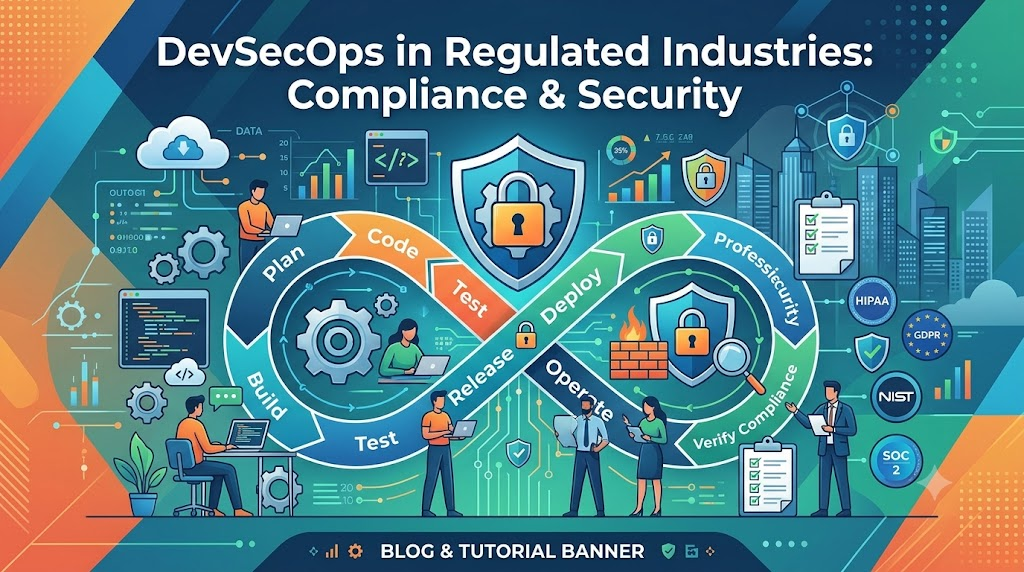
Modern enterprise software delivery in banking, healthcare, finance, and government requires a delicate balance between rapid digital innovation and strict regulatory compliance. Traditional security models—reliant on manual audit checkpoints and late-stage penetration testing—often create severe deployment bottlenecks, leaving organizations stuck between delaying critical features and exposing sensitive data to evolving cyber threats. By embedding security controls, compliance policies, and automated risk governance directly into continuous integration and delivery pipelines, adopting DevSecOps in Regulated Industries with guidance from leading ecosystems like DevOpsSchool allows organizations to achieve continuous audit readiness, accelerate secure software releases, and maintain uncompromised governance across complex cloud environments.
What Is DevSecOps in Regulated Industries?
DevSecOps stands for Development, Security, and Operations. It is an evolution of the traditional DevOps philosophy, adding security and compliance checks directly into every stage of the software delivery process.
       +---------------------------------------------------+
       |                 SECURITY & COMPLIANCE             |
       |  (Policies, Static Analysis, Secret Detection)   |
       +-------------------------+-------------------------+
                                 |
                                 v
+-------------+     +------------+------------+     +-------------+
| DEVELOPMENT | --> |   CONTINUOUS INTEGRATION    | --> | OPERATIONS  |
| (Code/Build)|     | (Automated Security Tests)  |     | (Deployment)|
+-------------+     +-------------------------+     +-------------+
                                 |
                                 v
       +-------------------------+-------------------------+
       |             CONTINUOUS AUDITING & LOGS            |
       |     (Policy-as-Code, SIEM, Real-time Alerts)      |
       +---------------------------------------------------+
In standard environments, DevSecOps focuses primarily on preventing software vulnerabilities, managing application security, and maintaining cloud stability. However, in regulated industries, DevSecOps expands to include regulatory compliance, automated audit trail generation, and strict data protection controls.
Traditional Security vs. Regulated DevSecOps
- Traditional Security: Security reviews occur late in the development cycle. Gatekeepers evaluate code manually, often generating long reports right before production deployment. Compliance audits rely on static documentation and manual sampling.
- Regulated DevSecOps: Security policies are expressed as code (Policy-as-Code). Tests run automatically on every code commit. Auditing documentation is generated continuously during deployment, turning compliance from a periodic hurdle into an automated background process.
Why Regulated Industries Need DevSecOps
Regulated sectors operate under strict legal frameworks, where security failures or compliance breaches can result in substantial financial penalties, legal liabilities, and reputational damage.
The Regulatory Challenge
Modern software applications rely on microservices, cloud platforms, third-party libraries, and automated deployment chains. This complexity creates a large attack surface. Manual compliance assessments cannot reliably keep up with daily or weekly software releases, creating a backlog that forces teams to choose between delaying features or taking on unmanaged risk.
The DevSecOps Solution
DevSecOps shifts security assessment “left” (earlier in the development cycle), allowing development teams to identify vulnerabilities when code is written. By validating security configurations automatically within CI/CD pipelines, regulated enterprises achieve:
- Continuous risk reduction across code, dependencies, and cloud environments.
- Continuous compliance verification without slowing software delivery.
- Immutable audit trails created automatically by pipeline builds.
- Shorter remediation cycles for high-severity vulnerabilities.
Understanding Regulated Industries and Their Security Requirements
Different regulated sectors face distinct operational constraints, legal obligations, and security mandates. Understanding these nuances is essential when designing a DevSecOps strategy.
                               REGULATED INDUSTRIES
                                        |
      +------------------+--------------+--------------+------------------+
      |                  |                             |                  |
      v                  v                             v                  v
+-----------+      +-----------+                 +-----------+      +-----------+
| BANKING & |      | HEALTHCARE|                 |PUBLIC SECTOR|    | FINTECH & |
|  FINANCE  |      +-----------+                 +-----------+      | INSURANCE |
+-----------+      | Patient   |                 | Citizen   |      +-----------+
| Financial |      | Privacy   |                 | Services  |      | Fraud     |
| Records   |      | (HIPAA)   |                 | (FedRAMP) |      | Prevention|
+-----------+      +-----------+                 +-----------+      +-----------+
Banking and Financial Services
Financial institutions process payments, manage monetary assets, and store sensitive customer account data.
- Key Concerns: Fraud prevention, transaction integrity, protection of personally identifiable information (PII), and non-repudiation.
- Core Regulations: PCI DSS, SOC 1/SOC 2, GLBA, and local banking guidelines.
- DevSecOps Impact: Automated secret scanning prevents API keys and database credentials from leaking into repositories. Immutable audit logging tracks every change made to payment systems.
Healthcare
Healthcare platforms manage sensitive electronic health records (EHR) and run connected medical systems.
- Key Concerns: Patient confidentiality, data integrity, access control, and high system availability.
- Core Regulations: HIPAA, HITECH, and GDPR.
- DevSecOps Impact: Automated policy validation ensures patient data is encrypted both in transit and at rest across modern cloud architectures.
Government and Public Sector
Government platforms host critical civil infrastructure, citizen records, and national defense applications.
- Key Concerns: Data sovereignty, role-based access control, system availability, and protection against advanced threats.
- Core Regulations: FedRAMP, NIST SP 800-53, and FISMA.
- DevSecOps Impact: Hardened container configurations and infrastructure code templates enforce strict system baselines before deployment.
Insurance and FinTech
FinTech firms operate at the intersection of finance and software, handling risk assessments, digital lending, and digital wallets.
- Key Concerns: API security, automated fraud detection, data isolation, and user authentication.
- Core Regulations: GDPR, CCPA, PCI DSS, and regional anti-money laundering (AML) laws.
- DevSecOps Impact: Automated dependency scanning flags unsafe third-party libraries before code is deployed to production.
Traditional Security Approach vs. DevSecOps Approach
Transitioning from traditional security models to a DevSecOps model changes how security, engineering, and audit teams work together.
| Area | Traditional Security | DevSecOps Security |
| Security Involvement | Late in the cycle (pre-release gatekeeper) | Continuous (integrated across design, build, and deploy) |
| Testing Approach | Manual penetration testing & point-in-time scans | Automated SAST, DAST, SCA, and secret scanning in CI/CD |
| Compliance Process | Paperwork-heavy, manual evidence collection | Continuous compliance with Policy-as-Code & automated evidence gathering |
| Automation Level | Minimal; relies on manual reviews | High; integrated pipelines validate code and infrastructure |
| Team Collaboration | Siloed teams (Dev vs. Ops vs. Security) | Cross-functional ownership of security outcomes |
| Risk Management | Reactive (issues found right before release) | Proactive (vulnerabilities identified during development) |
| Monitoring | Basic uptime and system metrics | Real-time monitoring, behavioral analysis, and automated compliance tracking |
Key Principles of DevSecOps in Regulated Industries
Implementing DevSecOps in regulated industries requires systematic changes to engineering processes and compliance workflows.
| Principle | Purpose | Compliance Benefit |
| Shift-Left Security | Run security tests early in development | Reduces the cost and time needed to fix vulnerabilities |
| Policy-as-Code | Express security and compliance policies as executable code | Enables consistent, repeatable automated policy checks |
| Continuous Auditing | Automatically collect and sign pipeline build logs | Streamlines regulatory audits with traceable deployment evidence |
| Automated Remediation | Block non-compliant code from deploying automatically | Prevents security regressions and illegal configurations from reaching production |
| Zero Trust Access | Enforce strict identity checks for all developer and service access | Protects source repositories, pipeline artifacts, and production systems |
| Shared Responsibility | Give developers clear security feedback and automated tooling | Makes security an operational habit for every team member |
Secure CI/CD Pipelines for Regulated Environments
The CI/CD pipeline serves as the control center of modern software delivery. In a regulated environment, the pipeline must enforce compliance boundaries automatically.
+---------------+     +---------------+     +---------------+     +---------------+
| DEVELOPER     |     | BUILD & SCAN  |     | DEPLOYMENT    |     | CONTINUOUS    |
| COMMIT        | --> | PIPELINE      | --> | GOVERNANCE    | --> | MONITORING    |
+---------------+     +---------------+     +---------------+     +---------------+
| • Code Commit |     | • SAST Check  |     | • Policy Gate |     | • Runtime Sec |
| • Pre-commit  |     | • SCA Check   |     | • Signed      |     | • SIEM Logs   |
|   Hooks       |     | • Secret Scan |     |   Artifacts   |     | • Audit Trail |
+---------------+     +---------------+     +---------------+     +---------------+
Key Security Gates in the Pipeline
1. Static Application Security Testing (SAST)
SAST tools scan application source code for security flaws (such as SQL injection, cross-site scripting, and buffer overflows) without executing the program. Pipeline gates automatically block builds if high-severity issues are found.
2. Software Composition Analysis (SCA)
Modern software applications rely heavily on open-source packages. SCA tools scan third-party dependencies for known vulnerabilities (CVEs) and licensing issues, ensuring that unpatched libraries are not bundled into production builds.
3. Secret Detection
Secret scanners analyze code commits, build configurations, and pipeline variables to catch hardcoded passwords, API keys, and private certificates before they are saved to version control.
4. Dynamic Application Security Testing (DAST)
DAST tools test running application instances in staging environments, analyzing API endpoints and system responses to catch runtime vulnerabilities that static analysis might miss.
5. Artifact Signing and Provenance Verification
Regulated pipelines sign built images and release binaries using cryptographic signatures. Production clusters verify these signatures to ensure that only approved code built through valid pipelines can run.
Compliance Automation Through DevSecOps
Manual compliance verification involves compiling screenshots, manual spreadsheets, and change request records. This process is time-consuming and prone to human error.
       POLICIES & REGULATORY STANDARDS
    (ISO 27001, SOC 2, PCI DSS, HIPAA)
                   |
                   v
      POLICY-AS-CODE DEFINITIONS
      (OPA, Rego, AWS Config Rules)
                   |
                   v
+------------------+------------------+
|                                     |
v                                     v
CI/CD PIPELINE CHECKS           INFRASTRUCTURE CHECKS
(Blocks Non-compliant Code)     (Enforces Cloud Standards)
|                                     |
+------------------+------------------+
                   |
                   v
     AUTOMATED AUDIT EVIDENCE STORE
   (Immutable Build Logs & Traceability)
Policy-as-Code (PaC)
Policy-as-Code defines compliance policies using version-controlled, executable code formats (such as Open Policy Agent or Rego).
Rather than relying on manual document reviews, security policies are applied directly to software changes. If a developer attempts to deploy an open storage bucket or a database with encryption disabled, the automated policy engine flags and blocks the change before deployment.
Automated Evidence Collection
DevSecOps pipelines generate structured logs at every step. These logs track:
- Who authored and reviewed the code commit.
- The test suites and security scans that were executed.
- The explicit scan outputs and approval records.
- The exact release artifacts deployed to production.
When auditors request proof of compliance, teams can supply clear, system-generated logs instead of manually assembling documentation.
Cloud Security in Regulated Industries
Cloud environments provide agility, but they also introduce shared responsibility models that require careful configuration.
Identity and Access Management (IAM)
Regulated industries must enforce strict least-privilege principles. IAM policies restrict access to developer environments, deployment pipelines, and cloud resources. Multi-Factor Authentication (MFA), role-based access control (RBAC), and short-lived session tokens ensure that user access remains secure and trackable.
Data Encryption and Key Management
Data must be encrypted both at rest and in transit across all environments.
- In Transit: Enforcing modern cryptographic protocols (such as TLS 1.3) across internal and external network connections.
- At Rest: Using Hardware Security Modules (HSM) and KMS integrations to manage encryption keys securely.
Cloud Security Posture Management (CSPM)
CSPM tools continuously monitor cloud assets to identify misconfigurations, unauthorized resource changes, open network ports, and policy violations in real time.
Infrastructure as Code (IaC) and Compliance
Managing infrastructure through manual console adjustments creates inconsistent configurations and compliance gaps. Infrastructure as Code (IaC) allows teams to define network settings, virtual machines, and cloud services using code templates (such as Terraform or Ansible).
+------------------+      +-------------------+      +-------------------+
|  IaC TEMPLATE    | ---> | AUTOMATED POLICY  | ---> | SECURE PROVISIONED|
| (Terraform Code) |      | CHECK (Checkov)   |      | INFRASTRUCTURE    |
+------------------+      +-------------------+      +-------------------+
Enforcing Security in IaC
IaC code templates are reviewed, version-controlled, and tested using the same practices applied to software source code. Static analysis tools (such as Checkov, tfsec, and KubeLinter) inspect infrastructure files before provisioning to ensure:
- Cloud storage buckets do not expose public read/write permissions.
- Databases require encrypted storage and secure passwords.
- Virtual private clouds (VPCs) do not allow unrestricted public access.
This approach creates consistent, reproducible environments that meet regulatory standards by default.
Container and Kubernetes Security in Regulated Environments
Containerized workloads and Kubernetes orchestrators add deployment flexibility, but they also require dedicated runtime security and configuration management.
Container Security Checklist
- Base Image Hardening: Use minimal, secure base images (such as distroless or minimal Linux builds) to keep the attack surface small.
- Vulnerability Scanning: Scan container images for vulnerabilities during the build process and inside the container registry.
- Non-Root Execution: Configure containers to run with unprivileged user accounts rather than root permissions.
- Immutable Containers: Block modifications to running container file systems during execution.
Kubernetes Compliance Controls
- Network Policies: Use granular network policies to isolate microservices and control traffic flow between application namespaces.
- Admission Control: Deploy admission controllers (like Gatekeeper or Kyverno) to reject pods that do not meet security criteria.
- RBAC Controls: Restrict access to cluster operations, API endpoints, and sensitive data configurations.
Continuous Monitoring and Security Operations
Security monitoring in regulated industries goes beyond tracking CPU usage and application uptime. It requires continuous visibility across user actions, infrastructure adjustments, and system events.
Security Information and Event Management (SIEM)
System logs, build records, network events, and access histories feed into centralized SIEM platforms (such as Splunk, Elastic, or Azure Sentinel). SIEM systems correlate event data to detect unusual access patterns, policy deviations, and security threats.
Automated Incident Response
When a security alert occurs, automated workflows can take initial protective action—such as revoking compromised authorization tokens, isolating affected network segments, or triggering security team notifications.
DevSecOps Compliance Frameworks and Standards
DevSecOps pipelines translate compliance framework requirements into automated code checks and system rules.
+-----------------------------------------------------------------------+
|                       REGULATORY FRAMEWORKS                           |
|       (PCI DSS, HIPAA, SOC 2, ISO 27001, NIST SP 800-53)              |
+----------------------------------- +----------------------------------+
                                     |
                                     v
+-----------------------------------------------------------------------+
|                    DEVSECOPS PIPELINE ENFORCEMENT                      |
|                                                                       |
|  • Access Control     ---> Automated RBAC & Secret Scanning           |
|  • Data Protection    ---> Automated Encryption Verification           |
|  • Vulnerability Mgmt ---> Pipeline SAST, DAST & Dependency Scans     |
|  • Audit & Logging    ---> Immutable Build Artifact Logs               |
+-----------------------------------------------------------------------+
ISO 27001
Focuses on information security management systems (ISMS). DevSecOps aligns with ISO 27001 by implementing risk assessment automation, formal access controls, and structured change management.
SOC 2 (Type II)
Evaluates controls related to security, availability, processing integrity, confidentiality, and privacy. DevSecOps automated logs and policy execution provide verifiable evidence of consistent control operations over time.
PCI DSS (Payment Card Industry Data Security Standard)
Requires strict protections for cardholder data, explicit network segmentation, continuous vulnerability scanning, and secure code practices.
HIPAA
Mandates protections for electronic protected health information (ePHI). DevSecOps ensures data encryption, strict access isolation, and explicit access tracking across health systems.
GDPR / Privacy Regulations
Requires privacy-by-design, explicit consent handling, data minimization, and secure data handling across application layers.
Role of Automation in DevSecOps Compliance
Automating compliance routines removes manual, repetitive tasks from engineering teams and lowers overall operating risks.
+---------------------------+-----------------------------------+
| MANUAL COMPLIANCE AUDIT   | AUTOMATED DEVSECOPS COMPLIANCE    |
+---------------------------+-----------------------------------+
| • Periodic manual checks  | • Continuous automated checks     |
| • Manual spreadsheets     | • System logs as audit evidence   |
| • High risk of human error| • Consistent enforcement          |
| • Slow approval cycles    | • Rapid, verified deployments     |
+---------------------------+-----------------------------------+
Key Benefits of Compliance Automation
- Error Reduction: Automated policy engines eliminate skipped security reviews caused by manual oversight.
- Real-time Assessment: Security teams track compliance posture on a daily basis rather than waiting for quarterly audits.
- Faster Audit Audits: Auditors access structured, system-generated verification records directly, reducing audit preparation time.
- Lower Costs: Engineering teams spend less time compiling audit documentation, allowing them to focus more on core software delivery.
Real-World DevSecOps Workflow in a Regulated Organization
Here is a step-by-step example of how code moves securely through a DevSecOps pipeline in a regulated financial enterprise.
  [1. Developer Commit]
            │
            ▼
  [2. Pre-Commit Hooks] ── (Secret Scanning & Linting)
            │
            ▼
  [3. Pipeline Invocation] ── (SAST & SCA Dependency Scans)
            │
            ▼
  [4. Policy Enforcement] ── (Policy-as-Code Gates)
            │
            ▼
  [5. Cryptographic Signing] ── (Artifact Provenance Verification)
            │
            ▼
  [6. Secure Deployment] ── (Kubernetes Admission Controllers)
            │
            ▼
  [7. Continuous Monitoring] ── (SIEM Logging & Runtime Defense)
- Local Development: A developer writes code locally. Pre-commit hooks run initial secret detection scans to prevent private keys or certificates from entering the commit history.
- Code Commit: The developer pushes code to a secure git branch, opening a pull request.
- Automated Analysis: The CI pipeline launches automatically, running SAST tools to inspect code quality and SCA tools to scan external dependencies for known security flaws.
- Policy Enforcement: A Policy-as-Code engine evaluates the pull request against security standards (such as requiring peer code approvals, secure dependency versions, and updated infrastructure templates).
- Artifact Build & Signing: Once all checks pass, the pipeline compiles the application artifact, packages it into a container image, and applies a cryptographic signature.
- Secure Deployment: The continuous delivery engine deploys the artifact to a target staging or production cluster. Admission controllers verify the image signature before authorizing deployment.
- Production Runtime Defense: Real-time monitoring systems observe application behavior, streaming logs directly to the enterprise SIEM platform to maintain continuous compliance visibility.
Benefits of DevSecOps in Regulated Industries
Adopting DevSecOps transforms security management into a practical, repeatable software delivery standard.
- Improved Risk Posture: Catching vulnerabilities early during development reduces high-severity production incidents.
- Accelerated Compliance Workflows: Automated policy tracking reduces manual evidence gathering and speeds up audit approvals.
- Faster Time-to-Market: Automated security gates eliminate long manual review cycles, allowing teams to ship features faster.
- Better Team Collaboration: Shared responsibilities help development, security, and operations teams work toward common delivery goals.
- Clear Traceability: Immutable build and deployment logs streamline traceability across complex cloud environments.
Challenges of Implementing DevSecOps in Regulated Industries
Transitioning to DevSecOps in regulated sectors involves navigating organizational, technical, and cultural challenges.
Challenge 1: Legacy Systems and Monolithic Architecture
Older enterprise applications often lack support for modern automation tools and pipeline deployments.
- Solution: Modularize applications systematically. Wrap legacy components in secure APIs and isolate sensitive workloads using dedicated security controls.
Challenge 2: Cultural Resistance to Change
Security and compliance teams may hesitate to trust automated approval gates over manual sign-off processes.
- Solution: Build trust gradually. Run automated checks alongside existing manual approvals initially to demonstrate policy accuracy before removing manual bottlenecks.
Challenge 3: Toolchain Complexity
Integrating disparate security tools into a unified pipeline can lead to fragmented alerting and maintenance overhead.
- Solution: Standardize on cohesive DevSecOps platforms and use clear dashboards to centralize security tracking.
Challenge 4: Alert Fatigue
Automated security scanners can generate false positives, frustrating development teams and masking real threats.
- Solution: Tune scanner rule sets to focus on real risk priorities and context-relevant threats.
Best Practices for Successful DevSecOps Adoption
To successfully implement DevSecOps in regulated environments, keep the following guidance in mind:
- Start with a Security Assessment: Analyze existing software delivery pipelines, identify manual compliance bottlenecks, and prioritize high-risk areas.
- Automate Step-by-Step: Focus first on high-impact wins like secret scanning and SCA dependency tracking before expanding to complex policy-as-code deployments.
- Train and Upskill Engineering Teams: Give developers context-rich security feedback directly within their day-to-day tools to encourage secure coding habits.
- Shift Left, Monitor Right: Pair early pipeline security checks with continuous runtime monitoring and real-time security observability.
- Maintain Transparent Governance: Involve security, risk management, and legal teams early when setting pipeline policy rules to ensure alignment with audit standards.
DevSecOps Tools for Regulated Organizations
Selecting the right toolchain is essential for building a reliable DevSecOps ecosystem.
| Category | Recommended Tools | Purpose |
| CI/CD Platforms | Jenkins, GitLab CI, GitHub Actions, Harness | Orchestrate automated build, test, and security pipelines |
| Code Security (SAST) | SonarQube, Checkmarx, Veracode, Snyk Code | Analyze source code for vulnerabilities and quality issues |
| Dependency Analysis (SCA) | Snyk, OWASP Dependency-Check, Mend, Black Duck | Scan third-party libraries for open-source vulnerabilities and license compliance |
| Secret Scanning | GitGuardian, Trufflehog, HashiCorp Vault | Prevent secret leaks and manage access credentials securely |
| Infrastructure-as-Code Security | Checkov, tfsec, Terrascan, Open Policy Agent (OPA) | Validate IaC templates against security and compliance baselines |
| Container & K8s Security | Trivy, Grype, Sysdig, Palo Alto Prisma Cloud | Scan image layers, enforce runtime security, and secure Kubernetes configuration |
| Compliance & Monitoring | AWS Config, Datadog, Splunk, Elastic Security | Track cloud configuration shifts, compile audit evidence, and monitor logs |
DevSecOps Maturity Roadmap for Regulated Industries
Transitioning to a modern DevSecOps architecture is a multi-phase journey. Organizations can track their progress using this maturity model:
+───────────────────────────────────────────────────────────────────────────+
| STAGE 1: SECURITY AWARENESS                                               |
| • Manual security testing, ad-hoc audits, basic vulnerability tracking    |
+─────────────────────────────────────┬─────────────────────────────────────+
                                      │
                                      ▼
+───────────────────────────────────────────────────────────────────────────+
| STAGE 2: SECURITY AUTOMATION                                              |
| • Basic SAST & SCA added to CI/CD, initial secret scanning implemented    |
+─────────────────────────────────────┬─────────────────────────────────────+
                                      │
                                      ▼
+───────────────────────────────────────────────────────────────────────────+
| STAGE 3: INTEGRATED DEVSECOPS                                             |
| • Policy-as-Code gates enforced, automated IaC checks, artifact signing   |
+─────────────────────────────────────┬─────────────────────────────────────+
                                      │
                                      ▼
+───────────────────────────────────────────────────────────────────────────+
| STAGE 4: CONTINUOUS COMPLIANCE                                            |
| • Automated evidence collection, real-time audit readiness dashboards     |
+─────────────────────────────────────┬─────────────────────────────────────+
                                      │
                                      ▼
+───────────────────────────────────────────────────────────────────────────+
| STAGE 5: OPTIMIZED SECURITY OPERATIONS                                    |
| • AI-assisted risk scoring, automated incident response, Zero Trust models|
+───────────────────────────────────────────────────────────────────────────+
Career Opportunities in DevSecOps and Compliance
As organizations adopt secure software practices, demand for skilled DevSecOps professionals continues to rise across banking, healthcare, and technology sectors.
                              DEVSECOPS CAREER PATHS
                                         |
     +-------------------+---------------+---------------+-------------------+
     |                   |                               |                   |
     v                   v                               v                   v
+----------+      +--------------+               +---------------+     +-----------+
| DEVSECOPS|      | CLOUD SEC    |               | APPSEC        |     | COMPLIANCE|
| ENGINEER |      | ENGINEER     |               | ENGINEER      |     | ENGINEER  |
+----------+      +--------------+               +---------------+     +-----------+
| Pipeline |      | Cloud Infra  |               | Vulnerability |     | Policy-as-|
| Security |      | Hardening    |               | Analysis      |     | Code      |
+----------+      +--------------+               +---------------+     +-----------+
Key Industry Roles
- DevSecOps Engineer: Builds and maintains secure deployment pipelines, integrates security tools, and automates pipeline governance.
- Cloud Security Engineer: Configures secure cloud architectures, manages IAM frameworks, and tracks infrastructure posture.
- Application Security (AppSec) Engineer: Performs threat modeling, manages security testing tools, and helps developers resolve complex vulnerabilities.
- Compliance Automation Engineer: Converts legal and regulatory mandates into executable Policy-as-Code guardrails.
Certifications & Learning Paths
Professional certifications demonstrate technical competence and familiarity with modern security practices.
| Certification Type | Best For | Skill Level | Focus Area |
| Certified DevSecOps Professional (CDP) | Developers & DevOps Engineers | Intermediate | Pipeline security integration and automated scanning |
| Certified Cloud Security Professional (CCSP) | Cloud Architects & Security Engineers | Advanced | Cloud infrastructure security and risk management |
| Certified Information Systems Auditor (CISA) | Auditors & Compliance Officers | Advanced | Information systems auditing and regulatory control |
| AWS / Azure Security Specialty | Cloud Engineers | Intermediate to Advanced | Provider-specific cloud security and identity management |
To build these skills, industry professionals often turn to comprehensive training ecosystems like DevOpsSchool. Hands-on learning paths covering container hardening, CI/CD pipeline automation, and Policy-as-Code give engineers practical experience with enterprise DevSecOps deployments.
Common Beginner Mistakes
- Treating Compliance as Paperwork: Treating compliance as a manual, periodic documentation exercise rather than a continuous engineering practice.
- Ignoring Automation: Trying to manage code reviews and deployment approvals manually in fast-moving delivery environments.
- Focusing Only on Tools: Installing security tools without updating underlying engineering workflows, training teams, or establishing clear processes.
- Separating Security from Engineering: Treating security as an isolated gatekeeper team rather than embedding security responsibility across all engineering roles.
- Overlooking Cloud Infrastructure Configurations: Securing application code while leaving cloud databases, storage buckets, and management access misconfigured.
Future of DevSecOps in Regulated Industries
The future of security and compliance in regulated sectors is driven by deeper automation and smarter risk management tools:
- AI-Assisted Security Analysis: Machine learning models help triage scanner alerts, reduce false positives, and suggest code remediations.
- Real-time Compliance Tracking: Systems continuously monitor security posture, replacing periodic audit assessments with real-time risk dashboards.
- Zero Trust CI/CD Architecture: Applying Zero Trust principles to build environments—verifying identity, access permissions, and build integrity at every pipeline step.
- Automated Governance Platforms: Centralized platforms coordinate policy enforcement across multi-cloud environments, modern containers, and legacy infrastructure.
Frequently Asked Questions (FAQs)
What is DevSecOps in regulated industries?
DevSecOps in regulated industries is the practice of embedding automated security checks, compliance controls, and continuous auditing directly into the software development life cycle to meet strict regulatory standards without slowing down releases.
Why is DevSecOps important for compliance?
DevSecOps automates policy verification and evidence collection during code build and deployment processes. This converts manual compliance tasks into repeatable, system-generated verification logs.
How does DevSecOps improve software security?
By running security checks early in the development lifecycle, DevSecOps helps engineering teams catch and fix vulnerabilities before code reaches production environments.
Can DevSecOps support regulatory audits?
Yes. DevSecOps platforms generate immutable, system-signed build logs that prove security controls and policy checks were executed for every release, streamlining the audit process.
Which industries benefit from DevSecOps?
Financial institutions, healthcare organizations, public sector entities, insurance providers, and FinTech platforms rely heavily on DevSecOps to maintain security and regulatory compliance.
How does Policy-as-Code assist with compliance?
Policy-as-Code defines regulatory requirements as executable code routines. This allows automated engines to check code and infrastructure changes against compliance rules automatically.
What are the main types of security scans in a DevSecOps pipeline?
Primary checks include Static Application Security Testing (SAST), Software Composition Analysis (SCA), secret detection, Dynamic Application Security Testing (DAST), and Infrastructure-as-Code (IaC) scanning.
How does DevSecOps differ from traditional DevOps?
Traditional DevOps focuses on deployment speed and operational efficiency. DevSecOps integrates security controls, compliance checks, and risk management into those same delivery pipelines.
How do security teams manage false positives from automated scanners?
Teams refine scanner rules based on application context, filter out non-critical alerts, and integrate intelligent vulnerability management platforms to focus engineering effort on real risks.
What role does Infrastructure as Code play in DevSecOps?
Infrastructure as Code allows teams to define cloud environments using version-controlled code files. These configurations are scanned automatically before deployment to prevent security misconfigurations.
How does DevSecOps secure containerized applications?
Container security involves scanning base images for vulnerabilities, restricting container execution privileges, enforcing network isolation, and using admission controllers in Kubernetes platforms.
Is DevSecOps difficult to implement in legacy environments?
While legacy architectures present integration challenges, organizations can introduce DevSecOps systematically by automating build checks, securing infrastructure, and wrapping legacy services in secure pipelines.
Who is responsible for security in a DevSecOps model?
Security becomes a shared responsibility across software development, IT operations, and security engineering teams, supported by automated tooling and guardrails.
How does DevSecOps help prevent secret leaks?
Automated secret detection tools scan code commits, configuration files, and deployment scripts to prevent credentials, API keys, and private certificates from leaking into code repositories.
What tools are commonly used for compliance automation?
Widely used tools include Open Policy Agent (OPA), Checkov, AWS Config, HashiCorp Sentinel, and Kyverno for managing policies across cloud environments and delivery pipelines.
Final Thoughts
Implementing DevSecOps in regulated industries provides a practical strategy for balancing software innovation with strict security requirements. By integrating security controls, policy checks, and automated monitoring into modern delivery pipelines, enterprises can meet compliance mandates while maintaining reliable release schedules.
Transitioning to DevSecOps requires aligning organizational culture, engineering workflows, and automation tools. Organizations that embrace continuous compliance and shared security ownership build resilient systems capable of adapting to evolving regulatory standards and emerging security challenges.
