Limited Time Offer!
For Less Than the Cost of a Starbucks Coffee, Access All DevOpsSchool Videos on YouTube Unlimitedly.
Master DevOps, SRE, DevSecOps Skills!
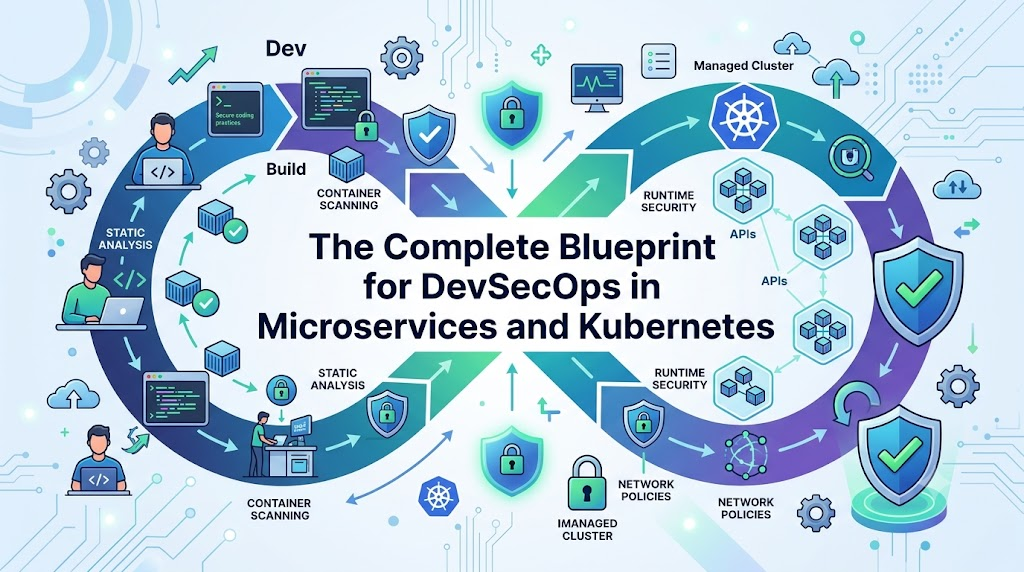
Introduction
In the modern software development landscape, organizations are rapidly transitioning from monolithic architectures to microservices to achieve greater agility, scalability, and speed. However, this architectural shift creates a vast and complex attack surface involving distributed services, dynamic containers, and numerous APIs that traditional, perimeter-focused security models cannot adequately protect. Relying on late-stage security audits causes severe release bottlenecks and leaves vulnerabilities exposed in production, making DevSecOps essential. By embedding automated security practices, vulnerability scanning, and compliance checks directly into every phase of the software delivery lifecycle, DevSecOps ensures that security is built-in rather than bolted on. For organizations seeking professional guidance and structured training in these critical practices, comprehensive programs are available through DevOpsSchool, helping engineering teams successfully balance rapid delivery with a robust cloud-native security posture.
What Are Microservices?
Microservices architecture is a design approach where an application is structured as a collection of loosely coupled, independently deployable services. Each service represents a specific business capability, owns its own data model or database, and communicates with other services through well-defined application programming interfaces (APIs), typically using lightweight protocols like HTTP/REST, gRPC, or messaging queues.
Monolithic vs. Microservices Architecture
| Feature | Monolithic Architecture | Microservices Architecture |
| Deployment | Entire application deployed as a single unit. | Individual services deployed independently. |
| Scalability | Scale the entire application, consuming more resources. | Scale only the specific services under high load. |
| Technology Stack | Uniform technology stack across the entire application. | Polyglot architecture; different services use different stacks. |
| Failure Impact | A bug in one module can crash the entire application. | Failures are isolated to the specific failing service. |
| Development Speed | Slower as codebase grows and teams step on each other. | Faster, parallel development across smaller, focused teams. |
In a microservices model, services run in isolated environments such as containers, making them highly portable across development, testing, and production clusters. While this independence empowers development teams to move quickly, it also shifts the complexity of security from a centralized perimeter to a decentralized, multi-layered architecture.
Why Security Becomes More Complex in Microservices
Moving to microservices introduces several architectural realities that fundamentally change how security must be handled:
- Multiple Distributed Services: Instead of securing a single application binary, security teams must protect dozens or hundreds of independent services, each with its own dependencies and configuration files.
- Distributed Network Communication: In monoliths, function calls happen in-memory. In microservices, communication happens over networks. Every inter-service call represents a potential wiretap or man-in-the-middle vulnerability if encryption and mutual authentication are not enforced.
- Proliferation of APIs: Microservices rely heavily on APIs for internal and external communication. Insecure endpoints, missing rate limiting, and broken object-level authorization can expose sensitive data to unauthorized actors.
- Ephemeral Containers and Orchestration: Containers spin up and spin down dynamically. Traditional security tools tied to static IP addresses or physical servers become obsolete, requiring dynamic runtime security and workload protection.
- Complex Cloud Infrastructure: Microservices run on distributed cloud platforms managed by Infrastructure as Code (IaC), where a single misconfiguration in security groups or storage buckets can expose internal databases to the public internet.
What Is DevSecOps?
DevSecOps is the cultural and technical philosophy of integrating security practices seamlessly into the DevOps lifecycle. It is built on the Shared Responsibility Model, where security is no longer siloed within a dedicated security team at the end of the development cycle. Instead, security becomes a shared responsibility shared by developers, operators, and security professionals alike.
Core Pillars of DevSecOps
- Shift Left Security: Moving security testing, threat modeling, and vulnerability assessments to the earliest possible stages of the software development lifecycle (SDLC), such as IDE coding and design reviews.
- Continuous Security Automation: Automating security checks within CI/CD pipelines so that every code commit, dependency update, and container build is automatically scanned for vulnerabilities and policy violations.
- Collaborative Culture: Fostering close collaboration between development, operations, and security teams to resolve vulnerabilities collaboratively and proactively.
By extending DevOps with built-in security guardrails, DevSecOps ensures that secure microservices delivery does not come at the expense of deployment velocity.
How DevSecOps Supports Secure Microservices Delivery
Secure Code Development
Security in microservices begins at the developer’s workstation. Developers utilize secure coding standards, conduct peer code reviews, and integrate Static Application Security Testing (SAST) tools directly into their Integrated Development Environments (IDEs). SAST analyzes source code for vulnerabilities like SQL injection, hardcoded credentials, and insecure cryptographic practices before code is even committed to the repository.
Secure CI/CD Pipelines
The CI/CD pipeline acts as the automated assembly line for microservices. DevSecOps integrates multiple automated security gates into this pipeline:
- Software Composition Analysis (SCA): Scans open-source libraries and third-party dependencies for known vulnerabilities (CVEs).
- Automated Testing: Runs unit, integration, and security regression tests on every pull request.
- Policy Enforcement: Blocks pipeline progression if critical vulnerabilities or compliance violations are detected.
Container Security
Microservices are almost universally packaged and distributed as containers. Container security requires a rigorous approach:
- Base Image Management: Using minimal, trusted base images (such as distroless images) to reduce the attack surface.
- Image Vulnerability Scanning: Scanning container images during the build phase to detect OS-level and application-level vulnerabilities before pushing them to a container registry.
- Runtime Protection: Monitoring container behavior in production to detect abnormal processes, unauthorized file modifications, or unexpected outbound network connections.
Kubernetes Security
As the de facto standard for orchestrating microservices, Kubernetes requires hardened security configurations:
- Namespace Isolation: Segmenting workloads logically into namespaces to limit blast radiuses.
- Role-Based Access Control (RBAC): Enforcing strict least-privilege permissions for users and service accounts interacting with the Kubernetes API.
- Network Policies: Restricting pod-to-pod communication so that services can only talk to explicitly authorized peers.
- Admission Controllers: Validating and mutating Kubernetes resource requests against security policies before objects are persisted to the cluster.
API Security
Because microservices communicate almost exclusively through APIs, securing these channels is critical:
- Authentication and Authorization: Implementing robust identity verification mechanisms using industry standards like OAuth 2.0 and OpenID Connect (OIDC).
- API Gateways: Centralizing traffic entry points to handle SSL termination, rate limiting, IP whitelisting, and request validation.
- Token Management: Ensuring secure issuance, validation, and short lifespan for JSON Web Tokens (JWT).
Secrets Management
Hardcoding database passwords, API keys, or encryption certificates in source code or configuration files is a major security risk. DevSecOps implements centralized secrets management systems that securely store, encrypt, and dynamically inject secrets into microservices at runtime, supporting automated secret rotation without requiring application restarts.
Infrastructure as Code Security
Microservices infrastructure is defined using code—such as Terraform, CloudFormation, or Kubernetes manifests. DevSecOps scans IaC templates for misconfigurations (such as public S3 buckets, overly permissive security groups, or missing encryption flags) prior to provisioning cloud resources.
Continuous Monitoring
Security does not stop at deployment. Continuous monitoring involves collecting logs, metrics, and audit trails from all microservices, feeding them into Security Information and Event Management (SIEM) systems or Cloud-Native Application Protection Platforms (CNAPP) to detect anomalous behavior, potential intrusions, and compliance drifts in real time.
DevSecOps Workflow for Secure Microservices Delivery
[Planning & Threat Modeling]
           │
           ▼
[Secure Code Development & IDE SAST]
           │
           ▼
[Code Review & Pull Request Checks]
           │
           ▼
[CI Pipeline: Unit Tests & SCA Dependency Scan]
           │
           ▼
[Container Build & Image Vulnerability Scan]
           │
           ▼
[Infrastructure as Code (IaC) Validation]
           │
           ▼
[CD Pipeline: Automated Deployment to Staging/Prod]
           │
           ▼
[Kubernetes Policy Enforcement & Admission Control]
           │
           ▼
[Runtime Monitoring, SIEM, & Continuous Improvement]
This structured workflow ensures that security checks are distributed across the entire delivery pipeline, catching errors early when they are easiest and cheapest to fix.
Security Challenges in Microservices Delivery
While DevSecOps provides the framework to secure microservices, engineering teams frequently encounter distinct challenges during implementation:
- Service-to-Service Authentication: Ensuring that Service A can securely prove its identity to Service B without relying on brittle static passwords requires robust service mesh architectures and mutual TLS (mTLS).
- Distributed Attack Surface: With hundreds of endpoints exposed across clusters, tracking down shadow APIs or misconfigured internal services requires continuous asset discovery and posture management.
- Secret Sprawl: Developers working across multiple distributed microservices often accidentally log sensitive tokens or store credentials in insecure configuration maps.
- Vulnerability Fatigue: Automated scanners can generate high volumes of alerts and false positives, overwhelming security and development teams if prioritization frameworks are not established.
- Compliance in Dynamic Environments: Maintaining continuous regulatory compliance (such as PCI-DSS, HIPAA, or SOC 2) is challenging when infrastructure scales up and down automatically in the cloud.
Best Practices for Secure Microservices Delivery
To overcome these challenges and build a resilient security posture, organizations should adhere to proven best practices:
- Shift Security Left: Introduce security requirements, threat modeling, and static analysis during the design and coding phases rather than treating security as a final gatekeeper.
- Automate Security Testing: Embed SAST, DAST, SCA, and container scanning directly into CI/CD pipelines to ensure consistent enforcement without manual friction.
- Implement Zero Trust Principles: Never trust implicitly within the cluster perimeter. Authenticate and authorize every service-to-service interaction using mTLS and fine-grained access policies.
- Secure APIs by Default: Enforce strict input validation, authorization checks, and rate limiting across all API gateways and service endpoints.
- Protect Kubernetes Clusters: Harden cluster nodes, enforce RBAC, apply Pod Security Standards, and use network policies to restrict lateral movement.
- Continuously Scan Containers: Maintain automated registries that rescan container images daily for newly discovered vulnerabilities in base images and software libraries.
- Monitor Runtime Activity: Deploy runtime security tooling to detect anomalous process executions, unexpected file modifications, and suspicious network traffic inside containers.
- Enforce Least Privilege Access: Grant human users and machine workloads only the minimum necessary permissions required to perform their specific functions.
Secure Microservices Checklist
- Threat modeling completed during service design phase.
- SAST and linting integrated into developer IDEs.
- Automated SCA scanning enabled for all third-party dependencies.
- Container base images minimized and scanned for CVEs before registry push.
- Kubernetes RBAC and Namespace isolation configured correctly.
- Network policies enabled to restrict pod-to-pod traffic.
- Secrets externalized into a dedicated secrets vault with rotation policies.
- IaC templates scanned for misconfigurations prior to deployment.
- API gateways configured with authentication, authorization, and rate limiting.
- Runtime security monitoring and centralized logging operational.
DevSecOps Tools Used in Secure Microservices
| Security Area | Purpose | Practical Example |
| SAST | Analyze source code for security vulnerabilities. | Semgrep, SonarQube, Checkmarx |
| DAST | Test running applications for external vulnerabilities. | OWASP ZAP, Burp Suite |
| SCA | Identify vulnerabilities in open-source dependencies. | Trivy, Snyk, Dependabot |
| Container Scanning | Scan container images for OS and package CVEs. | Grype, Trivy, Clair |
| Kubernetes Security | Audit cluster configurations and compliance. | Kubiscan, Checkov, Kube-bench |
| Secrets Management | Securely store and inject runtime credentials. | HashiCorp Vault, AWS Secrets Manager |
| SIEM / Monitoring | Aggregate logs and detect runtime threats. | Prometheus, Grafana, Falco |
| IaC Scanning | Validate infrastructure code for security flaws. | tfsec, Checkov, Kics |
| Compliance Monitoring | Continuous automated compliance auditing. | Open Policy Agent (OPA), Kyverno |
Benefits of DevSecOps for Microservices
| Benefit | Business Impact |
| Faster Secure Releases | Automated security testing eliminates release bottlenecks, enabling rapid, continuous deployment. |
| Reduced Vulnerabilities | Catching security flaws early during development significantly reduces the risk of costly production breaches. |
| Better Compliance | Automated policy checks and continuous auditing ensure consistent alignment with regulatory frameworks. |
| Improved Scalability | Secure containerization and Kubernetes orchestration allow applications to scale securely under load. |
| Stronger Customer Trust | Protecting sensitive user data and maintaining high service availability builds long-term customer confidence. |
| Continuous Monitoring | Real-time threat detection minimizes mean time to detection (MTTD) and recovery (MTTR). |
Common Mistakes Teams Make
- Security Added Too Late: Treating security as an afterthought review right before production deployment creates massive remediation delays and friction between teams.
- Ignoring API Security: Assuming internal microservices are safe because they sit behind a private network, leaving APIs vulnerable to lateral movement and compromised service accounts.
- Weak Secrets Management: Storing database credentials in plaintext environment variables inside Kubernetes ConfigMaps or source control repositories.
- Unpatched Container Images: Using outdated base images with unpatched critical CVEs that are continuously deployed across microservice clusters.
- Limited Monitoring: Relying solely on perimeter logs while lacking visibility into internal pod-to-pod communication and runtime container behavior.
- Manual Security Processes: Depending on manual code reviews and spreadsheets for compliance, which fail to scale in fast-moving microservices environments.
- Poor Access Control: Assigning overly permissive cluster-admin roles to service accounts and development teams, violating the principle of least privilege.
Real-World Example: Securing a Microservices Platform
Consider a fast-growing retail technology company migrating its e-commerce platform from monolithic infrastructure to a containerized Kubernetes environment. Initially, the engineering team faced pressure to launch new microservices quickly to support high-traffic holiday sales events. However, rapid deployments led to fragmented security visibility, unpatched container vulnerabilities, and exposed internal API endpoints.
To address this, the engineering leadership implemented a comprehensive DevSecOps strategy:
- Pipeline Integration: They integrated automated SAST and SCA scanning into their CI pipeline, ensuring that developers received immediate feedback on code vulnerabilities before merging pull requests.
- Container Hardening: They mandated the use of minimal base images and established automated container image scanning in their artifact registry, blocking any image with critical CVEs from reaching production.
- Cluster Security: They enforced Kubernetes Network Policies to isolate payment processing services from public-facing catalog services, ensuring strict pod-to-pod segmentation.
- Secrets Management: They migrated all database credentials and API keys into a centralized secrets vault, enabling automated rotation and dynamic injection at runtime.
- Runtime Protection: They deployed runtime security monitoring to detect anomalous process behavior within production containers.
As a result, the company successfully scaled its microservices architecture, reduced critical vulnerability remediation time from weeks to hours, and achieved seamless compliance certification without slowing down developer velocity.
Measuring DevSecOps Success in Microservices
| Metric | Why It Matters |
| Vulnerability Remediation Time | Measures how quickly identified security flaws are fixed by development teams. |
| Deployment Frequency | Ensures security automation is not hindering the speed of continuous delivery. |
| Security Incident Rate | Tracks the frequency of security breaches or exploitations in production environments. |
| Compliance Score | Measures continuous adherence to internal security policies and regulatory frameworks. |
| Container Scan Coverage | Percentage of deployed container images actively scanned and verified in the pipeline. |
| Mean Time to Recovery (MTTR) | Evaluates how quickly teams can detect, isolate, and recover from security anomalies. |
How DevOpsSchool Supports DevSecOps Learning
Organizations and professionals seeking to master secure cloud-native delivery can leverage structured educational pathways. DevOpsSchool offers comprehensive, industry-focused training programs designed to bridge the gap between traditional development, operations, and modern security practices.
Key offerings include:
- Industry-Focused DevSecOps Training: Comprehensive curricula covering the entire secure software delivery lifecycle.
- Hands-On Cloud-Native Labs: Practical exercises simulating real-world enterprise environments and security pipelines.
- Kubernetes Security Projects: Deep-dive modules on hardening clusters, configuring RBAC, and implementing admission controllers.
- Secure CI/CD Implementation: Practical workshops on embedding SAST, DAST, SCA, and container scanning into automated pipelines.
- Practical Enterprise Scenarios: Real-world case studies addressing common challenges in microservices security.
- Career-Focused Mentoring: Guidance from experienced industry architects to help engineers advance their cloud-native security expertise.
Future of DevSecOps and Secure Microservices
The landscape of cloud-native security continues to evolve rapidly. Key emerging trends shaping the future of DevSecOps include:
- AI-Assisted Security: Leveraging artificial intelligence and machine learning to analyze codebases, predict vulnerabilities, and auto-remediate configuration errors in real time.
- Zero Trust Architecture: Moving beyond perimeter security to enforce continuous identity verification and explicit authorization across every microservice interaction.
- Software Supply Chain Security: Implementing cryptographic software bills of materials (SBOMs) and artifact signing (using tools like Cosign) to ensure end-to-end provenance and integrity.
- GitOps Security: Securing declarative infrastructure and application deployments managed entirely through Git repositories with automated compliance checks.
- Platform Engineering: Providing internal developer platforms with built-in security guardrails, allowing developers to build secure microservices by default without needing deep security expertise.
- Service Mesh Security: Utilizing advanced service mesh capabilities for automated mTLS encryption, traffic governance, and fine-grained authorization policies.
- Cloud-Native Application Protection Platforms (CNAPP): Unifying cloud security posture management (CSPM) and cloud workload protection (CWLP) into a single continuous security solution.
FAQs (15 Questions)
1. What is DevSecOps for secure microservices?
DevSecOps for secure microservices is the practice of integrating automated security checks, policies, and testing into every stage of the software delivery lifecycle for distributed, containerized applications, ensuring security without sacrificing development speed.
2. Why are microservices harder to secure than monoliths?
Microservices involve distributed network communication, numerous independent APIs, ephemeral containers, dynamic cloud infrastructure, and a significantly expanded attack surface compared to a single monolithic application.
3. How does DevSecOps improve Kubernetes security?
DevSecOps integrates automated cluster configuration audits, vulnerability scanning of container images, enforcement of Role-Based Access Control (RBAC), and network policy validation directly into the deployment pipeline.
4. What is Shift Left Security?
Shift Left Security is the practice of moving security testing, vulnerability scanning, and threat modeling to the earliest possible phases of the software development lifecycle, such as design and coding.
5. Why is container security important in microservices?
Because microservices are packaged and run inside containers, securing them prevents vulnerabilities in base images, misconfigured container runtimes, and unauthorized container access from compromising the underlying host system.
6. How do organizations secure APIs in microservices?
Organizations secure APIs by implementing robust authentication and authorization protocols (such as OAuth 2.0 and OIDC), deploying API gateways for rate limiting and traffic validation, and enforcing strict input validation.
7. What role does Infrastructure as Code play in DevSecOps?
Infrastructure as Code allows teams to define cloud resources and Kubernetes manifests programmatically. DevSecOps scans this code for security misconfigurations before any resources are provisioned in the cloud.
8. How can teams automate microservices security?
Teams automate security by embedding Static Application Security Testing (SAST), Software Composition Analysis (SCA), and container vulnerability scanners into their CI/CD pipelines to run checks on every code commit.
9. What is the Shared Responsibility Model in DevSecOps?
It is a cultural principle where security is shared across developers, operations, and security teams rather than being solely owned by a dedicated security department at the end of a project.
10. How does a service mesh enhance microservices security?
A service mesh provides secure service-to-service communication by automatically managing mutual TLS (mTLS) encryption, traffic routing policies, and fine-grained access control between microservices.
11. What is Software Composition Analysis (SCA)?
SCA is a security practice that scans open-source libraries and third-party dependencies used in microservices to identify known vulnerabilities (CVEs) and license compliance issues.
12. Why are centralized secrets management systems necessary?
Centralized secrets vaults eliminate the risk of hardcoded credentials or plaintext passwords in configuration files, enabling secure storage, encryption, and automated rotation of secrets.
13. What is Runtime Security in containerized environments?
Runtime security involves monitoring active containers and Kubernetes pods in production to detect abnormal process behavior, unauthorized file modifications, and suspicious network connections.
14. How does continuous compliance support secure microservices?
Continuous compliance uses automated policy-as-code tools to verify that microservices configurations and cloud environments consistently adhere to regulatory standards like PCI-DSS, HIPAA, and SOC 2.
15. Where can professionals learn practical DevSecOps and cloud-native security?
Professionals can gain hands-on experience and structured industry training through specialized educational platforms like DevOpsSchool.
Final Thoughts
Delivering secure microservices requires more than just deploying advanced security tools; it requires a cultural transformation rooted in collaboration, automation, and continuous improvement. By integrating security principles throughout every phase of the software delivery lifecycle—from code creation and container building to Kubernetes deployment and runtime monitoring—organizations can successfully navigate the complexities of cloud-native architectures.
Balancing speed and security is no longer an impossible trade-off. Through effective DevSecOps practices, engineering teams can deliver scalable, resilient, and secure microservices with confidence, ensuring long-term digital success.
