Limited Time Offer!
For Less Than the Cost of a Starbucks Coffee, Access All DevOpsSchool Videos on YouTube Unlimitedly.
Master DevOps, SRE, DevSecOps Skills!
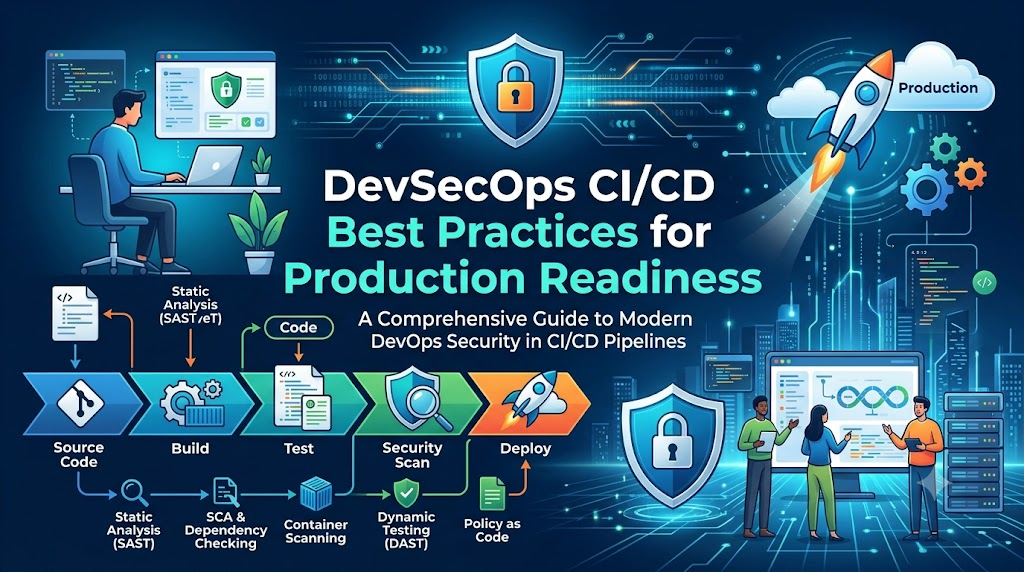
A green checkmark on a continuous integration run confirms that your code compiles, unit tests pass, and an artifact was generated. It does not prove that the software is ready for real users, production traffic, or hostile networks. Too often, teams discover this distinction the hard way: an unencrypted secret exposed in a container layer, an unindexed database migration locking production tables, an unpinned base image introducing remote code execution vulnerabilities, or an automated rollback failing because a stateful schema migration was backward-incompatible.
Building a production-ready CI/CD pipeline requires bridging the gap between basic automation and operational durability. DevSecOps embeds automated security controls, operational validation, and resilient deployment mechanics directly into the software delivery lifecycle. This guide outlines practical DevSecOps CI/CD best practices for production readiness, moving from pipeline architecture and threat mitigation to progressive rollouts and incident recovery.
What Production Readiness Means in DevSecOps
In traditional pipelines, software delivery is treated as an assembly line where code is packaged, tested functionally, and pushed downstream. If the pipeline exits with status code zero, the release is deemed successful.
In a robust DevSecOps model, production readiness requires meeting criteria across several distinct dimensions:
[ Build & Functional Tests ]  --> Confirms code syntax, units, and features work.
             │
             ▼
[ Security & Compliance ]     --> Confirms dependencies, code, secrets, and IaC meet policy.
             │
             ▼
[ Operational Resiliency ]    --> Confirms health checks, telemetry, quotas, and DB migrations.
             │
             ▼
[ Deployment Safety ]         --> Confirms immutable artifacts, canary gates, and rollback paths.
             │
             ▼
   =====================
    PRODUCTION READINESS
   =====================
- Successful Build: The source code compiles, imports resolve, and a deployable artifact is created.
- Passing Automated Tests: Unit, functional, and API tests demonstrate that the code fulfills business logic requirements under idealized conditions.
- Security and Governance Standards: The code contains no hardcoded secrets, dependencies are free from critical vulnerabilities, infrastructure-as-code templates adhere to policy engines, and artifact signatures are validated.
- Operational Supportability: The application emits structured, contextual telemetry, respects liveness and readiness constraints, handles graceful shutdowns on
SIGTERM, and supports clean rollback without data corruption.
DevSecOps treats security not as a late-stage approval gateway, but as a continuous property verified through code review, build execution, pre-flight staging, and post-deployment validation.
Production-Ready CI/CD Pipeline Architecture
To achieve this level of rigor, delivery pipelines require distinct stages that progressively build confidence while filtering out defects and security flaws as early as possible.
+----------------------------------------------------------------------------------------------------+
| 1. Pull Request / Pre-Merge                                                                        |
|    - Secret Detection (Pre-commit / PR)  - SAST (Incremental)  - Unit Tests  - Dependency Checks    |
+----------------------------------------------------------------------------------------------------+
                                                   │ (PR Merged)
                                                   ▼
+----------------------------------------------------------------------------------------------------+
| 2. Build & Artifact Hardening                                                                      |
|    - Deterministic Build  - Container Linting & Scanning  - SBOM Generation  - Cryptographic Signing|
+----------------------------------------------------------------------------------------------------+
                                                   │
                                                   ▼
+----------------------------------------------------------------------------------------------------+
| 3. Infrastructure & Pre-Production Delivery                                                        |
|    - IaC Policy Checks (OPA/Trivy)  - Ephemeral/Staging Deploy  - Backward-Compatible DB Migration |
|    - Integration & API Testing      - Dynamic Security Testing (DAST)                              |
+----------------------------------------------------------------------------------------------------+
                                                   │ (Automated Policy Gate / Signed Approvals)
                                                   ▼
+----------------------------------------------------------------------------------------------------+
| 4. Production Release & Progressive Rollout                                                        |
|    - Artifact Signature Verification  - Canary / Blue-Green Rollout  - Synthetic Smoke Tests       |
|    - Automated Metric Analysis (SLOs) - Rollback Trigger / Traffic Promotion                       |
+----------------------------------------------------------------------------------------------------+
The Delivery Lifecycle
- Stage 1: Pull-Request Validation: Fast feedback loops run in parallel. Secrets are scanned, incremental Static Application Security Testing (SAST) evaluates modified files, and linters enforce style and security conventions.
- Stage 2: Deterministic Builds and Artifact Security: Once code merges to the main branch, an isolated build environment produces a byte-reproducible artifact. Software Bills of Materials (SBOMs) are generated, container layers are scanned for Common Vulnerabilities and Exposures (CVEs), and the artifact is signed using cryptographic keys or short-lived identities.
- Stage 3: Infrastructure Validation and Pre-Production: Infrastructure-as-Code (IaC) definitions (Terraform, OpenTofu, Kubernetes manifests) are evaluated against security policies. Staging environments receive the signed artifact, executing integration tests, API fuzzing, and targeted Dynamic Application Security Testing (DAST).
- Stage 4: Progressive Production Release: The production orchestrator verifies the artifact’s digital signature before pulling it. The release deploys via rolling, canary, or blue-green patterns while synthetic smoke tests verify core user journeys.
- Stage 5: Continuous Post-Deployment Verification: Automated analyzers monitor Service-Level Indicators (SLIs) such as error budgets, latency percentiles, and crash loops. If metrics degrade beyond predefined thresholds, the deployment halts or rolls back automatically.
Implementing Risk-Based Security Gates
Security scans that fail builds arbitrarily produce friction and alert fatigue; scans that never block anything produce breaches. A production-ready pipeline implements risk-based security gates that balance automated enforcement with engineering velocity.
| Scan Type | Focus Area | Optimal Pipeline Stage | Gate Policy Threshold |
| Secret Detection | High-entropy strings, API tokens, private keys | Pre-commit / Pull Request | Hard Block: Zero tolerance for unrevoked plaintext credentials. |
| SAST | Source code logic flaws, injection paths, memory safety | Pull Request | Block: High/Critical findings with clear exploit paths; Warn: Medium/Low. |
| SCA / Dependency | Known CVEs in open-source libraries, licensing | PR & Nightly Builds | Block: Exploitable CVEs (EPSS > 0.5 or CISA KEV listing) with available patches. |
| Container Scanning | Vulnerable OS packages, excessive privileges, root user | Post-Build / Registry Admission | Block: Critical OS-level CVEs, containers running as root (UID 0). |
| IaC Scanning | Misconfigured security groups, open S3 buckets, IAM drift | Pull Request | Block: Overly permissive CIDRs (0.0.0.0/0), missing encryption flags. |
| DAST / API Security | Runtime vulnerabilities, CORS misconfigurations, auth bypass | Ephemeral / Staging Deployment | Block: Broken Object Level Authorization (BOLA), unauthenticated admin endpoints. |
Designing Practical Gate Policies
- Context-Aware Prioritization: Evaluate findings by exploitability, not just CVSS base scores. A critical CVE in an uncalled utility class inside an internal, network-isolated microservice presents lower immediate risk than an exploitable deserialization flaw on an internet-facing endpoint. Leverage exploit intelligence like the Exploit Prediction Scoring System (EPSS) and CISA’s Known Exploited Vulnerabilities (KEV) catalog.
- Deterministic Thresholds: Establish distinct thresholds based on exposure:
- Internet-facing services: Strict zero-tolerance for Critical/High vulnerabilities with functional exploit code.
- Internal background workers: Blocking restricted to Remote Code Execution (RCE) and privilege escalation risks.
- Formal Exception and Expiration Workflow: When a build must proceed despite a finding (e.g., an upstream fix is unavailable and mitigating runtime controls are in place), manage exceptions via code:
- Record exceptions in a tracked file (e.g.,
.security-exceptions.yaml) alongside the code. - Mandate an assigned owner, clear justification, mitigation reference, and an expiration timestamp (e.g., 14 days).
- Ensure the pipeline automatically re-fails the build if the exception expires before a fix is merged.
- Record exceptions in a tracked file (e.g.,
Secure Coding and Dependency Management
Software supply chain risks represent some of the most common vectors for production compromises. Vulnerabilities rarely originate solely from bespoke application logic; they often stem from third-party dependencies, transitivity, and untrusted registries.
       [ Upstream Ecosystem (npm, PyPI, OCI) ]
                          │
                          ▼
             [ Private Artifactory / Mirror ]
             (Scanned, Caching, Immutable)
                          │
                          ▼
            [ Dependency Lockfiles & SBOM ]
          (package-lock.json, CycloneDX/SPDX)
                          │
                          ▼
        [ SLSA Provenance / Cosign Signatures ]
     (Verifies builder identity & commit provenance)
Dependency Hardening Principles
- Immutable Lockfiles: Always use strict package lockfiles (
package-lock.json,poetry.lock,go.sum). Build pipelines must run install commands in immutable modes (e.g.,npm ci,poetry install --no-root) to prevent silent, on-the-fly dependency upgrades. - Internal Mirroring: Avoid pulling directly from public repositories during production builds. Cache and proxy dependencies through an internal artifact manager. This defends against registry downtime and upstream package deletion.
- Generate and Store SBOMs: Produce a machine-readable Software Bill of Materials (using CycloneDX or SPDX formats) during every build. Store this alongside the artifact to enable rapid querying whenever a zero-day vulnerability is disclosed.
- Artifact Provenance: Implement Supply-chain Levels for Software Artifacts (SLSA) standards. Use cryptographic tools such as Sigstore Cosign to sign build artifacts, verifying that the container or package deployed to production was built directly from a specific commit on a protected branch.
Protecting Pipeline Credentials and Execution Environments
A hardened application deployed by an insecure CI/CD system remains vulnerable. CI/CD runners often possess elevated cloud infrastructure permissions, making them high-value targets for attackers.
Eliminating Long-Lived Credentials
Avoid storing static cloud provider access keys inside CI/CD platform secret stores. Instead, configure OpenID Connect (OIDC) and Workload Identity Federation:
- The CI/CD runner requests a short-lived JSON Web Token (JWT) from its platform (GitHub, GitLab, etc.).
- The runner exchanges this token with the cloud provider (AWS STS, Google Cloud IAM, Azure AD).
- The cloud provider validates the cryptographic claims (repository name, target environment, git ref) and issues a short-lived, least-privilege token (valid for 15 to 60 minutes).
Hardening Build Runners
- Isolate Ephemeral Runners: Run pipeline jobs on clean, ephemeral virtual machines or containers that are destroyed immediately after job completion. This prevents cross-build contamination, secret harvesting, and persistent malware.
- Restrict Pull Request Permissions: Untrusted code originating from public forks or unvetted branches must never have access to production secrets, deployment roles, or self-hosted runners connected to private internal VPCs.
- Pin Actions and Plugins to Immutable Commit SHAs: Third-party pipeline dependencies (such as GitHub Actions or Jenkins plugins) can be compromised upstream. Pin plugins to a full 40-character commit SHA rather than a mutable tag:
YAML
# Vulnerable to tag mutation:
- uses: actions/checkout@v4

# Hardened against upstream tampering:
- uses: actions/checkout@11bd71901bbe5b1630ceea73d27597364c9af683 # v4.2.2
- Sanitize Pipeline Logs: Configure pipeline-level masking for all environment secrets. Ensure scripts avoid echoing raw inputs or unmasking complex strings (like base64-encoded payloads) that bypass default secret-scrubbing patterns.
Validating Software Before Production Deployment
Automated testing must provide high-confidence validation without creating multi-hour pipeline bottlenecks. Balancing execution speed against operational safety requires a tiered testing strategy.
+-------------------------------------------------------------------------------+
| Test Type         | Pipeline Execution Point | Primary Target                 |
+-------------------+--------------------------+--------------------------------+
| Unit Tests        | Pull Request (< 5 min)   | Pure logic, branch coverage    |
| Integration Tests | Post-Merge / Build Stage | DB queries, contract schemas   |
| API / E2E Tests   | Ephemeral / Staging      | Critical user journeys         |
| Performance Tests | Staging / Pre-Production | P99 Latency, memory leak check |
| Migration Tests   | Isolated DB Clone        | Schema locks, data integrity   |
+-------------------------------------------------------------------------------+
Managing Test Integrity
- Isolate Fast Feedback: Pull requests should only run unit and fast integration tests, returning actionable feedback to developers within 5 to 10 minutes. Deep load tests and comprehensive end-to-end suites should run in downstream deployment stages or scheduled runs.
- Tackle Flaky Tests Systematically: Rerunning a failed job until it passes undermines pipeline reliability. Track test flakes like critical defects. Quarantine unreliable tests immediately into an advisory suite so they do not block pipelines while engineers investigate race conditions or environment dependencies.
- Pre-Validate Database Migrations: Run database migration scripts against a sanitized clone of production data inside an isolated container during staging. Verify that operations do not acquire exclusive table locks that could disrupt live traffic.
Infrastructure as Code and Configuration Management
Application code and the infrastructure that hosts it must be validated with equal rigor. Configuration drift and poorly planned schema changes are common causes of deployment failures.
Validating Infrastructure as Code (IaC)
Before applying Terraform, OpenTofu, Helm charts, or Kubernetes manifests:
- Static IaC Scanning: Use tools like Trivy, Checkov, or KubeLinter to detect security flaws—such as unencrypted volumes, root execution contexts, and wide-open ingress rules—before executing an infrastructure plan.
- Deterministic Policy Enforcement: Use Open Policy Agent (OPA) or Conftest to validate infrastructure changes against organizational standards.
- Plan Output Verification: Store and review execution plans (
terraform plan -out=tfplan) within the pipeline to ensure that only the exact reviewed infrastructure changes are applied downstream.
Safe Database Migrations: The Expand-Contract Pattern
Deploying a breaking database schema change simultaneously with application code that expects that schema frequently leads to downtime if a rollback occurs. Use the Expand-Contract (or Parallel Run) design pattern:
Step 1: Expand
- Add the new column/table as nullable or with safe defaults.
- Deploy Application Version N (reads old, writes both old and new).

Step 2: Transition
- Backfill existing data asynchronously.
- Deploy Application Version N+1 (reads new, writes new).

Step 3: Contract
- Remove old application code dependencies.
- Deploy migration script to drop the old column/table.
Decoupling database updates from application logic ensures that rolling back an application version does not leave the database in an incompatible state.
Safe and Repeatable Deployment Strategies
Minimizing deployment risk requires moving away from in-place updates. Modern platforms use isolated, automated deployment patterns that maintain continuous service availability.
Rolling Deployment:
[ Pod v1 ] [ Pod v1 ] [ Pod v1 ]  ==>  [ Pod v2 ] [ Pod v1 ] [ Pod v1 ]  ==>  [ Pod v2 ] [ Pod v2 ] [ Pod v2 ]

Blue-Green Deployment:
[ Environment Blue (v1) - 100% Traffic ]  ── Router Switch ──►  [ Environment Green (v2) - 100% Traffic ]
[ Environment Green (v2) - Staging Test ]                       [ Environment Blue (v1) - Idle Standby ]

Canary Deployment:
[ Active Deployment (v1) - 95% Traffic ] ─── Split ───► [ Canary Deployment (v2) - 5% Traffic (Evaluated) ]
Choosing the Right Strategy
- Rolling Deployments: Replaces instances incrementally. It uses infrastructure efficiently, but during the rollout, two different versions of your application will run concurrently. Systems must be engineered to handle cross-version message queues and shared databases safely.
- Blue-Green Deployments: Deploys the new version (Green) alongside the running version (Blue). Router or DNS switches traffic instantly to Green once verification passes. This provides a clean deployment boundary and rapid rollback capability, but requires sufficient infrastructure capacity to run duplicate environments.
- Canary Deployments: Routes a small percentage of real production traffic (e.g., 2% to 5%) to the new version. The pipeline monitors telemetry and error budgets for a predefined observation window before expanding traffic in stages.
- Feature Flags: Decouples code deployment from feature release. Code can be deployed dormant to production behind a feature toggle, then safely enabled, tested on select user groups, or instantly disabled without triggering a pipeline execution.
The Golden Rule: Promote Identical Artifacts
Never recompile or rebuild container images for downstream environments. The exact binary or container image verified in staging must be the one promoted to production. Differences between compilers, library fetches, or build timestamps can introduce subtle, untracked bugs.
Manage environment-specific behavior exclusively through external runtime configuration, environment variables, or secret managers.
Observability and Operational Readiness
Production readiness extends beyond a clean deployment exit code. A pipeline must confirm that the application is operating correctly under real-world conditions.
Essential Operational Signals
- Differentiated Health Probes: Distinguish between liveness, readiness, and startup checks:
- Startup Probes: Inform the orchestrator that the application is initializing without prematurely terminating slow-starting processes.
- Readiness Probes: Signal whether the service can currently accept user traffic. If an internal cache is warming, return non-200 to drop out of the load balancer without triggering a process restart.
- Liveness Probes: Detect deadlocks or broken event loops where the process must be terminated and restarted. Avoid tying liveness checks to external downstream dependencies; if a shared database degrades, you do not want all application instances to enter concurrent crash loops.
- Contextual Structured Logging: Ensure application logs emit structured JSON containing standardized fields: timestamp, log level, correlation/trace IDs, service name, and tenant context.
- Distributed Tracing: Propagate OpenTelemetry trace contexts across service boundaries to trace transactions, identify latency spikes, and pinpoint external network bottlenecks.
Automated Smoke Tests and Post-Deployment Checks
Immediately following traffic cutover, pipelines should run automated synthetic transactions against production endpoints:
[ Deploy Candidate ]
        │
        ▼
[ Run Synthetic Health & Flow Check ] (e.g., /healthz, /api/v1/auth/verify)
        │
        ├── Pass ──► [ Begin Traffic Shift ]
        │
        └── Fail ──► [ Halt Deployment / Trigger Immediate Rollback ]
Preparing for Failure, Recovery, and Rollback
Resilient systems are engineered under the assumption that deployments will eventually fail. The goal is to design recovery mechanisms that minimize Mean Time to Recovery (MTTR) while preventing data loss.
Rollback vs. Roll-Forward
- Automated Rollback: Ideal for stateless changes, memory regressions, application crashes, or severe bugs detected early in a canary deployment. The system automatically shifts traffic back to the known good version without human intervention.
- Roll-Forward Strategy: When a deployment introduces complex, stateful schema changes or triggers asynchronous batch operations, an immediate automated rollback may corrupt data further. In these scenarios, having a validated hotfix path—allowing a small, targeted code change to proceed through an accelerated pipeline—is often safer than reverting stateful migrations.
Testing Recovery Procedures
- Validate Backups Continuously: Regularly run automated jobs that restore database backups to an isolated environment and execute health checks. An untested backup strategy is an unreliable recovery mechanism.
- Practice Disaster Recovery: Conduct structured game-day exercises. Simulate pipeline failures, expired registry signing certificates, and sudden database primary failovers to verify that your operational runbooks reflect current system realities.
Compliance, Governance, and Auditability
In regulated environments (governed by standards like SOC 2, ISO 27001, PCI DSS, or NIST SP 800-53), CI/CD pipelines serve as an automated, tamper-resistant system of record for technical controls.
+---------------------------------------------------------------------------------------+
| Traceable Audit Chain:                                                                |
| [ Git Commit (Signed) ] ──► [ Peer Review Record ] ──► [ Security Gate Results (SARIF)]|
|                                                                    │                  |
| [ Production Verification ] ◄── [ Immutable Artifact (Cosign) ] ◄──┘                  |
+---------------------------------------------------------------------------------------+
Key Audit Capabilities
- Separation of Duties: Enforce branch protection rules that require peer reviews and passing automated security checks. Ensure the engineer who author a change cannot unilaterally approve and deploy that change to production.
- Immutable Provenance and Attestation: Use open standards like in-toto to generate cryptographic attestations of the build process. Capture details including the source repository, commit SHA, build environment, and tool versions, signing this metadata alongside the artifact.
- Structured Log Retention: Centralize CI/CD execution logs in tamper-evident storage with access controls that satisfy retention requirements. Ensure logs are scrubbed of sensitive values, personal data, and infrastructure secrets.
- Standardized SARIF Outputs: Require security scanners to export results using the Static Analysis Results Interchange Format (SARIF). Ingest these reports into a centralized vulnerability dashboard to demonstrate consistent control enforcement across the organization.
Measuring Production Readiness and Pipeline Effectiveness
Evaluating whether your DevSecOps initiatives are improving system stability and delivery speed requires tracking both operational delivery metrics and security-specific indicators.
       OPERATIONAL VELOCITY                     SECURITY & STABILITY
    (DORA Metrics Framework)                 (DevSecOps Control Metrics)
┌───────────────────────────────┐        ┌────────────────────────────────┐
│ • Change Lead Time            │        │ • Vulnerability MTTR           │
│ • Deployment Frequency        │  vs.   │ • Change Failure Rate (CFR)    │
│ • Failed Deployment Recovery  │        │ • Flaky Test Ratio             │
│ • Rework Rate                 │        │ • Security Gate Exception Rate │
└───────────────────────────────┘        └────────────────────────────────┘
Metric Analysis and Trade-offs
- Change Lead Time: Measures the time from code commit to running in production. A sharp increase often highlights slow integration tests, manual approval bottlenecks, or pipeline flakiness.
- Change Failure Rate (CFR): The percentage of production deployments that require immediate remediation (hotfixes, rollbacks, patches). A high CFR signals inadequate pre-production testing or ineffective security gates.
- Mean Time to Remediate (MTTR) Vulnerabilities: Tracks how quickly teams resolve identified security flaws based on severity. Measuring this helps confirm that security scans lead to actual risk reduction rather than unaddressed backlogs.
- Security Gate Exception Velocity: Monitor the volume and age of active risk-acceptance waivers. A rising number of exceptions indicates that teams are bypassing gates to hit delivery deadlines, pointing to friction in remediation workflows or unrealistic scan thresholds.
Production-Ready Implementation Example
The following example demonstrates a hardened GitHub Actions workflow designed for a containerized microservice. It incorporates:
- OIDC-based cloud authentication (no static cloud keys).
- Parallel security scanning (SAST and dependency scanning).
- Read-only container construction and SBOM generation.
- Cryptographic image signing with Cosign.
- Immutable deployment to staging, followed by automated verification and production deployment.
YAML
name: Production-Ready DevSecOps Delivery

on:
  push:
    branches: [ main ]
  pull_request:
    branches: [ main ]

permissions:
  contents: read
  id-token: write      # Required for OIDC authentication
  security-events: write

concurrency:
  group: ${{ github.workflow }}-${{ github.ref }}
  cancel-in-progress: true

jobs:
  # =======================================================
  # 1. PULL REQUEST / FAST FEEDBACK VALIDATION
  # =======================================================
  validate:
    name: Code & Security Verification
    runs-on: ubuntu-24.04
    steps:
      - name: Checkout Source Code
        uses: actions/checkout@11bd71901bbe5b1630ceea73d27597364c9af683 # v4.2.2
        with:
          fetch-depth: 0

      - name: Scan for Hardcoded Secrets
        uses: gitleaks/gitleaks-action@b16955a5b2ab994065608677c7247854619a9d20 # v2.3.9
        env:
          GITHUB_TOKEN: ${{ secrets.GITHUB_TOKEN }}

      - name: Static Application Security Testing (Semgrep)
        run: |
          docker run --rm -v "${{ github.workspace }}:/src" returntocorp/semgrep:1.90.0 \
            semgrep scan --config=auto --error --sarif --output=/src/semgrep-results.sarif

      - name: Upload Security Results
        if: always()
        uses: github/codeql-action/upload-sarif@48ab28a6f5dab2a725327a667247738d0ba26c4d # v3.28.0
        with:
          sarif_file: semgrep-results.sarif

  # =======================================================
  # 2. BUILD, HARDEN & SIGN ARTIFACT
  # =======================================================
  build-and-sign:
    name: Build, Scan & Cryptographically Sign
    needs: [validate]
    if: github.event_name == 'push' && github.ref == 'refs/heads/main'
    runs-on: ubuntu-24.04
    outputs:
      image_tag: ${{ steps.meta.outputs.tag }}
      image_digest: ${{ steps.build.outputs.digest }}
    steps:
      - name: Checkout Source Code
        uses: actions/checkout@11bd71901bbe5b1630ceea73d27597364c9af683 # v4.2.2

      - name: Install Sigstore Cosign
        uses: sigstore/cosign-installer@dc72c7d5c4d10cd6bcb8cf6e3fd625a9e5e537da # v3.7.0

      - name: Set up Docker Buildx
        uses: docker/setup-buildx-action@b5ca514318bd6ebac0fb2aedd5d36ec1b5c232a2 # v3.10.0

      - name: Authenticate with Container Registry via OIDC
        run: |
          echo "Simulated: Logging into registry via short-lived OIDC federated token"
          # Example: aws ecr get-login-password | docker login --username AWS --password-stdin $REGISTRY

      - name: Build and Push Immutable Container Image
        id: build
        uses: docker/build-push-action@471d1dc4e07e5cdedd4c2171150001c434f0b7a4 # v6.15.0
        with:
          context: .
          push: false # Set to true when valid registry target is specified
          tags: internal-registry.net/apps/payments-service:${{ github.sha }}
          sbom: true
          provenance: mode=max

      - name: Run Container Security Scan
        uses: aquasecurity/trivy-action@18f2510ee396bbf400402947b394f2dd8c87dbb0 # v0.29.0
        with:
          image-ref: internal-registry.net/apps/payments-service:${{ github.sha }}
          format: 'table'
          exit-code: '1'
          ignore-unfixed: true
          severity: 'CRITICAL,HIGH'

      - name: Sign Container Image (Keyless via OIDC)
        if: false # Set to true with valid container registry push configuration
        run: |
          cosign sign --yes internal-registry.net/apps/payments-service@${{ steps.build.outputs.digest }}

  # =======================================================
  # 3. STAGING DEPLOYMENT & INTEGRATION VALIDATION
  # =======================================================
  deploy-staging:
    name: Deploy to Staging & Run Dynamic Verification
    needs: [build-and-sign]
    runs-on: ubuntu-24.04
    environment:
      name: staging
      url: https://staging.internal.net
    steps:
      - name: Deploy Staging Workload
        run: |
          echo "Deploying immutable image digest: ${{ needs.build-and-sign.outputs.image_digest }}"
          # Execute Helm upgrade or GitOps manifest update

      - name: Execute Synthetic Health Checks
        run: |
          echo "Executing automated HTTP integration and contract checks..."
          curl -f --retry 5 --retry-delay 5 --retry-connrefused https://staging.internal.net/healthz

  # =======================================================
  # 4. PRODUCTION CANARY RELEASE & OBSERVABILITY GATING
  # =======================================================
  deploy-production:
    name: Production Release (Canary Deployment)
    needs: [deploy-staging]
    runs-on: ubuntu-24.04
    environment:
      name: production
      url: https://api.production.net
    steps:
      - name: Verify Cryptographic Provenance
        run: |
          echo "Verifying Cosign signature against identity provider..."
          # cosign verify internal-registry.net/apps/payments-service@${{ needs.build-and-sign.outputs.image_digest }}

      - name: Initiate Progressive Canary (10% Traffic)
        run: |
          echo "Executing progressive rollout via traffic controller..."

      - name: Monitor Error Budgets & Telemetry
        run: |
          echo "Monitoring Prometheus / Datadog latency and 5xx thresholds (5m window)..."
          # Fail step if error rates exceed 0.1% baseline
Common Production-Readiness Anti-Patterns
Even teams with mature engineering cultures can fall into common delivery pitfalls. Understanding these anti-patterns helps organizations avoid operational regressions.
       ANTI-PATTERN                                 REMEDIATION
┌───────────────────────────────┐        ┌──────────────────────────────────┐
│ Over-Permissive Runners       │  ───►  │ Enforce OIDC & ephemeral runners │
│ Rebuilding Across Envs        │  ───►  │ Build once, promote by digest    │
│ Ignoring Schema Compatibility │  ───►  │ Apply Expand-Contract patterns   │
│ Alert Fatigue / Stale Gates   │  ───►  │ Contextual, exploit-based gates  │
│ Static Secret Storage         │  ───►  │ Centralized secret managers      │
└───────────────────────────────┘        └──────────────────────────────────┘
- Rebuilding Artifacts Across Environments: Building an artifact for staging and then rebuilding it from source for production introduces inconsistencies. Variations in dynamic base images, compiler updates, or dependency resolutions can cause staging-verified software to fail in production. Promote the exact same binary or digest across all environments.
- Treating Scanners as a Standalone Solution: Introducing SAST, DAST, and container scanners without dedicated ownership, triage processes, or remediation SLAs creates noisy backlogs that developers learn to ignore. Security tooling must integrate directly into developer workflows and provide actionable remediation guidance.
- Over-Permissive Pipeline Service Accounts: Granting CI/CD runners administrative access (such as AWS
AdministratorAccessor Kubernetescluster-admin) creates a significant supply chain vulnerability. If a pipeline execution is compromised, attackers inherit full control over your cloud estate. Restrict deployment runners using tightly scoped, role-based access controls. - Deploying Synchronous, Breaking Database Changes: Modifying database column names, removing active tables, or altering column constraints in lockstep with application updates often triggers downtime. If an application instance running older code queries an altered table, errors surface immediately. Always design schema updates using the Expand-Contract pattern.
- Relying on Untested Rollback Mechanisms: Assuming that triggering an automated redeploy of a previous version will resolve an outage is risky. If that older release cannot process newly formatted messages, schema states, or external API payloads, the rollback can worsen the incident. Regularly test your recovery procedures under realistic operational conditions.
How to Improve an Existing Pipeline Gradually
Transforming an existing delivery workflow into a robust DevSecOps pipeline does not require an immediate, ground-up overhaul. Adopting improvements incrementally allows teams to systematically reduce deployment risks while maintaining delivery momentum.
Incremental Maturity Path:
[ Phase 1: Visibility ] ──► [ Phase 2: In-Line Gates ] ──► [ Phase 3: Identity & Provenance ] ──► [ Phase 4: Progressive Safety ]
Phase 1: Visibility and Baselines (Weeks 1 to 4)
- Integrate Non-Blocking Scans: Add secret detection, dependency checking, and SAST tools to pull-request pipelines in advisory/informational mode (
exit-code 0). - Audit Pipeline Credentials: Locate static, long-lived API tokens in your CI/CD settings. Document where credentials can be transitioned to OIDC and Workload Identity Federation.
- Map Artifact Lifecycles: Verify that the build pipeline produces an immutable container or package that is promoted directly between environments without recompilation.
Phase 2: Targeted Hardening and Policy (Weeks 5 to 8)
- Enforce Strict Secret Blocking: Convert secret-scanning findings into a hard pipeline block. Secrets should never be committed to source code under any circumstances.
- Define Risk-Based Vulnerability Thresholds: Establish blocking gates for vulnerabilities with active, known exploits (matching CISA KEV or high EPSS ratings) that also have an available vendor patch.
- Enforce Branch Protections: Require clean, passing pipeline runs, passing security checks, and at least one peer review before code can be merged into protected branches.
Phase 3: Infrastructure and Ephemeral Security (Weeks 9 to 12)
- Transition to Short-Lived Credentials: Replace long-lived cloud keys with OIDC-based federation.
- Isolate Build Environments: Move workloads to auto-scaled, ephemeral runners, ensuring build tasks execute in clean, disposable environments.
- Adopt Immutable Dependencies: Verify that all application package manifests rely on strict, version-pinned lockfiles.
Phase 4: Progressive Delivery and Observability Integration (Beyond Week 12)
- Automate Dynamic Verification: Implement automated post-deployment synthetic tests that run against newly deployed workloads prior to complete traffic cutover.
- Implement Progressive Rollouts: Transition from all-at-once updates to canary or blue-green releases, using automated monitoring to halt traffic if error budgets degrade.
- Sign and Verify Artifacts: Integrate cryptographic image signing and provenance generation into builds, enforcing signature verification within your Kubernetes or cloud container runtime.
Conclusion
Production readiness is not a one-time approval gate or a superficial checklist. It is an ongoing engineering discipline that unites functional testing, automated security validation, robust infrastructure configuration, and resilient deployment mechanics. A successful build only proves that your code compiles. By hardening pipeline credentials, adopting risk-based security gates, promoting immutable artifacts, and monitoring operational telemetry during releases, organizations can deliver changes quickly while maintaining strong production stability. Take the next step by reviewing your critical delivery workflows: identify static deployment secrets, configure non-blocking security checks, and automate one manual verification step today.
