Skip to content
Menu
DevSecOps Now!!!
  • About
  • Certifications
  • Contact
  • Courses
  • DevSecOps Consulting
  • DevSecOps Tools
  • Training
  • Tutorials
DevSecOps Now!!!

Laptop Processor Suffixes Decoded: Choose the Right One for Your Needs

Posted on July 20, 2024

Limited Time Offer!

For Less Than the Cost of a Starbucks Coffee, Access All DevOpsSchool Videos on YouTube Unlimitedly.
Master DevOps, SRE, DevSecOps Skills!

Enroll Now

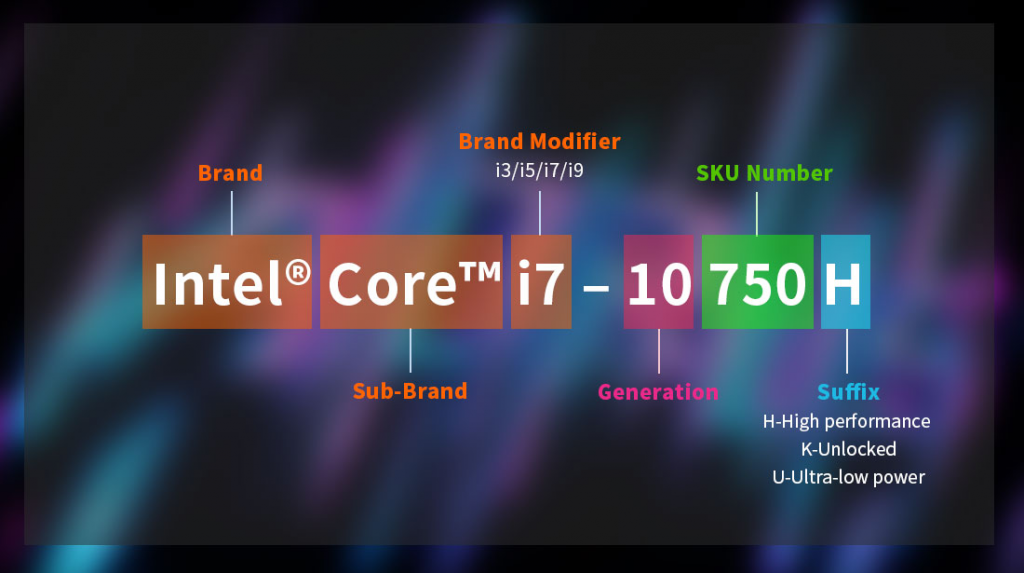
The letters at the end of a laptop processor’s model number typically indicate the processor’s performance characteristics and target usage. Here’s a detailed breakdown of common suffixes:

Intel Processor Suffixes
  1. H:
    • Usage: High performance.
    • Details: These processors are designed for higher performance laptops, such as gaming laptops and workstations. They have higher TDP (Thermal Design Power), usually around 45W, allowing for better performance but consuming more power and generating more heat.
    • Example: Intel Core i7-10750H.
  2. U:
    • Usage: Ultra-low power.
    • Details: These processors are designed for ultrabooks and thin-and-light laptops. They prioritize power efficiency, often with a TDP of 15W, which helps extend battery life but with lower performance compared to H-series processors.
    • Example: Intel Core i5-10210U.
  3. G:
    • Usage: Includes integrated graphics.
    • Details: These processors include enhanced integrated graphics, often part of Intel’s Iris Plus or Iris Xe series. The suffix might be followed by a number indicating the level of graphics performance (e.g., G7).
    • Example: Intel Core i7-1065G7.
  4. Y:
    • Usage: Extremely low power.
    • Details: These processors are designed for the thinnest and lightest devices, with TDPs around 7W. They are less powerful than U-series processors but offer significant power savings.
    • Example: Intel Core i7-8500Y.
  5. T:
    • Usage: Power-optimized lifestyle.
    • Details: These are desktop processors with lower power consumption and heat output, often used in all-in-one desktops and small form-factor PCs.
    • Example: Intel Core i5-9400T.

AMD Processor Suffixes
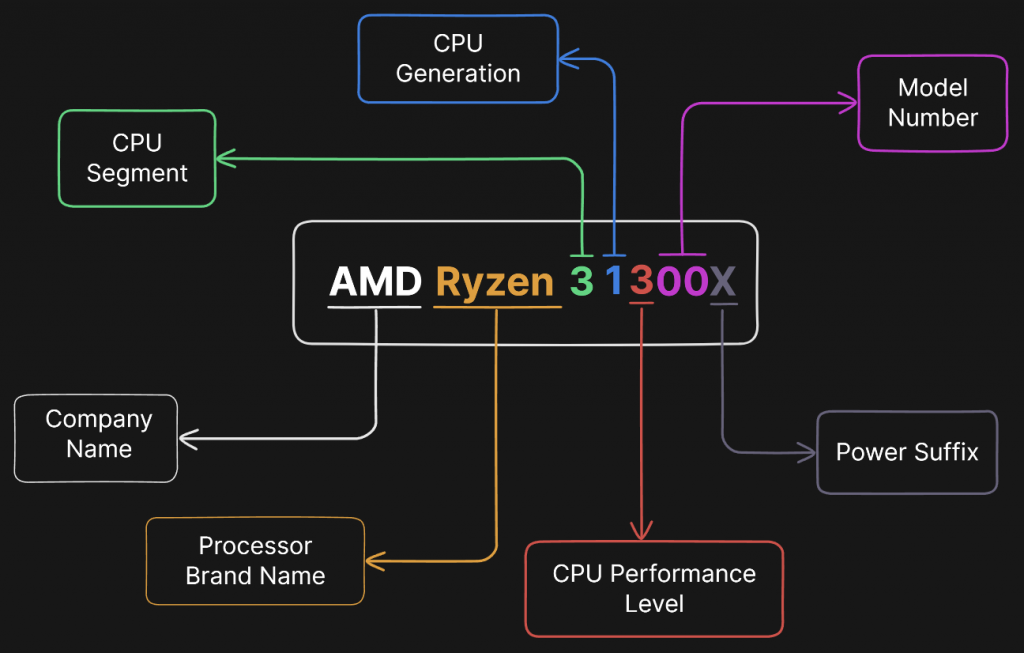
  1. H:
    • Usage: High performance.
    • Details: Similar to Intel, these processors are for high-performance laptops, gaming, and workstations, with higher TDPs for better performance.
    • Example: AMD Ryzen 7 4800H.
  2. U:
    • Usage: Ultra-low power.
    • Details: These processors are aimed at ultrabooks and thin-and-light laptops, balancing power efficiency and performance with TDPs around 15W.
    • Example: AMD Ryzen 5 4500U.
  3. HS:
    • Usage: High performance, power-efficient.
    • Details: These processors offer high performance with a slightly lower TDP (around 35W) compared to the standard H-series, aimed at balancing performance and battery life.
    • Example: AMD Ryzen 7 4800HS.
  4. HX:
    • Usage: High performance, overclockable.
    • Details: These are high-performance processors with the ability to be overclocked, offering top-tier performance for gaming and workstations.
    • Example: AMD Ryzen 9 5900HX.
  5. GE:
    • Usage: Embedded, low power.
    • Details: These processors are designed for embedded systems with low power requirements.
    • Example: AMD Ryzen Embedded V1605B.

Summary of Suffixes

SuffixManufacturerUsageTDPExample
HIntel, AMDHigh performance35-45WIntel Core i7-10750H
UIntel, AMDUltra-low power~15WIntel Core i5-10210U
GIntelIncludes integrated graphicsVariesIntel Core i7-1065G7
YIntelExtremely low power~7WIntel Core i7-8500Y
TIntelPower-optimized lifestyleVariesIntel Core i5-9400T
HSAMDHigh performance, power-efficient~35WAMD Ryzen 7 4800HS
HXAMDHigh performance, overclockableVariesAMD Ryzen 9 5900HX
GEAMDEmbedded, low powerVariesAMD Ryzen Embedded V1605B

Understanding these suffixes helps you choose a processor that best fits your needs, whether you prioritize performance, power efficiency, or a balance of both.

Post Views: 3,667
  • AMD
  • AMD Processor Suffixes
  • Intel Processor Suffixes
  • Laptop Processor Suffixes Decoded: Choose the Right One for Your Needs
  • Processor
  • Processor Suffixes
  • Suffixes
  • windows
  • windows Processor
Subscribe
Login
Notify of
guest
guest
0 Comments
Oldest
Newest Most Voted
Inline Feedbacks
View all comments
  • The Ultimate Guide to Certified FinOps Professional: Skills, Levels, and Career Impact
  • Certified FinOps Manager: Essential Skills for Modern Cloud Operations
  • How to Use Claude AI for Programming: Complete Guide for Developers to Boost Productivity
  • The Definitive Guide to Certified FinOps Engineer: Master Cloud Value Engineering
  • A Comprehensive Guide to the Certified FinOps Architect Certification and Training
  • Linux Server Diagnostic Commands: Complete Guide for Performance, Network & System Troubleshooting
  • The Ultimate Guide to CDOM – Certified DataOps Manager Certification
  • The Practical Path to AI Reliability: A Guide to the Certified MLOps Manager
  • Master the Machine Learning Lifecycle:Guide to Becoming a Certified MLOps Architect
  • How to Build a Project-Level AI Memory System That Works Across Codex, Claude, and Other AI Coding Tools
  • Certified MLOps Professional: A Deep Dive into the Certified MLOps Professional Certification
  • Certified MLOps Engineer : The Comprehensive Guide to Mastering Machine Learning Operations
  • Codex vs Claude: A Complete Practical Guide for Modern Developers (2026)
  • Certified AIOps Professional Program A Guide to Career Growth
  • Keycloak Multi-Client Architecture with Project-Based Email Validation (Student, Trainer, Company, Consulting)
  • Incorrect definition of table mysql.column_stats
  • Mautic and PHP 8.3 Compatibility Guide (2026)
  • Certified AIOps Engineer: The Complete Career Path and Certification Guide
  • How to Rename Apache Virtual Host Files Safely (Step-by-Step Guide for Linux)
  • AIOps Foundation Certification: Everything You Need to Know to Get Certified
  • DevOps to Certified Site Reliability Professional: A Senior Mentor’s Guide
  • Certified Site Reliability Manager Training, Preparation, and Career Mapping
  • Certified Site Reliability Architect: The Complete Career Guide
  • What Is a VPN? A Complete Beginner-to-Advanced Tutorial
  • How to Install, Secure, and Tune MySQL 8.4 on Ubuntu 24.04 for Apache Event MPM and PHP-FPM
  • Complete Guide to Certified Site Reliability Engineer Career
  • Certified DevSecOps Professional Step by Step
  • Certified DevSecOps Manager: Complete Career Guide
  • Certified DevSecOps Engineer: Skills, Career Path and Certification Guide
  • Step-by-Step: Become a Certified DevSecOps Architect

Recent Comments

  1. emmy day on SQLSTATE[42S22]: Column not found: 1054 Unknown column ‘provider’ in ‘field list’
  2. digital banking on Complete Tutorial: Setting Up Laravel Telescope Correctly (Windows + XAMPP + Custom Domain)
  3. SAHIL DHINGRA on How to Uninstall Xampp from your machine when it is not visible in Control panel programs & Feature ?
  4. Abhishek on MySQL: List of Comprehensive List of approach to secure MySQL servers.
  5. Kristina on Best practices to followed in .httacess to avoid DDOS attack?

Archives

  • May 2026
  • April 2026
  • March 2026
  • February 2026
  • January 2026
  • December 2025
  • November 2025
  • October 2025
  • September 2025
  • August 2025
  • July 2025
  • June 2025
  • May 2025
  • April 2025
  • March 2025
  • February 2025
  • January 2025
  • December 2024
  • November 2024
  • October 2024
  • September 2024
  • August 2024
  • July 2024
  • June 2024
  • May 2024
  • April 2024
  • March 2024
  • February 2024
  • January 2024
  • December 2023
  • November 2023
  • October 2023
  • September 2023
  • August 2023
  • July 2023
  • May 2023
  • April 2023
  • March 2023
  • February 2023
  • January 2023
  • December 2022

Categories

  • Ai
  • AI Blogging
  • AiOps
  • ajax
  • Android Studio
  • Antimalware
  • Antivirus
  • Apache
  • Api
  • API Security
  • Api Testing
  • APK
  • Aws
  • Bike Rental Services
  • ChatGPT
  • Code Linting
  • Composer
  • cPanel
  • Cyber Threat Intelligence
  • Cybersecurity
  • Data Loss Prevention
  • Database
  • dataops
  • Deception Technology
  • DeepSeek
  • Devops
  • DevSecOps
  • DevTools
  • Digital Asset Management
  • Digital Certificates
  • Docker
  • Drupal
  • emulator
  • Encryption Tools
  • Endpoint Security Tools
  • Error
  • facebook
  • Firewalls
  • Flutter
  • git
  • GITHUB
  • Google Antigravity
  • Google play console
  • Google reCAPTCHA
  • Gradle
  • Guest posting
  • health and fitness
  • IDE
  • Identity and Access Management
  • Incident Response
  • Instagram
  • Intrusion Detection and Prevention Systems
  • jobs
  • Joomla
  • Keycloak
  • Laravel
  • Law News
  • Lawyer Discussion
  • Legal Advice
  • Linkedin
  • Linkedin Api
  • Linux
  • Livewire
  • Mautic
  • Medical Tourism
  • MlOps
  • MobaXterm
  • Mobile Device Management
  • Multi-Factor Authentication
  • MySql
  • Network Traffic Analysis tools
  • Paytm
  • Penetration Testing
  • php
  • PHPMyAdmin
  • Pinterest Api
  • Quora
  • SAST
  • SecOps
  • Secure File Transfer Protocol
  • Security Analytics Tools
  • Security Auditing Tools
  • Security Information and Event Management
  • Seo
  • Server Management Tools
  • Single Sign-On
  • Site Reliability Engineering
  • soft 404
  • software
  • SuiteCRM
  • SysOps
  • Threat Model
  • Twitter
  • Twitter Api
  • ubuntu
  • Uncategorized
  • Virtual Host
  • Virtual Private Networks
  • VPNs
  • Vulnerability Assessment Tools
  • Web Application Firewalls
  • Windows Processor
  • Wordpress
  • WSL (Windows Subsystem for Linux)
  • X.com
  • Xampp
  • Youtube
©2026 DevSecOps Now!!! | WordPress Theme: EcoCoded
wpDiscuz