Limited Time Offer!
For Less Than the Cost of a Starbucks Coffee, Access All DevOpsSchool Videos on YouTube Unlimitedly.
Master DevOps, SRE, DevSecOps Skills!
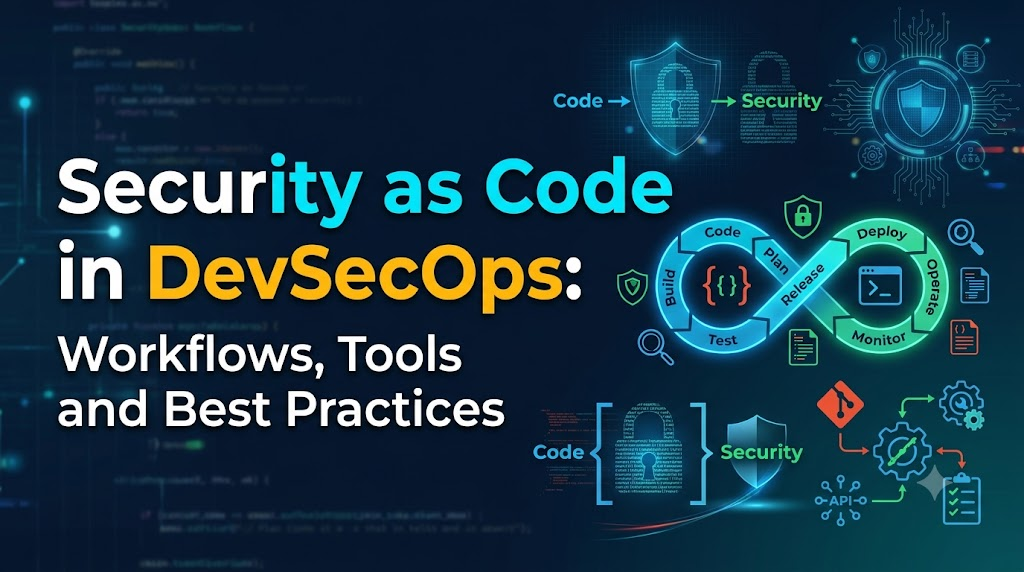
As cloud platforms, microservices, and rapid deployment pipelines accelerate software delivery, relying on manual security sign-offs and late-stage audits creates severe operational bottlenecks and lets critical misconfigurations slip unnoticed into production. Security as Code in DevSecOps solves this architectural mismatch by translating security policies, compliance standards, and risk controls into version-controlled, machine-readable code that runs directly within CI/CD pipelines and developer environments. By shifting security left through automated validation—spanning static analysis, secret detection, and policy-as-code evaluations of infrastructure manifests—organizations replace reactive fire drills with repeatable, auditable guardrails; in this guide, you will learn how Security as Code operates across the delivery lifecycle, the core tools that power it, and how to embed automated policy enforcement into your pipelines without compromising release speed.
What Is Security as Code?
Security as Code (SaC) is the systematic approach of managing security policies, compliance standards, risk controls, and validation rules in structured, version-controlled, and programmatically executable formats.
Rather than relying on human engineers to inspect every pull request or cloud configuration manually, Security as Code turns security guardrails into automated software tests. When developers make changes to application code, third-party libraries, container images, or infrastructure manifests, automated scanners and policy engines evaluate those changes against defined rules.
Key characteristics of Security as Code include:
- Machine-Readable Definitions: Security policies are expressed in structured configurations or domain-specific languages (DSLs) such as Rego, YAML, or native programming languages, rather than human-readable text documents alone.
- Source Control and Versioning: Policies live in repositories (such as Git), providing an immutable audit trail of who modified a rule, why it was changed, and when it took effect.
- Automated Pre-Flight Testing: Policies undergo automated unit and integration testing using positive (valid) and negative (invalid) inputs before they are deployed to production systems.
- Deterministic Policy Evaluation: Given the exact same infrastructure plan or workload manifest, an automated policy engine yields consistent decisions across development, staging, and production environments.
- Rollback and Auditing Capabilities: If a newly introduced security policy causes unintended disruptions or high false-positive rates, teams can revert the change through standard Git workflows (
git revert). - Shift-Left Security: By embedding automated checks directly into local IDEs, pre-commit hooks, and CI/CD pipelines, engineers receive actionable feedback within minutes of writing code.
Consider a practical example: An enterprise security mandate dictates that no cloud storage resource (such as an AWS S3 bucket, Azure Blob container, or Google Cloud Storage bucket) may be configured for public read access without explicit, documented architectural approval.
Under a legacy workflow, an auditor reviews the cloud console quarterly to flag exposed buckets. Under a Security as Code model, this requirement is expressed as a machine-readable rule inside a policy repository. When an engineer defines an S3 bucket in a Terraform file or a Kubernetes manifest, an automated linter or policy engine evaluates the declarative configuration inside the CI/CD pipeline. If the configuration sets public access flags to true, the pipeline rejects the build immediately and outputs actionable remediation instructions directly to the developer’s console.
Importantly, Security as Code is an architectural paradigm and an engineering discipline, not a single commercial off-the-shelf product or universally standardized tool.
Security as Code, Policy as Code, and Infrastructure as Code
Because the DevSecOps ecosystem uses multiple “as Code” concepts, practitioners frequently conflate them. While they share common mechanics—such as Git workflows, automated parsing, and declarative files—their scopes and functions differ significantly.
Security as Code
Security as Code is the overarching umbrella practice. It represents the broader methodology of translating all security and compliance requirements into code, automation, and continuous validation workflows. This includes vulnerability scanning thresholds, secrets detection patterns, runtime behavioral baselines, compliance audits, and automated remediation scripts.
Policy as Code
Policy as Code (PaC) is an essential, specialized subset of Security as Code. It refers specifically to writing decision-making logic, guardrails, and compliance rules in machine-readable languages so that automated engines can evaluate incoming data (such as JSON payloads, API requests, or Terraform plans) and return structured decisions (allow, deny, warn, or mutate).
Infrastructure as Code
Infrastructure as Code (IaC) is the practice of defining, provisioning, and managing computing environments (servers, networks, databases, cloud resources) through declarative or imperative definition files (e.g., Terraform, OpenTofu, AWS CloudFormation, Pulumi, Ansible) rather than manual interactive configuration tools.
Core Differences and DevSecOps Relationships
| Concept | Primary Purpose | Typical Examples | Role in DevSecOps |
| Infrastructure as Code (IaC) | Define, provision, and maintain infrastructure state deterministically. | Terraform HCL files, AWS CloudFormation templates, Pulumi scripts, Kubernetes manifests. | Provides the target configurations that represent environments; eliminates manual server provisioning. |
| Policy as Code (PaC) | Decouple decision-making logic from application code and validate structured data against rules. | Open Policy Agent (OPA) Rego rules, Kyverno ClusterPolicies, HashiCorp Sentinel policies. | Evaluates IaC plans, API inputs, or cluster resources against organizational guardrails before execution. |
| Security as Code (SaC) | Automate end-to-end security governance, controls, testing, and continuous enforcement across the software lifecycle. | Secret scanning configs, SAST rule definitions, container hardening checks, compliance validation workflows. | Unifies testing, automated guardrails, and compliance into daily development routines to achieve shift-left security. |
In short: IaC defines what you want to build. PaC defines the operational and regulatory rules that must be respected. SaC integrates these rules, along with vulnerability scanners, secret detectors, and runtime monitors, into a unified, automated DevSecOps delivery cycle.
How Security as Code Fits Into DevSecOps Workflows
Security as Code transforms security from a reactive gatekeeper into an active, automated participant throughout the software development life cycle (SDLC). Below is an end-to-end breakdown of how automated security controls operate across each phase.
+---------------+     +---------------+     +---------------+     +---------------+
| 1. Planning & | --> | 2. Dev &      | --> | 3. Build &    | --> | 4. Infra      |
| Threat Model  |     | Source Control|     | CI Pipelines  |     | Provisioning  |
+---------------+     +---------------+     +---------------+     +---------------+
                                                                          |
+---------------+     +---------------+     +---------------+             |
| 7. Runtime &  | <-- | 6. Release &  | <-- | 5. Container  | <-----------+
| Observability |     | Deployment    |     | & K8s Deploy  |
+---------------+     +---------------+     +---------------+
1. Planning and Threat Modeling
Security begins before a single line of code is committed. During the architecture and design phase, teams conduct threat modeling to identify critical assets, trust boundaries, external interfaces, and attack vectors.
Under a Security as Code framework, the requirements identified during threat modeling do not remain buried inside static architectural diagrams. Teams translate architectural trust boundaries into initial automated acceptance criteria—such as defining that an internal microservice must communicate solely over mutual TLS (mTLS), or establishing that a new database must never receive a public IP address. These security user stories provide the foundation for subsequent Policy as Code rules.
2. Development and Source Control
Security as Code empowers developers directly within their local development environments and source code management (SCM) platforms:
- IDE Linters and Pre-Commit Hooks: Tools run lightweight static checks locally, alerting engineers to obvious syntax errors or insecure configurations before code leaves their workstations.
- Secret Detection: Pre-commit hooks and repository scanners (such as Gitleaks or Trufflehog) scan diffs for high-entropy strings, API tokens, private keys, and hardcoded credentials.
- Branch Protection and Code Reviews: Git repositories enforce branch protection rules requiring automated status checks to pass and mandating peer review approvals before code merges into main branches. Policy changes themselves follow identical pull request workflows, ensuring peer scrutiny for all security rule updates.
3. Build and CI Pipelines
During continuous integration, the pipeline automatically compiles code, executes unit tests, and triggers a battery of automated security validations:
- Static Application Security Testing (SAST): Scanners analyze raw source code to detect common coding flaws, such as SQL injection, Cross-Site Scripting (XSS), or insecure deserialization (e.g., using Semgrep).
- Software Composition Analysis (SCA): Scanners inspect software bills of materials (SBOMs) and direct/transitive dependencies against known Common Vulnerabilities and Exposures (CVE) databases.
- Risk-Based Thresholds: Rather than failing builds on every low-severity informational issue, mature DevSecOps pipelines enforce rational, risk-based failure criteria. For example, a pipeline may block merges only when an unpatched Critical or High CVE with an active exploit vector is detected, while generating non-blocking advisory warnings for lower-severity findings.
4. Infrastructure Provisioning
Before cloud resources are instantiated, Security as Code validates declarative Infrastructure as Code manifests:
- Static IaC Scanning: Tools inspect Terraform configurations, CloudFormation templates, or ARM templates for misconfigurations, such as unencrypted EBS volumes or open security groups (
0.0.0.0/0). - Speculative Execution Checks: Advanced pipelines generate an execution plan (e.g.,
terraform plan -out=tfplan.binary), convert it to structured JSON, and evaluate it using a policy engine. This ensures the pipeline evaluates the exact state of resources that would be created, catching calculated attributes that raw static linters might miss.
5. Container and Kubernetes Deployment
When packaging applications into container images and deploying to Kubernetes clusters, Security as Code acts as a multi-stage validation engine:
- Base Image and Image Layer Scanning: Tools check base images for vulnerabilities, outdated OS packages, or elevated user permissions (e.g., running as root).
- Kubernetes Admission Control: Using dynamic admission controllers powered by engines like Kyverno or OPA Gatekeeper, the cluster validates incoming API requests (
kubectl applyor Helm releases) against cluster-wide policies. If an incoming pod manifest lacks resource limits, requests root privileges, or pulls from an untrusted registry, the admission controller rejects the request at the API level before the workload can ever run.
6. Release and Deployment
During the deployment phase, automated security gates enforce release criteria:
- Cryptographic Provenance and Attestation: Pipelines verify cryptographic signatures on container images and build artifacts (using tools such as Sigstore Cosign) to guarantee that only verified artifacts produced by authorized CI workflows can be deployed.
- Automated Exception Handling: When a business-critical deployment must proceed despite a known non-critical violation, the exception is managed through code (e.g., an annotated exception file in Git with an explicit expiration date and owner) rather than an undocumented verbal agreement.
7. Runtime Monitoring and Continuous Improvement
Security as Code does not terminate once a deployment completes. Cloud environments and running workloads experience configuration drift, newly discovered zero-day vulnerabilities, and dynamic operational modifications:
- Runtime Drift Detection: Continuous compliance engines evaluate deployed cloud resources against codified baselines, flagging drift if an engineer modifies a security group out-of-band via the cloud console.
- Runtime Threat Detection: Behavioral analysis engines monitor system calls, process executions, and network connections against declarative security rules (e.g., flagging unexpected shell invocations inside production containers).
- Feedback Loop: Findings from runtime incidents, penetration tests, and vulnerability discoveries feed directly back into the repository as new or refined test cases, ensuring the organization never suffers from the same misconfiguration twice.
Important Security Controls That Can Be Managed as Code
Not every organizational control can be automated entirely—strategic architectural reviews, exploratory threat modeling, and business logic assessments still require human judgment. However, high-volume, technical guardrails benefit immensely from codification.
+--------------------------------------------------------------------------+
|                 Categories of Codified Security Controls                 |
+--------------------------------------------------------------------------+
|  [Identity & Access]     [Network & Firewalls]     [Encryption & Data]   |
|  [Cloud Configurations]  [Secrets & Credentials]   [Containers & K8s]    |
|  [Dependencies & CVEs]   [Logging & Observability] [Compliance Evidence] |
+--------------------------------------------------------------------------+
1. Identity and Access Management (IAM)
- Codified Rule Example: Disallow wildcard permissions (
"Action": "*","Resource": "*") in cloud IAM policies, and require multi-factor authentication (MFA) for administrative roles. - Evaluation Point: CI/CD IaC plan validation and cloud provider governance policies.
- Security Benefit: Enforces the principle of least privilege, drastically limiting the blast radius if credentials are leaked.
2. Network Access and Firewall Rules
- Codified Rule Example: Prevent network security groups from exposing database ports (e.g., TCP 3306, 5432) or remote access ports (e.g., SSH 22, RDP 3389) directly to
0.0.0.0/0. - Evaluation Point: Pre-deployment IaC validation and post-provisioning drift checks.
- Security Benefit: Eliminates common perimeter misconfigurations that expose internal services directly to automated internet-wide scanners.
3. Encryption and Data Protection
- Codified Rule Example: Require all persistent storage volumes, object storage buckets, and relational database snapshots to enforce server-side encryption at rest using customer-managed keys (KMS).
- Evaluation Point: Static IaC analysis and Kubernetes admission webhooks.
- Security Benefit: Protects data confidentiality at rest and satisfies foundational requirements across SOC 2, HIPAA, and PCI-DSS frameworks.
4. Cloud Resource Configuration Standards
- Codified Rule Example: Require all cloud resources to include standardized metadata tags (
Environment,Owner,DataClassification) and disallow public bucket hosting. - Evaluation Point: Pre-commit linters, pipeline gate checks, and cloud configuration audit services.
- Security Benefit: Ensures resource traceability, cost allocation integrity, and immediate isolation of misconfigured assets.
5. Secret Handling and Credential Management
- Codified Rule Example: Enforce regex and entropy checks across all repository commits to block API keys, private certificates, and passwords.
- Evaluation Point: Local Git pre-commit hooks and SCM push-protection webhooks.
- Security Benefit: Prevents hardcoded credentials from ever being published into source control history.
6. Container and Kubernetes Security
- Codified Rule Example: Mandate
readOnlyRootFilesystem: true, setrunAsNonRoot: true, drop Linux capabilities (drop: ["ALL"]), and define memory/CPU resource requests and limits. - Evaluation Point: Static Helm/Kustomize manifest checks in CI, and Kubernetes admission controllers.
- Security Benefit: Prevents container breakout exploits, stops malware from persisting on the filesystem, and protects the cluster against noisy-neighbor resource exhaustion.
7. Dependency and Vulnerability Policies
- Codified Rule Example: Block application builds if any direct dependency contains a CVE with a CVSS score greater than 8.0 that has an available upstream patch.
- Evaluation Point: Build step inside CI pipeline.
- Security Benefit: Prevents vulnerable open-source components from entering production while avoiding build failures on vulnerabilities that lack an available vendor fix.
8. Logging and Audit Requirements
- Codified Rule Example: Require cloud audit logging services (such as AWS CloudTrail, GCP Cloud Audit Logs, or Azure Activity Logs) to remain enabled with log file validation and multi-region collection configured.
- Evaluation Point: Infrastructure provisioning pipelines and continuous cloud posture assessments.
- Security Benefit: Guarantees that tamper-resistant forensic trails exist for incident response and compliance verification.
9. Approved Deployment Configurations
- Codified Rule Example: Ensure that production workloads only pull container images hosted on private, organizationally controlled registries (e.g.,
registry.internal.net/*) rather than public registries. - Evaluation Point: Kubernetes Admission Webhooks and CI/CD deployment scripts.
- Security Benefit: Mitigates software supply-chain poisoning and squatting attacks from unvetted public registries.
10. Compliance-Related Controls and Evidence Collection
- Codified Rule Example: Execute periodic automated scans that query production configurations against CIS Benchmarks and export signed JSON compliance reports into an audit repository.
- Evaluation Point: Scheduled CI/CD automation workflows or runtime compliance agents.
- Security Benefit: Transforms annual audit scrambles into continuous, automated compliance evidence collection.
Security as Code Tools and Technologies
Building a Security as Code ecosystem does not require a single monolithic product. Modern DevSecOps teams select specialized, best-in-breed tools that integrate cleanly into their developer workflows, SCM platforms, and deployment targets.
| Tool | Primary Use | Workflow Stage | Important Consideration |
| Open Policy Agent (OPA) | General-purpose, declarative policy engine evaluating JSON/YAML data across systems. | CI/CD, Kubernetes (via Gatekeeper), API gateways, service meshes. | Uses Rego, a specialized declarative query language that requires an initial learning curve. |
| Conftest | Structured configuration testing utility using OPA rules against local files. | Local developer workstation, pre-commit, and CI pipeline stages. | Optimized for testing static configuration files (Terraform plans, Kubernetes YAML, Dockerfiles, JSON). |
| Kyverno | Kubernetes-native policy engine providing policy validation, mutation, and resource generation. | Kubernetes Admission Control, CI pipeline manifest testing. | Written specifically for Kubernetes; policies are written as native Kubernetes Custom Resources (YAML), eliminating the need to learn Rego. |
| Checkov | Static code analysis tool for Infrastructure as Code (Terraform, CloudFormation, Helm, K8s, ARM). | Pre-commit hooks, CI pipelines, and IDE plugins. | Comes with hundreds of built-in policies out-of-the-box; supports custom policies written in Python or YAML. |
| HashiCorp Sentinel | Embedded policy-as-code framework integrated into HashiCorp Enterprise ecosystems. | Speculative and pre-apply checks in Terraform Enterprise / Cloud. | Proprietary framework closely tied to HashiCorp products; not an open-source, general-purpose engine. |
| Semgrep | Fast, lightweight static analysis engine for codebases and semantic pattern searching. | Local workstation, CI pipeline (SAST), code review automation. | Rules look like actual source code rather than abstract syntax tree (AST) queries, making rule creation accessible to developers. |
| Gitleaks | Fast, lightweight scanner designed to detect and prevent secrets in Git repositories. | Pre-commit hooks, CI pull request checks, historical repository audits. | Relies on regex patterns and entropy analysis; requires periodic tuning to eliminate false positives in test fixtures. |
| Trivy | Comprehensive, versatile security scanner for container images, filesystems, and Git repos. | CI/CD build steps, container registries, Kubernetes cluster operators. | Extremely fast vulnerability and misconfiguration scanning; highly popular due to its single-binary footprint and broad ecosystem integration. |
Practical Example: Enforcing Security Policies in a CI/CD Pipeline
To understand how Security as Code operates in practice, let us walk through a realistic scenario: preventing an insecure cloud storage bucket from reaching production.
The Scenario
A platform engineering team manages cloud storage using Terraform. An engineer proposes a change that modifies an S3 bucket configuration. Inadvertently, the engineer removes the block on public access configurations to troubleshoot a file-sharing issue.
The Automated Workflow
[ Developer updates Terraform ]
              │
              ▼
[ Git Push to Feature Branch ]
              │
              ▼
[ CI Pipeline Triggers ]
      ├─ Step 1: Run Terraform Init & Validate
      ├─ Step 2: Generate Speculative Plan (tfplan.json)
      └─ Step 3: Run Policy Engine (Conftest / OPA)
              │
       ┌──────┴──────┐
       │             │
  [ Rule Passed ]  [ Rule Failed (Exit Code 1) ]
       │             │
       │             ▼
       │      [ Pipeline Blocks Merge ]
       │      [ Actionable Error Outputted to PR ]
       │             │
       │      [ Developer Fixes Config & Pushes ]
       │             │
       └─────────────┘
              │
              ▼
[ Pull Request Approved & Merged ]
              │
              ▼
[ CD Pipeline Deploys to Production ]
              │
              ▼
[ Continuous Runtime Drift Monitoring ]
- Code Modification: The developer updates the Terraform file locally and commits the change to a feature branch.
- Pull Request Created: Pushing the branch triggers the automated CI/CD pipeline (e.g., GitHub Actions, GitLab CI, or Jenkins).
- Plan Generation: The pipeline runs
terraform plan -out=tfplan.binaryand converts the binary plan into structured JSON:Bashterraform show -json tfplan.binary > tfplan.json - Policy Evaluation: A policy testing tool (such as Conftest) evaluates
tfplan.jsonagainst the organization’s version-controlled Rego policies:Bashconftest test tfplan.json --policy ./policies/storage.rego - Violation Detection: The policy engine discovers that the proposed plan violates the rule requiring private access controls.
- Pipeline Rejection: Conftest exits with an error code (e.g.,
exit 1), failing the CI step, blocking the merge, and outputting clear remediation instructions. - Developer Remediation: The developer reads the failure message, restores the private access settings, and pushes the updated commit.
- Automated Verification: The pipeline runs again, passes all security checks, allows peer review, and merges the code.
- Deployment & Runtime Verification: The Continuous Deployment pipeline applies the Terraform plan. Downstream, runtime posture tools continuously monitor the bucket to ensure its state does not deviate.
Illustrative Policy Example (Rego for OPA / Conftest)
Below is an illustrative Rego policy demonstrating how a security team defines this guardrail as machine-readable code.
Code snippet
# storage_security.rego
# Purpose: Ensure S3 buckets enforce public access block configurations.
package terraform.storage

import future.keywords.in

default allow = false

# Identify any aws_s3_bucket_public_access_block resource that allows public access
deny[msg] {
    resource := input.resource_changes[_]
    resource.type == "aws_s3_bucket_public_access_block"

    # Check if any public access settings are explicitly set to false
    not all_public_access_blocked(resource.change.after)

    msg := sprintf(
        "SECURITY VIOLATION: Resource '%v' must set all public access block properties to true.",
[resource.address]
) } # Helper function to ensure all required boolean flags are strictly true all_public_access_blocked(config) { config.block_public_acls == true config.block_public_policy == true config.ignore_public_acls == true config.restrict_public_buckets == true }
What Happens When the Check Fails?
When an engineer submits an invalid configuration, the CI pipeline output avoids cryptic stack traces. Instead, it presents contextual, actionable feedback:
FAIL - tfplan.json - terraform.storage - SECURITY VIOLATION: Resource
'aws_s3_bucket_public_access_block.customer_data' must set all public
access block properties to true.

Remediation: Set block_public_acls, block_public_policy, ignore_public_acls,
and restrict_public_buckets to 'true'.
Policy Documentation: https://internal-wiki.enterprise.com/policies/SEC-042
By providing the exact resource address, the specific rule violated, and a link to the remediation guide, the developer can resolve the issue immediately without waiting for a scheduled review with an overburdened security team.
Benefits of Security as Code in DevSecOps
When organizations properly implement and maintain Security as Code, they unlock significant operational, technical, and cultural improvements:
- Consistent Security Enforcement: Automated checks apply identical standards across every microservice, application, and environment, eliminating the variability inherent in manual audits.
- Early Detection (Shift-Left): Discovering vulnerabilities during the pull-request phase is exponentially faster and less expensive to remediate than patching running production clusters.
- Elimination of Repetitive Manual Reviews: Routine validation tasks (such as inspecting open firewall ports or verifying resource tags) are automated, freeing security professionals to focus on high-impact threat modeling and architecture design.
- Complete Audit Traceability: Every change to a security policy is recorded in Git. Teams can track precisely who authored a rule, who approved it, and the commit history justifying its existence.
- Accelerated Developer Feedback Loops: Developers receive immediate, deterministic results in their CI logs rather than waiting days for a ticket-based security review.
- Cross-Environment Uniformity: Policies can enforce identical baseline standards across development, test, and production, ensuring that security-related configurations do not break unexpectedly during promotion.
- Fostering Engineering Collaboration: Instead of working in silos where security serves as an antagonistic gatekeeper, security engineers and software developers collaborate using the same engineering medium: code, Git workflows, pull requests, and automated tests.
- Scalable Reusability: Once codified and validated, policy modules can be shared across multiple business units and repositories as standard libraries.
Note: The actual realized benefits depend directly on policy quality, coverage, integration discipline, and continuous maintenance. Poorly designed policies can impede development without substantially reducing risk.
Common Challenges and How to Overcome Them
Adopting Security as Code requires addressing both technical and organizational hurdles. Below are common pitfalls teams encounter along with practical mitigation strategies.
1. Alert Fatigue and False Positives
- The Problem: Scanners that flag hundreds of theoretical or irrelevant issues flood developers with noise, leading teams to ignore alerts or disable scanners.
- The Solution: Establish risk-based gating thresholds. Fail builds only on high-confidence, actionable vulnerabilities (e.g., known exploited CVEs with available fixes). Continually tune custom rules and maintain exclusion lists for test fixtures or benign configurations.
2. Excessive CI/CD Pipeline Latency
- The Problem: Appending dozens of heavy scanners to every pipeline run causes build times to skyrocket from minutes to hours, crippling developer productivity.
- The Solution: Tier your scanning strategy. Run lightweight linters and fast secret scanners locally or during initial pull requests. Defer deeper, compute-intensive scans (like comprehensive container image builds or dynamic analysis) to asynchronous workflows or nightly builds.
3. Policy Divergence Across Environments
- The Problem: Development environments often require looser controls than production (e.g., mock endpoints vs. hardened networking), leading to complex, brittle policy exceptions.
- The Solution: Parameterize your policies. Write policy logic that accepts environment context as input (e.g.,
environment: development), allowing controlled relaxations for development sandboxes while strictly locking down staging and production environments.
4. Overly Restrictive or Brittle Rules
- The Problem: Security teams author overly strict rules without consulting engineering teams, abruptly breaking legitimate deployments and sparking organizational friction.
- The Solution: Roll out new policies in Audit Mode (Warn Mode) first. Run rules without breaking builds, log violations over a 2–4 week period to evaluate real-world impact, refine edge cases, and transition to strict enforcement (
Deny Mode) only after baseline compliance is achieved.
5. Managing Exceptions and Expirations
- The Problem: Emergency business requirements often necessitate temporary security exceptions. If granted verbally, these temporary overrides quietly turn into permanent vulnerabilities.
- The Solution: Manage exceptions as code. Store approved exceptions in version-controlled metadata files with strictly required parameters: the resource ID, business justification, approving manager, and an immutable expiration date. Automated policy checks must ignore exceptions once their expiration date passes.
6. Protecting the Security Pipelines
- The Problem: If developers have permission to edit or disable policy steps within their pipeline configuration files (
.gitlab-ci.ymlor GitHub Actions workflows), security enforcement is easily bypassed. - The Solution: Use centrally governed, immutable pipeline templates. Platforms allow security teams to mandate specific job executions that downstream application repositories cannot override. Restrict write access to policy repositories using strict branch protections and CODEOWNERS files.
Security as Code Best Practices
To ensure your Security as Code initiative delivers measurable security without impeding delivery velocity, adhere to the following core practices:
- Keep All Policies in Version Control: Treat security policies with the same engineering rigor as application code. Store them in Git, use modular folder structures, and enforce branch protections.
- Mandate Rigorous Peer Review: Require changes to policies to undergo peer review by both security engineers and platform practitioners before merging into production branches.
- Write Unit and Integration Tests for Policies: Test your policies using both positive (valid configurations that must pass) and negative (invalid configurations that must fail) test cases to prevent regressions.
- Use Reusable, Modular Policies: Build small, composable policy functions rather than massive, monolithic scripts. Reuse standard helper libraries across teams.
- Align Code with Documented Governance: Ensure every codified policy links directly back to an organizational standard, framework control (e.g., NIST, CIS, ISO 27001), or business requirement.
- Start Small with High-Impact Controls: Begin with a focused set of high-value, low-friction checks (such as blocking hardcoded secrets and closing open database ports) before expanding to nuanced application-level policies.
- Provide Actionable Remediation Guidance: Every policy failure must provide a concise explanation of what failed, why it failed, and exact instructions or documentation on how to fix it.
- Enforce Risk-Based Thresholds: Reserve pipeline-breaking enforcement for high-risk, exploitable findings. Use non-blocking warnings or informational notices for lower-priority findings.
- Formalize Ephemeral Exceptions: Enforce time-bound exceptions via version-controlled configuration files that automatically re-enable enforcement upon expiration.
- Secure the Policy Pipeline: Protect policy repositories, signing keys, and CI/CD runners using multi-factor authentication, least privilege access, and strict role separation.
- Monitor Violation Metrics Continuously: Track recurring policy failures to identify common developer pain points or systemic architecture flaws requiring training or updated base templates.
- Review and Refine Policies Iteratively: Revisit policies regularly to align with new cloud service features, deprecations, and emerging threat intelligence.
- Separate Concerns Across Lifecycle Roles: Establish clear division between who writes policies, who approves exceptions, and who manages pipeline enforcement to satisfy governance standards.
- Combine Automated Checks with Human Insight: Never view Security as Code as a replacement for human security expertise. Use automated guardrails to handle routine hygiene so expert engineers can conduct threat modeling, architecture reviews, and red team exercises.
How to Measure Security as Code Effectiveness
Implementing automated security policies requires continuous validation to determine whether the approach is genuinely improving security posture or simply introducing unnecessary friction.
Establish baseline metrics and monitor trends over time rather than targeting arbitrary industry numbers:
[ Security as Code Key Performance Indicators ]
  ├── Pipeline Coverage Rate (%)
  ├── Pre-Deployment High-Risk Interceptions (Count)
  ├── Mean Time to Remediate - MTTR (Hours/Days)
  ├── Recurring Violation Frequency (Trend)
  ├── Outstanding Exception Count & Age (Days)
  ├── Automated Policy Test Coverage (%)
  └── False-Positive & Override Rate (%)
- Pipeline Coverage Rate: The percentage of organizational repositories and CI/CD pipelines that actively run automated security policy checks.
- Pre-Deployment High-Risk Interceptions: The number of critical vulnerabilities and misconfigurations caught and resolved in pre-production pipelines before reaching production.
- Mean Time to Remediate (MTTR): The time required for developers to resolve a policy violation once detected in the pipeline.
- Frequency of Recurring Configuration Issues: Whether the recurrence rate of common configuration flaws (e.g., unencrypted disks) decreases as developers learn from immediate feedback.
- Outstanding Policy Exceptions: The total number, business justification, and age of active policy exemptions across the enterprise.
- Policy Test Coverage: The percentage of custom policy rules that have automated positive and negative unit test suites.
- False Positive and Override Rate: The frequency with which developers must request manual overrides or flag policy engine findings as incorrect.
- Policy Review Turnaround Time: The time it takes for security teams to evaluate, approve, and merge requested policy updates or exceptions.
Metric Interpretation Caution: A sharp increase in detected violations does not necessarily indicate a deteriorating security posture. It often reflects improved detection coverage as new policy rules are activated across previously unmonitored pipelines.
How Security as Code Supports Compliance and Governance
Modern compliance frameworks—such as SOC 2, ISO/IEC 27001, PCI-DSS, HIPAA, and GDPR—increasingly require organizations to demonstrate consistent, verifiable control enforcement across their technical estates.
Traditional compliance efforts rely heavily on annual, retroactive audits where engineers manually gather screenshots, review ticketing systems, and compile spreadsheets. Security as Code fundamentally modernizes this workflow:
- Mapping Code Directly to Framework Controls: A policy rule enforcing encryption on relational databases can be annotated with its exact compliance reference (e.g.,
PCI-DSS v4.0 Requirement 3.4orNIST SP 800-53 SC-28). - Deterministic Verification of Configuration States: Code-based rules continuously verify that required settings (such as audit logging, network segmentation, and access controls) remain enabled across all environments.
- Immutable Change and Approval History: Because policies are maintained in version-controlled repositories, every modification, peer review, and deployment is recorded in cryptographically verifiable Git commits.
- Structured Evidence Generation: Security as Code pipelines can generate machine-readable compliance attestations, SBOMs, and signed scan reports automatically during every build. These artifacts serve as objective, point-in-time evidence for internal and external auditors.
- Continuous Compliance vs. Point-in-Time Audits: By executing policy evaluations against every commit and continuously checking runtime drift, organizations transition from an annual audit scramble to a state of continuous compliance governance.
Important Compliance Reality: While automated policy engines significantly streamline evidence gathering and operational control enforcement, they do not automatically make an organization “compliant.” Regulatory compliance encompasses organizational governance, legal assessments, employee training, physical security, and operational processes that cannot be verified by code alone.
How DevOpsSchool Can Support DevSecOps Learning
Mastering Security as Code requires hands-on familiarity with multiple disciplines: software engineering, cloud architecture, pipeline automation, and security principles. Practitioners must understand not only how to write application code and build infrastructure, but also how to craft robust policy rules, design admission webhooks, and integrate automated scanners without disrupting delivery velocity.
For engineers, platform architects, and technology leaders looking to build practical, enterprise-grade capabilities in this space, DevOpsSchool provides dedicated educational programs, industry-aligned training, and practical resources focused on DevOps and DevSecOps practices.
When evaluating learning resources to advance your skills in Security as Code and cloud security automation, consider reviewing:
- Structured DevSecOps Curricula: Explore programs that cover the entire DevSecOps lifecycle—from threat modeling and SAST/SCA scanning to Policy as Code and runtime observability.
- Practical Hands-On Labs: Look for training modules that provide real-world environments to configure tools such as Open Policy Agent (OPA), Checkov, Kyverno, Docker, and Kubernetes admission controllers.
- Integration with Modern CI/CD Platforms: Ensure courses demonstrate real-world pipeline integration using platforms like Jenkins, GitHub Actions, or GitLab CI.
- Experienced Practitioner Mentorship: Assess the real-world industry background of mentors who have designed and operated security automation across production cloud systems.
To explore current learning tracks, certifications, and technical workshops in DevSecOps, container security, and automation, visit DevOpsSchool to find resources that match your career goals and organizational needs.
Frequently Asked Questions About Security as Code
1. What is Security as Code?
Security as Code (SaC) is the methodology of defining, versioning, testing, and enforcing security policies, compliance guardrails, and validation checks as machine-readable code integrated directly into automated software delivery pipelines.
2. How does Security as Code fit into DevSecOps?
It operationalizes the “shift-left” principle of DevSecOps. Instead of relying on manual security gatekeeping at the end of a project, SaC embeds automated security checks into every phase—planning, coding, building, provisioning, deploying, and runtime monitoring.
3. What is the difference between Security as Code and Infrastructure as Code?
Infrastructure as Code (IaC) defines and provisions technical resources (such as virtual machines, networks, and databases). Security as Code (SaC) is the broader discipline of defining, validating, and enforcing security policies across code, configurations, infrastructure, and runtime environments.
4. How is Policy as Code related to Security as Code?
Policy as Code (PaC) is an essential component of Security as Code. It focuses specifically on writing decision-making rules in declarative languages (like Rego) so policy engines can evaluate configurations and return deterministic pass/fail decisions.
5. Which tools are commonly used for Security as Code?
Common tools include Open Policy Agent (OPA), Conftest, Kyverno, Checkov, Trivy, Semgrep, Gitleaks, and HashiCorp Sentinel. Each tool focuses on different stages, such as code analysis, secrets detection, IaC evaluation, or Kubernetes admission control.
6. How does Security as Code improve CI/CD security?
It integrates automated tests directly into CI/CD pipelines. Every commit is automatically scanned for hardcoded credentials, vulnerable dependencies, insecure source code patterns, and infrastructure misconfigurations before changes can be merged or deployed.
7. Can Security as Code prevent cloud misconfigurations?
Yes. By evaluating IaC manifests (like Terraform plans) prior to execution, policy engines can detect and block misconfigurations—such as publicly accessible storage buckets, unrestricted firewall rules, or missing encryption—before resources are provisioned in the cloud.
8. How does Security as Code support Kubernetes security?
Through Kubernetes admission controllers (such as Kyverno or OPA Gatekeeper), codified policies validate or mutate incoming workload manifests at the cluster API level, rejecting pods that attempt to run as root, lack resource limits, or use unvetted registries.
9. Can Security as Code automate compliance checks?
It automates the continuous verification of technical configuration controls and generates verifiable audit logs. However, it supports compliance rather than replacing it—formal compliance still requires legal interpretation, risk management, and administrative governance.
10. What are the main challenges of implementing Security as Code?
Key challenges include managing alert fatigue and false positives, preventing pipeline execution delays, handling policy exceptions cleanly, maintaining policy parity across environments, and ensuring that security teams do not author overly rigid policies that block legitimate work.
11. Should security policies block every pipeline violation?
No. Mature teams use risk-based thresholds. Critical, exploitable vulnerabilities and severe misconfigurations should block pipelines, while low-severity, non-exploitable findings should generate informational warnings to avoid unnecessary disruptions to developer productivity.
12. How can teams test security policies before enforcing them?
Teams should write automated unit tests for policies using positive and negative sample files. Additionally, new policies should be deployed in a non-blocking “Audit” or “Warn” mode in CI/CD pipelines to evaluate real-world impact before activating strict blocking (“Deny”) enforcement.
13. How do organizations manage policy exceptions?
Exceptions should be codified in version-controlled configuration files with mandatory metadata: resource identifier, business justification, approving authority, and an explicit expiration date. Automated checks must ignore expired exemptions.
14. Is Security as Code suitable for small teams?
Yes. Small teams often benefit the most because automated guardrails reduce the need for dedicated manual review staff. Small teams can begin with lightweight, turnkey tools like Gitleaks, Trivy, or Checkov before crafting complex custom policies.
15. What skills are needed to implement Security as Code?
Practitioners need a solid foundation in Git workflows, CI/CD pipeline automation, declarative configuration formats (JSON, YAML), cloud infrastructure fundamentals, and specialized policy engines (such as OPA/Rego or Kyverno).
Conclusion
Implementing Security as Code bridges the historical divide between rapid engineering velocity and rigorous system defense by transforming security from an antagonistic, manual gatekeeper into an automated, transparent software discipline. Achieving long-term resilience requires treating policies like production software—storing rules in version control, running comprehensive unit tests, enforcing risk-based thresholds, and establishing feedback loops between runtime drift and developer tooling. Take your first step today by codifying a single high-frequency guardrail—such as blocking unencrypted storage or hardcoded secrets—into your CI/CD pipeline, and explore structured training programs on DevOpsSchool to master end-to-end security automation and scalable DevSecOps practices.
