Limited Time Offer!
For Less Than the Cost of a Starbucks Coffee, Access All DevOpsSchool Videos on YouTube Unlimitedly.
Master DevOps, SRE, DevSecOps Skills!
Introduction
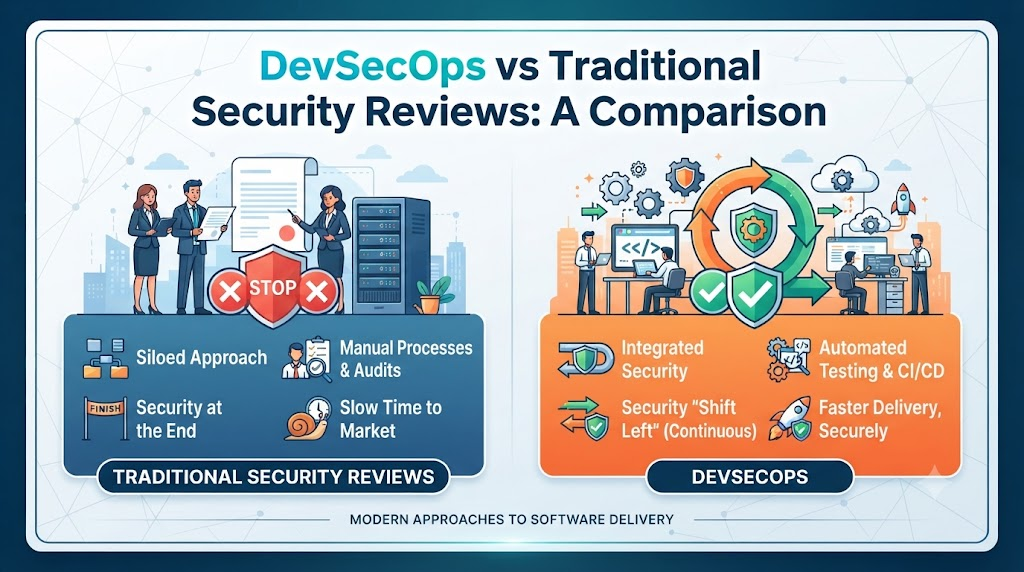
In the modern digital landscape, the speed of software delivery has accelerated dramatically. Organizations across industries release updates daily, weekly, or even multiple times a day to meet user demands and maintain a competitive edge. Historically, software security was treated as a distinct phase near the end of the Software Development Lifecycle (SDLC). However, as cyber threats grow more sophisticated and development cycles become continuous, organizations are moving from isolated security checkpoints toward continuous security practices. Understanding DevSecOps vs Traditional Security Reviews is critical for engineering leaders, developers, and security professionals striving to balance rapid delivery with robust protection.
What Is DevSecOps?
DevSecOps is an evolution of software engineering that integrates security practices seamlessly into every stage of the DevOps lifecycle—from initial design and coding through CI/CD pipelines, infrastructure deployment, and runtime operations. Instead of treating security as an external gatekeeper, DevSecOps embraces the philosophy that “security is everyone’s responsibility.” By embedding automated security checks, vulnerability scans, and policy enforcement directly into development workflows, teams can identify and resolve security flaws early without sacrificing delivery speed.
What Are Traditional Security Reviews?
Traditional Security Reviews refer to established, often manual methodologies where security validation occurs at specific, discrete milestones before software is deployed to production. Common components of traditional security reviews include:
- Security reviews before release
- Manual code reviews
- Architecture reviews
- Periodic vulnerability assessments
- Penetration testing
- Compliance reviews
- Manual approval gates
How Traditional Security Reviews Work
The traditional approach typically follows a linear workflow:
$$\text{Development} \rightarrow \text{Testing} \rightarrow \text{Security Review} \rightarrow \text{Remediation} \rightarrow \text{Approval} \rightarrow \text{Release}$$
Advantages and Limitations of This Model
- Advantages: Traditional security reviews provide deep human analysis, specialized security expertise, and formal compliance sign-offs that are valuable for high-risk systems.
- Limitations: This model often creates severe bottlenecks. Discovering critical vulnerabilities late in the cycle leads to costly rework, delayed releases, and friction between development and security teams.
How DevSecOps Security Works
In contrast, a DevSecOps approach embeds security into a continuous, iterative workflow:
$$\text{Plan} \rightarrow \text{Code} \rightarrow \text{Build} \rightarrow \text{Test} \rightarrow \text{Security Scan} \rightarrow \text{Package} \rightarrow \text{Deploy} \rightarrow \text{Monitor} \rightarrow \text{Improve}$$
Security activities occur continuously throughout the lifecycle, ensuring that code is scrutinized the moment it is written and tested automatically as it moves through the pipeline.
DevSecOps vs Traditional Security Reviews: Key Differences
| Area | Traditional Security Reviews | DevSecOps |
| Security Timing | Periodic checkpoints before release | Continuous validation across the entire SDLC |
| Security Ownership | Siloed security team | Shared responsibility across developers, ops, and security |
| Automation | Highly manual, human-driven | Heavily automated with tooling and pipelines |
| Testing Frequency | Periodic (milestone-based) | Continuous on every commit, build, or deploy |
| Developer Involvement | Minimal until remediation phase | High; active participants in early bug fixing |
| CI/CD Integration | Minimal or detached from pipelines | Deeply integrated into automated pipelines |
| Vulnerability Detection | Late-stage (pre-release or post-release) | Shift-left (earliest possible coding/build stage) |
| Feedback Speed | Slow (weeks or months) | Fast (minutes or hours) |
| Compliance | Manual audits and documentation | Automated policy enforcement and Continuous Compliance |
| Scalability | Low (constrained by security staff bandwidth) | High (scales automatically with infrastructure) |
| Runtime Security | Periodic assessments and infrastructure audits | Continuous monitoring, logging, and observability |
| Remediation Workflow | Disruptive, expensive, and time-consuming | Iterative, incremental, and cost-effective |
| Overall Approach | Gatekeeper and audit-oriented | Collaborative and enablement-oriented |
Security Timing: Periodic Reviews vs Continuous Security
The fundamental difference between these two paradigms lies in timing. Traditional security reviews rely on checkpoint security—holding up a release until a manual review or penetration test is completed. If a critical architectural flaw is discovered during this final gate, fixing it requires rewriting substantial portions of code.
Continuous security validation, on the other hand, breaks security down into smaller, automated checks performed continuously. By catching issues at the commit or build stage, the cost and effort required for remediation drop significantly.
Security Ownership: Security Team vs Shared Responsibility
In traditional environments, security is viewed as the exclusive domain of a specialized security team. Developers write code, QA tests functionality, and the security team hunts for vulnerabilities right before launch. This creates an adversarial “us vs. them” culture.
DevSecOps replaces this siloed model with a shared responsibility model. While security architects and engineers provide governance, define policies, and handle complex threat modeling, developers take ownership of writing secure code and fixing automated findings within their day-to-day workflows.
Manual Reviews vs Automated Security Testing
Automation is a cornerstone of DevSecOps Automation, but it does not completely replace human expertise. Automated tools excel at scale and speed, covering:
- SAST (Static Application Security Testing): Analyzing source code for vulnerabilities.
- DAST (Dynamic Application Security Testing): Testing running applications for exploitable weaknesses.
- Software Composition Analysis (SCA): Identifying vulnerable open-source dependencies.
- Container scanning: Inspecting container images for known CVEs.
- Infrastructure-as-Code (IaC) scanning: Validating cloud configurations (e.g., Terraform, Kubernetes manifests).
- Secret detection: Preventing API keys and passwords from leaking into code repositories.
- Configuration validation: Ensuring environment settings adhere to security baselines.
While these tools handle high-volume, repetitive analysis, human expertise remains vital for evaluating complex business logic flaws, creative threat scenarios, and nuanced architectural risks.
DevSecOps and CI/CD Pipeline Integration
Integrating security into CI/CD pipelines ensures that every code change undergoes rigorous automated inspection. A standard secure pipeline workflow looks like this:
$$\text{Code Commit} \rightarrow \text{Build} \rightarrow \text{Unit Tests} \rightarrow \text{Security Scan} \rightarrow \text{Dependency Scan} \rightarrow \text{Container Scan} \rightarrow \text{Artifact Validation} \rightarrow \text{Deployment}$$
If a severe vulnerability or policy violation is detected at any stage, the pipeline can automatically fail or flag the issue, preventing insecure artifacts from moving downstream.
Traditional Security Gates vs Automated Security Gates
Traditional approval processes often rely on manual change advisory boards (CABs) or sign-offs that can stall software delivery for days. DevSecOps replaces or augments these manual gates with automated policy and security controls (Policy as Code).
However, manual approval remains appropriate for high-risk changes—such as core database migrations, major architectural pivots, or modifications touching highly regulated financial systems.
Vulnerability Detection and Remediation
In traditional models, vulnerabilities are discovered late, communicated via lengthy reports, and prioritized based on generic severity scores. This often overwhelms developers with false positives.
DevSecOps emphasizes risk-based prioritization, contextualizing vulnerabilities based on whether code is actually exposed to the internet or reachable by attackers. Fixing a bug immediately after committing code takes minutes, whereas fixing it months later after deployment requires context switching, re-testing, and complex redeployments.
Developer Experience and Security Feedback
For DevSecOps to succeed, security must be friction-free for developers. Providing immediate, actionable feedback directly inside Integrated Development Environments (IDEs) or pull request comments allows developers to fix security issues while the code is fresh in their minds.
DevSecOps and Shift-Left Security
Shift Left Security means moving security considerations earlier in the SDLC. By designing with security in mind during the planning and coding phases, organizations prevent vulnerabilities before they manifest in binaries. However, a mature shift-left strategy does not mean ignoring runtime; production and runtime security remain equally vital safeguards.
DevSecOps and Runtime Security
Modern cloud-native applications require robust runtime visibility. DevSecOps extends security beyond the build phase into live environments by monitoring:
- Application behavior
- Cloud infrastructure
- Containers and Kubernetes clusters
- Identity and access management (IAM)
- Network activity and logs
- Runtime vulnerabilities and anomalies
Traditional Penetration Testing vs Continuous Security Testing
Periodic penetration testing provides a valuable point-in-time assessment by human ethical hackers who can chain multiple vulnerabilities together. While continuous automated security checks handle daily hygiene, periodic penetration testing provides an essential external validation of an organization’s overall defense posture.
Compliance: Traditional Reviews vs DevSecOps
Compliance is often viewed as a painful audit checkbox. DevSecOps transforms compliance through Continuous Compliance and Policy as Code. Instead of scrambling to gather audit evidence manually, organizations use automated tools to continuously verify that infrastructure and application configurations match regulatory standards, generating real-time documentation and audit trails.
Benefits of DevSecOps Over Traditional Security-Only Checkpoints
- Earlier vulnerability detection: Catching bugs at the commit stage.
- Faster feedback: Delivering instant insights to engineering teams.
- Reduced security bottlenecks: Eliminating end-of-cycle release delays.
- Greater automation: Scaling security checks across hundreds of microservices.
- Better developer awareness: Fostering a security-first engineering culture.
- Continuous validation: Ensuring posture remains secure across rapid iterations.
- Improved scalability: Managing growing application portfolios without expanding security headcount linearly.
- Faster remediation: Fixing code when it is cheapest and easiest to modify.
Where Traditional Security Reviews Still Add Value
Even in mature environments, traditional security reviews and human-led assessments remain indispensable for:
- High-risk architecture reviews
- Comprehensive threat modeling
- Complex regulatory requirements
- Major infrastructure changes
- Independent third-party penetration testing
- Complex security governance decisions
Mature organizations do not abandon governance; they combine automated DevSecOps pipelines with targeted human expertise.
Challenges of Moving From Traditional Security Reviews to DevSecOps
Transitioning from legacy models to DevSecOps presents several hurdles:
- Cultural resistance and siloed mindsets
- Complex tool integration across disparate ecosystems
- Managing false positives that lead to alert fatigue
- Security expertise gaps within development teams
- Supporting legacy systems that resist automation
- Maintaining pipeline performance and build speeds
- Clarifying shared ownership and governance
How to Transition From Traditional Security Reviews to DevSecOps
Organizations can navigate this transformation using a practical roadmap:
- Assess the current security-review process to identify chokepoints.
- Identify repetitive manual security activities suitable for automation.
- Select high-value activities (like secret scanning and dependency checks) to implement first.
- Integrate security into CI/CD pipelines incrementally.
- Introduce automated vulnerability scanning with tuned thresholds to minimize false positives.
- Establish clear security ownership and cross-functional collaboration.
- Implement policy as code where appropriate to automate governance.
- Add container and IaC security checks for cloud environments.
- Expand runtime monitoring and observability.
- Measure results and continuously improve pipeline performance and security posture.
Real-World Example: Traditional Review vs DevSecOps Workflow
Consider a financial technology team releasing an updated microservice that handles user profile data in a cloud environment.
- Traditional Security Review Workflow: Developers write code over three months. QA tests functionality for two weeks. The code is handed off to the security team for a manual code review and penetration test, which takes three weeks. Security discovers an insecure direct object reference (IDOR) and an outdated library. The release is delayed by a month while developers scramble to refactor code under pressure.
- DevSecOps Workflow: Developers commit code daily. As code is pushed to the repository, SAST and SCA tools automatically scan the pull request within minutes, flagging the outdated library and suggesting a secure patch. The developer updates the dependency before merging. Automated IaC checks validate cloud configuration templates. The code merges, passes automated container scans, and deploys securely to production the same day without emergency bottlenecks.
DevSecOps Security Tools and Technologies
Organizations select toolchains according to their architecture, risk profile, and technology stack:
- CI/CD platforms (e.g., GitLab, GitHub Actions, Jenkins)
- SAST and DAST solutions
- Software Composition Analysis (SCA)
- Container and Kubernetes security scanners
- Infrastructure-as-Code (IaC) security tools
- Secret scanning utilities
- Cloud Security Posture Management (CSPM)
- Vulnerability management and SIEM / observability platforms
How to Decide Which Security Approach Your Organization Needs
Selecting the right balance depends on several factors:
- Application complexity and architecture
- Release frequency (daily deployments vs annual releases)
- Risk profile and data sensitivity
- Compliance and regulatory mandates
- Team maturity and security culture
- Cloud adoption and legacy infrastructure constraints
Best Practices for Combining DevSecOps With Traditional Security Reviews
- Automate repeatable, high-volume checks within pipelines.
- Reserve human review for complex architectural decisions and threat modeling.
- Define clear security ownership across engineering and security teams.
- Use risk-based policies to prioritize actual threats over noise.
- Monitor runtime environments continuously.
- Regularly review and tune security controls to avoid slowing delivery unnecessarily.
How DevSecOps Training Helps Build Practical Security Skills
Building a successful DevSecOps culture requires continuous learning. Structured training programs help professionals master secure CI/CD, security automation, vulnerability management, container security, Kubernetes hardening, cloud infrastructure security, and modern DevSecOps tools.
For professionals looking to build practical, hands-on capabilities in security automation and DevSecOps, DevOpsSchool offers comprehensive learning resources, expert-led courses, and practical training programs designed to bridge the gap between traditional IT operations, software development, and modern security governance.
Future of DevSecOps and Security Reviews
The security landscape continues to evolve alongside cloud-native technologies. Key emerging trends include:
- Continuous security validation and shift-down monitoring
- Advanced Policy as Code frameworks
- Enhanced software supply-chain security (SBOMs and provenance tracking)
- AI-assisted security analysis and automated remediation workflows
- Unified security observability across hybrid cloud environments
While artificial intelligence and automation streamline detection and triage, human expertise remains irreplaceable for strategic risk management.
Frequently Asked Questions
What is the difference between DevSecOps and traditional security reviews?
Traditional security reviews rely on isolated checkpoints and manual audits before release, whereas DevSecOps integrates automated security validation continuously throughout the development lifecycle.
Is DevSecOps better than traditional security reviews?
DevSecOps provides superior speed, scalability, and early vulnerability detection for fast-paced modern software development, but it is most effective when combined with targeted human security governance and architecture reviews.
Can DevSecOps completely replace security reviews?
No. While DevSecOps automates a vast amount of security testing, human-led penetration testing, complex threat modeling, and high-risk architecture reviews remain essential components of a mature security program.
What are the benefits of DevSecOps security?
Benefits include faster vulnerability detection, reduced remediation costs, lower operational bottlenecks, deeper developer engagement, and continuous compliance.
Why is security automation important in DevSecOps?
Automation allows security checks to run at machine speed across every code commit and deployment without slowing down engineering delivery.
How does DevSecOps integrate security into CI/CD?
Security scanners for code, dependencies, containers, and infrastructure configurations are embedded directly into pipeline stages to automatically validate artifacts before deployment.
Are manual security reviews still necessary?
Yes, for complex business logic assessment, architectural threat modeling, and periodic third-party penetration testing.
What security testing can be automated?
Static code analysis (SAST), dynamic testing (DAST), dependency checks (SCA), secret detection, container scanning, and infrastructure-as-code validation can all be fully automated.
How does DevSecOps improve vulnerability remediation?
By catching issues immediately upon code commit, developers can fix bugs while the context is fresh, drastically reducing remediation time and cost.
How can organizations transition to DevSecOps?
By assessing current processes, automating repetitive manual checks, integrating tools into CI/CD pipelines incrementally, and fostering a shared security culture.
How can DevOpsSchool help professionals learn DevSecOps?
DevOpsSchool provides structured training programs and practical learning resources that equip engineers with hands-on skills in DevSecOps tooling, security automation, and cloud-native protection.
Conclusion
The debate between DevSecOps vs Traditional Security Reviews is not about choosing one exclusive path over another. While traditional security reviews historically created silos and release bottlenecks, they still offer valuable human expertise and governance. By blending continuous automated security controls, developer involvement, and pipeline integration with expert-led reviews and periodic validation, organizations can achieve a resilient, scalable, and secure software development lifecycle.
