Limited Time Offer!
For Less Than the Cost of a Starbucks Coffee, Access All DevOpsSchool Videos on YouTube Unlimitedly.
Master DevOps, SRE, DevSecOps Skills!
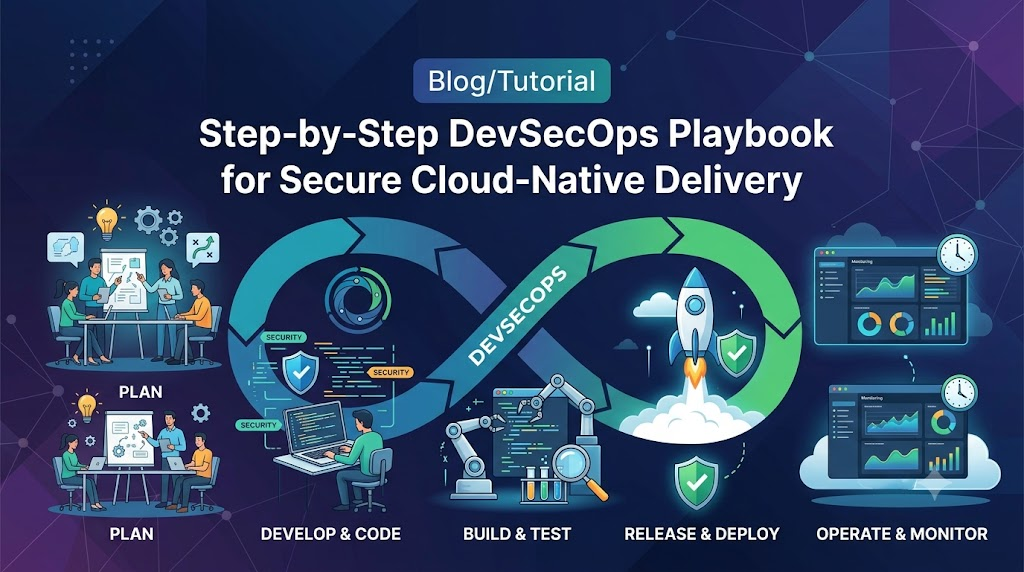
Introduction
Modern software delivery demands unprecedented speed, but traditional security models—acting as late-stage gatekeepers—inevitably create release bottlenecks, developer friction, and unaddressed production risks. Consider a fintech company rushing a major feature update to launch on schedule, only to have a manual audit right before release uncover exposed API keys and vulnerable dependencies, forcing a costly and stressful delay. To break this cycle, organizations must integrate continuous security directly into their engineering workflows using a structured DevSecOps Playbook
. By embedding automated security checks, threat modeling, and shared operational guardrails across every phase of the development lifecycle, teams can transition from reactive firefighting to proactive, automated protection—a cultural and technical shift made seamless through comprehensive learning platforms like DevOpsSchool.
What Is a DevSecOps Playbook?
A DevSecOps Playbook is a comprehensive, operational framework that defines how an organization embeds security practices, tools, and controls into every stage of its software development lifecycle (SDLC). Rather than treating security as an isolated function or an afterthought, the playbook acts as a blueprint that aligns development, security, and operations around a shared operational standard.
       TRADITIONAL SECURITY MODEL (GATEKEEPER)
+-------------+     +-------------+     +-------------------+     +----------+
|  Planning   | --> | Development | --> | Late Security     | --> | Production
|  & Design   |     | & Building  |     | Audit (Bottleneck)|     | Release  |
+-------------+     +-------------+     +-------------------+     +----------+

       DEVSECOPS PLAYBOOK MODEL (CONTINUOUS & EMBEDDED)
+----------------------------------------------------------------------------+
|                            CONTINUOUS SECURITY                             |
|  +------------+    +------------+    +------------+    +------------+      |
|  |  Planning  | -> | Development| -> | Build & CI | -> | Production |      |
|  | & Modeling |    |  & Review  |    |  Pipeline  |    | Monitoring |      |
|  +------------+    +------------+    +------------+    +------------+      |
+----------------------------------------------------------------------------+
Purpose and Strategic Importance
The core purpose of a DevSecOps playbook is to eliminate guesswork. In many organizations, developers are instructed to write secure code, but they lack clear guidelines on what tools to run locally, what compliance policies apply, or how to remediate flagged vulnerabilities.
Conversely, security teams often lack visibility into fast-moving delivery pipelines. A playbook closes this gap by establishing:
- Clear Ownership: Explicitly mapping out which team handles specific security activities at each phase.
- Standardized Tooling: Defining approved scanners, static code analysis rules, and dependency inspection tools.
- Automated Guardrails: Establishing automated checks within pipelines that give developers fast feedback without stopping progress.
- Repeatable Processes: Providing consistent patterns for infrastructure provisioning, secret management, and incident management.
By documenting these standards, a DevSecOps playbook transitions an organization away from reactive firefighting—where vulnerabilities are addressed only after an exploit or audit failure—toward a proactive security posture where risk management is continuous, automated, and measurable.
Why Organizations Need a DevSecOps Strategy
The shift toward modern cloud architectures has altered the corporate attack surface. Monolithic applications hosted in on-premises datacenters are increasingly replaced by microservices running in multi-cloud environments, container orchestrators like Kubernetes, and serverless platforms. While these technologies increase agility, they also introduce architectural complexity.
+-----------------------------------------------------------------+
|               MODERN CLOUD ATTACK SURFACE                      |
+-----------------------------------------------------------------+
| [ Microservices ]  --->  [ API Gateways ] --->  [ Managed DBs ] |
|        |                        |                    |          |
| [ Containers ]     --->  [ IAM Policies ] --->  [ S3 Buckets ]  |
+-----------------------------------------------------------------+
Escalating Cyber Risks and Automated Threats
Modern cyber threats are highly automated. Attackers continuously scan public IP ranges and code repositories for exposed API keys, unpatched container images, and vulnerable open-source libraries. If a developer accidentally commits a credential to a public or internal repository, automated botnets can discover and exploit that secret in minutes. A strategy relying on manual quarterly security reviews cannot defend against automated, round-the-clock attacks.
Enterprise Scale and Regulatory Compliance
Enterprises face stringent regulatory frameworks such as GDPR, HIPAA, PCI-DSS, SOC 2, and ISO 27001. Demonstrating compliance requires providing auditable evidence that software is tested, data is encrypted, access is controlled, and vulnerabilities are tracked and resolved.
Consider a large retail bank updating its digital banking platform. A traditional security audit conducted right before release might require three weeks of manual documentation and penetration testing. If a high-severity vulnerability is discovered, the release is delayed, missing critical market windows.
By applying a DevSecOps strategy, the bank automates security compliance checks directly within the CI/CD pipeline. Every build automatically generates a Bill of Materials (BOM), verifies dependency licenses, runs static security analysis, and verifies infrastructure configurations against CIS Benchmarks. Compliance becomes a natural outcome of the development process rather than a manual audit.
DevSecOps Principles Behind the Playbook
To build a reliable software security program, organizations must base their implementation on core architectural principles.
| Principle | Meaning | Business Impact |
| Shift-Left Security | Moving security activities to the earliest possible phases of the development lifecycle. | Drastically reduces remediation costs and prevents architectural security flaws. |
| Automation-First | Automating security scans, checks, and compliance validations within the deployment pipeline. | Enables rapid software delivery without sacrificing security quality or speed. |
| Shared Responsibility | Treating security as an organizational responsibility shared by Dev, Sec, and Ops teams. | Eliminates cross-team friction, removes operational silos, and accelerates release cycles. |
| Continuous Monitoring | Real-time observability of application behavior, configurations, and runtime environments. | Rapidly identifies active security incidents and reduces mean time to detect and respond. |
| Risk-Based Security | Prioritizing security efforts and fixes based on context, asset sensitivity, and impact. | Focuses engineering resources on high-impact vulnerabilities rather than minor noise. |
| Collaboration | Designing shared workflows, shared tools, and open communications between teams. | Replaces manual approvals with automated feedback loops and trust. |
| Continuous Improvement | Regularly updating security policies, rules, and workflows based on telemetry and post-mortems. | Ensures defense strategies adapt alongside emerging software threat landscapes. |
Understanding the Core Principles
Shift-Left Security
Shift-left means bringing security evaluation into the planning, design, and initial coding phases. Fixing a vulnerability during the design phase (such as identifying a missing authorization check during threat modeling) requires simple design edits. Fixing that same flaw after deployment might require database schema updates, code refactoring, system downtime, and emergency patch deployments.
Automation-First Approach
Manual security processes do not scale alongside modern continuous delivery platforms. If a pipeline deploys code fifty times daily, security checks must execute automatically within that pipeline. Automation ensures that static analysis, dependency scanning, container checks, and policy evaluations run consistently on every commit.
Shared Responsibility
Security cannot sit solely on the shoulders of a isolated security team. Developers write the code, and operations engineers maintain the hosting infrastructure. Therefore, software security must be a shared responsibility. Security teams pivot from acting as gatekeepers to operating as enablers—building tools, policies, and pipelines that allow developers to ship secure software independently.
DevSecOps Lifecycle: From Planning to Production
Implementing DevSecOps requires embedding security practices systematically across all six primary phases of the software development lifecycle.
+---------------------------------------------------------------------------+
|                        DEVSECOPS LIFECYCLE PHASES                         |
+-------------+-------------+-------------+-------------+-------------+-------------+
| Phase 1     | Phase 2     | Phase 3     | Phase 4     | Phase 5     | Phase 6     |
| Planning    | Secure      | Secure      | Pipeline    | Secure      | Production  |
| & Strategy  | Design      | Development | Testing     | Deployment  | Monitoring  |
+-------------+-------------+-------------+-------------+-------------+-------------+
Phase 1: Planning and Security Strategy
Security begins long before developers write code. During the initial planning phase, teams define functional scope alongside clear security requirements.
Threat Modeling and Risk Assessment
Before writing architecture blueprints, engineering and security teams conduct threat modeling exercises. Using frameworks like STRIDE (Spoofing, Tampering, Repudiation, Information Disclosure, Denial of Service, Elevation of Privilege), teams analyze system boundaries, data flows, and potential attacker paths.
+-----------------------------------------------------------------+
|                   STRIDE THREAT MODELING                        |
+-----------------------------------------------------------------+
| [S]poofing          --> Impersonating something or someone      |
| [T]ampering         --> Modifying code or data                  |
| [R]epudiation       --> Claiming you didn't perform an action   |
| [I]nformation Disc. --> Exposing sensitive information          |
| [D]enial of Service --> Degrading application availability      |
| [E]levation of Priv.--> Gaining unauthorized permissions        |
+-----------------------------------------------------------------+
Defining Security User Stories
Security requirements are converted into actionable user stories directly within product backlogs. Examples include:
- “As an API developer, I must enforce rate limiting on the login endpoint to prevent brute-force attacks.”
- “As a platform engineer, I must ensure all database connections use TLS 1.3 encryption in transit.”
Compliance Planning
Organizations establish compliance benchmarks during planning. This involves mapping regulatory mandates (e.g., storing personal data locally, encrypting health records) directly into initial technical acceptance criteria.
Phase 2: Secure Application Design
Secure architecture ensures that applications remain resilient even if individual components are compromised.
                         SECURE DESIGN PATTERNS
+-------------------+     +---------------------+     +--------------------+
|  Identity (IAM)   | --> | Zero-Trust Network  | --> | Data Encryption    |
| Least Privilege   |     | Microsegmentation   |     | At-Rest & In-Transit|
+-------------------+     +---------------------+     +--------------------+
Zero-Trust Architecture
Modern cloud architectures operate under a Zero-Trust framework: never trust, always verify. Every service-to-service communication must be explicitly authenticated and authorized, regardless of whether the traffic originates inside or outside the network perimeter.
Least Privilege Access
Identity and Access Management (IAM) policies must enforce the principle of least privilege. Services are granted only the minimum permissions required to execute their specific task. For example, a web application container requiring access to read user images should only hold read permissions for a specific storage bucket, rather than full administrative cloud privileges.
Data Protection Strategies
Secure design mandates robust encryption protocols:
- Encryption in Transit: Enforcing TLS 1.3 across all internal and external communication routes.
- Encryption at Rest: Utilizing AES-256 encryption for managed databases, object storage, and block volumes using customer-managed KMS keys.
Phase 3: Secure Development Practices
The developer desktop is the first line of defense. Equipping developers with the right security tools and IDE extensions prevents vulnerabilities from entering source control.
Secure Coding Standards
Organizations maintain clear, language-specific coding standards (e.g., OWASP Top 10 mitigation guidelines). Developers learn to avoid common pitfalls such as raw SQL queries prone to SQL injection, unvalidated redirects, and improper error-handling routines that expose stack traces to end-users.
IDE Security Plugins and Pre-Commit Hooks
Developers install security plugins within integrated development environments (IDEs) like VS Code or IntelliJ. Tools such as SonarLint or Snyk scan code as it is typed, highlighting vulnerable functions and recommending secure syntax alternatives. Additionally, Git pre-commit hooks run locally to block commits containing sensitive strings, private keys, or API tokens.
Secret Management
Hardcoding database passwords, API keys, or certificates into source code repositories is a severe vulnerability risk. DevSecOps workflows require externalized secret management solutions such as HashiCorp Vault, AWS Secrets Manager, or Azure Key Vault. Applications retrieve credentials at runtime using secure environment variables or identity tokens.
Phase 4: Security Testing in CI/CD Pipeline
The continuous integration pipeline serves as an automated security gate. Every code commit triggers automated security tests that analyze the application from multiple perspectives.
                     CI/CD PIPELINE SECURITY FLOW
+--------+     +--------+     +--------+     +--------+     +----------+
| Commit | --> | SAST   | --> | SCA    | --> | DAST   | --> | Deployment|
| Code   |     | Scan   |     | Check  |     | Scan   |     | Gate     |
+--------+     +--------+     +--------+     +--------+     +----------+
Static Application Security Testing (SAST)
SAST tools analyze source code from the inside out without executing the application. They parse source code to identify structural defects, insecure API usage, and input validation vulnerabilities.
Software Composition Analysis (SCA)
Modern applications consist largely of open-source libraries and third-party dependencies. SCA tools inspect package manager manifests (e.g., package.json, pom.xml, requirements.txt) against known vulnerability databases (such as the NVD). SCA identifies outdated, vulnerable, or improperly licensed components.
Dynamic Application Security Testing (DAST)
While SAST scans static source code, DAST tests the running application from an external point of view. DAST scanners simulate real-world attacks against deployed web endpoints, attempting cross-site scripting (XSS), header manipulation, and parameter injection to discover runtime vulnerabilities.
CI/CD Security Workflow
[ Developer Commits Code ]
          │
          ▼
[ Trigger CI Build Pipeline ]
          │
          ▼
[ Run SAST & SCA Scans ]
          │
    ┌─────┴─────┐
    │ High/Crit │
    │ Security  │
    │ Flaws?    │
    └─────┬─────┘
       YES│           │NO
          ▼           ▼
   [ Fail Build &  [ Deploy to Staging ]
     Notify Dev ]     │
                      ▼
               [ Run DAST Scans ]
                      │
                ┌─────┴─────┐
                │ Critical  │
                │ Runtime   │
                │ Vulnerab.?│
                └─────┬─────┘
                   YES│           │NO
                      ▼           ▼
               [ Block Deployment ] [ Promote to Production ]
Phase 5: Secure Deployment
Once software passes pipeline checks, it must be deployed into host infrastructure securely and predictably.
                      SECURE DEPLOYMENT LAYERS
+-------------------------------------------------------------------+
| Infrastructure as Code (IaC) Scanning (Terraform / CloudFormation) |
+-------------------------------------------------------------------+
| Container Security & Image Signing (Cosign / Trivy)               |
+-------------------------------------------------------------------+
| Kubernetes Admission Controllers (OPA Gatekeeper / Kyverno)        |
+-------------------------------------------------------------------+
Infrastructure as Code (IaC) Security
Modern infrastructure is defined through code files using tools like Terraform, CloudFormation, or Ansible. IaC security scanners analyze infrastructure templates before deployment, flagging misconfigurations such as publicly accessible S3 storage buckets, overly permissive Security Group ingress rules, or disabled encryption settings.
Container and Kubernetes Security
For containerized applications, security teams enforce strict base image standards. Container images are scanned for OS-level vulnerabilities, stripped of unnecessary debugging utilities, and signed using digital signature tools like Cosign. Within Kubernetes clusters, admission controllers (e.g., OPA Gatekeeper, Kyverno) enforce policies that prevent root containers, enforce read-only root filesystems, and restrict capabilities.
Phase 6: Production Monitoring and Response
Security responsibilities continue long after deployment. Production environments require continuous monitoring to detect anomalies, dynamic threats, and unauthorized configuration drift.
Observability, Centralized Logging, and SIEM
Applications, servers, container platforms, and cloud infrastructure stream operational logs into centralized Security Information and Event Management (SIEM) systems. Correlation engines analyze millions of daily log lines, alerting security operations centers (SOC) to suspicious activities—such as rapid login failures, unauthorized IAM API calls, or abnormal data transfer volumes.
Runtime Application Self-Protection (RASP) and eBPF
Modern runtime security leverages eBPF (Extended Berkeley Packet Filter) and RASP engines embedded within application environments. These systems observe process executions, system calls, and network connections in real time, automatically blocking malicious behaviors like remote code execution attempts as they occur.
DevSecOps Tools and Technologies
Building an effective DevSecOps architecture requires selecting tools that integrate smoothly into existing engineering workflows.
| Category | Purpose | Example Tools | Example Usage |
| Source Control | Manages codebase history and controls code access. | GitHub Enterprise, GitLab, Bitbucket | Enforcing branch protection rules and requiring security reviews before merging pull requests. |
| CI/CD Security | Automates security checks within build engines. | Jenkins, GitLab CI, GitHub Actions | Triggering automated SAST, SCA, and container security scans on every pull request. |
| Code Analysis (SAST) | Scans static source code for security flaws. | SonarQube, Checkmarx, Veracode | Identifying SQL injection risks and insecure code paths before code is compiled. |
| Dependency Analysis (SCA) | Identifies vulnerable third-party dependencies. | Snyk, OWASP Dependency-Check, Black Duck | Blocking builds that incorporate open-source components with known critical CVEs. |
| Dynamic Analysis (DAST) | Tests running application endpoints externally. | OWASP ZAP, Burp Suite Enterprise | Simulating web application attacks against staging environments to find runtime flaws. |
| Container Security | Scans container images for OS flaws and misconfigurations. | Trivy, Clair, Aqua Security | Preventing container deployment if vulnerable system libraries are present in the base image. |
| IaC Security | Validates cloud infrastructure configuration files. | Checkov, tfsec, Kubeaudit | Scanning Terraform code to detect unencrypted storage volumes before cloud creation. |
| Secrets Management | Secures and centralizes sensitive system credentials. | HashiCorp Vault, AWS Secrets Manager | Injecting runtime API credentials directly into applications without saving them to disk. |
| Monitoring & SIEM | Monitors operational logs and detects active incidents. | Datadog Security, Splunk, Elastic SIEM | Correlating application logs to identify and alert on credential-stuffing attacks. |
| Compliance Automation | Automates regulatory compliance auditing. | Chef InSpec, OpenSCAP, Prisma Cloud | Continuously auditing AWS cloud environments against CIS Benchmarks and SOC 2 controls. |
Building a DevSecOps CI/CD Pipeline
To make a DevSecOps playbook operational, organizations convert theoretical guidelines into an automated build pipeline.
                           DEVSECOPS PIPELINE
+-------------+     +-------------+     +-------------+     +-------------+
| Source      | --> | Build &     | --> | Security    | --> | Gated       |
| Security    |     | Test        |     | Scans       |     | Deployment  |
+-------------+     +-------------+     +-------------+     +-------------+
Stage 1: Source Code Management Gate
- Developer creates a feature branch and writes code locally.
- Pre-commit hooks run secret detection tools (e.g., GitGuardian, Trufflehog) to verify no tokens or API keys are committed.
- Code is pushed to the central repository; a Pull Request (PR) is opened.
Stage 2: Automated Build and Static Analysis
- The CI engine (e.g., GitHub Actions, GitLab CI, Jenkins) initiates a build job.
- SAST tools scan modified files. If high-severity flaws are found, inline code comments highlight the exact lines requiring remediation.
- SCA tools analyze package dependencies, verifying licenses and checking vulnerability feeds.
Stage 3: Image Creation and IaC Inspection
- The application is compiled and packaged into a container image.
- Container security scanners inspect image layers for vulnerable OS packages.
- IaC security tools scan deployment manifests (Helm charts, Terraform) to verify security configurations.
Stage 4: Staging Deployment and Dynamic Testing
- The signed image is deployed to an isolated staging environment.
- Automated DAST scanners execute web security tests against active endpoints.
- API security scanners test endpoint authentication and input validation.
Stage 5: Policy Enforcement and Deployment Approval
- An automated policy gate checks overall test results against defined security thresholds (e.g., zero Critical or High CVEs permitted).
- If all policies pass, the image is digitally signed and approved for release.
- Automated continuous deployment tools deploy the workload to production zero-downtime environments.
DevSecOps Roles and Responsibilities
DevSecOps replaces traditional operational silos with shared accountability. Defining roles prevents confusion during daily operations and incident responses.
                    SHARED RESPONSIBILITY MODEL
+-------------------------------------------------------------------+
| Developers      --> Write secure code, remediate SAST findings    |
| DevOps          --> Maintain CI/CD pipelines, automate infrastructure |
| Security Engineers--> Set security policies, analyze threat models  |
| SRE             --> Maintain system availability, lead incidents  |
+-------------------------------------------------------------------+
| Role | Core Responsibilities in DevSecOps |
| Developer | Writes secure code according to team guidelines, fixes code flaws flagged by SAST/SCA tools, and manages secrets responsibly using Vault integrations. |
| DevOps Engineer | Builds, maintains, and optimizes automation pipelines, manages IaC scripts, embeds security scanners into CI/CD jobs, and ensures infrastructure reliability. |
| Security Engineer | Conducts threat modeling exercises, selects enterprise security tools, defines policies and quality gates, and supports developers with complex remediation advice. |
| DevSecOps Engineer | Bridges engineering and security domains by building custom security integrations, maintaining automated scanning tooling, and refining operational security automation. |
| Site Reliability Engineer (SRE) | Focuses on production resilience, uptime, incident response automation, runtime monitoring, and ensuring security controls do not degrade performance. |
| Cloud Architect | Designs secure multi-cloud environments, configures enterprise IAM structures, ensures microservice communication privacy, and guides Zero-Trust architectures. |
| Engineering Manager | Allocates engineering bandwidth for security remediation, tracks vulnerability debt metrics, fosters cross-team communication, and drives security culture. |
DevSecOps Implementation Roadmap
Transitioning an enterprise to DevSecOps requires a phased implementation strategy rather than a single enterprise-wide overhaul.
                    DEVSECOPS IMPLEMENTATION ROADMAP
+------------+    +------------+    +------------+    +------------+    +------------+
| Step 1     | -> | Step 2     | -> | Step 3     | -> | Step 4     | -> | Step 5     |
| Assess     |    | Define     |    | Cross-Func |    | Automate   |    | Measure &  |
| Maturity   |    | Goals      |    | Teams      |    | Scans      |    | Scale      |
+------------+    +------------+    +------------+    +------------+    +------------+
Step 1: Assess Current Security Maturity
Evaluate existing organizational workflows, current tool integrations, existing security skills, and pain points. Identify where security checks are currently performed and quantify past release delays caused by late-stage audits.
Step 2: Define Clear DevSecOps Goals
Establish clear, achievable objectives. Avoid setting vague goals like “make the software secure.” Instead, define precise metrics, such as: “Automate dependency scanning on 100% of core repositories and reduce critical vulnerability remediation time to under 48 hours within six months.”
Step 3: Build Cross-Functional Security Champions
Establish a Security Champions network. Train selected developers within each engineering team to serve as localized security advisors. Security Champions help conduct peer code reviews, champion threat modeling, and act as a link between security teams and product developers.
Step 4: Automate Security Practices incrementally
Begin integrating automated security tooling gradually:
- Month 1: Add secret detection pre-commit hooks and central secret management.
- Month 2: Introduce dependency (SCA) and static code (SAST) scanning into CI pipelines in non-blocking/informational mode to avoid disrupting developers.
- Month 3: Define strict policy gates that automatically block builds containing newly introduced Critical vulnerabilities.
- Month 4: Introduce IaC and container security checks.
Step 5: Measure Progress and Refine
Track operational metrics like mean time to remediate (MTTR), pipeline execution speeds, and scan accuracy. Use these data points to refine pipeline performance and reduce developer friction.
Step 6: Continuously Improve Culture
Provide ongoing secure coding education, conduct blameless post-mortems following security incidents, and update security guidelines continuously to defend against emerging software threats.
DevSecOps Maturity Model
Organizations progress through distinct capability stages as their DevSecOps practices mature.
| Maturity Level | Organization Capability | Security Practice Characteristics |
| Level 1: Initial | Reactive and Ad-Hoc | Security testing is entirely manual and performed right before production releases. No automated scanning exists in pipelines. Vulnerability management is ad-hoc. |
| Level 2: Developing | Basic Scanning | Basic SAST or dependency scanners are added to select CI pipelines. Security findings are reported manually via ticket tracking systems, but friction remains high. |
| Level 3: Defined | Standardized Integration | Standard security tools run across all engineering pipelines. Quality gates block insecure builds automatically. Basic IaC scanning and secret management are enforced. |
| Level 4: Managed | Metric-Driven & Continuous | Security operations are fully automated. Vulnerabilities are tracked via centralized dashboards with strict MTTR SLAs. Container environments run runtime security controls. |
| Level 5: Optimized | Proactive & Self-Healing | Security is an intuitive part of team culture. Automated remediation, real-time threat intelligence feeds, runtime application protection, and continuous policy tuning are standard. |
Common DevSecOps Challenges and Solutions
Transitioning to DevSecOps involves overcoming operational, technical, and cultural obstacles.
                    CHALLENGE AND SOLUTION MATRIX
+--------------------------+-----------------------------------+
| Challenge                | Practical Solution                |
+--------------------------+-----------------------------------+
| Security Team Resistance | Involve security in early design  |
| Developer Tool Fatigue   | Consolidate tools into single IDE |
| High False Positive Rate | Fine-tune rulesets continually    |
| Pipeline Speed Lag       | Run heavy scans asynchronously    |
| Security Skill Shortages | Upskill existing dev & ops teams  |
+--------------------------+-----------------------------------+
Security Team Resistance
- The Challenge: Traditional security professionals may worry that automated pipelines reduce control or miss nuanced vulnerability scenarios.
- The Solution: Involve security engineers early when defining pipeline automation rules. Empower them to write automated policy rules using engines like OPA (Open Policy Agent), shifting their role from manual auditors to platform security designers.
Developer Adoption Issues and Alert Fatigue
- The Challenge: Scanners that flag thousands of low-priority issues or produce high numbers of false positives overwhelm developers, leading them to ignore security alerts entirely.
- The Solution: Fine-tune scanning tools aggressively. Filter out low-severity or irrecoverable alerts initially, focusing developer attention exclusively on actionable, High and Critical findings within their IDE or native Git PR interfaces.
Pipeline Performance Bottlenecks
- The Challenge: Comprehensive security scans can slow down build times from minutes to hours, frustrating engineering teams.
- The Solution: Optimize scan execution strategies. Run lightweight, fast SAST and secret checks inline on pull requests. Move time-intensive DAST or full-code SAST scans to asynchronous, nightly build pipelines.
DevSecOps Best Practices Checklist
Use this practical checklist to ensure key security controls are active across your software lifecycle.
Planning & Architecture
- Conduct STRIDE threat modeling for new application architectures.
- Define explicit security acceptance criteria in product user stories.
- Document data classification levels and regional regulatory requirements.
Development & Code Management
- Install Git pre-commit hooks to block local credential commits.
- Externalize all application credentials to a secure Secret Manager.
- Enforce protected Git branches requiring code reviews and passing builds before merging.
Build & CI/CD Pipeline
- Execute SAST scanners on every code pull request.
- Run SCA dependency inspections to track open-source vulnerabilities.
- Scan IaC templates and container images before build approval.
- Enforce automated security policy gates for staging deployments.
Deployment & Runtime Operations
- Digitally sign container images and enforce validation upon Kubernetes cluster entry.
- Apply least-privilege IAM policies to cloud workloads.
- Aggregate application, container, and cloud audit logs into a central SIEM platform.
- Establish an incident response playbook with automated alert routing.
Real-World Example: DevSecOps from Planning to Production
To understand how a DevSecOps Playbook operates in practice, consider the end-to-end journey of a health-tech enterprise launching a cloud-native Patient Portal Service.
                  REAL-WORLD WORKFLOW: PATIENT PORTAL
+-----------------+     +-----------------+     +-----------------+
| Threat Modeling | --> | Pre-Commit /    | --> | Automated CI    |
| & Requirements  |     | IDE Checks      |     | Security Scans  |
+-----------------+     +-----------------+     +-----------------+
                                                         |
+-----------------+     +-----------------+              |
| Production      | <-- | IaC & Container | <------------+
| Monitoring      |     | Validation      |
+-----------------+     +-----------------+
Step 1: Secure Planning
The project begins with a threat modeling workshop. The team identifies potential risks surrounding sensitive patient data storage (HIPAA compliance). They establish rules requiring TLS 1.3 encryption for data in transit, AES-256 for data at rest, and strict OAuth2 authentication.
Step 2: Secure Development
A developer writes a new API endpoint handling patient health records. The developer’s IDE runs a security plugin that flags an unvalidated parameter input, suggesting a sanitized function alternative. When committing the code, a pre-commit hook verifies that no API tokens were left inside configuration files.
Step 3: CI/CD Pipeline Execution
The pull request triggers an automated build pipeline. The SAST tool analyzes the code changes in under two minutes, while the SCA tool scans NPM libraries, discovering a critical vulnerability in an outdated HTTP parsing library. The pipeline fails automatically, posting a notification into the developer’s pull request with instructions to update the library version.
Step 4: Vulnerability Remediation and Staging
The developer updates the dependency and pushes the update. Pipeline security checks pass. The application is compiled, packaged into a signed container image, and deployed to an isolated staging environment. An automated DAST scanner runs targeted security tests against the live staging API, verifying access controls work as expected.
Step 5: Secure Production Deployment
The infrastructure is deployed using Terraform. IaC scanners verify that the cloud storage bucket housing patient records is private, encrypted, and monitored. Kubernetes admission controllers verify the container image’s digital signature and enforce execution without root access. The deployment completes without downtime.
Step 6: Continuous Runtime Monitoring
In production, centralized logging engines track API access events. Runtime security agents monitor system calls made by the application container. If unusual data extraction attempts occur, security monitors trigger real-time alerts to the on-call SRE and security teams, while automated firewall policies throttle the suspicious traffic.
Measuring DevSecOps Success
A successful DevSecOps implementation should produce measurable security and operational improvements over time.
| Metric | Why It Matters | Target Direction |
| Vulnerability Detection Time | Measures how early in the SDLC security issues are identified. | Decrease: Shift testing left to identify defects during early coding phases. |
| Mean Time to Remediate (MTTR) | Tracks the time required to fix identified security vulnerabilities. | Decrease: Address critical flaws in hours rather than months. |
| Security Automation Coverage | Calculates the percentage of software pipelines running automated security checks. | Increase: Aim for 100% automated scan coverage across all repositories. |
| Deployment Frequency | Measures how often code changes are safely released to production. | Increase: Release smaller code increments safely and frequently. |
| False Positive Rate | Tracks the accuracy of automated security alerts generated by scanners. | Decrease: Continually refine scanning rules to maintain developer trust. |
| Compliance Audit Readiness | Measures the time and effort required to collect security audit evidence. | Decrease: Achieve near-zero preparation time via continuous policy checks. |
| Failed Deployment Rate | Tracks the percentage of releases rolled back due to security or stability issues. | Decrease: Block flawed builds earlier in the pipeline using quality gates. |
How DevOpsSchool Helps Professionals Learn DevSecOps
Building real-world DevSecOps capability requires practical skill development and hands-on experience with production-grade tools. Leading educational ecosystems like DevOpsSchool play a vital role in upskilling engineers and technology leaders.
DevOpsSchool provides structured, industry-aligned learning paths designed to bridge the gap between theoretical knowledge and enterprise execution. Their DevSecOps training programs focus on practical, real-world implementations, including:
- Hands-on Tooling Mastery: Deep dives into configuring enterprise security tools such as SonarQube, Snyk, Trivy, HashiCorp Vault, Checkov, OWASP ZAP, and Aqua Security within real CI/CD environments.
- Pipeline Integration: Practical guidance on constructing end-to-end secure pipelines using GitHub Actions, GitLab CI, Jenkins, and Kubernetes platforms.
- Cloud-Native Security: Real-world training covering IaC security, container image hardening, service mesh security, and Kubernetes admission controllers.
- Industry Mentorship: Guidance from senior practitioners with decades of experience leading DevSecOps transformations in enterprise environments.
Whether you are a developer looking to understand secure coding practices, a DevOps engineer implementing automated pipeline gates, or a technology leader driving enterprise security transformations, structured platforms like DevOpsSchool offer the roadmap needed to build modern security engineering skills.
Future Trends in DevSecOps
As modern applications evolve, DevSecOps practices continue to adapt to new technologies and architectural paradigms.
                        FUTURE DEVSECOPS TRENDS
+-------------------------------------------------------------------+
| AI-Driven Vulnerability Remediation & Contextual Alerting        |
+-------------------------------------------------------------------+
| Continuous Compliance Automation & Real-Time Auditing            |
+-------------------------------------------------------------------+
| Internal Developer Platforms (Platform Engineering Integration)  |
+-------------------------------------------------------------------+
| eBPF-Powered Deep System Observability and Security               |
+-------------------------------------------------------------------+
AI-Powered Security Automation
Artificial intelligence is changing security analysis. Machine learning models now provide intelligent contextual triage, filtering out false positives by determining whether vulnerable code paths are actually reachable at runtime. Furthermore, AI tools generate automated pull requests that offer ready-to-merge fix code for identified vulnerabilities.
Platform Engineering Integration
DevSecOps is increasingly merging with Platform Engineering. Dedicated platform teams build Internal Developer Platforms (IDPs) that embed security tools, compliance configurations, and infrastructure blueprints directly into self-service portals. Developers can provision secure, compliant infrastructure without configuring complex security settings manually.
eBPF and Kernel-Level Observability
Extended Berkeley Packet Filter (eBPF) technology allows security teams to achieve deep visibility into Linux kernel operations without modifying application code or adding heavy sidecar containers. This enables real-time runtime monitoring, network microsegmentation tracking, and threat detection with minimal operational performance overhead.
FAQs (Frequently Asked Questions)
1. What is a DevSecOps Playbook?
A DevSecOps Playbook is an operational guide that defines how an organization embeds security practices, tools, and processes into every phase of the software development lifecycle, from initial planning to production monitoring.
2. How does DevSecOps differ from traditional DevOps?
Traditional DevOps focuses primarily on speeding up software delivery through continuous integration and deployment. DevSecOps incorporates security directly into this process, ensuring that security testing and compliance checks are automated alongside traditional build and deployment workflows.
3. Why is shifting security left important?
Shifting left moves security evaluations to early development phases. Finding and fixing flaws early—such as during design or code construction—is faster, less expensive, and prevents security flaws from reaching production environments.
4. What are the core phases of the DevSecOps lifecycle?
The DevSecOps lifecycle includes six core phases: Security Planning & Strategy, Secure Design, Secure Development, CI/CD Security Testing, Secure Deployment, and Production Monitoring & Response.
5. What is the difference between SAST and DAST?
SAST (Static Application Security Testing) analyzes source code from the inside out without running the application. DAST (Dynamic Application Security Testing) evaluates a running application from an external perspective, testing endpoints against real-world attack vectors.
6. What is Software Composition Analysis (SCA)?
SCA tools inspect an application’s codebase to identify open-source libraries, third-party dependencies, and public modules. SCA flags known vulnerabilities (CVEs) and licensing compliance issues present in imported code.
7. How does DevSecOps address secret management?
DevSecOps eliminates hardcoded secrets in code repositories by utilizing centralized secret management systems (like HashiCorp Vault or AWS Secrets Manager). Applications fetch credentials dynamically at runtime using secure identity controls.
8. Is DevSecOps only the responsibility of security teams?
No. DevSecOps relies on a shared responsibility model. Developers, DevOps engineers, platform teams, SREs, and security specialists collaborate to maintain security standards across the entire delivery pipeline.
9. How do automated security gates work in CI/CD pipelines?
Security gates are programmatic checks embedded in deployment pipelines. They evaluate scan results against organizational risk policies (e.g., zero Critical CVEs permitted) and automatically stop builds or deployments if policies are violated.
10. What is Infrastructure as Code (IaC) security?
IaC security involves scanning automation templates (such as Terraform or CloudFormation files) before provisioning infrastructure to identify misconfigurations like exposed storage buckets or open firewall ports.
11. What is the role of a Security Champion?
A Security Champion is a developer or engineer embedded within a product delivery team who receives extra security training. They advocate for secure coding practices, assist with threat modeling, and serve as a liaison to the central security team.
12. How do false positives impact DevSecOps adoption?
High numbers of false positives lead to alert fatigue, causing developers to lose trust in security tools and ignore notifications. Fine-tuning scanning rules to focus strictly on relevant, high-severity findings is critical for adoption.
13. What metrics track DevSecOps success?
Key operational metrics include Mean Time to Remediate (MTTR), vulnerability detection timing, deployment frequency, pipeline automation coverage, false positive rates, and audit preparation times.
14. How can small engineering teams begin implementing DevSecOps?
Small teams can start simple: add local secret detection pre-commit hooks, centralize application credentials in a secret manager, enable automated dependency scanning in source control repositories, and gradually introduce static code analysis into pipelines.
15. What technical skills are necessary for a DevSecOps Engineer?
Key skills include proficiency with continuous integration engines (GitHub Actions, GitLab CI, Jenkins), container and orchestration tools (Docker, Kubernetes), IaC platforms (Terraform), secure coding practices, cloud security architectures, and hands-on experience with security scanning tools (SAST, SCA, DAST).
Final Thoughts
Transitioning to DevSecOps is an essential evolution for modern technology organizations. As cloud architectures increase in complexity and software update frequencies accelerate, traditional security approaches can no longer keep pace with development teams. Implementing a DevSecOps Playbook is not about adding more security tools or placing additional administrative hurdles in front of developers. It is about building a modern engineering culture grounded in automation, shared accountability, and continuous improvement. By integrating threat modeling during planning, adding automated security checks to delivery pipelines, hardening runtime platforms, and prioritizing developer enablement, organizations build resilient, secure platforms that support rapid business innovation. Building modern security operational capabilities requires patience, leadership commitment, clear frameworks, and ongoing skill development. With a structured operational strategy and the right educational foundation, engineering teams can successfully bridge the gap between delivery speed and enterprise security—delivering reliable, high-quality software to users safely and efficiently.
