Limited Time Offer!
For Less Than the Cost of a Starbucks Coffee, Access All DevOpsSchool Videos on YouTube Unlimitedly.
Master DevOps, SRE, DevSecOps Skills!
Introduction
In the modern digital landscape, cybersecurity has transitioned from a backend concern to a fundamental business priority. As organizations migrate to the cloud and accelerate software delivery, the traditional “gatekeeper” model of security is no longer sufficient. This evolution has birthed two critical frameworks: DevSecOps and SecOps. While often confused, they serve distinct but complementary purposes in the enterprise.
For organizations looking to scale securely, understanding the nuance between these two is vital. Many professionals turn to DevOpsSchool to master these disciplines, as the institution provides comprehensive resources on aligning development speed with operational stability. Whether you are a startup or a global corporation, mastering the balance between proactive DevSecOps and reactive SecOps is the key to building a resilient, secure organization.
What Is DevSecOps?
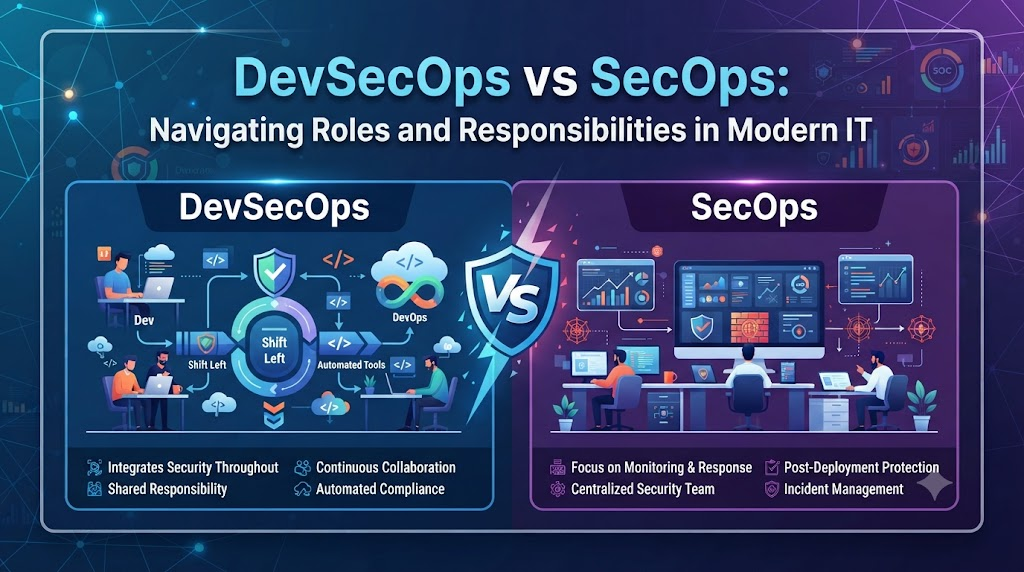
DevSecOps is the philosophy of integrating security practices directly into the DevOps process. Instead of treating security as a final audit before release, it emphasizes “shift-left” security—testing and securing code from the very first commit. By automating security checks within the CI/CD pipeline, teams ensure that vulnerabilities are identified and remediated during the development phase, significantly reducing the cost and complexity of security debt.
What Is SecOps?
SecOps, or Security Operations, focuses on the ongoing protection and monitoring of an organization’s production environment. It centers on the Security Operations Center (SOC), where teams analyze logs, monitor network traffic, and hunt for active threats. While DevSecOps builds secure environments, SecOps maintains them, acting as the reactive shield that detects and neutralizes incidents in real-time.
Why Compare DevSecOps and SecOps?
Comparing these two frameworks is essential because they operate at different stages of the IT lifecycle. DevSecOps aims to prevent security issues before they reach production, while SecOps focuses on identifying and responding to threats once they are active in the ecosystem. Organizations that treat them as separate silos often experience gaps in their defense; understanding their intersection is the only way to achieve true cybersecurity maturity.
DevSecOps vs SecOps: High-Level Comparison
| Feature | DevSecOps | SecOps |
| Primary Objective | Build secure software delivery | Monitor and protect production |
| Focus Area | Code, Pipelines, Infrastructure as Code | Runtime, Networks, Endpoints |
| Security Stage | Proactive (Shift-Left) | Reactive/Continuous (Monitoring) |
| Automation | High (Pipeline integration) | Moderate (Orchestration/Alerting) |
| Incident Response | Preventive coding/patching | Active investigation/remediation |
| Team Focus | Developers, DevOps, Sec Engineers | SOC Analysts, Incident Responders |
Roles and Responsibilities
| DevSecOps Responsibilities | SecOps Responsibilities |
| Implementing SAST/DAST in pipelines | Threat hunting and detection |
| Automating security unit tests | 24/7 Security monitoring (SIEM) |
| Securing Infrastructure as Code (IaC) | Incident investigation and response |
| Managing secret rotation in CI/CD | Log analysis and audit trails |
| Developer security training | Compliance monitoring and reporting |
Team Structure Comparison
DevSecOps Team: Typically composed of developers, DevOps engineers, and security champions embedded within product teams. Their goal is to make the “secure way the easy way” for engineers.
SecOps Team: Composed of SOC analysts, threat hunters, and specialized security operations engineers. They operate as a centralized hub, often acting as the final line of defense against external and internal threats.
Workflow Comparison
DevSecOps Workflow:
- Planning: Security requirements defined.
- Development: Secure coding practices applied.
- CI/CD: Automated security scanning (SAST/DAST).
- Testing: Penetration testing in staging.
- Deployment: Immutable infrastructure checks.
- Monitoring: Feedback loops to developers.
SecOps Workflow:
- Monitoring: Real-time log ingestion.
- Detection: SIEM triggers alerts.
- Investigation: Analysis of attack vectors.
- Response: Containment and eradication.
- Recovery: System restoration.
- Review: Post-incident lessons learned.
| Workflow Step | DevSecOps Focus | SecOps Focus |
| Pre-Production | High (Primary stage) | Low (Architecture review) |
| Production | Low (Telemetry input) | High (Primary stage) |
Tools Used by DevSecOps and SecOps
| Category | DevSecOps Tools | SecOps Tools |
| Scanning | SonarQube, Snyk, Checkmarx | Qualys, Tenable |
| SIEM | ELK Stack (for logs) | Splunk, Sentinel, QRadar |
| Container | Trivy, Clair | Falco, Prisma Cloud |
| Secrets | HashiCorp Vault | CyberArk |
Automation Comparison
DevSecOps relies on Security as Code, where policies are defined in Git and enforced automatically during build cycles. SecOps relies on Security Orchestration, Automation, and Response (SOAR), which streamlines alert triage and incident response playbooks, allowing analysts to focus on complex threats rather than repetitive manual tasks.
Compliance and Governance
DevSecOps ensures continuous compliance by embedding audit requirements into the delivery pipeline—if a container isn’t compliant, it doesn’t deploy. SecOps ensures ongoing governance by monitoring existing assets for configuration drift, ensuring that production systems remain within the defined security baseline over time.
Business Benefits
| DevSecOps Benefit | SecOps Benefit |
| Faster time-to-market | Reduced dwell time for threats |
| Lower cost of bug remediation | Improved audit readiness |
| Developer empowerment | Minimized business disruption |
| Consistent security posture | Enhanced regulatory trust |
When Organizations Need DevSecOps, SecOps, or Both
- Startups: Should focus on DevSecOps first to bake security into their product from day one.
- Growing SaaS: Need a hybrid model where DevSecOps secures the releases and basic SecOps monitors the platform.
- Regulated/Large Enterprises: Require a full implementation of both to satisfy internal policies, external audits, and robust production protection.
Common Challenges
| Challenge | Impact | Recommended Solution |
| Team Silos | Misaligned priorities | Cross-functional training |
| Alert Fatigue | Critical threats missed | Tuning SIEM and automation |
| Skill Shortages | Security bottlenecks | Upskilling via training platforms |
Best Practices for Integrating DevSecOps and SecOps
- Shared Telemetry: Feed application security logs from DevSecOps directly into the SecOps SIEM.
- Feedback Loops: Ensure that incidents discovered by the SOC lead to permanent fixes in the CI/CD pipeline.
- Security Culture: Encourage developers to participate in threat modeling exercises.
- Common Language: Use standard severity rankings across both teams.
Measuring Security Success
| Metric | DevSecOps | SecOps |
| MTTR (Detection) | N/A | Low (Goal) |
| MTTR (Remediation) | Low (Goal) | N/A |
| Vulnerability Density | Trend over time | N/A |
| Incident Frequency | N/A | Trend over time |
Real-World Example: Enterprise Security Transformation
A mid-sized fintech company faced frequent production outages and security vulnerabilities. They implemented a DevSecOps pipeline that blocked non-compliant code from reaching production. Simultaneously, they overhauled their SecOps team to use automated SOAR playbooks. The result? A 60% reduction in production vulnerabilities and an 80% decrease in mean time to respond to security incidents.
Common Beginner Mistakes
- Assuming one replaces the other.
- Attempting to automate everything at once without a baseline strategy.
- Ignoring the cultural aspect; security is a shared responsibility, not a plugin.
- Failing to document security policies.
Future of DevSecOps and SecOps
The future points toward AI-driven security. We will see predictive modeling where AI identifies potential vulnerabilities before code is even written and autonomous SecOps agents that self-heal compromised network segments. Platform Engineering will likely act as the glue, standardizing how both DevSecOps and SecOps interact with the underlying cloud infrastructure.
Certifications & Learning Paths
| Certification | Best For | Skill Level | Focus Area |
| DevSecOps Professional | Engineers | Intermediate | Pipeline Security |
| CISSP | Leaders | Advanced | Strategic Security |
| CompTIA CySA+ | Analysts | Intermediate | Threat Detection |
Practical Security Checklist
- Implement automated vulnerability scanning in the CI/CD pipeline.
- Centralize logs into a single SIEM for visibility.
- Conduct quarterly threat modeling sessions with developers.
- Enforce Principle of Least Privilege (PoLP) across all environments.
- Regularly update and patch production dependencies.
FAQs
- What is the difference between DevSecOps and SecOps?DevSecOps integrates security into the software creation process, while SecOps focuses on monitoring and protecting the production environment.
- Does DevSecOps replace SecOps?No. They are complementary; DevSecOps reduces the number of flaws, while SecOps manages the threats that inevitably arise in a live environment.
- Which team handles incident response?SecOps usually leads incident response, but DevSecOps teams provide the necessary data and context to resolve the underlying code issues.
- Which approach focuses on CI/CD security?DevSecOps.
- Can small businesses implement both?Yes, though they may start with smaller, leaner versions of each.
- How do the teams collaborate?Through shared metrics, joint incident reviews, and integrated tooling (like SIEM/DevOps platforms).
- Which certifications should beginners pursue?Cloud security and foundational DevSecOps certifications are excellent starting points.
- How should organizations get started?Start by identifying your biggest risk areas and implementing automation in those specific segments.
Final Thoughts
True organizational security is not about choosing between DevSecOps and SecOps, but rather fostering a culture where they feed into each other. By shifting security left, we reduce the burden on operations. By strengthening operations, we gain the data needed to make development more secure. This symbiotic relationship is the foundation of long-term business resilience in the digital age.
