Limited Time Offer!
For Less Than the Cost of a Starbucks Coffee, Access All DevOpsSchool Videos on YouTube Unlimitedly.
Master DevOps, SRE, DevSecOps Skills!
Introduction
In the current digital landscape, the speed of delivery is often prioritized over the stability of the foundation. Organizations are shipping code faster than ever, relying heavily on third-party libraries, open-source frameworks, and complex cloud-native architectures. This rapid pace has opened a new vector for cybercriminals: the software supply chain. A software supply chain attack does not target the final product directly; instead, it infiltrates the tools, libraries, or processes used to build that product. As highlighted by experts at DevOpsSchool, the transition from traditional security models to a robust, integrated security posture is no longer optional. Whether you are a startup or a global enterprise, the necessity to secure the software supply chain with DevSecOps has become a cornerstone of modern engineering.
By moving away from “security as a gatekeeper” and toward “security as an enabler,” teams can identify vulnerabilities before they reach production. In this guide, we will break down the complexities of the supply chain and provide a pragmatic roadmap for implementation.
What Is the Software Supply Chain?
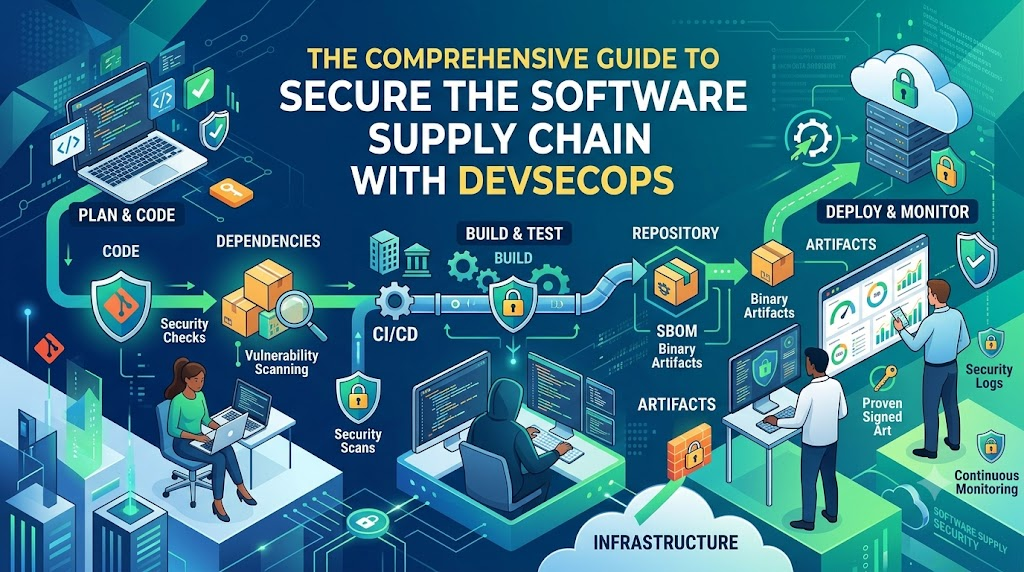
The software supply chain encompasses everything that goes into your application, from the first line of code written by a developer to the final artifact deployed in a cloud environment.
- Source Code: The original code created by your developers.
- Third-Party Dependencies: Open-source libraries and frameworks imported to speed up development.
- CI/CD Pipelines: The automated tools that build, test, and package your software.
- Infrastructure as Code (IaC): The definitions used to provision servers, databases, and network environments.
- Deployment Targets: Containers, Kubernetes clusters, and serverless environments.
Think of it like a physical manufacturing line: if a supplier provides a faulty bolt, the entire engine is compromised. In software, if a library you use has a hidden backdoor, your entire application—and your customer’s data—is at risk.
Why Software Supply Chain Security Matters
The stakes are high. A single compromised dependency can lead to data breaches, massive financial losses, and long-term damage to brand reputation.
- Business Continuity: An attack can halt production, forcing teams to roll back changes or shut down entire services.
- Regulatory Compliance: Frameworks like SOC 2, HIPAA, and PCI DSS increasingly require rigorous proof of software integrity.
- Customer Trust: Modern customers expect transparency. Being unable to guarantee the security of your software supply chain is a significant liability.
Consider the real-world impact: a vulnerability in a common logging library can be exploited across millions of applications simultaneously. Without a strategy to secure the software supply chain with DevSecOps, you are essentially blind to the risks hidden deep within your own tech stack.
Common Software Supply Chain Threats
| Threat | Risk | Potential Business Impact |
| Malicious Dependencies | Code injection via public repos | Full system compromise |
| Vulnerable Libraries | Unpatched security flaws | Data exfiltration |
| Compromised Build Pipelines | Injection of malicious build steps | Unauthorized code deployment |
| Container Vulnerabilities | Outdated OS images | Lateral movement in K8s |
| Secrets Exposure | Hardcoded credentials in source | Permanent infrastructure access |
| Artifact Tampering | Replacing signed binaries | Malware distribution |
Understanding DevSecOps
DevSecOps is the practice of integrating security testing and compliance into every phase of the software development lifecycle (SDLC). It is not a specific tool, but a cultural shift where security is a shared responsibility between developers, operations, and security teams.
The core principle is Shift-Left Security. By testing for vulnerabilities during the development phase rather than just before release, you catch bugs early, reduce remediation costs, and prevent security from becoming a bottleneck.
How DevSecOps Secures the Software Supply Chain
| Supply Chain Stage | DevSecOps Practice | Security Benefit |
| Planning | Threat Modeling | Identifying risks before coding |
| Coding | IDE Security Plugins | Real-time vulnerability feedback |
| Building | SCA and SAST | Checking for weak code and dependencies |
| Testing | DAST and IAST | Functional security verification |
| Packaging | Container Image Scanning | Ensuring base image integrity |
| Deployment | Policy as Code | Preventing unauthorized configurations |
| Monitoring | Real-time Threat Detection | Rapid incident response |
Step-by-Step Guide to Securing the Software Supply Chain
Step 1: Secure Source Code Repositories
Access control is your first line of defense. Use Multi-Factor Authentication (MFA), branch protection rules, and signed commits to ensure only authorized changes reach the repository.
Step 2: Verify Open-Source Dependencies
Use automated Software Composition Analysis (SCA) tools to maintain a Software Bill of Materials (SBOM). This inventory tracks every library, version, and license in your project.
Step 3: Automate Security Testing
Integrate Static Application Security Testing (SAST) into your CI pipeline. If a developer pushes code with a known vulnerability, the pipeline should fail the build automatically.
Step 4: Secure CI/CD Pipelines
Treat your CI/CD configuration as production code. Implement strict least-privilege access, rotate service account credentials frequently, and ensure pipeline logs are immutable.
Step 5: Protect Build Artifacts
Use a private registry for your binaries and containers. Digitally sign your images so that production environments only run code that has passed through your secure pipeline.
Step 6: Secure Containers
Use “distroless” images to minimize the attack surface. Regularly scan images for vulnerabilities and use admission controllers in Kubernetes to block non-compliant containers.
Step 7: Monitor Production Continuously
Security doesn’t stop at deployment. Use Runtime Application Self-Protection (RASP) and centralized logging to detect anomalies in real-time.
Dependency Management Best Practices
An effective strategy relies on knowing exactly what is inside your software.
- Generate an SBOM: Every release should have a machine-readable bill of materials.
- Use Private Mirrors: Don’t pull directly from the internet; mirror trusted packages in a private repository.
- Version Pinning: Avoid using “latest” tags; specify exact versions to prevent unexpected updates from introducing malicious code.
Securing CI/CD Pipelines
A pipeline is a privileged path to production. If an attacker gains control here, they own your infrastructure.
- Pipeline Isolation: Run builds in ephemeral, isolated environments.
- Secrets Management: Never use environment variables for secrets. Use vault solutions like HashiCorp Vault or cloud-native key management systems.
Container and Kubernetes Security
Containers are often the weakest link in modern stacks.
- Image Scanning: Block images with “Critical” or “High” vulnerabilities.
- Runtime Security: Monitor process activity inside containers; if a container starts a shell unexpectedly, kill it.
Infrastructure as Code (IaC) Security
Terraform or CloudFormation scripts are as dangerous as application code. Use automated tools to scan IaC for misconfigurations, such as open S3 buckets or overly permissive IAM roles, before they are provisioned.
Secrets Management
Hardcoded API keys are a high-risk liability.
- Rotation: Automatically rotate secrets every 30 to 90 days.
- Dynamic Secrets: Use tools that generate temporary credentials for the duration of a specific task.
Secure Code Review and Testing
| Testing Type | Focus | When to Use |
| SAST | Static code analysis | During local dev and build |
| DAST | Runtime vulnerability scanning | After deployment to staging |
| SCA | Library/Dependency risks | Every build |
| IAST | Interactive behavior analysis | During integration testing |
Continuous Monitoring and Threat Detection
Security teams should treat production as an active battleground. By centralizing logs in a SIEM, you can correlate events—for example, linking a failed login attempt with a sudden change in an infrastructure configuration file.
Compliance and Governance
Whether you follow the NIST SSDF or ISO 27001, compliance should be treated as Policy as Code. If a deployment does not meet your organization’s internal standards, the automation should reject it automatically, removing human error from the audit process.
Measuring Software Supply Chain Security
| Metric | Why It Matters | Business Value |
| MTTR | Speed of fixing vulnerabilities | Reduced window of exposure |
| Scan Coverage | Visibility into all assets | Lower chance of “shadow” risks |
| Dependency Freshness | Keeping libraries updated | Fewer exploits available to attackers |
Common Software Supply Chain Security Mistakes
- Blind Trust: Assuming that because a library is popular, it is secure.
- Manual Gates: Relying on human reviews for security approvals is slow and error-prone.
- Ignoring SBOMs: Failing to track what is actually running in production.
Real-World Example: Securing a Modern DevOps Pipeline
Imagine an organization suffering from frequent dependency updates breaking their builds. By implementing a DevSecOps pipeline, they introduced:
- Automated Dependency Scanning: Automatically blocking libraries with known CVEs.
- Container Signing: Ensuring only approved builds reached the K8s cluster.
- Result: They saw a 60% reduction in production vulnerabilities and increased developer velocity, as teams no longer had to stop work to address major security incidents after release.
Building a Security-First Engineering Culture
The most advanced tools will fail if the culture is not aligned. Security must be positioned as a team sport. Organize “security champion” programs, where one developer per squad takes the lead on security initiatives. This promotes peer-to-peer knowledge sharing.
Future of Software Supply Chain Security
We are moving toward attestations. In the near future, every artifact will carry a cryptographic “passport” that proves it passed every stage of the secure build pipeline. Combined with AI-assisted threat detection, organizations will be able to predict and neutralize threats before they even reach the development environment.
Certifications & Learning Paths
For those looking to deepen their expertise, building a formal foundation is key. Explore the training paths provided by the DevOpsSchool ecosystem to gain hands-on experience.
| Certification | Best For | Skill Level | Focus Area |
| Certified DevSecOps Professional | Engineers | Intermediate | Security Automation |
| Kubernetes Security Specialist | Cloud Engineers | Advanced | Container/K8s Hardening |
| Secure CI/CD Architecture | Architects | Advanced | Pipeline Integrity |
Best Practices Checklist
- Implement MFA across all code repositories.
- Automate SCA scans on every commit.
- Generate and store an SBOM for every release.
- Use a centralized, encrypted secret management vault.
- Scan infrastructure templates for misconfigurations.
- Rotate service account credentials regularly.
- Establish a clear, documented incident response plan.
FAQs
- What is software supply chain security? It is the practice of protecting the entire lifecycle of software, from source code to deployment, against tampering and vulnerabilities.
- Why is DevSecOps important? It integrates security into the CI/CD process, enabling teams to catch risks early.
- What is an SBOM? A Software Bill of Materials is an inventory of every third-party component in your software.
- How do supply chain attacks happen? Often by compromising a popular open-source library that many companies use.
- How can CI/CD pipelines be secured? By using isolated build environments and rigorous access controls.
- Why are dependencies risky? They often contain unmaintained code with unknown vulnerabilities.
- What role does container security play? It ensures that the base operating environment of your application is hardened.
- How should organizations get started? Begin by mapping your current delivery process and automating one security gate at a time.
- Is security only for the security team? No, in DevSecOps, security is a shared responsibility across all engineering teams.
- Does automation replace human review? It handles repetitive tasks, allowing humans to focus on complex threat modeling.
- What is “Shift-Left”? Moving security checks earlier in the development lifecycle.
- How do I handle legacy code? Perform a baseline audit and prioritize the most exposed components.
- Is open-source safe? It is safe when managed with proper scanning and version control.
- What is Policy as Code? Defining compliance rules in code so they can be enforced automatically.
- How often should I scan for vulnerabilities? Continuously, ideally on every build and regularly in production.
Final Thoughts
Securing the software supply chain is not a destination but a continuous process. As our dependencies grow and our architectures become more distributed, the need for automated, integrated, and vigilant security practices increases.
By embracing DevSecOps, you are not just “adding security”—you are building a more resilient, reliable, and trustworthy business. The goal is to create a culture where security is baked into the DNA of every feature deployed.
