Limited Time Offer!
For Less Than the Cost of a Starbucks Coffee, Access All DevOpsSchool Videos on YouTube Unlimitedly.
Master DevOps, SRE, DevSecOps Skills!
Introduction
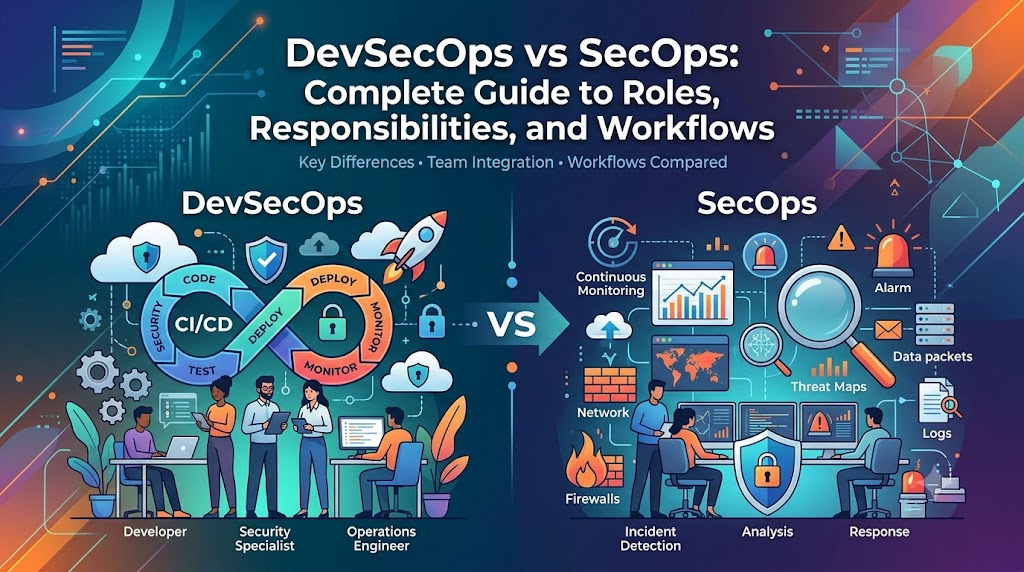
Modern enterprise security demands a unified approach to counter the unprecedented volume of sophisticated cyber threats targeting cloud-native architectures, microservices, and continuous delivery pipelines. While traditional, periodic manual audits can no longer keep pace with development teams deploying code multiple times a day, a single unpatched library or public cloud misconfiguration can lead to devastating data breaches within minutes of deployment. To bridge this gap between software engineering and live active defense, organizations rely on two distinct yet deeply complementary disciplines: DevSecOps, which injects proactive, automated security checks directly into the early stages of the software development lifecycle, and SecOps, which maintains constant vigilance, continuous monitoring, and real-time incident response across active production environments. Mastering these modern frameworks is essential for building a resilient corporate security posture, and exploring specialized training tracks on platforms like DevOpsSchool provides engineers and security professionals alike with the hands-on technical capabilities required to seamlessly integrate both preventive engineering and tactical defense operations.
What Is DevSecOps?
DevSecOps stands for Development, Security, and Operations. It is a cultural, engineering, and architectural approach that integrates security practices directly into every phase of the software development lifecycle (SDLC). Rather than treating security as an afterthought or a final gatekeeping step, DevSecOps treats security as a fundamental, continuous requirement embedded within the core CI/CD (Continuous Integration/Continuous Deployment) pipeline.
Core Principles of DevSecOps
- Shift-Left Security: Moving security testing as close to the beginning of the development process as possible. Developers catch and fix vulnerabilities while writing code, rather than discovering them weeks later in production.
- Security Automation: Eliminating manual compliance checkpoints by embedding automated scanners into the development workflow. This ensures that every code commit, third-party library dependency, and infrastructure template is verified instantly.
- Shared Responsibility: Breaking down traditional operational silos. Under a DevSecOps model, software developers and platform engineers share ownership of the application’s security posture alongside dedicated security architects.
Developer Involvement and Real-World Examples
In a mature DevSecOps ecosystem, software developers do not need to be deeply trained penetration testers, but they must use linting and analysis tools embedded directly into their Integrated Development Environments (IDEs). For example, when an engineer writes code to handle user authentication, an automated Static Application Security Testing (SAST) tool flags a potential SQL injection vulnerability right inside their text editor. The developer remediates the issue before ever pushing the code to a shared repository.
Another practical example involves Infrastructure as Code (IaC). If an engineer configures a Terraform template to provision an Amazon S3 bucket but accidentally leaves the access control list (ACL) set to public, an automated linting step within the CI/CD pipeline blocks the pull request. The build fails automatically, providing the developer with an explicit error message outlining how to secure the configuration before the infrastructure can ever be deployed to the cloud.
What Is SecOps?
SecOps represents the collaboration between IT Operations and Security teams to monitor, detect, analyze, and mitigate active threats across an enterprise infrastructure. While DevSecOps focuses heavily on application development and release pipelines, SecOps is primarily concerned with the real-time operational environment, covering corporate networks, data centers, endpoints, and cloud infrastructure.
The Role of the Security Operations Center (SOC)
At the heart of a SecOps strategy sits the Security Operations Center (SOC). The SOC is a centralized facility where dedicated security professionals utilize advanced telemetry tools to maintain visibility over the entire corporate footprint. The SOC acts as an enterprise’s digital defense command center, executing round-the-clock defensive operations.
Core Pillars of SecOps
- Continuous Monitoring: Collecting, aggregating, and parsing millions of log events every day from firewalls, operating systems, cloud providers, and databases to establish baseline behaviors and flag anomalies.
- Incident Response: Executing pre-planned playbooks when a verified security incident occurs, ensuring rapid containment, eradication of the threat, and systemic recovery.
- Threat Detection: Proactively analyzing indicators of compromise (IoCs) and behavioral patterns to uncover hidden malicious activity before it results in a massive data breach.
Practical SecOps Examples
Consider a scenario where an enterprise employee falls victim to a phishing email, allowing an attacker to harvest their active session token. The attacker attempts to log into the corporate cloud environment from an unfamiliar IP address located in a different country while simultaneously initiating a massive data download.
A mature SecOps team detects this anomaly through a Security Information and Event Management (SIEM) platform. The system generates a high-priority alert based on the impossible travel time and unusual data volume. A SOC analyst immediately reviews the event, confirms the malicious activity, triggers an incident response playbook to revoke the compromised session tokens, and isolates the affected user account across the enterprise identity provider within minutes, neutralizing the threat before data exfiltration occurs.
Why Organizations Need Both DevSecOps and SecOps
Organizations frequently make the strategic mistake of assuming that adopting DevSecOps eliminates the need for an active SecOps capability, or vice-versa. In reality, relying on only one of these methodologies leaves dangerous blind spots across your defense strategy. Enterprise security relies heavily on two primary paradigms: Preventive Security and Detective Security.
Preventive vs. Detective Security
DevSecOps delivers preventive security. It ensures that applications are designed securely, open-source dependencies are free from known vulnerabilities, and cloud infrastructure is provisioned using hardened blueprints. However, prevention cannot account for everything. Zero-day exploits (vulnerabilities unknown to software vendors), insider threats, advanced persistent threats (APTs), and human configuration errors post-deployment will always exist.
This is where the detective security of SecOps becomes mandatory. SecOps assumes that attackers will eventually find a way in, focusing heavily on minimizing the mean time to detect (MTTD) and mean time to respond (MTTR). Without SecOps, a zero-day vulnerability exploited in production would go unnoticed indefinitely. Without DevSecOps, the SecOps team would be completely overwhelmed by a non-stop flood of basic, avoidable vulnerabilities slipping out of development pipelines into live environments.
Operational Resilience and Business Continuity
The combination of both disciplines creates operational resilience. When an organization faces a major vulnerability event—such as a zero-day exploit in a deeply embedded logging library—the two teams respond in tandem to preserve business continuity.
SecOps provides immediate operational defense, spinning up web application firewall (WAF) rules to detect and block active exploit attempts in real time. Concurrently, the DevSecOps team uses automated build pipelines to patch the codebase, run regression testing, and safely deploy a remediated software version across production clusters within hours. Together, they create a continuous feedback loop that hardens the enterprise against future disruptions.
High-Level Comparison Overview
To clarify the distinct operational focuses of DevSecOps and SecOps, the following table maps out how each framework approaches core engineering and operational objectives.
| Area | DevSecOps | SecOps |
| Primary Objective | Build secure software and infrastructure by default; minimize vulnerabilities before production release. | Defend live enterprise assets; detect, isolate, and remediate active security incidents. |
| Team Focus | Software engineering, CI/CD automation, cloud architecture, and source code management. | Security monitoring, host/network forensics, threat hunting, and incident response. |
| Workflow Timing | Proactive; integrated throughout the early design, build, and deployment phases (Pre-Production). | Reactive and Proactive; continuous operational monitoring across live active systems (Production). |
| Security Approach | Prevention and hardening via automated linting, dependency analysis, and structural unit tests. | Detection, containment, and eradication via behavioral analysis, telemetry logs, and playbooks. |
| Automation Level | High; natively embedded directly within developer software delivery and validation pipelines. | High to Medium; driven by orchestration playbooks and automated response rules. |
| Key Stakeholders | Developers, QA testers, platform engineers, product managers, and DevSecOps architects. | SOC analysts, incident response teams, network engineers, and Chief Information Security Officers (CISOs). |
DevSecOps Roles and Responsibilities
Implementing a successful DevSecOps practice requires cross-functional engineering roles focused on embedding security guardrails into automated pipelines.
DevSecOps Engineer
The DevSecOps Engineer acts as an automation specialist who bridges the gap between classic application development and corporate security infrastructure.
- Responsibilities: Designs, implements, and maintains security scanning tools within the CI/CD pipeline. They author configuration policies, build automated container scanning steps, and configure static and dynamic analysis tools.
- Business Impact: Accelerates delivery velocity by removing manual compliance barriers, ensuring that software code can move from development to production without sacrificing structural safety.
Security Champion
A Security Champion is a core software developer or QA engineer with a specialized interest in security who serves as the embedded security lead within a standard product engineering squad.
- Responsibilities: Conducts internal threat modeling for new product features, mentors peer developers on secure coding standards, and helps triage security defects discovered during regular pipeline runs.
- Business Impact: Scales security awareness organically across large engineering organizations without requiring a massive, dedicated security team for every single product line.
Cloud Security Engineer
This role focuses specifically on the underlying infrastructure layers, identity controls, and software-defined networks supporting the application ecosystem.
- Responsibilities: Audits and hardens Infrastructure as Code (IaC) configurations, establishes cloud identity and access management (IAM) permissions based on the principle of least privilege, and designs secure cloud network boundaries.
- Business Impact: Mitigates the financial and reputational risk of massive public cloud misconfigurations, ensuring data stores remain locked down from day one.
DevOps Engineer
While primarily focused on system availability, deployment speed, and reliability, the modern DevOps engineer plays an essential role in supporting the DevSecOps framework.
- Responsibilities: Provisions and optimizes the core build pipelines, manages secret storage engines (such as HashiCorp Vault), and handles immutable deployment strategies like blue-green or canary releases.
- Business Impact: Ensures that security platforms do not degrade build performance or introduce unnecessary friction into the delivery infrastructure.
Platform Engineer
The Platform Engineer constructs the standardized internal developer platform (IDP) that product developers use to run their workloads.
- Responsibilities: Hardens container orchestration clusters (such as Kubernetes), configures base system operating container images, and enforces cluster-wide runtime security policies.
- Business Impact: Minimizes cognitive load on development teams by providing pre-configured, highly secure execution environments out of the box.
SecOps Roles and Responsibilities
The SecOps organization is built to operate under operational pressure, defending enterprise boundaries and executing real-time system triage.
SOC Analyst (Tiers 1–3)
SOC Analysts are front-line operators responsible for monitoring incoming data streams and triaging active security alerts.
- Responsibilities: Tier 1 analysts monitor the SIEM console to filter out false positives and perform initial alert validation. Tier 2 analysts conduct deeper analysis on validated alerts to assess scope. Tier 3 analysts perform advanced threat forensics and handle highly complex security escalations.
- Business Impact: Provides continuous defensive visibility, ensuring that potential security incidents are identified before they escalate into catastrophic breaches.
Incident Responder
The Incident Responder is an operational specialist tasked with managing and mitigating a security crisis once an active breach is declared.
- Responsibilities: Executes incident mitigation playbooks to isolate infected network subnets, preserve compromised storage volumes for formal forensic analysis, wipe compromised assets, and restore production system capabilities safely.
- Business Impact: Directly reduces corporate MTTR, limiting financial losses and operational downtime during an active security event.
Threat Hunter
Threat Hunters operate under the core assumption that the network has already been breached and that attackers are actively evading traditional security alerts.
- Responsibilities: Conducts proactive, hypothesis-driven investigations across historical enterprise logs, searching for subtle indicators of malicious presence or hidden lateral movement.
- Business Impact: Uncovers complex, low-and-slow cyber attacks that bypass automated rule-based signature detection platforms.
Security Engineer
The Security Engineer maintains and optimizes the underlying infrastructure utilized by the defensive operations team.
- Responsibilities: Deploys and configures enterprise endpoint detection systems, manages central log aggregation farms, updates firewall inspection rule definitions, and codes automation workflows within SOAR systems.
- Business Impact: Guarantees that the defensive team has highly reliable telemetry and working tools necessary to defend corporate assets.
SOC Manager
The SOC Manager oversees the personnel, operational tooling, and overarching metrics defining defensive readiness.
- Responsibilities: Tracks key performance metrics like MTTD and MTTR, coordinates cross-departmental incident reviews, designs training simulations, and reports operational security readiness directly to executive leadership.
- Business Impact: Aligns technical defense metrics with broader corporate risk management and governance objectives.
DevSecOps Workflow Explained
A mature DevSecOps workflow is completely continuous, integrating specific security checks into every phase of the traditional software development lifecycle.
[1. Planning] ──> [2. Secure Coding] ──> [3. Code Review] ──> [4. Security Testing]
                                                                      │
[7. Monitoring] <── [6. Deployment] <── [5. CI/CD Validation] <───────┘
1. Planning
Security begins before a single line of code is written. During the planning phase, the team conducts formal architectural threat modeling. Product managers, architects, and security champions analyze the proposed system design to identify potential attack paths, define data classification requirements, and establish access boundaries. For example, if a team plans to build a public-facing API that handles payment data, the planning phase mandates encryption-at-rest protocols and tight rate-limiting boundaries before development begins.
2. Secure Coding
As developers write code, they receive immediate, real-time feedback within their development environment. Pre-commit hooks run quick linting tools locally to prevent credentials, private keys, or insecure cryptographic functions from being saved into local code repositories. IDE extensions analyze raw syntax inline, recommending safer function alternatives for input validation as the engineer types.
3. Code Review
When a developer submits a pull request to merge their changes into the master branch, automated static analysis kicks off alongside mandatory peer reviews. The code cannot be merged until it successfully passes linting benchmarks and receives approval from a team member. Peer reviewers look specifically for business logic flaws, such as improper authorization checks between microservices, which automated scanners might miss.
4. Security Testing
Once code is merged into a shared test branch, the automated CI/CD pipeline triggers an intensive suite of security scanners. This stage includes Software Composition Analysis (SCA) to check open-source packages against databases of known vulnerabilities (such as CVEs). Simultaneously, Static Application Security Testing (SAST) engines run deep semantic scans across the entire application codebase to catch structural security flaws.
5. CI/CD Security Validation
In this validation stage, the built application artifact is instantiated within an isolated staging sandbox. Dynamic Application Security Testing (DAST) tools launch automated, non-destructive web attacks against the running staging application to test for issues like cross-site scripting (XSS) and broken session handling. Concurrently, container scanning tools inspect container filesystems for OS-level vulnerabilities, and compliance engines verify that cloud deployment manifests match corporate security compliance baselines.
6. Deployment
After clearing all automated validation gates, the application is pushed to production using secure infrastructure automation. Deployment configurations are cryptographically signed, and secrets are injected at runtime via secure vaults rather than being embedded within application files. Blue-green deployment strategies are utilized to ensure that if a post-deployment security anomaly is discovered, the environment can instantly roll back to the previous secure state.
7. Continuous Monitoring
Post-deployment, the infrastructure relies on runtime security tools to monitor container behavior and system calls. Service meshes enforce strict mutual TLS (mTLS) encryption for all inter-service communications, while application performance monitoring tools stream security telemetry directly to centralized log repositories, closing the loop between development and live operations.
SecOps Workflow Explained
The SecOps workflow operates as a continuous loop focused on data ingestion, analysis, rapid response, and system hardening.
[1. Event Collection] ──> [2. Monitoring] ──> [3. Alerting] ──> [4. Investigation]
                                                                        │
[7. Reporting] <── [6. Remediation] <── [5. Incident Response] <────────┘
1. Event Collection
The operational flow begins with comprehensive log ingestion. Agents installed across corporate endpoints, firewalls, core database engines, cloud providers, and identity platforms continuously stream operational events into a centralized SIEM platform. This layer handles normalization, transforming disparate raw log formats into a standardized, searchable data schema.
2. Monitoring
Automated correlation engines within the SIEM continuously parse the incoming stream of normalized data. The system matches incoming behaviors against known threat intelligence indicators, bad reputation IP lists, and baseline user behavioral profiles. The monitoring layer filters out millions of everyday benign system actions to maintain an accurate operational overview.
3. Alerting
When a sequence of log events matches an established threat signature or exhibits a severe behavioral anomaly, the system generates a formal alert. This alert is automatically prioritized based on asset criticality and routed to the SOC ticketing queue. For instance, an alert indicating a successful administrator login from an unauthorized VPN gateway skips the standard queue and is flagged for immediate human review.
4. Investigation
A SOC analyst claims the alert and initiates a formal investigation. They pivot through related telemetry to reconstruct the timeline of events. The analyst checks if the targeted host has recently executed unusual command-line processes, queries endpoint logs to see if new network sockets were opened, and verifies whether neighboring assets show similar patterns of anomalous activity.
5. Incident Response
If the investigation confirms a live threat, the analyst declares a formal security incident, escalating the ticket to the Incident Response team. The team acts immediately to limit the attacker’s blast radius. Following pre-configured playbooks, they might segment the targeted network zone, block malicious domain traffic at the corporate DNS level, or quarantine compromised hosts from the active directory environment.
6. Remediation
With the threat safely contained, the team shifts focus toward systemic clean-up and long-term recovery. This phase involves removing malicious persistence mechanisms, changing compromised user credentials, applying immediate patch updates to the exploited software systems, and restoring damaged file networks from verified off-site backups.
7. Reporting
Following incident resolution, the team conducts a comprehensive post-incident review. They document the root cause of the compromise, evaluate the efficiency of the response timeline, and update automated SIEM rules or playbooks to ensure the organization can automatically block or detect similar attack methodologies in the future.
Security Philosophy: Prevention vs Detection
The fundamental distinction between DevSecOps and SecOps lies in their underlying operational philosophy. DevSecOps operates on a philosophy of Prevention, while SecOps operates on a philosophy of Detection and Containment.
DevSecOps treats security as a software engineering defect problem. The core objective is to build an environment so structurally sound that vulnerabilities never reach the wild. It views security through the lens of continuous code engineering, shifting accountability onto the design and development phases.
SecOps operates on an assumption of breach. It accepts that despite the best preventive engineering controls, attackers will eventually find a way to compromise a system—whether through social engineering, zero-day vulnerabilities, or third-party vendor breaches. SecOps focuses on operational readiness, visibility, speed of detection, and tactical response.
The following table summarizes how these two distinct philosophies compare across critical operational vectors.
| Vector | DevSecOps (Prevention Focus) | SecOps (Detection Focus) |
| Core Assumption | Vulnerabilities can be systematically engineered out of software systems before release. | Systems will inevitably be compromised; speed of discovery and containment is critical. |
| Primary Metric | Number of code vulnerabilities resolved pre-release; automated pipeline test coverage. | Mean Time to Detect (MTTD); Mean Time to Respond (MTTR). |
| Core Strategy | Code hardening, threat modeling, architecture reviews, and immutable infrastructure. | Continuous logging, behavioral analysis, threat hunting, and playbook execution. |
| Failure Scenario | A major software flaw or security misconfiguration slips past the CI/CD pipeline into production. | An intruder establishes long-term persistence in the network without triggering an alert. |
Security Tools Used in DevSecOps
DevSecOps relies heavily on automated scanning and validation tools integrated directly into the software compilation and release pipeline.
| Category | Example Tools | Purpose |
| Static Application Security Testing (SAST) | SonarQube, Checkmarx, Snyk Code | Analyzes raw source code for structural security vulnerabilities, backdoors, and logic bugs without executing the program. |
| Software Composition Analysis (SCA) | Snyk, OWASP Dependency-Check, Black Duck | Scans application dependency trees to identify open-source libraries containing known public vulnerabilities (CVEs) and license compliance issues. |
| Dynamic Application Security Testing (DAST) | OWASP ZAP, Burp Suite Enterprise, Veracode | Evaluates a running instance of an application from the outside, mimicking external web application attacks to identify exploitable edge cases. |
| Container Security Scanners | Trivy, Clair, Aqua Security | Inspects container base images, system packages, and application layers for unpatched vulnerabilities prior to registry storage. |
| Infrastructure as Code (IaC) Security | Checkov, TFLint, Tfsec | Audits cloud configuration blueprints (Terraform, CloudFormation, Ansible) for misconfigurations and security policy violations before provisioning infrastructure. |
Security Tools Used in SecOps
The SecOps team relies on infrastructure-wide telemetry tools designed to aggregate logs, analyze behaviors, and enable fast network-wide response.
| Category | Example Tools | Purpose |
| Security Information & Event Management (SIEM) | Splunk Enterprise Security, Microsoft Sentinel, Elastic Security | Aggregates and correlates real-time log events from disparate enterprise sources to provide a unified platform for alerting and historical data analysis. |
| Security Orchestration, Automation, & Response (SOAR) | Palo Alto Cortex XSOAR, Splunk SOAR | Automatically executes security response playbooks, coordinates alert routing, and orchestrates remediation tasks across security tools. |
| Endpoint Detection & Response (EDR) | CrowdStrike Falcon, SentinelOne, Microsoft Defender for Endpoint | Monitors host endpoints for anomalous processes, memory injections, and file modifications, providing remote isolation capabilities. |
| Threat Intelligence Platforms | Anomali ThreatStream, Recorded Future | Collects, normalizes, and feeds global indicator of compromise (IoC) data streams into internal monitoring tools to identify active external threats. |
| Log Management & Aggregation | Logstash, Fluentd, OpenSearch | Collects, indexes, and retains high-volume log streams from systems, networks, and applications to support long-term compliance audits and forensics. |
Automation in DevSecOps vs SecOps
While both methodologies utilize extensive automation to replace slow, error-prone manual tasks, they apply automation at completely different stages of the asset lifecycle and for entirely different operational outcomes.
DevSecOps CI/CD and Scanning Automation
DevSecOps automation is integrated into the software build and deployment infrastructure. It is strictly deterministic and bound to code lifecycle events (such as a pull request, code branch merge, or container build). If a developer triggers a build, the automated DevSecOps scanners execute as a mandatory compilation gate. If a high-severity flaw is detected, the automation alters the state of the infrastructure by failing the build, preventing insecure artifacts from moving forward.
SecOps Orchestration and Response Automation
SecOps automation is reactive, threat-driven, and managed by SOAR (Security Orchestration, Automation, and Response) platforms. It triggers based on real-time operational events occurring across production environments. When a SIEM flags a verified brute-force login attack against a critical server, the SecOps automation acts immediately by communicating with network firewalls to block the attacker’s source IP address and isolating the target host from the active directory pool.
The table below contrasts the distinct automation strategies of both disciplines.
| Attribute | DevSecOps Automation | SecOps Automation |
| Primary Trigger | Code management actions (Git commits, pull requests, container build triggers). | Security events (Anomalous logs, high-priority SIEM alerts, EDR detections). |
| Execution Domain | CI/CD build environments and automated pipeline runner nodes. | Enterprise-wide networks, production hosts, firewalls, and directory systems. |
| Core Goal | Fail fast; block insecure code from advancing through deployment pipelines. | Contain fast; isolate compromised assets and block active malicious traffic. |
| Primary Tooling | Git hooks, pipeline plugins, and policy-as-code linting engines. | SOAR playbooks, webhook API integrations, and endpoint management scripts. |
Incident Management Comparison
When a security vulnerability or active threat surfaces, DevSecOps and SecOps handle the issue through fundamentally different incident management paths.
DevSecOps: Pre-Release Vulnerability Resolution
In a DevSecOps paradigm, an incident is typically a pre-release finding—such as an automated scanner discovering an outdated, vulnerable open-source library within a release candidate branch.
- The Path: The pipeline automatically marks the build as failed, opens a high-priority bug ticket within the development team’s project tracking board, and attaches the specific file location and remediation path. The developer updates the dependency library version within their local workspace, validates the change, and pushes a new commit. The pipeline runs again, verifies the fix, and clears the path for deployment. No live production systems are harmed, and no crisis containment protocols are required.
SecOps: Post-Deployment Live Response
In a SecOps paradigm, an incident represents an active threat against live infrastructure—such as an attacker exploiting an unpatched vulnerability in an application already running in production to drop a web shell.
- The Path: The EDR tool flags an unauthorized process spawning from the web server engine. The SOC analyst immediately investigates, confirms the active web shell, and declares a critical incident. Following the incident response playbook, the responder isolates the server node from the production network to prevent lateral movement.
- The Feedback Loop: Once the threat is contained, the SecOps team passes the attack forensics over to the DevSecOps team. The DevSecOps team then identifies the underlying code flaw, designs a permanent patch, and deploys a secure version through the CI/CD pipeline, closing the vulnerability gap permanently.
Compliance and Governance Responsibilities
Modern enterprises must comply with rigorous regulatory frameworks such as SOC 2, ISO 27001, PCI-DSS, and HIPAA. DevSecOps and SecOps share the burden of maintaining compliance, but they address different sections of the compliance matrix.
DevSecOps ensures that compliance controls are structurally integrated into the software and deployment architecture (Compliance as Code). It focuses on proving that code cannot be modified without peer approvals, that dependencies are actively audited, and that cloud infrastructure configurations are consistently checked against secure baselines.
SecOps handles operational compliance and Audit Readiness. They prove to external auditors that the live environment is continuously monitored, that user access reviews are conducted systematically, and that security incidents are investigated, logged, and resolved within the strict timelines mandated by regulatory frameworks.
The matrix below illustrates how compliance ownership is divided between both teams across common regulatory domains.
| Compliance Requirement | DevSecOps Responsibility | SecOps Responsibility |
| Access Control & Permissions | Implements least-privilege IAM policies directly within infrastructure templates. | Continuously audits active production permissions and flags anomalous privilege escalations. |
| Vulnerability Assessment | Runs automated code, dependency, and container scans on every build cycle. | Performs periodic infrastructure-wide network vulnerability scans across live assets. |
| Log Management & Audit Trails | Configures applications to output structured, audit-ready security events. | Collects, indexes, and retains security logs securely for regulatory lookback windows. |
| Change Management Evidence | Maintains immutable Git commit logs, peer approvals, and pipeline execution histories. | Monitors production configurations for unauthorized, ad-hoc changes (drift detection). |
Cloud Security Perspective
The transition to cloud architecture has redefined how organizations handle data boundaries, making the collaboration between DevSecOps and SecOps even more critical.
DevSecOps Cloud Security: Shift-Left Engineering
From the DevSecOps perspective, cloud security is an architectural engineering task. The team enforces policy guardrails before any infrastructure is provisioned, ensuring that security boundaries are defined within software blueprints.
- Practical Example: A DevSecOps engineer configures a global Open Policy Agent (OPA) policy within the deployment pipeline. This policy evaluates all Terraform manifests. If a developer accidentally writes code to provision an AWS EC2 instance with SSH ports open to the entire public internet (
0.0.0.0/0), the pipeline detects the violation, rejects the code, and prevents the infrastructure from ever existing in the cloud provider’s console.
SecOps Cloud Security: Real-Time Monitoring and Triage
From the SecOps perspective, cloud security is a real-time monitoring and visibility challenge. Since cloud environments are highly dynamic, SecOps utilizes Cloud Security Posture Management (CSPM) and runtime logging tools to watch for human mistakes or malicious activity post-deployment.
- Practical Example: A cloud administrator bypasses the standard deployment pipeline and manually modifies a live production network storage bucket through the cloud console to troubleshoot an emergency issue, accidentally leaving the bucket exposed to the public. A CSPM tool used by the SecOps team detects the configuration drift instantly, raises a high-priority alert in the SOC console, and triggers an automated playbook that flips the bucket back to private while the analyst investigates the unauthorized manual change.
Collaboration Between DevSecOps and SecOps
DevSecOps and SecOps are not competing frameworks; they are deeply codependent. If these teams operate in isolation, the organization’s defensive posture suffers significantly. True enterprise resilience requires building continuous, bidirectional feedback loops between the two teams.
┌────────────────────────────────────────────────────────┐
│                                                        │
▼                                                        │
DevSecOps Pipeline ──[Deploy Secure Code]──> Production Environment
▲                                                        │
│                                                        ▼
└─────[Share Attack Telemetry]─────────────── SecOps SOC Monitoring
Incident Feedback Loops
When the SecOps team discovers an active threat or a successful exploit in production, they must share their forensic findings directly with the DevSecOps team. For instance, if an attacker successfully executes a sophisticated directory traversal attack against a live web API, the SecOps team provides the DevSecOps engineers with the exact HTTP payload logs used by the attacker. DevSecOps uses this data to write specific integration test cases, patch the application code, and verify that the vulnerability cannot resurface in future releases.
Shared Security Goals
The two teams should also collaborate on refining alerting criteria to reduce operational noise. DevSecOps engineers can help SecOps analysts understand the internal mechanics of cloud-native applications, allowing the SOC to build precise behavioral baselines. This technical understanding helps eliminate false-positive alerts caused by routine application actions, such as microservices scaling out automatically during peak traffic hours.
DevSecOps vs SecOps Skill Requirements
Pursuing a career in either DevSecOps or SecOps requires developing a distinct set of technical competencies and analytical mindsets.
DevSecOps Skill Profile
DevSecOps is fundamentally a software engineering and automation discipline. Professionals in this field must be comfortable working directly within application source code, designing complex automation pipelines, and managing software-defined infrastructure layers. They need a strong builder mindset, focusing on how to integrate security seamlessly into development workflows without slowing down delivery velocity.
SecOps Skill Profile
SecOps is an analytical and operational defense discipline. Professionals in this field must excel at pattern recognition, system forensics, and working under operational pressure during active incidents. They need a strong defender mindset, focusing on understanding attacker methodologies, interpreting complex network traffic, and reconstructing security events from raw log data across diverse enterprise infrastructures.
The following table contrasts the core technical and operational skills required for success in each field.
| Skill Area | DevSecOps Requirements | SecOps Requirements |
| Coding & Scripting | Proficient in languages used for automation and tooling (Python, Go) and application security analysis. | Proficient in scripting for data parsing and automation (Bash, Python, PowerShell). |
| Infrastructure Focus | Infrastructure as Code (Terraform), container orchestration (Kubernetes), and CI/CD tools (Jenkins, GitHub Actions). | Enterprise operating systems (Linux/Windows internals), network routing, and directory services. |
| Automation Focus | Integrating security scanners, linters, and policy engines directly into software build pipelines. | Authoring automated incident response playbooks and alert correlation rules within SOAR platforms. |
| Security Core | Threat modeling, secure software design patterns, and application vulnerability remediation. | Threat intelligence analysis, host/network forensics, and log correlation methodologies. |
| Primary Tooling | SAST, DAST, SCA, and container security scanners. | SIEM, SOAR, EDR, packet analyzers, and log management platforms. |
Real-World Example: Vulnerability Lifecycle
To better understand how these two security practices interact, let’s trace how a critical remote code execution (RCE) vulnerability is handled at different stages of the asset lifecycle.
Scenario A: Vulnerability Discovered During Development (DevSecOps approach)
A developer needs to add an external open-source library to handle file uploads in a web application.
[Developer Adds Library] ──> [Git Push Trigger] ──> [SCA Scanner Flags RCE] ──> [Build Blocked / Developer Patches Code]
- The developer adds the library version to the project configuration file and pushes the changes to a Git repository.
- The automated DevSecOps pipeline triggers instantly, initiating a Software Composition Analysis (SCA) scan.
- The SCA scanner flags the library version, noting that it contains a known, critical RCE vulnerability with a public exploit available.
- The pipeline automatically fails the build, preventing the code from being merged into the main branch or deployed to staging.
- The pipeline output provides the developer with the minimum safe version of the library. The developer updates the version string, verifies the local build, and pushes a clean update. The pipeline passes, and the application is safely deployed.
Scenario B: Vulnerability Discovered After Deployment (SecOps + DevSecOps Combined Response)
A critical zero-day vulnerability is publicly disclosed for an open-source framework that the enterprise already runs across dozens of live production servers.
[Zero-Day Disclosed] ──> [SecOps deploys WAF rule / Monitors EDR] ──> [Attacker attempts exploit; blocked]
                                                                                  │
[Secure Release Deployed] <── [DevSecOps patches base image & runs pipeline] <────┘
- SecOps Immediate Detection and Mitigation: The SecOps team ingests the new threat intelligence report. They immediately deploy custom rules across Web Application Firewalls (WAF) to detect and drop traffic containing the specific exploit string. Concurrently, they configure EDR platforms to monitor production servers for unusual process rollouts.
- The Attack Attempt: An automated botnet scans the enterprise’s public IP range and attempts to exploit the zero-day flaw on an unpatched production server. The WAF detects the malicious payload string and blocks the connection, while the SIEM logs the blocked attempt and alerts the SOC.
- DevSecOps Long-Term Remediation: Simultaneously, the DevSecOps team pulls the updated, patched base image provided by the vendor. They update the centralized container blueprints, triggering the automated CI/CD pipeline to rebuild all dependent enterprise applications.
- The Resolution: The pipeline runs through automated unit tests, container verification, and regression staging. Within hours, a clean, fully remediated application version is deployed across production clusters via a rolling update, eliminating the vulnerability entirely and allowing SecOps to stand down from high-alert monitoring.
Benefits of DevSecOps
Integrating security directly into the engineering culture and development pipelines provides measurable advantages across the enterprise.
- Faster Vulnerability Remediation: Finding a security defect during the design or coding phase is significantly cheaper and faster to fix than resolving a flaw discovered in production, which often requires emergency code branches, manual testing, and potential system downtime.
- Secure Development by Default: Automated pipeline gates ensure that every application release matches corporate compliance baselines, preventing human error from introducing common security flaws like unencrypted data fields or open access keys.
- Reduced Operational Risk: Continuous software and container scanning minimizes the attack surface of production systems, leaving fewer exploitable entry points for malicious actors.
- Improved Developer Awareness: Embedding real-time security linting directly into development workflows educates engineers on secure coding best practices, helping teams write safer code over time.
Benefits of SecOps
Maintaining a dedicated, highly automated operational defense team provides essential protection for enterprise environments.
- Continuous Threat Visibility: Round-the-clock monitoring ensures that anomalous events, unauthorized access attempts, and system drift are captured and analyzed in real time across the entire corporate footprint.
- Rapid Incident Containment: Automated playbooks and specialized incident responders ensure that live security breaches are isolated within minutes, significantly reducing data loss and potential financial impact.
- Proactive Threat Hunting: Dedicated threat hunters uncover sophisticated attackers who have bypassed standard signature-based defenses, reducing the long-term dwell time of intruders within corporate networks.
- Systemic Operational Resilience: Post-incident investigations provide the precise data necessary to continuously update firewalls, refine correlation rules, and harden operational networks against evolving cyber threats.
Common Challenges in DevSecOps
Shifting security left is a complex undertaking that often encounters cultural and technical friction during implementation.
Developer Resistance
Development teams are traditionally measured on their feature delivery speed. If automated security tools slow down build pipelines or generate confusing error reports, developers may view security as a roadblock and look for ways to bypass established controls.
- The Solution: Embed security seamlessly into existing tools. Use IDE plugins that provide actionable remediation advice inline, and ensure pipeline scanners are optimized to run quickly, minimizing disruption to development velocity.
Tool Overload and False Positives
Deploying multiple security scanners without careful calibration can overwhelm engineering teams with hundreds of low-severity findings or false positives, leading to alert fatigue.
- The Solution: Start with conservative rulesets. Focus initial pipeline controls on blocking high-severity, easily exploitable vulnerabilities. Regularly tune scanners based on real-world feedback to filter out irrelevant findings.
Skill Shortages
Finding engineers who possess a deep understanding of both advanced software development practices and modern cybersecurity design is notoriously difficult.
- The Solution: Invest in structured internal training programs and establish a formal Security Champions network to cultivate security awareness within existing development teams.
Common Challenges in SecOps
Defensive operations teams face high-pressure environments that can easily lead to operational bottlenecks if not managed correctly.
Alert Fatigue
SOC analysts are often bombarded with thousands of automated security alerts every day, many of which turn out to be benign background noise or false positives, increasing the risk of missing a genuine attack.
- The Solution: Leverage SOAR platforms to automate the initial triage and validation of low-priority alerts. Ensure correlation rules are continuously refined to maintain a high-quality alert queue.
Tool Integration Issues
Enterprise environments frequently use a disparate mix of legacy systems and modern cloud security tools that do not naturally communicate with each other, creating critical data silos.
- The Solution: Prioritize security tools that offer robust, open API frameworks. Focus engineering efforts on building a centralized data lake within the SIEM to ensure comprehensive visibility.
Staffing Shortages and Burnout
The demanding, round-the-clock nature of incident response work often leads to high turnover and chronic staffing shortages within the SOC.
- The Solution: Automate repetitive manual tasks to allow analysts to focus on engaging work like proactive threat hunting, and design clear career progression paths to retain talent.
Industries That Benefit Most from DevSecOps and SecOps
While every modern organization requires robust security, certain highly regulated sectors face elevated compliance requirements and sophisticated threat profiles that make both frameworks essential.
Banking and Financial Services
Financial institutions handle massive volumes of sensitive transaction data and capital flows, making them prime targets for cyber criminals.
- Security Priorities: DevSecOps is critical for ensuring that web banking applications and mobile APIs are designed with strong encryption and secure authentication models. Simultaneously, SecOps provides continuous monitoring to detect fraudulent transactions, insider threats, and sophisticated network intrusions in real time.
Healthcare
Healthcare organizations manage highly confidential patient records protected by strict regulatory frameworks like HIPAA.
- Security Priorities: DevSecOps ensures that internal healthcare platforms and patient portals handle data securely and maintain compliance by default. SecOps is vital for protecting connected clinical devices and defending critical network systems against disruptive ransomware attacks.
E-Commerce and Retail
E-commerce companies process high volumes of consumer credit card transactions and experience significant traffic fluctuations during peak shopping seasons.
- Security Priorities: DevSecOps focuses on securing cloud-native payment architectures and preventing vulnerabilities like cross-site scripting (XSS) or data leaks. SecOps monitors live web environments around the clock to detect and mitigate automated credential-stuffing attacks and distributed denial-of-service (DDoS) attempts.
Career Paths in DevSecOps
The growing focus on application and cloud security has created strong demand for skilled professionals who can build secure automation pipelines.
[Entry-Level: Junior DevSecOps / QA Security]
                     │
                     ▼
[Mid-Level: DevSecOps Engineer / Cloud Security Specialist]
                     │
                     ▼
[Senior-Level: Lead DevSecOps Architect / Application Security Manager]
                     │
                     ▼
[Leadership: Director of Product Security / Head of DevSecOps]
Entry-Level Opportunities
Professionals typically enter the field from a background in software development, system administration, or quality assurance. Initial roles include Junior DevSecOps Analyst or QA Security Specialist, focusing on managing vulnerability scan reports and assisting development teams with basic remediation tasks.
Mid-Level Roles
With experience, professionals advance to roles like DevSecOps Engineer or Cloud Security Specialist. In these positions, they take ownership of designing CI/CD security integrations, authoring policy-as-code definitions, and building secure deployment patterns across public cloud environments.
Senior and Leadership Positions
Experienced professionals can step into senior roles such as Lead DevSecOps Architect or Application Security Manager, designing security strategies across entire product lines. Long-term career progression leads to executive leadership positions, including Director of Product Security or Chief Information Security Officer (CISO), which focus on aligning engineering practices with corporate risk management.
Career Paths in SecOps
The defensive operations field offers a structured career path centered on threat detection, incident management, and tactical leadership.
[Entry-Level: Tier 1 SOC Analyst]
               │
               ▼
[Mid-Level: Tier 2/3 Analyst / Incident Responder]
               │
               ▼
[Senior-Level: Threat Hunter / Lead Security Engineer]
               │
               ▼
[Leadership: SOC Manager / Director of Incident Response]
Entry-Level Opportunities
Most professionals begin their careers as a Tier 1 SOC Analyst. In this role, they focus on monitoring the central alert queue, performing initial validation on incoming alerts, and escalating verified anomalies to senior team members.
Mid-Level Roles
As technical skills develop, analysts progress to roles like Tier 2/3 SOC Analyst or Incident Responder. These positions involve executing deep forensic investigations, reconstructing complex security event timelines, and leading containment efforts during active system compromises.
Senior and Leadership Positions
Advanced practitioners often transition into specialized roles like Threat Hunter, Forensics Specialist, or Lead Security Engineer, focusing on uncovering hidden persistence mechanisms and building advanced detection tools. Leadership tracks lead to positions such as SOC Manager or Director of Incident Response, overseeing personnel, budgets, and executive crisis management strategies.
Future Trends in DevSecOps and SecOps
As enterprise architectures evolve, both disciplines are adapting to incorporate advanced automation and modern security paradigms.
AI-Powered Security Engineering
Artificial intelligence and machine learning are becoming deeply integrated into security tools. In DevSecOps pipelines, AI engines analyze code repositories to predict where vulnerabilities are likely to appear and automatically generate precise patch suggestions for developers. Within SecOps teams, AI-driven correlation tools analyze millions of raw log entries to identify subtle multi-stage attack patterns that might bypass traditional signature-based detection.
The Expansion of Zero Trust Architectures
Organizations are steadily moving away from perimeter-based network security models toward a comprehensive Zero Trust paradigm, which operates on the principle of never trust, always verify. DevSecOps supports this trend by implementing mutual TLS (mTLS) and micro-segmentation directly into application microservices. At the same time, SecOps continuously monitors identity authentication patterns and session tokens to detect anomalous access attempts instantly.
Automated SOAR Playbooks
To combat increasing attack speeds and alert volume, SecOps organizations are expanding their use of automated playbooks. Modern SOAR systems handle complex workflows without human intervention—automatically isolating compromised hosts, revoking active session tokens across identity providers, and initiating forensic log compilation the moment a high-severity alert is validated.
Certifications & Learning Paths
Obtaining respected industry certifications helps professionals validate their technical expertise and keep pace with evolving security methodologies. To build a strong foundation, professionals can leverage the comprehensive educational resources available across the DevOpsSchool learning ecosystem, which provides hands-on practical training designed for both engineering and operational paths.
The following table highlights the key industry certifications tailored for different career tracks and skill levels.
| Certification | Best For | Skill Level | Focus Area |
| Certified DevSecOps Professional (CDP) | DevSecOps Engineers, DevOps Specialists | Intermediate | Integrating SAST/DAST tools, container scanning, and secure CI/CD pipeline building. |
| Certified SOC Analyst (CSA) | Entry-Level Security Analysts, SOC Operators | Beginner | Core SOC monitoring workflows, threat triage, and incident logging mechanics. |
| Certified Information Systems Security Professional (CISSP) | Security Architects, Leadership, Managers | Advanced | Broad security governance, risk management, and enterprise architectural principles. |
| AWS Certified Security – Specialty | Cloud Security Engineers, Platform Architects | Advanced | Securing Amazon Web Services cloud infrastructure, IAM design, and runtime logging. |
| Certified Computer Security Incident Handler (CSIH) | Incident Responders, Crisis Managers | Intermediate | Incident response strategies, containment playbooks, and systemic system recovery. |
Common Beginner Mistakes
When starting out in DevSecOps or SecOps, avoiding these common conceptual errors will help you build a more effective long-term security posture.
- Assuming DevSecOps Replaces the SOC: DevSecOps hardens pipelines and prevents common development flaws, but it does not replace the round-the-clock monitoring, threat hunting, and live incident response capabilities that a dedicated SecOps team provides.
- Over-Focusing on Tooling Over Process: Simply buying expensive security scanners or SIEM platforms will not secure an enterprise. Tools are only as effective as the processes, configuration tuning, and cultural adoption supporting them.
- Neglecting Basic Cloud Security Fundamentals: Relying entirely on automated scanning scripts without understanding core underlying concepts like network routing, identity access boundaries, and the shared responsibility model can lead to critical security blind spots.
- Allowing Scan Results to Create Silos: Flooding development teams with raw, unverified vulnerability reports without clear remediation context creates friction and undermines collaboration.
- Ignoring the Incident Response Plan: Building secure applications is essential, but assuming your defenses are completely impenetrable means your team will be unprepared to act efficiently when a live security incident occurs.
FAQs (15 Questions)
1. What is the difference between DevSecOps and SecOps?
DevSecOps integrates automated security testing directly into the software development and deployment pipeline to prevent vulnerabilities before release. SecOps focuses on monitoring live enterprise environments to detect, analyze, and respond to active security threats across production systems.
2. Does DevSecOps replace the need for a SOC team?
No. DevSecOps reduces the number of application vulnerabilities that reach production, but it cannot defend against live operational threats like insider attacks, zero-day exploits, phishing campaigns, or compromised user credentials. A SOC team is always necessary to maintain round-the-clock defensive monitoring.
3. Which role is more technical: DevSecOps or SecOps?
Both roles are highly technical but require different skill sets. DevSecOps requires deep expertise in software engineering, CI/CD pipeline automation, and Infrastructure as Code. SecOps requires deep expertise in network forensics, operating system internals, log analysis, and incident mitigation methodologies.
4. Can small organizations implement both DevSecOps and SecOps?
Yes. Small organizations can start by utilizing open-source automation tools within their build pipelines (DevSecOps) and leveraging managed security service providers (MSSPs) or cloud-native monitoring tools to handle live logging and alerting (SecOps) without needing a large internal team.
5. How does automation differ between DevSecOps and SecOps?
DevSecOps automation runs deterministically during software build and deployment phases to block insecure code from advancing. SecOps automation runs reactively via SOAR platforms based on runtime security alerts to contain live threats by isolating hosts or blocking malicious IP addresses.
6. What programming languages should I learn for DevSecOps?
DevSecOps professionals benefit most from learning languages widely used in cloud-native development and pipeline automation, such as Python, Go, and Shell scripting, alongside configuration languages like YAML and JSON.
7. What programming languages are best for a career in SecOps?
SecOps professionals rely heavily on scripting languages to parse high-volume log streams, automate forensic tasks, and write custom detection rules. Python, Bash, and PowerShell are the most valuable languages for this career track.
8. How do DevSecOps and SecOps teams collaborate during a security breach?
During a breach, the SecOps team manages immediate containment and collects attack forensics. They share these logs with the DevSecOps team, who analyze the root cause of the code vulnerability, develop a permanent software patch, and deploy the secure update through the CI/CD pipeline.
9. What is “Shift-Left” security?
Shift-left security is the practice of moving security testing closer to the beginning of the software development lifecycle. By testing code during the design and development phases, engineers can identify and resolve vulnerabilities when they are fastest and cheapest to fix.
10. What is the role of a Security Champion?
A Security Champion is a core software developer or QA engineer embedded within a product team who acts as the primary advocate for security. They assist with internal threat modeling, mentor peers on secure coding practices, and help triage vulnerability scan results.
11. What is the main metric used to measure SecOps efficiency?
SecOps efficiency is primarily measured by Mean Time to Detect (MTTD), which tracks how quickly the team identifies a security threat, and Mean Time to Respond (MTTR), which measures the time taken to fully contain and mitigate the incident.
12. What does SAST stand for, and how is it used?
SAST stands for Static Application Security Testing. It is an automated tool that analyzes raw source code for structural security vulnerabilities and compliance issues without executing the application, providing developers with early feedback during development.
13. What does DAST stand for, and how does it differ from SAST?
DAST stands for Dynamic Application Security Testing. Unlike SAST, which analyzes uncompiled source code, DAST tests a running instance of an application from the outside, simulating external web attacks to find exploitable runtime vulnerabilities.
14. What is Cloud Security Posture Management (CSPM)?
CSPM is a security tool used primarily by SecOps teams to continuously monitor public cloud environments for configuration drift, compliance violations, and improper access controls post-deployment, allowing for rapid automated remediation.
15. Which certifications should a beginner target for SecOps?
Beginners looking to build a career in defensive operations should focus on foundational security certifications such as Security+, Certified SOC Analyst (CSA), or cloud-specific security credentials to build practical baseline monitoring skills.
Final Thoughts
Building a resilient modern enterprise requires moving away from traditional, siloed security models. DevSecOps and SecOps represent two sides of the same coin; they are deeply complementary practices that work best when tightly integrated. DevSecOps provides the preventive engineering discipline necessary to build secure pipelines and minimize the software attack surface before code ever reaches production. SecOps provides the continuous visibility, threat intelligence, and rapid response capabilities needed to defend live operational assets against inevitable attack attempts.
An effective corporate cybersecurity strategy does not choose between prevention and detection—it prioritizes both. By cultivating continuous collaboration and open feedback loops between your development pipelines and your security operations center, your organization can significantly reduce its operational risk, accelerate delivery velocity, and build long-term systemic resilience against an evolving threat landscape.
