Limited Time Offer!
For Less Than the Cost of a Starbucks Coffee, Access All DevOpsSchool Videos on YouTube Unlimitedly.
Master DevOps, SRE, DevSecOps Skills!
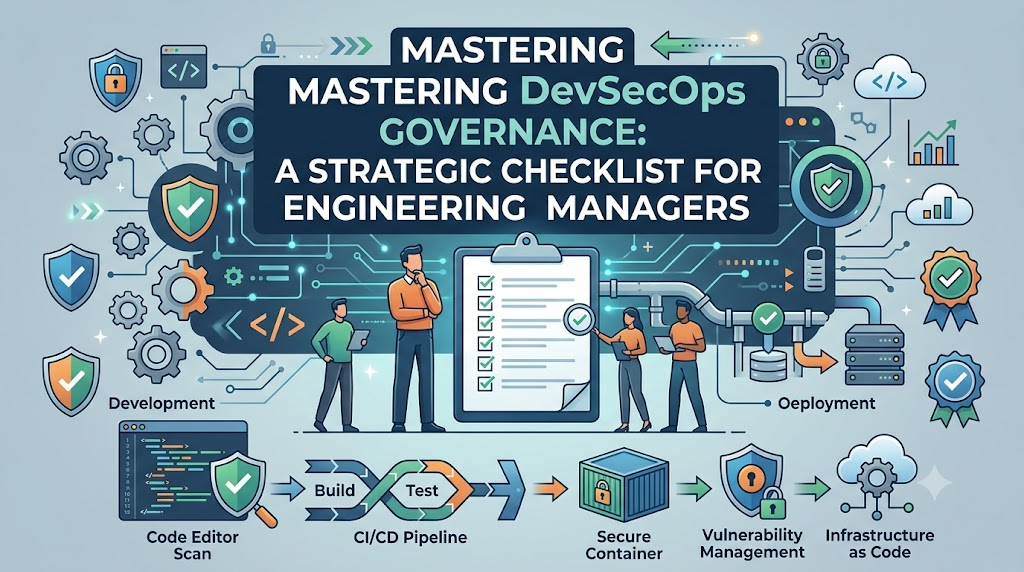
Introduction
In modern software engineering, the tension between velocity and security is a perennial challenge. Engineering leaders are often caught between the demand for rapid feature releases and the immutable requirement for robust security. Many organizations attempt to address this by simply telling developers to “be more secure,” which invariably leads to burnout, inconsistent security postures, and a reactive culture where vulnerabilities are patched long after they are introduced.
True DevSecOps is not merely a toolset or a cultural slogan; it is a discipline of systematic engineering. When security is left to ad-hoc processes or tribal knowledge, gaps inevitably emerge. These gaps are not usually due to a lack of talent, but a lack of structured, repeatable frameworks. To move beyond the chaos of manual security checks, engineering leaders must adopt a systematic approach, often utilizing advanced training and frameworks provided by institutions such as DevOpsSchool. By adopting a comprehensive DevSecOps checklist, organizations can move from a posture of “hope-based security” to one of “verified, engineered resilience.” This blog provides the leadership-level checklist necessary to operationalize security at scale.
Why Engineering Leaders Need a DevSecOps Checklist
Modern distributed systems are far too complex for any single engineer—or even a single team—to hold the entire security model in their head. When you have multiple microservices, elastic cloud infrastructure, and a rotating cast of third-party dependencies, security becomes an architectural problem.
Without a checklist, security execution relies on the individual judgment of every contributor. One engineer might prioritize IAM roles correctly, while another might inadvertently expose an S3 bucket because they were rushing to meet a deadline. This variance is the enemy of enterprise security.
Engineering leaders need checklists to serve as the “source of truth” for security standards. Think of it like a pilot’s pre-flight check. A pilot is highly skilled and experienced, yet they use a checklist because complexity increases the probability of human error. For an engineering manager or CTO, a DevSecOps checklist functions as the architectural blueprint that ensures every deployment, regardless of which team pushed it, adheres to the baseline security requirements of the organization.
Core Areas Covered in a DevSecOps Checklist
A robust DevSecOps strategy must cover the full lifecycle of software development. It cannot be localized to just the “ops” side or just the “dev” side.
- Application Security: The logic and dependencies within the code itself.
- Infrastructure Security: The hardening of the environments where code executes.
- CI/CD Pipeline Security: The integrity of the delivery mechanism.
- Cloud Security: Identity management and configuration governance.
- Governance & Compliance: The regulatory and internal policy alignment required for audit readiness.
DevSecOps Maturity Checklist for Leaders
Use this table to assess where your organization currently stands and where you need to move the needle.
| Maturity Area | Checklist Focus |
| Process Maturity | Are security requirements defined before the first line of code? |
| Automation Maturity | Is security testing triggered by code commits or manual requests? |
| Security Integration | Do tools report directly to developer dashboards, or in silos? |
| Monitoring Maturity | Are alerts actionable, or is there significant “noise” in logs? |
| Governance | Can you prove compliance for any build at any time? |
Secure SDLC Checklist
The Secure Software Development Life Cycle (SDLC) is the foundation of security. If your early stages are insecure, the downstream automation will only accelerate the delivery of vulnerable code.
- Requirements Security Validation: Define security requirements (e.g., data encryption at rest) during the backlog grooming phase.
- Design Threat Modeling: Perform lightweight threat modeling for every major feature update.
- Secure Coding Standards: Enforce linting and static analysis (SAST) as part of the IDE experience, not just the CI/CD pipeline.
- Security Gates: Implement automated “kill switches” in the pipeline that stop deployments if high-severity vulnerabilities are detected.
- Training & Awareness: Ensure every developer understands the OWASP Top 10 as it pertains to your tech stack.
CI/CD Security Checklist
The pipeline is the most critical asset in your engineering organization. If the pipeline is compromised, your entire production environment is at risk.
- Pipeline Integrity: Ensure build servers are ephemeral and hardened. Avoid long-lived “pet” build servers.
- Dependency Scanning: Automate software composition analysis (SCA) to detect vulnerabilities in third-party libraries before the build proceeds.
- Artifact Validation: Use digital signing for all container images and binaries. Verify signatures before deployment to production.
- Least Privilege Access: Ensure the CI/CD system has only the permissions required to deploy, not administrative rights to the entire infrastructure.
- Hardcoded Secrets: Implement pre-commit hooks to prevent developers from checking secrets or API keys into source control.
Infrastructure & Cloud Security Checklist
In the cloud, your infrastructure is defined as code. Therefore, infrastructure security is actually a code security problem.
- IAM Policies: Implement the principle of least privilege for all service accounts. Rotate keys automatically.
- Network Segmentation: Use VPCs, subnets, and security groups to isolate internal services from public endpoints.
- Secret Management: Utilize centralized secret managers (like HashiCorp Vault or cloud-native equivalents) rather than environment variables or hardcoded files.
- Configuration Compliance: Use Policy-as-Code to ensure all infrastructure deployments meet security baselines (e.g., no public read access on storage).
- Infrastructure as Code (IaC) Validation: Scan IaC templates (Terraform, CloudFormation) for security misconfigurations before deployment.
Monitoring & Incident Response Checklist
Security is not a static state; it is a dynamic operation. You must assume that vulnerabilities will be discovered, and incidents will occur.
- Security Logging: Ensure all audit-critical logs are centralized, immutable, and exported to a SIEM tool.
- Real-Time Alerting: Define specific thresholds for security alerts to avoid alert fatigue.
- Incident Response Playbooks: Have pre-defined runbooks for common scenarios like a compromised credential or a detected vulnerability in a production container.
- Post-Incident Reviews: Conduct blameless post-mortems to understand the systemic cause of security failures, not just the technical symptom.
- Drift Detection: Continuously monitor production infrastructure to detect “configuration drift” where manual changes have bypassed the CI/CD security controls.
Governance & Compliance Checklist
For leaders in regulated industries, “security” is often synonymous with “compliance.”
- Audit Readiness: Can you generate a report on who approved a change, who reviewed the code, and what tests passed for any production artifact?
- Policy Enforcement: Move security policies into code format so they are automatically enforced during the review process.
- Regulatory Alignment: Map your technical controls to the specific compliance frameworks relevant to your industry (e.g., SOC2, ISO 27001, HIPAA).
- Continuous Compliance: Shift from “point-in-time” audits to continuous monitoring of compliance status.
Real-World Example: Organization Without DevSecOps Checklist
Consider a mid-sized SaaS company where developers have “root” access to cloud environments. Security testing happens once a quarter, manually.
- Outcome: A developer accidentally pushes a misconfigured database with public read access.
- Result: The vulnerability exists for three weeks before a security consultant discovers it. The remediation requires a massive scramble, downtime, and a public relations crisis. This is “firefighting” mode.
Real-World Example: Organization Using DevSecOps Checklist
Consider an enterprise team that uses a rigorous DevSecOps checklist.
- Outcome: The same developer attempts to push the infrastructure code.
- Result: The pipeline’s IaC scanning tool detects the open security group rule and automatically blocks the build. The developer receives an immediate notification explaining the policy violation and a link to the correct configuration. The fix takes five minutes. The vulnerability never reaches production. This is “secure-by-design” mode.
Common Mistakes Engineering Leaders Make
- Treating Security as the Final Step: Trying to bolt on security at the end of the sprint cycle is ineffective and costly.
- Lack of Automation: If your security checklist is a physical document or a PDF that is checked manually, it will fail. It must be code.
- Ignoring Developer Experience: If security tools make the developer’s job significantly harder without clear benefits, they will bypass them.
- Over-complicated Policies: Security policies that are too restrictive lead to “shadow engineering,” where teams find workarounds to get their jobs done.
- No Measurable KPIs: If you cannot measure your mean time to remediate (MTTR) or the number of vulnerabilities caught in pre-production, you cannot improve.
Best Practices for Implementing DevSecOps Checklists
- Start with Critical Systems: Do not try to apply the checklist to everything at once. Focus on the core business services first.
- Automate Everything: Every checklist item should ideally be mapped to a tool, a test, or a gate in the pipeline.
- Integrate into Workflow: Meet developers where they work—integrate security feedback into Jira, GitHub, or Slack.
- Review Regularly: Security threats evolve. Your checklist should be a living document, reviewed quarterly by your senior engineering team.
- Align with Business Goals: Frame security improvements as “reliability improvements” or “operational efficiency” to gain executive buy-in.
Role of DevOpsSchool in DevSecOps Learning
As organizations mature, they often realize that technology is only half the battle; the other half is the mindset of the team. Leaders frequently turn to structured learning environments to ensure their teams share a common vocabulary and understanding of security frameworks. Programs focused on the technical nuances of DevSecOps—from CI/CD pipeline integrity to infrastructure governance—help bridge the gap between abstract policy and practical implementation. By engaging with structured educational resources, engineering leaders can ensure that the entire team understands not just the “how” of security tools, but the “why” of the security architecture.
Industries That Rely on DevSecOps Checklists
- Banking & Finance: High regulatory scrutiny requires strict audit trails and automated compliance.
- Healthcare: Protection of PII and PHI demands rigorous access controls and encryption management.
- SaaS: Rapid release cycles make automated security gates essential to prevent regression.
- E-Commerce: Massive scale and constant threat of bot attacks necessitate robust cloud and application security.
- Telecom: Infrastructure complexity requires automated configuration management to prevent systemic failures.
- Government Systems: High security requirements demand that every change is verified, tested, and documented.
Future of DevSecOps Governance
The future is moving toward “self-healing” pipelines. We are seeing the rise of AI-driven security enforcement, where models predict potential misconfigurations based on historical data. Policy-as-code is becoming the standard, allowing security teams to write compliance rules that the pipeline enforces automatically. The role of the engineering leader will shift from enforcing rules to defining the policy-as-code that machines then enforce at scale.
FAQs
1. What is a DevSecOps checklist?
It is a structured list of security controls, procedures, and validation steps that must be fulfilled throughout the software development lifecycle to ensure a secure, compliant release.
2. Why do engineering leaders need checklists?
They reduce human error, ensure consistency across distributed teams, and provide a measurable baseline for security maturity.
3. How does DevSecOps improve security?
By integrating security gates directly into the development pipeline, it identifies and fixes vulnerabilities early, reducing the cost and risk of remediation.
4. What should a CI/CD security checklist include?
It should include dependency scanning, secret management, artifact signing, least-privilege access, and automated configuration validation.
5. How do you measure DevSecOps maturity?
Through metrics like mean time to remediate (MTTR) vulnerabilities, deployment frequency, change failure rate, and the percentage of security tests automated.
6. Is automation required for DevSecOps?
Yes. Manual security checks do not scale in a modern DevOps environment. Automation is the only way to achieve consistent security at speed.
7. What is Secure SDLC?
It is the integration of security activities—such as threat modeling, code analysis, and testing—into every phase of the traditional software development lifecycle.
8. How often should checklists be updated?
They should be reviewed quarterly or whenever the architecture, tech stack, or compliance requirements undergo significant changes.
9. Can DevSecOps work without a dedicated security team?
While dedicated security expertise is valuable, the goal of DevSecOps is to empower developers to handle standard security tasks via automation, reducing the burden on central security teams.
10. How do you get developer buy-in for these checklists?
Focus on the developer experience. Ensure security tools are fast, provide clear remediation advice, and do not create unnecessary friction.
11. What is the difference between DevOps and DevSecOps?
DevOps focuses on the collaboration between development and operations to increase velocity; DevSecOps explicitly incorporates security as a core, automated part of that collaboration.
12. How does Policy-as-Code work?
It involves defining security policies in machine-readable code, which is then automatically evaluated against your infrastructure configuration to ensure compliance before deployment.
13. What is the “Shift Left” philosophy?
It means moving security testing as early as possible in the development process—ideally into the developer’s IDE or commit process—rather than at the end.
14. Does a checklist guarantee 100% security?
No. Security is about risk management. A checklist helps mitigate known risks and ensure a high baseline, but it cannot predict every zero-day vulnerability.
15. How do I start if my team is currently chaotic?
Start with a “Quick Wins” checklist. Pick the three most critical security risks in your environment and automate their detection first.
Final Thoughts
Security is not a final destination; it is a continuous state of operation. For engineering leaders, the goal is not to eliminate all risk—which is impossible—but to establish a predictable, measurable, and resilient system. A DevSecOps checklist is not just a document; it is the discipline that keeps your team focused on the right things. By standardizing these practices, you move your organization from being reactive to being proactive, ensuring that your delivery speed does not come at the cost of your system’s integrity. Leadership discipline is the differentiator between an organization that struggles with security and one that masters it.
