Limited Time Offer!
For Less Than the Cost of a Starbucks Coffee, Access All DevOpsSchool Videos on YouTube Unlimitedly.
Master DevOps, SRE, DevSecOps Skills!
Introduction
Implementing DevSecOps is often framed as a simple plug-and-play addition to existing software delivery pipelines. From my two decades in the trenches working as an architect and consultant, I can tell you it is anything but that. While the industry pushes the narrative of seamless, automated security, the reality for most organizations is a complex struggle involving cultural shifts, technical debt, and process re-engineering.
Many organizations jump into DevSecOps because of the hype, only to find themselves drowning in false positives, blocked deployments, and frustrated developer teams. The cost of these mistakes is not just financial; it is a loss of trust between engineering and security departments. To navigate this successfully, we must move away from the “tool-first” mindset and focus on the human and procedural elements that truly define security at scale.
In this guide, we will dissect the common DevSecOps implementation mistakes that stall progress and offer actionable strategies to build a resilient, secure, and developer-friendly pipeline. For those looking to master these concepts through structured training and real-world scenarios, resources at DevOpsSchool offer a foundational look at how these workflows operate in modern enterprise environments.
Why DevSecOps Implementations Often Fail
The primary reason DevSecOps implementations fail is the fundamental misunderstanding of the term itself. It is not just about adding security tools to a Jenkins or GitHub Actions pipeline. It is a philosophy of shared responsibility.
Most organizations fail because they treat security as a phase that can be automated away. They attempt to shoehorn security tools into existing processes that are already fragile. Without a change in culture, where developers feel empowered—not policed—by security, the implementation will inevitably hit a wall. When security becomes a blocker rather than an enabler, teams will find ways to bypass it, rendering your entire investment moot.
Common DevSecOps Mistakes Overview
| Mistake | Impact |
| Treating DevSecOps as only a tool problem | Cultural rejection and failed adoption |
| Adding security too late | Exponential increase in remediation costs |
| Overloading pipelines | Massive deployment delays and alert fatigue |
| Ignoring developer experience | High friction and security bypass attempts |
| Lack of training | Inability to fix vulnerabilities at the root |
| Too many security tools | High complexity and maintenance overhead |
| Ignoring secrets management | Direct path to catastrophic data breaches |
| No continuous monitoring | Blind spots in production environments |
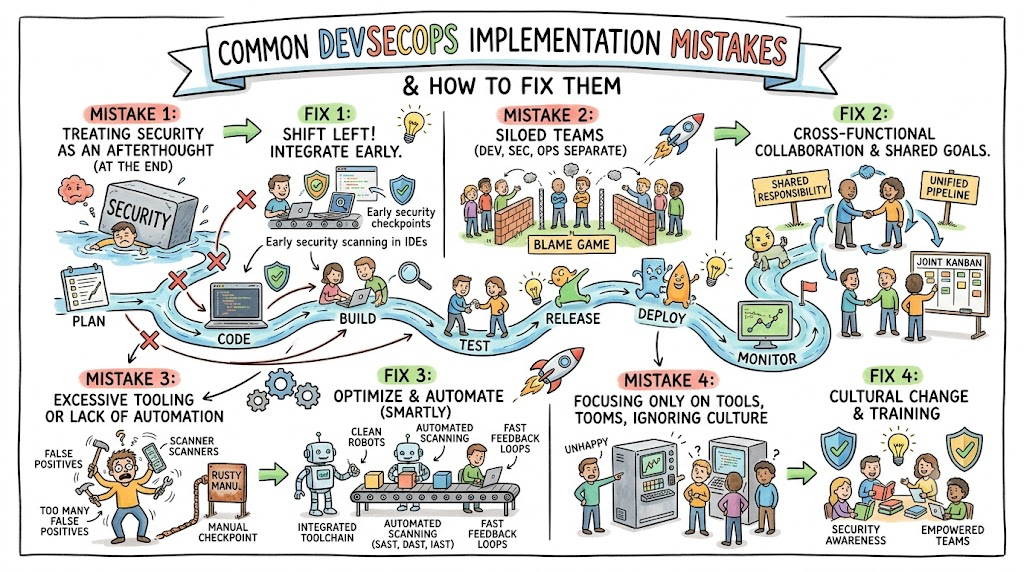
Mistake #1: Treating DevSecOps as Only a Tool Problem
The biggest pitfall I encounter is the belief that purchasing a suite of “Shift Left” security tools will magically secure an organization. Tools are simply accelerators for a process. If your process is broken, a tool will only accelerate the creation of garbage data.
In one enterprise scenario, a client bought a top-tier SAST (Static Application Security Testing) tool and mandated that all code must pass a 100% clean check. The result? The tool flagged thousands of minor issues, including legacy code written a decade ago. Developers were forced to spend 80% of their time fixing trivial warnings rather than shipping features. The project stalled because the culture of security—prioritization, risk appetite, and collaboration—had not been established before the tools were turned on.
Mistake #2: Adding Security Too Late
“Shifting Left” is a popular buzzword, but many teams treat it as “Shifting Left” only in name. They still develop code for months and then introduce security scans right before the release candidate phase. This is not DevSecOps; it is just traditional security with a different name.
True shift-left requires integrating security checks at the IDE level, in the pre-commit hooks, and within the initial build stages. When you wait until the end of the pipeline to run a scan, you are looking at remediation costs that are often 10x to 100x higher than if the issue had been caught during the coding phase.
Mistake #3: Overloading Pipelines With Security Scans
I have seen pipelines that take three hours to run because they execute every available security scan at every single commit. While thoroughness is admirable, it kills velocity.
A balanced approach is necessary. Run fast, lightweight scans on every commit (like secret detection and linting). Run deeper, more computationally expensive scans (like full DAST or dependency analysis) on a schedule or on specific branches (e.g., when merging to the main or release branch). Developers need feedback in minutes, not hours. If they have to wait an hour to know if their build passed, they will stop looking at the results entirely.
Mistake #4: Ignoring Developer Experience
Developer experience (DX) is the unspoken key to DevSecOps success. If your security implementation makes the developer’s life harder, they will fight it.
I once worked with a team where every security alert was sent as a high-priority ticket in Jira. This created “alert fatigue,” where the developers started ignoring notifications because there were simply too many. A better approach is to integrate feedback directly into their workflow—their IDE, their command line, or their pull request comments. If they have to switch context to a different tool to understand why their build failed, you have lost them.
Mistake #5: Lack of Security Training
You cannot expect a developer to write secure code if they do not know what secure code looks like. Often, organizations blame developers for insecure code while providing them zero training on secure coding practices (like OWASP Top 10 mitigation).
Security training should not be a one-time yearly compliance video. It needs to be practical, ongoing, and relevant to the technologies they use. When developers understand why a vulnerability is a risk, they become your greatest security asset.
Mistake #6: Too Many Security Tools
Complexity is the enemy of security. Managing a fleet of disparate security tools—SAST, DAST, SCA, IAST, Container Scanning, Infrastructure-as-Code (IaC) Scanning—is a full-time job.
Many teams suffer from the “best-of-breed” trap, where they acquire a different specialized tool for every tiny vulnerability type. This leads to integration hell, where data is siloed and cannot be correlated. Focus on platforms that can orchestrate these tools or provide a single pane of glass for all security findings.
Mistake #7: Ignoring Secrets Management
Secrets management is often the most neglected part of a DevSecOps implementation. Hardcoding API keys, database passwords, and service tokens in source code or CI/CD variable files is a recipe for disaster.
I have seen public repositories and internal CI logs leak production credentials because developers treated environment variables like configuration files. A robust secrets management strategy—using tools like HashiCorp Vault, AWS Secrets Manager, or Azure Key Vault—is mandatory. Secrets should be injected at runtime, not stored in the repository.
Mistake #8: No Continuous Monitoring
DevSecOps does not end when the code is deployed. Threat landscapes change daily. A library that was secure yesterday might have a new Zero-Day vulnerability discovered today.
Many organizations treat production as a “set and forget” environment. Continuous monitoring, including runtime protection and regular vulnerability scanning of running containers, is essential. You need to know when your production environment drifts from your secure baseline.
Real-World Example: Failed DevSecOps Implementation
A large financial firm attempted to implement DevSecOps by creating a “Security Committee.” This committee mandated that all pipelines must go through a rigid, manual security sign-off before deployment.
The result was predictable: The security team became a bottleneck. Developers stopped iterating, deployments slowed from daily to monthly, and the firm suffered a major outage because the emergency hotfix had to wait for a 48-hour security review. The team eventually abandoned the process, reverting to “fix it later,” which left the system even more exposed. This failed because they prioritized control over agility.
Real-World Example: Successful DevSecOps Implementation
Contrast this with a SaaS startup I advised. They started by automating the “low-hanging fruit.” They implemented automatic secret scanning in their PRs and dependency scanning in their builds.
They did not block builds initially; they just gathered data. Once they had visibility, they worked with the developers to identify the biggest risks and built automation to address those first. They fostered a culture where developers were rewarded for finding security bugs. By the time they implemented strict blocking policies, the developers already understood the tools, the process, and the value. This “crawl, walk, run” approach turned security into an engineering superpower.
How to Avoid DevSecOps Implementation Mistakes
- Start Small: Pick one application or microservice and optimize its security pipeline before scaling to the entire organization.
- Prioritize Automation: Automate only the tasks that provide high-value feedback. Avoid automating noise.
- Train Developers: Invest in hands-on security training that focuses on the tech stack your teams actually use.
- Reduce Alert Noise: Configure tools to show only high-confidence, actionable findings. Use deduplication to avoid showing the same issue multiple times.
- Build Collaboration: Create a “Security Champions” program where developers act as the bridge between the security and engineering teams.
Best Practices for Successful DevSecOps Adoption
- Shift-Left Gradually: Do not force a massive change overnight. Introduce security controls one layer at a time.
- Automate Intelligently: Use “Policy as Code” to define security requirements that the CI/CD pipeline can enforce automatically.
- Keep Pipelines Fast: Optimization of the pipeline is a security task. If it is slow, people will bypass it.
- Build a Security Culture: Encourage a blameless post-mortem culture. When a vulnerability is found, ask “How can we change the process to prevent this?” rather than “Who broke the build?”
- Measure Outcomes: Track metrics like Mean Time to Remediation (MTTR) and number of vulnerabilities caught in pre-production versus production.
Role of DevOpsSchool in Learning Practical DevSecOps
Gaining the skills to navigate these implementation challenges requires more than just reading documentation. It requires exposure to the messy, real-world constraints of actual software delivery.
At DevOpsSchool, the focus is on practical, hands-on learning. By working through labs that mirror enterprise CI/CD security environments, learners understand how to integrate tools without breaking pipelines. Understanding the ecosystem—from cloud-native security to automated governance—helps bridge the gap between being a tool-user and a true DevSecOps engineer. This is the difference between blindly implementing a tool and architecting a secure workflow.
Career Importance of DevSecOps Skills
The demand for professionals who understand the intersection of development and security is at an all-time high.
- DevSecOps Engineer: The bridge builder who integrates security into the pipeline.
- Security Engineer: Now evolving to understand infrastructure and code, not just policy.
- DevOps Engineer: Requires a deep understanding of security to maintain compliant infrastructure.
- Cloud Security Engineer: Essential for managing secure identities and data in the cloud.
- SRE Engineer: Increasingly involved in security monitoring and incident response.
These roles are no longer optional. Organizations are realizing that a single cloud misconfiguration can cost millions, making these skills highly lucrative and essential for long-term career growth.
Industries Facing DevSecOps Challenges
Certain industries are under more pressure than others:
- Banking & Finance: High regulatory scrutiny and target for attackers; they need the strictest controls.
- Healthcare: Protection of patient data (HIPAA/GDPR) requires rigid, auditable security pipelines.
- SaaS Platforms: Constant deployment cycles make them vulnerable to rapid attacks; speed and security are equally critical.
- E-Commerce: Transaction security and user privacy are the core of their business model.
- Government Systems: High standards of compliance and threat prevention.
Future of DevSecOps Implementation
The future of DevSecOps lies in intelligence and abstraction. We are moving toward:
- AI-powered security automation: Tools that do not just flag vulnerabilities but suggest the code fix.
- Policy as Code: Treating security policies like versioned software, making them auditable and scalable.
- Secure-by-Design: Moving security before the code, into the design phase of architecture.
- Cloud-Native DevSecOps: Security tools that are built into the fabric of Kubernetes and serverless platforms rather than bolted on top.
FAQs
- Why do DevSecOps projects fail?Usually due to cultural resistance and prioritizing tools over processes.
- What is shift-left security?The practice of moving security testing to the earliest possible stages of the development lifecycle.
- Are security tools enough?No, tools are only effective when backed by strong processes and a security-aware culture.
- Why do developers resist DevSecOps?They often see it as a hurdle to their productivity rather than an enabler of quality.
- How many security tools are needed?Only enough to cover your core risks. Focus on depth of coverage rather than breadth of tools.
- What is secrets management?The secure storage and controlled access of sensitive credentials like API keys and passwords.
- Is DevSecOps difficult to implement?Yes, because it requires changing how people work, which is harder than changing software.
- Can startups use DevSecOps?Yes, and they should. Starting early prevents the accumulation of technical and security debt.
- What is the role of a Security Champion?A developer who acts as a liaison, helping the security team understand dev constraints and vice-versa.
- Does DevSecOps slow down development?Poorly implemented DevSecOps does; well-implemented DevSecOps makes code safer and more reliable.
- What is Policy as Code?Defining security and compliance requirements in code, allowing for automated enforcement.
- Is training necessary for all developers?Yes, basic security awareness and secure coding skills are essential for everyone writing code.
- How do I measure DevSecOps success?Look at metrics like Mean Time to Remediation and the number of vulnerabilities found early vs. in production.
- Should I automate every security test?No, prioritize tests that provide high value and quick feedback.
- What is the most common mistake?Treating DevSecOps as a tool implementation project rather than a cultural and procedural evolution.
Final Thoughts
DevSecOps is not a product you buy or a certification you pass. It is a mindset you adopt. The mistakes I have outlined here—over-tooling, ignoring developers, and poor planning—are common, but they are avoidable.
When you focus on incremental improvements, prioritize developer experience, and foster a culture of shared responsibility, you move from just “securing” the pipeline to truly building resilient software. Keep your pipelines fast, your feedback loops short, and your eyes on the long-term goal of building a culture where security is naturally woven into the fabric of engineering. Success is found in the small, consistent habits, not in the big, noisy tools.
