Limited Time Offer!
For Less Than the Cost of a Starbucks Coffee, Access All DevOpsSchool Videos on YouTube Unlimitedly.
Master DevOps, SRE, DevSecOps Skills!
Introduction
Modern software engineering has evolved at a pace that was unimaginable two decades ago. We have moved from monolithic, quarterly release cycles to continuous deployment models where code changes move from an engineer’s laptop to production environments in minutes. While this agility has fueled innovation, it has also introduced significant surface area for security vulnerabilities.
In traditional software development, security was treated as a final gate—a hurdle to clear right before release. Today, that approach is a liability. As systems become more interconnected and cloud-native architectures become the standard, the old model of perimeter security no longer suffices. We need a methodology that evolves with the speed of development. This is where DevSecOps comes in. It is not just a trend; it is a critical requirement for any organization aiming to build secure, reliable software.
At DevOpsSchool, we have observed that successful engineering teams are those that treat security not as an afterthought, but as a fundamental component of the software development lifecycle. By integrating security early, teams can identify risks, automate compliance, and build trust with users. This article explores why DevSecOps in modern software engineering is no longer optional, providing a roadmap for engineers, managers, and organizations to adopt these essential practices.
How Modern Software Engineering Has Changed
To understand the necessity of DevSecOps, we must first look at the landscape of modern software engineering. The shift from physical servers to cloud-native environments has fundamentally changed how we build and ship software.
- Cloud-Native Systems: Most modern applications are built to run in the cloud, utilizing containers, orchestration tools like Kubernetes, and serverless functions. These architectures are ephemeral and highly dynamic, making static security measures obsolete.
- Faster Release Cycles: Continuous Integration and Continuous Deployment (CI/CD) pipelines allow teams to push updates multiple times a day. If security testing is manual or occurs at the end of this cycle, it inevitably acts as a bottleneck.
- Distributed Architecture: Microservices have replaced monolithic applications. While this improves scalability, it also means that the attack surface is distributed across hundreds of services, each requiring its own security posture.
In this environment, an engineer cannot wait for a security team to review their code manually. The sheer volume of changes makes such oversight impossible. Software engineering today relies on speed, and security must match that pace.
Why Traditional Security Approaches No Longer Work
Many organizations still cling to a “Water-Scrum-Fall” approach to security. In this model, development and operations teams work in an agile manner, but security is kept in a silo, often engaging only in the final stages of the development cycle.
Consider this realistic scenario: A development team spends three months building a new feature. They perform unit testing, integration testing, and performance testing. Finally, they submit the build to the security team for a penetration test. The security team finds critical vulnerabilities in the architecture. Now, the developers have to backtrack, refactor the code, and redeploy. This results in delayed releases, increased costs, and frustrated team members.
This “Gatekeeper” approach creates several problems:
- Slow Feedback Loops: Developers do not learn from their mistakes until weeks or months after the code was written.
- Security as a Blocker: Security teams become synonymous with “slowing things down,” leading to friction between departments.
- High Remediation Costs: Fixing a vulnerability in production is exponentially more expensive and time-consuming than fixing it during the design or development phase.
What Is DevSecOps?
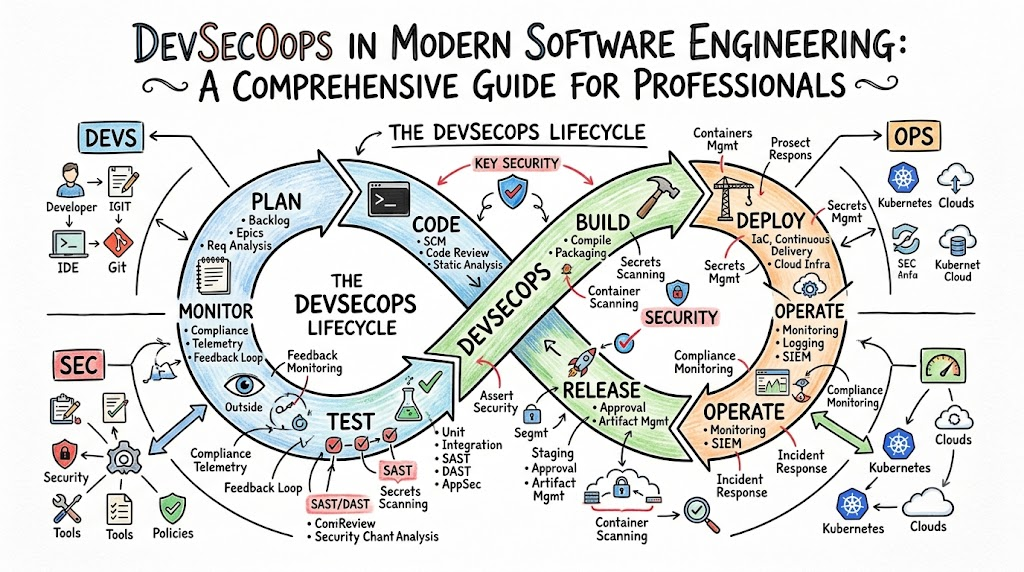
DevSecOps is the practice of integrating security best practices and automated tools into every stage of the DevOps pipeline. Instead of seeing security as a “quality gate” at the end of the process, DevSecOps treats security as a shared responsibility—the “Sec” in DevOps.
At its core, DevSecOps is about breaking down the silos between development, security, and operations teams. It is a cultural shift, supported by the right tools, that encourages engineers to write secure code from day one. It is not about replacing security professionals; it is about empowering developers and operations engineers to incorporate security into their daily workflows.
Why DevSecOps Is Critical for Modern Software Engineering
The following table summarizes the key areas where DevSecOps fundamentally shifts the paradigm of software delivery.
| Area | Traditional Approach | DevSecOps Approach |
| Security Testing | Done at the end (Manual) | Continuous (Automated) |
| Responsibility | Security Team Only | Shared (Dev + Ops + Sec) |
| Workflow | Security as a Gate | Security as an Enabler |
| Feedback Loop | Slow (Weeks/Months) | Instant (Minutes/Hours) |
| Infrastructure | Manual Configuration | Policy as Code |
| Risk Management | Reactive (Fixing breaches) | Proactive (Preventing issues) |
Area #1: Shift-Left Security
“Shift-Left” means moving security testing to the earliest possible stage of the development process. By performing security checks in the IDE, during the commit process, and in the build pipeline, developers get immediate feedback.
- Example: An engineer writes a piece of code that hardcodes a database password. A pre-commit hook runs a scanner locally, flags the issue, and prevents the commit before it ever reaches the shared repository.
Area #2: Faster Vulnerability Detection
In modern software, open-source libraries make up a large portion of our codebase. Manually tracking vulnerabilities in these dependencies is impossible. DevSecOps uses Software Composition Analysis (SCA) to automatically identify known vulnerabilities in dependencies during the build process.
Area #3: Secure CI/CD Pipelines
The CI/CD pipeline is the factory floor of software delivery. If the pipeline itself is insecure, it can be exploited to inject malicious code into the production environment. Secure CI/CD involves securing the build agents, signing artifacts, and ensuring only authorized users can trigger deployments.
Area #4: Infrastructure Security
With the rise of Infrastructure as Code (IaC), we define our servers, networks, and databases using configuration files. DevSecOps allows us to scan these files for misconfigurations (e.g., an open S3 bucket or an overly permissive firewall rule) before the infrastructure is even provisioned.
Area #5: Continuous Monitoring
Security does not end at deployment. Continuous monitoring involves tracking application logs, network traffic, and system behavior in real-time. If an anomaly occurs, the system can trigger automated alerts or even self-healing routines to contain the threat.
Area #6: Better Team Collaboration
DevSecOps fosters a culture where security is a team sport. Security engineers act as consultants rather than policemen, providing developers with the training, tools, and guardrails they need to build securely. This collaboration breaks down the “Us vs. Them” mentality.
Area #7: Compliance and Governance
Compliance is often seen as a bureaucratic burden. DevSecOps automates compliance by turning regulatory requirements into code. Instead of manual audits that happen annually, the system generates continuous audit trails, making it easy to prove compliance at any time.
Real-World Example: Team Without DevSecOps
Imagine a FinTech startup that does not prioritize DevSecOps.
- Development: Developers push code to the main branch without static analysis.
- Build: The build server compiles the code, but there are no automated security checks.
- Deployment: The application is deployed to production.
- Security Audit: Three weeks later, a third-party audit discovers that the application is vulnerable to SQL injection because of a flaw in the user input handling.
- Result: The team must stop all new feature development to fix the critical flaw, patch the database, and run extensive regression tests. The release cycle is halted for two weeks, and customer trust is damaged.
Real-World Example: Team Using DevSecOps
Now, consider a team that has integrated DevSecOps.
- Development: As the developer writes the code, their IDE warns them about the potential SQL injection vulnerability.
- Build: The CI pipeline runs a Static Application Security Testing (SAST) tool that catches the flaw in the build phase. The build fails, and the developer receives an automated notification.
- Fix: The developer fixes the code within minutes, commits, and pushes again.
- Deployment: The build passes all security gates and is deployed securely.
- Result: The vulnerability never reaches production. Feature development continues uninterrupted, and the team maintains a high velocity.
Benefits of DevSecOps in Software Engineering
- Faster Delivery: By catching bugs early and automating security testing, teams reduce the time spent on rework and “firefighting” production issues.
- Improved Security Posture: Proactive scanning and automated patching create a robust defense that is harder to penetrate.
- Lower Risk: By identifying vulnerabilities during development, the risk of a high-impact breach in production is significantly minimized.
- Higher Reliability: Security and stability go hand in hand. A secure system is generally a more stable, predictable system.
- Cost Efficiency: Automating security reduces the need for large manual security teams and minimizes the high costs associated with emergency patch deployments.
Challenges in DevSecOps Adoption
Adopting DevSecOps is not without its hurdles. It requires a fundamental shift in both technology and mindset.
- Tool Complexity: The market is flooded with security tools. Choosing the right ones and integrating them into an existing CI/CD pipeline can be overwhelming for teams.
- Cultural Resistance: Moving from a siloed model to a collaborative one requires a change in culture. Some team members may be resistant to taking on “more work” (security tasks) or relinquishing control.
- Skill Gaps: Developers are not typically trained in security, and security engineers may lack experience with modern DevOps tools. This requires significant investment in training and upskilling.
- False Positives: Automated security tools can sometimes be noisy, flagging non-issues as critical vulnerabilities. If not tuned properly, this can lead to “alert fatigue” where engineers start ignoring security warnings.
Common Misunderstandings About DevSecOps
It is important to clarify some common myths that can hinder adoption.
- Myth: Security slows down development.
- Reality: While manual security processes slow down development, automated DevSecOps integration speeds it up by preventing expensive rework.
- Myth: DevSecOps is just a collection of tools.
- Reality: Tools are only 20% of the solution. The other 80% is culture, process, and training.
- Myth: Developers do not need to know security.
- Reality: Security is everyone’s responsibility. Developers are the first line of defense.
- Myth: Only large enterprises need DevSecOps.
- Reality: Security breaches can destroy a startup. Every organization, regardless of size, needs a baseline security posture.
Best Practices for Implementing DevSecOps
If you are looking to introduce DevSecOps in your organization, follow this structured approach:
- Start Small: Do not try to automate everything at once. Begin by integrating one automated security scan into your CI/CD pipeline.
- Automate Everything: Wherever possible, use tools to automate testing, policy enforcement, and reporting.
- Train Your Team: Invest in security training for your developers. Help them understand common vulnerabilities (like the OWASP Top 10) and how to write secure code.
- Define Security Policies as Code: Treat your security policies like your software configuration. Keep them in version control so they are auditable and reproducible.
- Encourage Collaboration: Create forums where security engineers and developers can share knowledge. Make security part of the team’s definition of “Done.”
- Measure and Iterate: Track metrics like the “time to remediate” vulnerabilities. Use this data to improve your processes continuously.
Role of DevOpsSchool in Learning DevSecOps
Learning the nuances of DevSecOps requires more than just reading documentation; it requires hands-on experience in a simulated or real-world engineering environment. At DevOpsSchool, we emphasize a pragmatic, learning-by-doing approach.
We recognize that the modern engineer needs to understand not just how to deploy code, but how to deploy it securely. Our programs focus on:
- Security-Focused Learning: We integrate security principles into every course module, ensuring that DevOps is always taught with security in mind.
- Practical CI/CD Exposure: Students work with industry-standard CI/CD tools, learning how to configure security gates and automated testing.
- Real-World Engineering Mindset: We simulate real-world challenges, teaching students how to balance security requirements with business delivery goals.
By focusing on labs and practical scenarios, we help engineers transition from theoretical knowledge to professional application, making them assets to any team adopting DevSecOps practices.
Career Importance of DevSecOps Skills
The demand for professionals who understand DevSecOps is skyrocketing. Organizations are realizing that they cannot hire enough security specialists to “guard” their infrastructure; they need engineers who can “build” securely.
- DevSecOps Engineer: A dedicated role focused on building security into the pipeline. This is one of the highest-paying roles in the industry.
- Security Engineer: Modern security engineers are no longer just auditors; they are now building platforms and tools to enable developers.
- DevOps Engineer: DevOps engineers who understand security are far more employable and capable of handling complex cloud architectures.
- Cloud Security Engineer: Specialized roles focusing on securing cloud environments (AWS, Azure, GCP).
- SRE Engineer: Site Reliability Engineers are increasingly responsible for the security and stability of the platform, making DevSecOps skills essential.
Developing these skills signals to employers that you understand the full lifecycle of software—not just how to write code, but how to do it safely and sustainably.
Industries Adopting DevSecOps
While DevSecOps is beneficial for any software-driven business, it is mission-critical in industries where the cost of failure is high.
- Banking & Finance: Financial institutions must adhere to strict regulatory compliance and protect sensitive customer data. DevSecOps provides the automated audit trails and security controls they require.
- Healthcare: With the shift to digital health records and telehealth, healthcare providers must protect patient privacy. DevSecOps ensures data protection is baked into the architecture.
- SaaS Platforms: SaaS companies survive on trust. A security breach can lead to massive churn and loss of reputation. DevSecOps helps them maintain the high uptime and security standards their customers expect.
- E-Commerce: Managing payment gateways and personal user data makes e-commerce sites attractive targets. DevSecOps secures these platforms against common attacks.
- Telecom: With 5G and edge computing, telecom networks are becoming software-defined, requiring deep integration of security and operations.
Future of DevSecOps in Software Engineering
The future of DevSecOps is evolving alongside advancements in technology. We are moving toward:
- AI-Assisted Security: Machine learning models are becoming better at identifying patterns of malicious activity and suggesting code fixes before the developer even commits.
- Policy as Code: Automated governance tools will continue to evolve, making it easier to enforce security policies globally across large, distributed cloud environments.
- Zero Trust Architecture: The concept of “never trust, always verify” will become the standard, with DevSecOps providing the automation to enforce these checks at every level.
- Advanced Automation: We will see more “self-healing” infrastructure that can identify a compromised node and automatically rotate credentials or rebuild the environment without human intervention.
FAQs
1. Why is DevSecOps important for modern software? It allows teams to deliver software faster while minimizing security risks by integrating security controls directly into the development pipeline.
2. What is shift-left security? It is the practice of performing security testing earlier in the development lifecycle, typically in the IDE or CI/CD pipeline, rather than at the end.
3. Can beginners learn DevSecOps effectively? Yes, but it requires a solid foundation in DevOps practices first. Start by learning basic security principles and automation tools.
4. Does DevSecOps actually slow down delivery? No. While there is an initial investment in setting up automation, it speeds up delivery by preventing costly rework and security bottlenecks.
5. What tools are commonly used in DevSecOps? Tools vary, but common categories include SAST (Static Analysis), DAST (Dynamic Analysis), SCA (Software Composition Analysis), and Infrastructure as Code scanners.
6. Is DevSecOps only for large enterprises? No. Startups benefit significantly from it because they often lack the resources to handle large-scale security breaches.
7. Why do developers need to learn security? Developers are responsible for the code being written; understanding how to secure that code prevents vulnerabilities before they reach production.
8. What is a secure CI/CD pipeline? It is a pipeline designed to ensure that code is scanned, verified, and signed throughout the build, test, and deployment phases.
9. Is there a difference between DevOps and DevSecOps? DevOps focuses on speed and collaboration between development and operations. DevSecOps adds security as an explicit, integrated requirement to that relationship.
10. How does DevSecOps handle compliance? It automates compliance by turning regulatory requirements into code, allowing for continuous monitoring and automated reporting.
11. What is the biggest challenge in adopting DevSecOps? Cultural resistance. Changing how teams work and share responsibility is often harder than choosing the right tools.
12. How do I start with DevSecOps if my team is resistant? Start by demonstrating the “WIIFM” (What’s In It For Me) value to developers: fewer production bugs, less firefighting, and easier releases.
13. Does DevSecOps replace the security team? No, it changes the role of the security team from a “gatekeeper” to an “enabler” who provides tools and expertise to developers.
14. What are the first steps to automate security? Begin by integrating simple linting or container scanning into your CI/CD pipeline.
15. Is DevSecOps relevant for on-premise applications? Yes. While cloud-native systems benefit the most, the principles of automated testing and policy enforcement are applicable to any software environment.
Final Thoughts
DevSecOps is not just another industry buzzword; it is the natural evolution of software engineering. As our systems grow in complexity and speed, we simply cannot afford to keep security on the sidelines. By integrating security into the DNA of our development process, we build more resilient, reliable, and trustworthy software.
For any modern engineer, understanding DevSecOps is a career-defining skill. It moves you from being a coder who delivers features to an architect who builds robust, enterprise-grade systems. Security must become part of engineering. Early fixes reduce risk, collaboration strengthens reliability, and the right mindset is the best tool you can possess. Keep learning, keep automating, and keep building securely.
