Limited Time Offer!
For Less Than the Cost of a Starbucks Coffee, Access All DevOpsSchool Videos on YouTube Unlimitedly.
Master DevOps, SRE, DevSecOps Skills!
Introduction
In the current digital landscape, the speed of software delivery has become the primary metric for business success. Companies are releasing features, updates, and patches at a pace that was unimaginable a decade ago. However, this velocity often creates a significant tension with security. For years, security was a final checkpoint, a gatekeeper that existed outside the development lifecycle. Today, that model is failing. The modern approach, known as DevSecOps, aims to integrate security practices into the entire software development lifecycle (SDLC).
Yet, adopting this model is far easier said than done. I have spent over two decades in this industry, working with teams ranging from agile startups to massive, legacy-laden financial institutions. If there is one thing I have learned, it is that DevSecOps is not just about buying a security tool or hiring a few specialized engineers. It is about a fundamental shift in how teams operate, communicate, and perceive risk.
Organizations frequently find themselves stuck in the “middle ground”—they have automated their build pipelines, but their security posture remains fragmented. They face resistance from teams, confusion over tool selection, and the constant friction between “going fast” and “being secure.” Understanding these DevSecOps adoption challenges is the first step toward overcoming them.
For those looking to gain hands-on expertise or formal training to bridge these gaps, DevOpsSchool provides comprehensive pathways to mastering these complex integrations, helping teams move from theory to practical implementation. In this article, I will break down the five most common barriers teams face and, more importantly, share practical, experience-driven solutions to help you successfully navigate your own transformation.
What Is DevSecOps?
At its core, DevSecOps is the practice of integrating security testing, compliance, and risk management into every phase of the software development process. It is the natural evolution of DevOps. While DevOps broke down the silos between Development and Operations, DevSecOps brings Security into that same collaborative ecosystem.
The fundamental mindset here is “Shift-Left Security.” This means moving security considerations from the end of the development cycle (often right before release) to the very beginning (design and coding).
Think of it like this: In a traditional setup, you build a house, finish the walls, install the electricity, and then ask a security inspector to come in. If the inspector finds the electrical wiring unsafe, you have to tear down the walls to fix it. This is expensive and slow. In a DevSecOps model, the security inspector is part of the construction crew from day one. They review the blueprints, monitor the wiring installation as it happens, and ensure compliance before the walls are ever closed.
By adopting DevSecOps, organizations aim to:
- Identify vulnerabilities during the coding phase rather than in production.
- Automate security compliance to prevent human error.
- Foster a culture where security is a shared responsibility, not just the job of a siloed “security team.”
Why DevSecOps Adoption Is Challenging
If DevSecOps is objectively better for the business, why is it so hard to implement? The challenge lies in the fact that you are changing the behavior of human beings and the established inertia of legacy systems.
- Organizational Complexity: Large enterprises often have established hierarchies where development, operations, and security teams report to different leadership. Getting them to align on goals is a management challenge, not just a technical one.
- The Skill Gap: There is a scarcity of professionals who truly understand both the complexities of cloud-native development (Kubernetes, CI/CD, Microservices) and the intricacies of offensive and defensive security.
- Fast Delivery Expectations: Business leadership demands faster releases. When security is perceived as an impediment to speed, it is often bypassed or pushed to the end, defeating the purpose of DevSecOps.
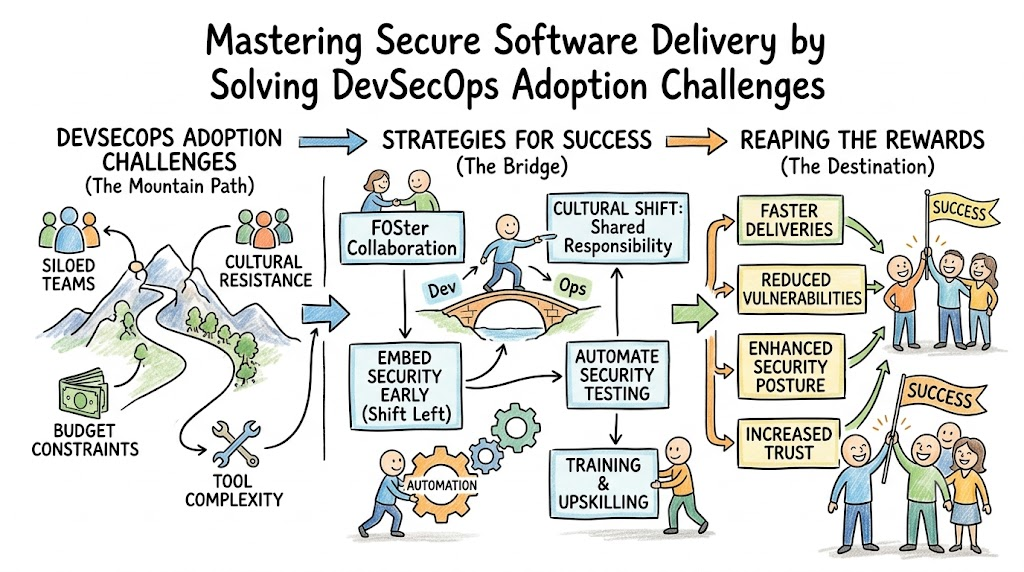
Overview Table: 5 Common DevSecOps Adoption Challenges
| Challenge | Impact | Solution |
| Cultural Resistance | Siloed teams, finger-pointing, and low morale. | Shared responsibility model and collaborative culture building. |
| Lack of Skills | Insecure code, slow adoption, and technical debt. | Continuous learning, cross-team mentoring, and hands-on training. |
| Tool Complexity | Analysis paralysis, integration nightmares, and high costs. | Start simple, standardize tooling, and consolidate the toolchain. |
| Slow Security Processes | Development bottlenecks and “Security says NO” syndrome. | Shift-left automation, automated gated checks, and self-service. |
| Weak Automation Strategy | Human error, inconsistency, and missed vulnerabilities. | Policy-as-code, automated scanning, and CI/CD integration. |
Challenge #1: Cultural Resistance to Security Integration
This is, without a doubt, the most difficult hurdle. For years, the Development team was measured on “speed of delivery” (KPI: Deployment Frequency), while the Security team was measured on “risk avoidance” (KPI: Number of Vulnerabilities found). These goals are fundamentally misaligned.
Workplace Scenario:
Imagine a developer, Sarah, has been working for three weeks on a new feature for the mobile app. She submits her code to be deployed. The Security team runs a manual scan, finds a configuration issue, and rejects the deployment. Sarah has to pause her current work to fix a problem from three weeks ago. She feels frustrated, and the Security team feels like the “police.”
Solution:
- Shared Responsibility Model: Move away from “Security is the Security Team’s job.” Make security a requirement for “Done.” If a feature isn’t secure, it isn’t considered complete.
- Security Awareness Training: Do not just run boring compliance videos. Bring developers into security incident response discussions. Let them see the impact of a breach firsthand.
- Incentive Alignment: Ensure the Security team is also measured on “Velocity” or “Enablement,” not just risk avoidance.
Challenge #2: Lack of DevSecOps Skills
The demand for security professionals who understand how to code or interact with a CI/CD pipeline is vastly higher than the supply. We often see developers who know how to build features but don’t understand how to secure them, and security professionals who understand threats but don’t know how to navigate a Kubernetes cluster.
Discussion:
CI/CD security is not just about running a script; it is about understanding how to secure the supply chain. If your team does not understand the difference between SAST (Static Application Security Testing) and DAST (Dynamic Application Security Testing), they will struggle to choose the right tools.
Solution:
- Continuous Learning: Invest in upskilling. Encourage developers to take certifications in cloud security.
- Cross-Team Mentoring: Pair a developer with a security engineer for a sprint. This “shadowing” approach builds empathy and knowledge transfer in both directions.
- Focus on Fundamentals: Don’t try to learn every tool at once. Focus on the basics of Cloud Security, Container Security, and CI/CD security workflows.
Challenge #3: Tool Complexity and Overload
I have seen organizations purchase a dozen expensive security tools, thinking it would solve their problems. Instead, they ended up with a “tool swamp.” Every tool generates alerts, and developers are overwhelmed by thousands of false positives.
Discussion:
If you have a Jenkins pipeline, a SonarQube installation for quality, a Snyk tool for dependency scanning, and a cloud-native tool for Kubernetes scanning, the integration fatigue is real. If the tools don’t talk to each other, the data becomes noisy.
Solution:
- Start Simple: You do not need to automate everything on day one. Start with one area, such as Dependency Scanning. Master that, then move to others.
- Standardize Tooling: Choose a platform-based approach where possible to reduce context switching.
- Focus on High Fidelity: Turn off the noise. If a tool reports too many false positives, tune the rules until the alerts are actionable.
Challenge #4: Security Slowing Development
The perception that “Security = Slow” is a common killer of DevSecOps adoption. If a developer has to wait for a manual review that takes three days, they will bypass it, use a shadow IT service, or simply ignore the request.
Workplace Scenario:
A team wants to deploy a hotfix to production. They need to get approval from the manual Change Advisory Board (CAB). The CAB meeting is on Friday. It is Tuesday. The team sits idle or pushes a risky fix through an unofficial channel.
Solution:
- Shift-Left Security: Move the check earlier. If the check is automated in the commit phase, the developer gets feedback in minutes, not days.
- Automated Gated Checks: If the automated scan passes, let the code pass through to production. Reserve manual reviews only for complex architectural changes, not minor bug fixes.
Challenge #5: Weak Automation Strategy
Automation is the engine of DevSecOps. However, a weak strategy—or trying to automate a broken, manual process—is a recipe for failure. If you automate a process that requires human judgment, the automation will fail.
Practical Examples:
Trying to automatically approve all security patches without any context, or relying on scripts that no one maintains. This leads to “brittle” pipelines where one change breaks the entire security workflow.
Solution:
- Policy-as-Code: Define your security rules in code (e.g., OPA – Open Policy Agent). This allows security policies to be versioned, tested, and audited just like application code.
- Continuous Scanning: Move from “scheduled weekly scans” to “continuous scanning on every pull request.”
- Feedback Loops: Ensure that when an automation fails, the developer knows exactly why and how to fix it immediately within their IDE.
Real-World Example: Failed DevSecOps Adoption
Let’s look at a case study of “Company X.” They were a mid-sized e-commerce platform. They decided to implement DevSecOps overnight. They bought three expensive security tools, mandated that all developers attend a one-day security seminar, and implemented a strict “fail-stop” policy in their CI/CD pipeline.
The Result:
- Deployment frequency dropped by 60%.
- Developers were inundated with thousands of security alerts, 90% of which were irrelevant.
- The Security team spent all their time triaging noise rather than helping developers.
- The project was abandoned after six months because the business could not release features fast enough.
The Lesson:
They tried to force a cultural and technical change without building the foundation. They prioritized the tools over the process and the people.
Real-World Example: Successful DevSecOps Transformation
Now, look at “Company Y.” They took a different approach. They started with one small team—the “payments team.” They introduced a single security tool (Dependency Scanning) into their CI/CD pipeline.
The Strategy:
- They engaged the developers in choosing the tool.
- They set the tool to “log-only” mode for the first month to tune out false positives.
- Once the noise was low, they turned on the “gate” for high-severity vulnerabilities only.
- They celebrated the small wins (e.g., catching a critical library vulnerability before it reached production).
The Result:
The payment team saw that security helped them deliver more stable code. Other teams saw this success and started asking how they could adopt the same practices. The transformation was organic, measurable, and sustainable.
Role of Shift-Left Security in Solving Challenges
Shift-left is the antidote to the “Security-is-a-bottleneck” problem. By performing security testing earlier in the development lifecycle, you enable developers to resolve issues while the code is fresh in their minds. It is far cheaper and faster to fix a bug in the IDE than it is to patch a vulnerability in a production environment.
Practical Scenario:
Instead of a Security Engineer running a vulnerability scan on a completed container image, the developer runs a local scan using a CLI tool before they even push the code to the repository. The vulnerability is caught at the developer’s workstation. This creates a culture of “Fix it now, move on,” rather than “Push it now, break later.”
Common Beginner Misunderstandings
When starting out, it is easy to fall into traps. Here is a checklist to keep in mind:
- Myth: DevSecOps replaces DevOps.
- Fact: DevSecOps is an extension of DevOps, not a replacement. You cannot have effective DevSecOps without a solid DevOps foundation.
- Myth: Security belongs only to the Security team.
- Fact: Security is a shared responsibility. The security team acts as enablers, providing the tools and policies, but developers own the code.
- Myth: More tools solve everything.
- Fact: Complexity is the enemy of security. A few well-integrated, high-quality tools are better than a dozen siloed tools.
- Myth: Automation removes manual responsibility.
- Fact: Automation handles the heavy lifting, but humans must still define the policies, review the exceptions, and handle the complex edge cases.
Best Practices for Successful DevSecOps Adoption
To ensure your adoption strategy sticks, follow these best practices:
- Start Small: Pick one application or one team as a pilot.
- Train Teams: Invest in your people. They are your greatest security asset.
- Automate Wisely: Do not automate everything at once. Focus on the most frequent and risky tasks first.
- Measure Outcomes: Track metrics like “Time to Remediate” and “Deployment Frequency.” If security efforts are slowing down delivery, you are likely doing it wrong.
- Encourage Collaboration: Create “Security Champions” within development teams—developers who have an interest in security and can act as the first point of contact.
Role of DevOpsSchool in Learning DevSecOps
Building a DevSecOps practice requires more than just reading articles; it requires hands-on experience and expert guidance. DevOpsSchool is designed to help professionals and teams bridge the gap between theoretical knowledge and practical execution. By focusing on real-world secure delivery mindsets, cloud-native security practices, and practical automation, they provide the ecosystem necessary for mastering these transitions. Whether you are an individual developer or a leader looking to transform your organization, the structured learning paths offer the exposure needed to handle modern security automation challenges.
Career Importance of DevSecOps Skills
The industry is currently in a state where “Security Engineer” and “DevOps Engineer” are merging into a hybrid role. Organizations are desperate for talent that can build and secure infrastructure simultaneously.
- DevSecOps Engineer: The bridge builder. You understand the architecture and how to secure the pipeline.
- Cloud Security Engineer: Specializing in securing the cloud control plane (AWS, Azure, GCP).
- Security Engineer: Moving from manual review to programmatic security enforcement.
- SRE (Site Reliability Engineer): Security is now a core component of “Reliability.” If it isn’t secure, it isn’t reliable.
Developing these skills now puts you in a top-tier bracket of employability in the IT sector.
Industries Benefiting from DevSecOps
While every industry needs security, these sectors are currently leading the adoption:
- Banking & Finance: They have the strictest compliance requirements and are naturally leading in shift-left.
- Healthcare: Dealing with sensitive patient data makes DevSecOps mandatory for privacy regulations.
- SaaS Platforms: Speed is their lifeblood, but breaches are their death knell.
- E-Commerce: Protecting customer transactions requires constant, automated security monitoring.
- Telecom: Managing massive infrastructure at scale requires the automation that DevSecOps brings.
Future of DevSecOps Adoption
The future of DevSecOps lies in AI-assisted security. We are moving toward models where AI will not only detect vulnerabilities but suggest the code fixes, integrate them into the pull request, and verify the patch. Furthermore, Policy-as-Code will become the standard for compliance, making “audits” a continuous, automated process rather than a painful annual event.
FAQs
- What are common DevSecOps adoption challenges?The top challenges include cultural resistance, lack of specialized skills, tool overload, slow security processes, and ineffective automation strategies.
- Why is DevSecOps hard to implement?It requires a cultural shift where developers and security teams must align their goals, moving away from siloed working environments.
- What is shift-left security?It is the practice of moving security testing and compliance checks earlier into the development lifecycle, closer to the design and coding phases.
- Does DevSecOps slow development?Ideally, it speeds it up. While initial implementation can cause friction, effective automation reduces long-term rework and prevents costly production vulnerabilities.
- Can beginners learn DevSecOps?Yes, but it is best to start by mastering foundational DevOps and basic security principles before diving into advanced cloud-native security tools.
- Why is automation important in DevSecOps?Automation removes human error, provides consistency, and ensures that security checks happen on every single change without requiring manual intervention.
- What tools are used in DevSecOps?Common tools include CI/CD platforms like Jenkins/GitLab CI, security scanners like SonarQube/Snyk, and container security tools like Aqua or Prisma Cloud.
- How do organizations start DevSecOps?Start small with a pilot team, choose one manageable security focus area, and build a culture of shared responsibility before scaling.
- What is a “Security Champion”?A Security Champion is a developer or team member who acts as a liaison between the security team and their development team, advocating for security best practices.
- How does DevSecOps improve compliance?By using Policy-as-Code, organizations can automatically enforce compliance rules and generate audit logs, making the compliance process continuous.
- Do I need to be a security expert to learn DevSecOps?No, you can start by learning how to secure the CI/CD pipeline and then gradually expand your security knowledge.
- What if the Security team resists?Focus on collaboration, not confrontation. Show them how automated security can reduce their workload and free them to work on more complex, high-value security tasks.
- Is DevSecOps just about tools?No, tools are only a small part. Culture and communication are the primary drivers of successful adoption.
- How do I measure DevSecOps success?Look at metrics such as the number of vulnerabilities found in pre-production versus production, mean time to remediate, and deployment frequency.
- What is the first step after deciding to adopt DevSecOps?Assess your current team culture and identify the biggest bottleneck in your delivery pipeline.
Final Thoughts
Adopting DevSecOps is a journey, not a destination. You will face resistance, you will encounter technical hurdles, and you will have to learn new things every day. That is the nature of our field.
Remember that the goal is not to have perfect security—that is impossible. The goal is to build a process that is resilient, scalable, and secure enough to support the speed your business demands. Focus on your people, prioritize collaboration over tooling, and treat security as an enabler of speed, not an obstacle to it. If you keep these principles at the heart of your transformation, you will overcome the challenges and build a sustainable DevSecOps culture.
