Limited Time Offer!
For Less Than the Cost of a Starbucks Coffee, Access All DevOpsSchool Videos on YouTube Unlimitedly.
Master DevOps, SRE, DevSecOps Skills!
Introduction
In the past two decades of engineering and architectural practice, I have witnessed a fundamental shift in how we deliver software. Years ago, security was an isolated gatekeeper at the end of the development lifecycle—a toll booth that software had to pass through before deployment. This model simply does not function in the modern era of rapid, iterative release cycles.
Today, the complexity of modern software delivery—characterized by microservices, cloud-native infrastructure, and continuous integration—demands a shared responsibility model. Security cannot be the sole concern of a centralized security team; it must be woven into the fabric of the entire development process. This is where the concept of Security Champions becomes critical.
Security Champions are not just another job title; they are the bridge between development, operations, and security. They are the individuals embedded within engineering teams who possess the knowledge, authority, and passion to advocate for secure coding practices and proactive risk management.
To truly master the nuances of building these programs, teams often look toward comprehensive training and structured guidance. Resources like DevOpsSchool provide the necessary framework for engineers and security professionals to learn these practices, understand secure CI/CD pipelines, and implement cloud-native security strategies effectively.
In this guide, we will explore the role of Security Champions in DevSecOps teams, how they operate, and why they are the key to building a robust, secure software delivery culture.
What Are Security Champions?
At their core, Security Champions are developers, DevOps engineers, or SREs who have an interest in security and take on the responsibility of advocating for it within their specific teams. They are not necessarily full-time security professionals, though they often work closely with the security organization.
Think of them as the primary security advocates on the ground. When a team is writing code, a Security Champion is the one asking, “What happens if this input is not validated?” or “How does this service authenticate with the database?”
Organizations create Security Champion programs to distribute security knowledge. Instead of having a security team of ten people trying to audit the work of five hundred developers, you empower one person in every squad to handle basic security reviews, threat modeling, and code guidance. This creates a distributed network of expertise that scales effectively with the organization.
Why Security Champions Matter in DevSecOps
In a DevSecOps environment, speed is essential, but security is non-negotiable. Without Security Champions, teams often rely on periodic penetration tests or automated scanning tools that lack context, leading to long feedback loops and “security friction.”
Security Champions matter because they solve the following problems:
- Faster Security Adoption: Because the Champion sits within the team, they are present during sprint planning and daily standups. They do not need to wait for a security ticket to be reviewed; they are part of the conversation from the start.
- Reduced Vulnerabilities: By having a security-minded individual involved early, common vulnerabilities like injection flaws or insecure configurations are caught before the code is even committed to the repository.
- Better Collaboration: They break down the “us vs. them” wall between security teams and engineering teams. They translate security requirements into developer-friendly language.
- Security Ownership: When a team has a designated Champion, ownership of the code’s security increases. The team stops viewing security as “someone else’s job” and starts viewing it as a component of code quality.
Security Champions vs Traditional Security Teams
The following table highlights the difference in operational models between utilizing Security Champions and relying solely on traditional, centralized security teams.
| Area | Security Champions | Traditional Security Teams |
| Role | Embedded, collaborative, ongoing | Centralized, auditor-like, periodic |
| Focus | Prevention, coaching, design-time | Detection, audit, remediation-time |
| Team Involvement | Daily sprint integration | Engaged at release milestones |
| Security Ownership | Shared across engineering teams | Isolated to the security department |
| Speed of Feedback | Real-time (during coding/planning) | Delayed (during testing phases) |
| Collaboration Model | Peer-to-peer mentoring | Compliance-based directives |
Core Responsibilities of Security Champions
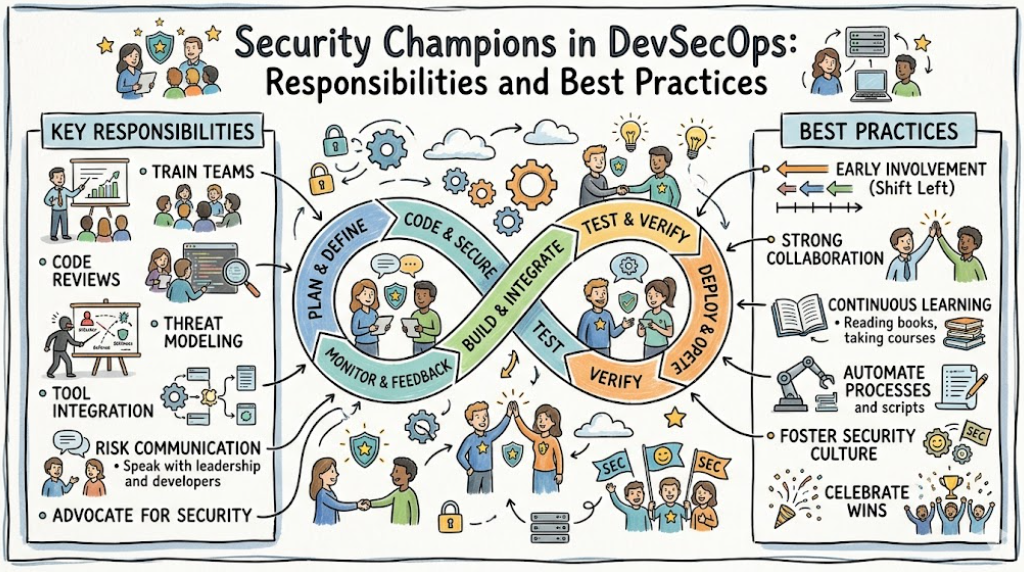
The responsibilities of a Security Champion are balanced between technical execution and cultural advocacy. They act as the “security conscience” of their respective teams.
Secure Coding Advocacy
They promote the use of secure coding standards. They guide their peers in avoiding anti-patterns and encourage the use of proven security libraries and frameworks.
Vulnerability Awareness
They are responsible for staying updated on the latest security trends, common vulnerabilities in their tech stack, and emerging threats. They ensure that their team is aware of these risks.
Threat Modeling Support
They facilitate light-weight threat modeling exercises during the design phase of new features. By mapping out potential attack vectors early, the team can design security into the architecture rather than patching it later.
CI/CD Security Integration
They work with DevOps engineers to ensure that security tooling is integrated into the CI/CD pipeline. This includes managing static analysis (SAST), dynamic analysis (DAST), and dependency scanning tools to ensure they provide actionable results rather than noise.
Knowledge Sharing
They serve as the main point of contact for the central security team and facilitate the flow of information back to their engineering squad.
How Security Champions Improve DevSecOps
The impact of Security Champions on the software delivery lifecycle is measurable through improved efficiency and higher quality code.
| Responsibility | DevSecOps Benefit |
| Threat Modeling | Prevents architectural security flaws before coding begins. |
| SAST/DAST Triage | Reduces false positives and prioritizes critical fixes. |
| Code Review | Catches insecure patterns during peer review, saving rework. |
| Dependency Management | Ensures libraries are patched and updated promptly. |
| Security Training | Builds long-term expertise within the development team. |
Shift-Left Security
Shift-left security is the practice of moving security checks as early in the development lifecycle as possible. Security Champions are the primary engine for this shift. By educating developers on how to write secure code from the first line, the team spends less time fixing vulnerabilities after they have been deployed, resulting in faster and more secure releases.
Role of Security Champions in CI/CD Pipelines
In a mature CI/CD environment, security is automated. However, automation often generates noise. The Security Champion’s role here is vital:
- Code Scanning Tuning: They work to refine SAST/DAST rules so that the pipeline only breaks for genuine, high-risk vulnerabilities, preventing developer fatigue.
- Dependency Checks: They ensure that the team is alerted to known vulnerabilities in third-party libraries (SCA) and establish a process for updating them.
- Container Security: They help define and maintain secure base images for containers and ensure that infrastructure-as-code (IaC) templates are scanned for misconfigurations.
- Policy Enforcement: They help configure guardrails that prevent insecure code from being merged or deployed to production.
Building a Security Culture Through Security Champions
Security is often more about people than technology. A strong security culture is one where every engineer feels responsible for the security of their product.
Security Champions drive this by:
- Peer Mentorship: Providing non-judgmental guidance to colleagues.
- Visibility: Celebrating security wins, such as successfully mitigating a threat or cleaning up technical debt.
- Communication: Acting as a two-way channel, translating security compliance requirements into technical tasks that engineers understand and feel motivated to complete.
Skills Every Security Champion Should Have
A successful Security Champion does not need to be a world-class penetration tester, but they do need a foundational understanding of secure systems.
| Skill Category | Key Competencies |
| Secure Coding | Understanding OWASP Top 10, input validation, output encoding. |
| Threat Modeling | Ability to draw data flow diagrams and identify trust boundaries. |
| Cloud Security | Knowledge of IAM, network security, and cloud configuration best practices. |
| CI/CD Awareness | Proficiency with Jenkins, GitHub Actions, GitLab CI, or similar tools. |
| Soft Skills | Communication, negotiation, and influence without authority. |
Real-World Example: Team Without Security Champions
Consider an engineering team working on a high-traffic e-commerce platform. Without a Security Champion:
- Late Discovery: A critical vulnerability is discovered by the central security team three days before a major product launch.
- Bottlenecks: The security team demands a code freeze to address the issue, forcing the engineering team to scramble and delay the release.
- Friction: The developers feel the security team is impeding their progress, creating resentment and a lack of transparency.
- Risk: The team fixes the immediate issue but doesn’t understand the underlying architectural flaw, meaning the same issue might reappear in a different module.
Real-World Example: Team With Security Champions
Now, consider the same scenario with a Security Champion embedded in the team:
- Early Detection: The Security Champion facilitated a threat modeling session during the design phase of the new feature.
- Proactive Fix: The potential vulnerability was identified weeks before the code was written.
- Fast Remediation: The developers built the fix into the initial code structure.
- Reliability: The launch proceeded on schedule, with the security team acting as a second pair of eyes rather than a gatekeeper. The team feels a sense of accomplishment and ownership.
Benefits of Security Champions in DevSecOps Teams
- Faster Security Reviews: Because the Champion understands the product intimately, security assessments are quicker and more accurate.
- Stronger Collaboration: Relationships between development and security become collaborative rather than adversarial.
- Reduced Risk: A proactive security posture results in fewer production incidents.
- Better Developer Awareness: The broader team learns security principles through osmosis, simply by working alongside a Champion.
- Improved Compliance: Security requirements are met consistently throughout the development lifecycle, making audit preparation significantly easier.
Common Challenges in Security Champion Programs
- Lack of Time: Champions often have their own development duties. If security work is not prioritized, it gets dropped. Solutions include explicitly allocating a percentage of their time (e.g., 20%) to security tasks.
- Limited Training: Without adequate training, Champions may feel ill-equipped. Programs need a structured path for continuous learning.
- Weak Management Support: If leadership does not value the role, it will fail. Success requires executive buy-in.
- Role Confusion: When the lines between “Developer” and “Security Champion” blur too much, tasks can become ambiguous. Clear role definitions are essential.
Common Beginner Misunderstandings
When starting a program, address these misconceptions early:
- Myth: Security Champions replace security teams.
- Fact: They extend the reach of the security team, but specialized security tasks (like deep forensic analysis) still require the core security team.
- Myth: Only security experts can become champions.
- Fact: Passion and a willingness to learn are more important than existing expertise.
- Myth: Security Champions slow development.
- Fact: They prevent the “stop-everything” moments caused by late-stage vulnerability discovery.
- Myth: Security Champions only handle vulnerabilities.
- Fact: They are responsible for design, culture, and architecture—not just fire-fighting.
Best Practices for Building a Successful Security Champion Program
- Choose Motivated Engineers: Volunteerism works better than forced assignments. Look for developers with a genuine interest in security.
- Provide Regular Training: Invest in the Champions. Give them access to training platforms, certifications, and conferences.
- Reward Participation: Recognize the effort. Include security contributions in their performance reviews.
- Build Cross-Team Communication: Create a community of practice where Champions from different teams can share knowledge and war stories.
- Measure Outcomes: Track metrics that matter, such as the reduction in vulnerabilities found in production or the speed of remediation.
Role of Leadership in Supporting Security Champions
For a Security Champion program to survive, leadership must provide the environment for it to thrive.
- Executive Support: Leaders must vocalize the importance of the program.
- Time Allocation: Managers must accept that a Security Champion will spend less time on feature development than their peers because they are balancing security duties.
- Training Investment: Budgets must be allocated for the continuous education of these Champions.
- Security-First Culture: Leadership must ensure that the pressure to meet deadlines does not override the need for secure software.
Role of DevOpsSchool in Learning DevSecOps Security Practices
Building a Security Champion program requires a strong foundational knowledge of modern DevSecOps tools and principles. The learning ecosystem at DevOpsSchool is designed to help professionals develop these exact skills.
Whether you are looking to understand the intricacies of secure CI/CD pipelines, learn how to implement automated security testing in cloud environments, or master the art of threat modeling, structured learning is essential. DevOpsSchool offers hands-on guidance that helps bridge the gap between theoretical knowledge and practical, real-world execution. Engaging with these resources allows teams to standardize their security language and approach, which is crucial for any organization aiming to scale their Security Champion program successfully.
Career Importance of Security Champion Skills
Being a Security Champion is a high-value career move. It expands your skillset and makes you highly desirable in the job market.
- DevSecOps Engineer: Understanding the intersection of security and development is the core of this role.
- Security Engineer: Having deep development experience makes you a better security engineer, as you understand how code is actually written.
- Cloud Security Engineer: Modern cloud security is entirely based on automation and pipeline security.
- Application Security Engineer: The ability to communicate security concepts to developers is the most critical trait for an AppSec professional.
Skills acquired include secure coding, CI/CD security automation, threat modeling, and influence management.
Industries Benefiting from Security Champion Programs
- Banking & Finance: High regulatory requirements necessitate rigorous security checks at every stage.
- Healthcare: Protection of patient data is paramount, and secure software is the primary defense.
- SaaS Platforms: Fast release cycles require security that can keep pace with continuous deployment.
- E-Commerce: Protecting customer transactions and data against attackers is a daily operational requirement.
- Telecom: Managing massive infrastructure requires decentralized security oversight.
- Enterprise IT: Large organizations need to standardize security practices across hundreds of disparate engineering teams.
Future of Security Champions in DevSecOps
The future of the Security Champion role is evolving alongside the technology landscape. We are seeing:
- AI-Assisted Security Reviews: Champions will move from manual code review to reviewing AI-generated security insights, allowing them to scale their impact across more codebases.
- Automated Compliance: Security Champions will focus more on defining the policies that automated systems enforce, moving toward “Security-as-Code.”
- Security-by-Default Engineering: As libraries and frameworks become more secure by default, the focus will shift from fixing low-level bugs to managing complex supply chain risks and architectural threats.
- Stronger Developer Ownership: We are moving toward a future where “Developer” and “Security Champion” will be practically synonymous for high-performing teams.
FAQs (Frequently Asked Questions)
- What is a Security Champion in DevSecOps?A Security Champion is a member of an engineering team who acts as a security advocate, bridging the gap between security and development teams.
- Why are Security Champions important?They allow security to scale by embedding expertise directly into engineering squads, enabling proactive security decisions rather than reactive ones.
- Do Security Champions replace security teams?No. They augment security teams by handling day-to-day security guidance, allowing the core security team to focus on complex, high-level strategy.
- Can developers become Security Champions?Yes, developers are often the best candidates because they understand the codebase and the development process intimately.
- What skills are needed to be a Security Champion?A mix of secure coding knowledge, understanding of CI/CD pipelines, threat modeling basics, and strong communication skills.
- How do Security Champions improve DevSecOps?They reduce feedback loops, promote shift-left security, and improve code quality, which accelerates the release of secure software.
- Are Security Champions only for large enterprises?No. While enterprises benefit significantly from the scale, even small teams benefit from having a designated security-conscious engineer.
- Can beginners learn these skills?Yes. With the right training resources, such as those provided by DevOpsSchool, anyone with a passion for security can develop these competencies.
- How much time does a Security Champion need to dedicate?This varies, but 10% to 20% of their time is generally recommended to handle security reviews, training, and coordination.
- How do you handle friction between developers and the security team?Security Champions act as translators, helping both sides understand each other’s constraints and priorities.
- How do you choose a Security Champion?Look for engineers who are curious about security, are respected by their peers, and have a good grasp of the team’s architecture.
- How do you measure the success of a Security Champion program?Look at metrics like the number of vulnerabilities caught during the design/coding phase versus production, and the speed of vulnerability remediation.
- Is automation enough, or do you need humans?Automation is essential for scale, but humans (Champions) are needed to provide context, make risk-based decisions, and drive cultural change.
- How does a Security Champion impact team culture?They shift the mindset from “security is the security team’s job” to “security is part of our quality standards.”
- How do I start a Security Champion program?Start small with one or two motivated volunteers, provide them with training, define their responsibilities clearly, and secure management support.
Final Thoughts
The integration of security into DevSecOps is not merely a technical challenge; it is a cultural transformation. Security Champions are the catalysts for this transformation. By empowering engineers to take ownership of security, organizations can move away from being reactive to being proactive.
This role requires a balance of empathy, technical rigor, and persistent advocacy. It is about creating a collaborative environment where security is considered a feature, not a tax on innovation. As we move toward more complex and automated software delivery systems, the human element—the Security Champion—will remain the most vital component in ensuring that software is not just delivered fast, but delivered securely.
