Limited Time Offer!
For Less Than the Cost of a Starbucks Coffee, Access All DevOpsSchool Videos on YouTube Unlimitedly.
Master DevOps, SRE, DevSecOps Skills!
Introduction
Modern enterprise software infrastructure has fundamentally changed. The rapid growth of cloud-native applications, microservices, and serverless architectures allows development teams to ship code to production multiple times per day. While this high velocity drives business agility, it also introduces substantial software supply chain complexities, configuration drifts, and systemic cybersecurity risks. Traditional security methodologies, which rely on manual audits and end-of-lifecycle security gates, cannot keep pace with modern automated deployment pipelines.
When security testing remains an isolated, late-stage manual checkpoint, it creates friction, delays production releases, and forces security teams to make risky trade-offs. To counter sophisticated automated threats, modern organizations must implement programmatic, continuous security automation throughout their software development lifecycle. Elevating an organization’s engineering practices to meet these requirements demands a structured strategy: the DevSecOps Maturity Model.
Understanding where your organization stands on the security automation spectrum is the first step toward building resilient delivery systems. For professionals and engineering teams looking to master these security frameworks, platforms like DevOpsSchool provide structured educational frameworks, deep practical training, and enterprise adoption programs designed to navigate these architectural transformations. By evaluating your processes against a proven maturity framework, your organization can transition from reactive troubleshooting to proactive, automated security governance.
What Is a DevSecOps Maturity Model?
A DevSecOps Maturity Model is a structured engineering framework designed to help organizations evaluate, measure, and scale their security practices across the entire software delivery lifecycle. Rather than treating security as a static checklist or a single tool deployment, a maturity model views security as a continuous, evolving operational capability. It establishes a clear baseline of an enterprise’s current security habits and provides a phased, measurable roadmap for improvement.
The core purpose of a DevSecOps maturity assessment is to analyze how deeply security principles are embedded within your people, processes, and technology. It looks beyond the mere presence of vulnerability scanners to evaluate the efficacy of automated feedback loops, security team alignment, and infrastructure safeguards. This evaluation allows engineering leaders to identify process bottlenecks, address security tool fragmentation, and justify strategic security investments based on objective performance data.
At its core, a maturity model fosters a continuous improvement mindset across product and operations teams. Security transformation does not happen overnight. By utilizing a standardized maturity journey, engineering teams can transition from fragmented manual processes to fully automated, self-healing, cloud-native environments. This framework serves as a strategic compass, ensuring that security scales naturally alongside deployment frequency and architectural complexity.
Why the DevSecOps Maturity Model Matters
Implementing security tools without an overarching framework leads to operational fragmentation and alert fatigue. A DevSecOps Maturity Model brings much-needed security consistency across diverse engineering departments. By establishing standardized metrics and gates, every product team—regardless of their specific tech stack—follows uniform compliance, testing, and vulnerability remediation protocols.
Furthermore, a mature model significantly mitigates operational risk. By integrating automated vulnerability scanning, secret detection, and software composition analysis directly into code workflows, architectural flaws and vulnerabilities are mitigated early in the design cycle. This proactive mitigation dramatically reduces the cost and organizational disruption associated with fixing critical security defects directly inside live production systems.
[Traditional Security] ----> Discovered late in production (High Cost & Friction)
[Mature DevSecOps]     ----> Blocked at Commit/Build stage (Low Cost & High Velocity)
From a regulatory standpoint, maturity frameworks streamline compliance workflows. In highly regulated industries, manual compliance reporting is time-consuming and error-prone. A mature framework treats compliance as an automated, continuous process, generating real-time audit trails for standards like PCI-DSS, SOC2, and HIPAA. This level of readiness accelerates secure deployments, ensuring cloud-native environments remain structurally safe without hindering developer velocity.
Evolution of DevSecOps Maturity
The evolution of security infrastructure mirrors the broader shift from monolithic architectures to cloud-native platforms. Historically, traditional security frameworks relied heavily on manual testing, black-box penetration testing, and periodic compliance reviews. Security teams operated as siloed gatekeepers, delivering massive, hard-to-parse PDF vulnerability reports to engineering teams just days before a major production release. This dynamic caused significant project delays and tension between development and security teams.
As organizations adopted agile methodologies and DevOps pipelines, deployment velocity quickly outpaced manual security validations. This mismatch led to the initial wave of DevSecOps, where teams rushed to bolt standalone security scanners directly onto existing CI/CD pipelines. However, without a clear maturity framework, these early implementations often caused pipeline friction, generating excessive false positives that overwhelmed engineers and slowed down code delivery.
Today, the evolution of cloud-native infrastructure—characterized by Kubernetes orchestration, microservices, and Infrastructure as Code—demands a completely unified security paradigm. Modern DevSecOps maturity treats security policies as code, automates compliance verification, and embeds guardrails directly into development workflows. Security is no longer an external checkpoint; it is an integrated architectural component that runs continuously from local source code execution to live cloud runtime monitoring.
Overview of DevSecOps Maturity Levels
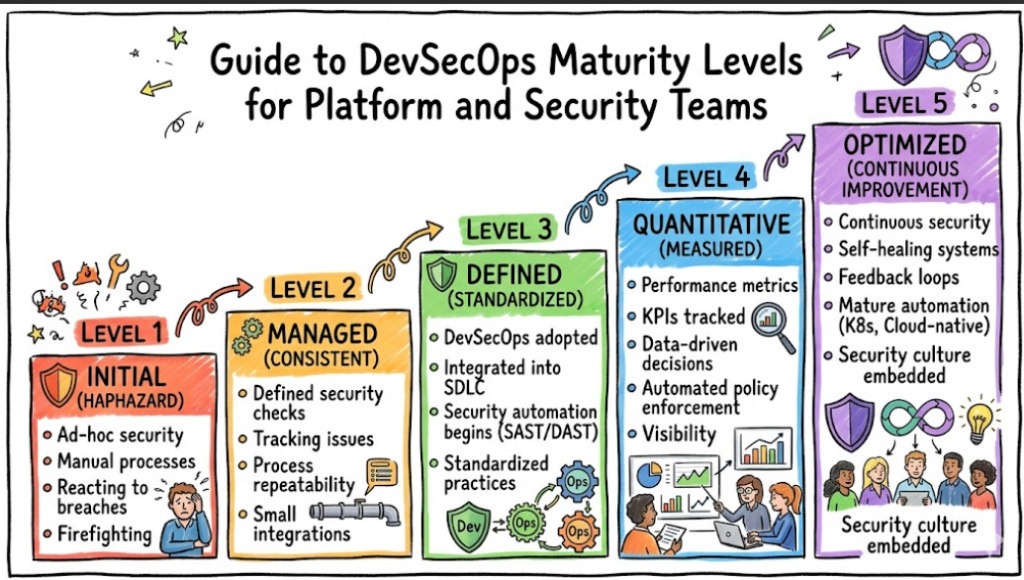
To effectively measure progress, the DevSecOps journey is categorized into five distinct maturity levels. Each phase represents a significant advancement in automated testing capabilities, organizational collaboration, and cloud-native operational readiness.
| Maturity Level | Characteristics | Security Automation Level | Operational Readiness |
| Level 1: Initial | Reactive, manual testing, siloed teams, ad-hoc fixes | Little to no automation; sporadic manual checks | Poor; high risk of production vulnerabilities |
| Level 2: Developing | Early CI/CD scanning, basic compliance, initial IaC | Scripted tools; basic SAST and dependency checks | Moderate; security is visible but still causes friction |
| Level 3: Defined | Standardized workflows, automated gates, container security | Fully integrated CI/CD scans; automated policy checks | High; proactive vulnerability management in place |
| Level 4: Managed | Continuous monitoring, compliance as code, K8s governance | Advanced automation; real-time alert triage systems | Advanced; metrics-driven security operations |
| Level 5: Optimized | AI-assisted operations, zero trust, predictive threat models | Comprehensive; self-healing pipelines and infrastructure | Elite; continuous feedback loops and adaptive security |
Level 1: Initial DevSecOps Maturity
At Level 1, an organization’s security posturing is completely reactive. Security audits and vulnerability assessments are performed manually, often right before major product releases or during annual compliance audits. There is minimal communication between development, operations, and security teams, resulting in isolated workflows and fragmented technology implementations.
Security testing at this stage is primarily handled via external black-box penetration testing or manual code reviews. Because these assessments happen late in the development lifecycle, discovered vulnerabilities require extensive engineering rework, directly delaying deployment schedules. Compliance tracking relies on manual spreadsheets, making it difficult to maintain an accurate, up-to-date security posture.
[Code] -> [Build] -> [Deploy] -> [Manual Audit Gate] -> [Production (High Risk)]
Organizations at this stage frequently experience firefighting scenarios when resolving production security incidents. Without automated feedback loops or centralized visibility, engineers lack the necessary insights to prevent repetitive coding errors. This initial stage highlights the urgent need for basic, automated security scanning within the software delivery pipeline.
Level 2: Developing DevSecOps Maturity
As organizations transition to Level 2, they begin integrating basic security scanners into their CI/CD workflows. Teams implement foundational Static Application Security Testing (SAST) and Software Composition Analysis (SCA) tools to detect obvious code vulnerabilities and outdated open-source dependencies. Security awareness improves as developers gain direct visibility into early scan results.
This stage also marks the initial adoption of Infrastructure as Code (IaC), using basic linting tools to check infrastructure definitions before provisioning cloud resources. While security scanning is automated within the pipeline, the process for triaging and remediating alerts remains largely manual. Engineering teams often struggle with false positives, which can lead to alert fatigue and occasional pipeline bypasses.
At this level, security policies are documented but not yet enforced programmatically. Pipelines generate alerts, but they rarely block insecure builds automatically. While Level 2 provides critical visibility into code security, it requires further standardization to eliminate manual remediation bottlenecks and scale across the enterprise.
Level 3: Defined DevSecOps Maturity
At Level 3, DevSecOps practices are fully standardized and enforced across all engineering teams. Security checks are no longer optional or informational; they function as automated quality gates within the CI/CD pipeline. If a code commit contains high-severity vulnerabilities, unpatched dependencies, or exposed secrets, the pipeline automatically blocks the build and provides immediate feedback to the developer.
                  +-------------------------+
                  |  Developer Commits Code |
                  +------------+------------+
                               |
                               v
               +-------------------------------+
               |   Automated CI/CD Scan Gate   |
               +---------------+---------------+
                               |
                       +-------+-------+
                       |               |
               [Passes Gates]    [Fails Gates]
                       |               |
                       v               v
               +---------------+---------------+
               | Deploy Allowed| Pipeline Block|
               +---------------+---------------+
Infrastructure security validation is also standard practice at this stage. Infrastructure as Code configurations are automatically scanned for misconfigurations, such as overly permissive firewalls or unencrypted storage buckets, before cloud resources are updated. Organizations running containerized workloads implement automated container image scanning within their artifact registries to block insecure layers from deploying.
Collaboration between development and security teams shifts from adversarial compliance checks to shared engineering goals. Security engineers build and maintain reusable pipeline templates, empowering developers to remediate vulnerabilities independently. This milestone establishes a predictable, secure software delivery pipeline across the enterprise.
Level 4: Managed DevSecOps Maturity
Level 4 organizations shift their focus toward advanced automation, comprehensive operational metrics, and runtime cloud security governance. Security operations are highly data-driven, utilizing centralized dashboards to track key performance indicators such as Mean Time to Detect (MTTD) and Mean Time to Remediate (MTTR). This telemetry allows engineering leaders to continuously optimize their security guardrails.
Kubernetes and container orchestration environments are secured via automated admission controllers and advanced role-based access controls (RBAC). Security policies are managed as code, ensuring that running workloads conform to organizational compliance baselines in real time. Any configuration drift in production environments is automatically detected and flagged for remediation.
[Production Runtime] -> [Drift Detected] -> [Automated Alert & Guardrail Action]
Compliance validation is transformed from a point-in-time audit into a continuous, automated operation. Pipelines and cloud monitoring systems continuously gather and log evidence of compliance, significantly reducing the overhead of regulatory audits. Incident response processes are highly mature, leveraging automated playbooks to isolate compromised resources or revoke compromised credentials instantly.
Level 5: Optimized DevSecOps Maturity
Level 5 represents the highest state of DevSecOps maturity, characterized by self-healing infrastructure, predictive threat intelligence, and a deep-seated blameless security culture. At this stage, security operations leverage machine learning and AI-assisted workflows to analyze threat patterns, automate complex triage tasks, and predict vulnerabilities before they manifest in code.
The infrastructure architecture is built entirely on Zero Trust principles, enforcing strict identity verification, micro-segmentation, and encrypted communications for every microservice and system component. Security automation spans the entire ecosystem, seamlessly connecting local development environments, code repositories, cloud-native pipelines, and global runtime environments.
[AI/Predictive Analysis] <--> [Zero Trust Mesh] <--> [Self-Healing Infrastructure]
When a runtime anomaly or zero-day vulnerability is detected, the ecosystem can automatically initiate self-healing protocols—such as spinning down compromised containers, rolling back malicious infrastructure changes, or dynamically modifying network security groups. Security is treated as an iterative, continuous optimization process, allowing the business to innovate rapidly while maintaining a highly resilient defensive posture.
Key Components of a DevSecOps Maturity Model
To evaluate an organization’s overall maturity, assessments analyze several core technical and operational dimensions. The following matrix details the primary components required for a comprehensive DevSecOps maturity assessment.
| Component | Purpose | Maturity Indicators |
| CI/CD Security | Embed automated scanning directly into application delivery pipelines | Automated SAST/DAST gates, zero hardcoded secrets, automated dependency patching |
| Infrastructure as Code Security | Validate cloud infrastructure definitions before resources are provisioned | Static analysis of cloud templates, policy-as-code enforcement, drift detection |
| Container Security | Protect application container layers from build to live runtime | Base image hardening, minimal distroless images, registry vulnerability scanning |
| Kubernetes Security | Govern orchestrator configurations and control plane access | Strict RBAC, network policies, automated admission controllers, pod security standards |
| Compliance Automation | Convert regulatory requirements into continuous, automated checks | Continuous compliance logging, automated audit evidence generation, policy-as-code |
| Monitoring & Observability | Maintain real-time visibility into application and cluster security behavior | Centralized log aggregation, real-time runtime anomaly alerts, deep tracing |
| IAM and RBAC | Enforce strict access control across all human users and software services | Least privilege tracking, temporary short-lived credentials, automated access reviews |
| Incident Response | Minimize blast radius and remediate production security issues rapidly | Automated incident playbooks, self-healing systems, blameless post-mortems |
Secure CI/CD Pipeline Maturity
The evolution of secure CI/CD pipelines shifts application security from an isolated gate to an integrated, step-by-step validation process. In mature organizations, every single stage of the deployment pipeline serves as an automated quality check, ensuring that insecure code cannot advance through the delivery lifecycle.
[Git Commit] -> [Secret Scan] -> [SAST & SCA] -> [Container Build & Scan] -> [Secure Deploy]
- Automated Code Scanning (SAST): Static analysis tools run immediately upon code submission, scanning source code for injection vulnerabilities, cross-site scripting vulnerabilities, and logical flaws before compilation.
- Dependency Management (SCA): Software Composition Analysis tools automatically scan application dependency trees to identify, flag, and block known vulnerable open-source libraries.
- Secret Scanning: Automated scanning hooks check code commits for hardcoded API keys, database credentials, and private certificates, preventing credential leaks before code leaves the developer’s machine.
- Deployment Security Validation: Dynamic testing tools run against staging environments to identify runtime vulnerabilities, misconfigured headers, and authentication weaknesses before production deployment.
Modern engineering teams standardize these automated checks across orchestrators like Jenkins, GitHub Actions, and GitLab CI/CD. By embedding these security tools directly into central pipeline templates, organizations ensure uniform security guardrails across every engineering team without impacting developer workflows.
Infrastructure as Code Security Maturity
Managing modern cloud infrastructure at scale requires treating infrastructure definitions with the same rigorous security standards applied to application source code. Infrastructure as Code (IaC) maturity ensures that cloud misconfigurations are caught and corrected well before resources are provisioned in live cloud environments.
[Terraform Code] -> [Checkov Policy Scan] -> [Policy Evaluation] -> [Cloud Provisioning]
- Secure Terraform Practices: Using verified, hardened module registries and enforcing state file encryption with strict access controls to prevent sensitive data exposure.
- Automated Policy Validation: Integrating static analysis tools into developer workflows to scan infrastructure files for security flaws, such as unencrypted storage buckets or overly permissive security groups.
- Infrastructure Compliance: Utilizing Policy as Code frameworks to programmatically enforce internal corporate governance and external regulatory baselines across all cloud templates.
- Configuration Consistency: Implementing automated drift detection systems to continuously monitor running cloud assets and alert operations teams if manual modifications deviate from git-backed infrastructure definitions.
By utilizing automation tools like Terraform, Ansible, and Checkov, enterprise platforms shift infrastructure security to the earliest phases of development. This approach eliminates configuration drift and ensures that all deployed networks, virtual machines, and managed services conform to organizational security baselines by default.
Container and Kubernetes Security Maturity
Securing containerized applications requires a multi-layered strategy that covers the entire lifecycle—from initial image creation to live orchestrator runtime management. Because containers share the underlying host kernel, maintaining a strong container and Kubernetes security posture is critical for cloud-native compliance.
+-------------------------------------------------------+
|                 Kubernetes Cluster                    |
|                                                       |
|   +---------------------+     +-------------------+   |
|   | Admission Controller| --> |   Running Pods    |   |
|   | (Kyverno / OPA)     |     | (Falco Runtime)   |   |
|   +---------------------+     +-------------------+   |
+-------------------------------------------------------+
- Secure Docker Images: Building minimalist, distroless base images that exclude unnecessary shell utilities and package managers, drastically minimizing the available attack surface.
- Kubernetes RBAC: Enforcing strict Role-Based Access Control policies that leverage the principle of least privilege, restricting access to cluster control planes and namespaces.
- Runtime Protection: Monitoring live container behaviors to identify anomalous system calls, unexpected file modifications, or unauthorized binary executions.
- Admission Controllers: Deploying policy enforcement engines to intercept requests to the Kubernetes API server, blocking pods that fail to meet strict security baselines.
- Namespace Isolation: Utilizing native network policies and namespace boundaries to segment cluster traffic, preventing unauthorized lateral movement across microservices.
By combining runtime observability and policy enforcement tools like Falco, Kyverno, and OPA Gatekeeper, platform engineers establish robust defense-in-depth security. These integrated layers prevent misconfigured containers from running and actively defend containerized workloads against active production threats.
Monitoring and Observability Maturity
In a highly dynamic cloud-native environment, maintaining deep runtime observability is essential for rapid threat detection and response. Mature monitoring infrastructure transforms standard system logs into actionable security intelligence, providing engineering teams with complete visibility across application layers.
[System/K8s Telemetry] -> [Prometheus/ELK] -> [Datadog/SIEM] -> [Real-time Alerts]
- Threat Monitoring: Continuously collecting system, network, and application metrics to detect unauthorized access patterns, data exfiltration attempts, and anomalies.
- Logging and Alerting: Setting up structured, centralized application logs with context-rich alerts, ensuring response teams receive actionable data without experiencing alert fatigue.
- SIEM Integration: Aggregating infrastructure events, cloud trail logs, and identity access events into central Security Information and Event Management systems for deep cross-layer correlation.
- Runtime Observability: Tracking active container state changes, system call frequencies, and inter-service network requests to visualize the system’s real-time security health.
- Incident Analytics: Leveraging historical monitoring data to perform detailed post-incident root cause investigations, allowing engineers to permanently close architectural security gaps.
Utilizing powerful visualization and ingestion platforms like Prometheus, Grafana, the ELK Stack, and Datadog allows operations teams to identify and respond to production threats in real time. This deep visibility shortens breach detection windows and ensures system reliability under changing operational conditions.
Compliance and Governance Maturity
For modern digital enterprises, compliance is an ongoing operational requirement rather than a point-in-time preparation for an annual audit. Achieving compliance and governance maturity requires converting complex legal and regulatory frameworks into reliable, automated engineering workflows.
[Regulatory Requirements] -> [Policy as Code Engine] -> [Continuous Audit Evidence Logs]
- Compliance Automation: Shifting from manual check-sheets to automated validation systems that continuously monitor cloud resources against frameworks like SOC2, ISO 27001, and HIPAA.
- Policy Enforcement: Using programmatic guardrails within development workflows to stop non-compliant application infrastructure from ever deploying to live staging or production clusters.
- Audit Readiness: Maintaining automated, tamper-proof system logs and audit trails, enabling security teams to generate comprehensive compliance reports instantly at any time.
- Regulatory Alignment: Centralizing security definitions so updates to regulatory mandates are automatically propagated across all CI/CD pipelines and infrastructure checks.
- Governance Workflows: Implementing clear, automated authorization models for policy exceptions, ensuring all architectural deviations are documented and approved.
This systematic approach allows highly regulated industries, such as financial tech and digital healthcare platforms, to maintain a continuous state of compliance. By embedding governance directly into cloud orchestration platforms, organizations significantly reduce audit overhead while ensuring reliable security posture enforcement.
Identity and Access Management Maturity
Identity and Access Management (IAM) serves as the primary security perimeter for modern cloud-native systems. A mature IAM architecture ensures that both human operators and programmatic service accounts are strictly authenticated, continuously authorized, and restricted to the bare minimum permissions necessary.
[User/Service Request] -> [IAM Policy Engine] -> [Short-Lived Token Issued] -> [Resource Access]
- Least Privilege Access: Continuously auditing permission profiles to remove unused access rights, ensuring users and microservices hold only the permissions required for their specific functions.
- RBAC Implementation: Standardizing role hierarchies across cloud control planes, source repositories, and orchestration clusters to simplify user provisioning and access control management.
- Secret Management: Replacing static credentials with automated, centralized secret management vaults that generate short-lived, dynamic tokens and handle automatic credential rotation.
- IAM Governance: Enforcing centralized Single Sign-On (SSO) systems combined with Multi-Factor Authentication (MFA) requirements across all corporate platforms, systems, and code registries.
- Cloud Access Security: Monitoring cross-account access configurations and machine identity behaviors to detect and block credential abuse or lateral privilege escalation attempts.
By implementing strict access governance, enterprises prevent credential compromise from turning into a major data breach. Restricting service boundaries and eliminating static keys protects critical cloud systems against both external threats and internal process errors.
Real-World DevSecOps Maturity Workflow Example
To understand how an enterprise operates at a high level of DevSecOps maturity, consider the step-by-step lifecycle of a single application code update. This integrated workflow demonstrates how automated guardrails collaborate to validate security at every phase of the delivery lifecycle.
 [1. Git Commit] -----> [2. CI/CD Scans] -----> [3. IaC Policy Check]
                                                    |
                                                    v
 [6. Runtime Alert] <-- [5. Admission Gate] <-- [4. Registry Scan]
         |
         v
 [7. Dashboard Feedback]
- Step 1: Developer Commits Code: A software engineer finishes a feature update and pushes the code to the enterprise git repository, triggering local pre-receive hooks that scan for hardcoded secrets.
- Step 2: CI/CD Pipeline Executes Scans: The central orchestrator initiates the build pipeline, running automated SAST tools to check for application code vulnerabilities and SCA tools to verify dependency patch levels.
- Step 3: Infrastructure Policies Validate Terraform: The pipeline runs automated linters against accompanying Terraform scripts, evaluating the configuration against organizational Policy-as-Code rules to prevent cloud misconfigurations.
- Step 4: Container Vulnerabilities Get Scanned: Once compiled, the application is packaged into a container image. This image is pushed to a secure registry where scanner tools evaluate container layers for vulnerabilities.
- Step 5: Kubernetes Admission Controls Enforce Policies: The deployment manifests are sent to the staging cluster. The cluster’s admission controller analyzes the deployment request, validating that the container runs with non-root privileges and has strict resource limits.
- Step 6: Monitoring Systems Track Runtime Threats: The application goes live. Runtime security daemons monitor system calls, checking for unexpected binary execution or unauthorized outbound network connections.
- Step 7: Security Dashboards Provide Continuous Feedback: Metrics and vulnerability insights from the entire lifecycle are aggregated into a centralized dashboard, providing development and security teams with clear, actionable improvement data.
Benefits of High DevSecOps Maturity
Investing in a comprehensive DevSecOps Maturity Model yields significant operational, security, and financial rewards for enterprise engineering organizations.
- Faster Secure Deployments: By resolving security defects early in the development lifecycle, organizations eliminate late-stage release blockages, enabling rapid feature delivery without compromising safety.
- Better Compliance Readiness: Shifting to automated compliance tracking replaces stressful annual audit preparation with continuous audit readiness, drastically reducing regulatory overhead.
- Reduced Vulnerabilities: Automated quality gates prevent unpatched dependencies, code flaws, and misconfigured infrastructure templates from ever reaching production, lowering the system’s attack surface.
- Stronger Cloud Native Security: Integrating security across container registries, orchestrators, and service meshes provides deep defense-in-depth protection for complex distributed environments.
- Improved Operational Reliability: Consistent, automated security testing leads to standardized environment configurations, which directly minimizes production downtime caused by configuration drift.
- Better Incident Response: Deep runtime observability coupled with automated response playbooks allows operations teams to rapidly contain, isolate, and remediate production anomalies.
Common Challenges in DevSecOps Maturity Adoption
While the benefits of achieving a high maturity level are clear, organizations often encounter significant hurdles during their DevSecOps transformation journey.
- Tool Complexity and Fragmentation: Deploying too many disconnected security tools without a unified strategy leads to fragmented data silos and intense alert fatigue for development teams.
- Solution: Standardize on integrated platforms and aggregate security alerts into a centralized dashboard for unified triage.
- Legacy Infrastructure Bottlenecks: Monolithic applications and legacy on-premise environments often lack the APIs and native integration capabilities required for modern automated security testing.
- Solution: Use containerization wrappers or introduce abstract policy checking layers while gradually modernizing core application components.
- Organizational Cultural Resistance: Developers may view automated security checks as restrictive roadblocks that slow down feature delivery, leading to friction with security teams.
- Solution: Involve development leaders early, establish blameless security cultures, and treat security templates as internal open-source projects.
- Significant Skill Gaps: Traditional security analysts may lack deep automation and software engineering skills, while developers may lack a comprehensive understanding of cloud-native threat models.
- Solution: Implement continuous training programs and leverage structured learning paths to build cross-functional engineering expertise.
Best Practices for Improving DevSecOps Maturity
Advancing through the levels of DevSecOps maturity requires a deliberate, step-by-step approach focused on automation, collaboration, and measurable engineering outcomes.
- Automate Security Testing Early: Integrate SAST, SCA, and secret detection tools directly into the foundational developer commit workflow to catch code flaws as early as possible.
- Standardize Security Workflows: Avoid custom, team-specific pipeline scripts. Build and maintain centralized, reusable CI/CD templates that embed security guardrails by default across the enterprise.
- Improve Monitoring and Feedback Loops: Ensure security scan results provide clear, context-rich remediation advice directly within developer tools, rather than routing alerts through external ticketing queues.
- Practice Infrastructure as Code Security: Treat cloud configurations identically to application source code. Scan all infrastructure templates for misconfigurations before resources are provisioned.
- Build Cross-Team Collaboration: Establish a Security Champions program by embedding interested developers within security planning sessions, fostering shared ownership of application safety.
- Continuously Assess Maturity: Regularly schedule objective maturity assessments to re-evaluate your workflows, identify new process bottlenecks, and adjust your implementation roadmap.
DevSecOps Maturity Model vs Traditional Security Models
Understanding the structural differences between mature DevSecOps frameworks and legacy security methodologies highlights why modern cloud environments require an automated approach.
| Feature | Traditional Security | DevSecOps Maturity Model |
| Security Timing | Late-stage checkpoint; performed right before production releases | Continuous validation; embedded across every phase of the development lifecycle |
| Automation Level | Heavily manual; relies on point-in-time penetration tests and audits | Highly automated; runs continuous quality gates and policy-as-code checks |
| Monitoring Focus | Perimeter security; relies on standard firewalls and network logs | Runtime observability; monitors container system calls and microservice behaviors |
| Compliance Approach | Manual spreadsheets; point-in-time preparation for annual reviews | Continuous compliance; automated evidence logging and continuous governance |
| Cloud Native Readiness | Poor; struggles to scale with microservices and container drift | Native; designed specifically to govern Kubernetes and dynamic cloud assets |
| Collaboration Model | Siloed; security operates as an external, adversarial gatekeeper | Integrated; shared engineering responsibility between development and security |
| Deployment Agility | Slow; introduces significant release friction and manual delays | High; supports rapid, secure automated deployment pipelines |
Industries Benefiting Most from DevSecOps Maturity
While every digital business requires robust security automation, specific industries running high-scale cloud operations derive massive value from adopting a mature DevSecOps framework.
Banking & Finance
Financial institutions manage massive transactional volumes while adhering to strict regulatory standards like PCI-DSS and SOC2. Achieving high DevSecOps maturity allows fintech platforms to automate compliance verification, secure complex API networks, and defend against targeted data exfiltration attempts while maintaining daily deployment cadences.
Healthcare
Digital health platforms process highly sensitive Electronic Health Records (EHR) governed by strict regulatory frameworks like HIPAA. Implementing continuous security automation and policy-as-code guardrails ensures that all cloud data storage, application microservices, and user authentication layers remain continuously compliant and protected against data leaks.
E-Commerce
E-commerce ecosystems experience highly volatile user traffic and continuous product updates. A mature DevSecOps posture allows engineering teams to ship features rapidly to meet market demands while ensuring payment gateways, user data repositories, and third-party vendor integrations remain resilient against automated fraud and web application attacks.
SaaS Platforms
Software-as-a-Service providers run complex multi-tenant architectures where secure data isolation is absolutely critical. Adopting a mature DevSecOps framework allows SaaS engineering teams to enforce strict identity boundaries, automate isolation testing, and secure application microservices at scale without impacting platform performance or deployment velocity.
Telecom
Modern telecommunications infrastructure relies heavily on cloud-native deployments, software-defined networking, and distributed edge computing nodes. DevSecOps maturity allows telecom architects to secure high-throughput containerized environments, automate cluster policy enforcement, and protect critical communication pipelines from network-level threats.
Enterprise IT
Large-scale enterprise IT departments manage extensive portfolios of both modern cloud-native systems and legacy applications. Utilizing a standardized maturity model provides technology leaders with a clear, unified framework to modernize security habits, unify fragmented toolsets, and establish consistent security guardrails across global engineering teams.
Popular Tools Supporting DevSecOps Maturity
Building a resilient DevSecOps ecosystem requires integrating specialized security tools across every stage of the software delivery pipeline.
- CI/CD Security Tools: Platforms focused on scanning application code and managing open-source dependencies. Examples include Snyk, SonarQube, and GitHub Advanced Security.
- Infrastructure Security Platforms: Systems designed to evaluate cloud-native infrastructure templates and verify compliance. Examples include Checkov, TFLint, and Aqua Security.
- Kubernetes Security Tools: Software tailored to enforce cluster policies and track runtime behaviors. Examples include Falco, Kyverno, and OPA Gatekeeper.
- Monitoring & SIEM Platforms: Systems that ingest runtime telemetry to identify security incidents. Examples include the ELK Stack, Datadog, and Splunk.
- Compliance Automation Tools: Specialized frameworks that track regulatory status and generate audit logs. Examples include Drata, Vanta, and OpenSCAP.
- Secret Management Platforms: Secure vaults designed to securely store and rotate system credentials. Examples include HashiCorp Vault, AWS Secrets Manager, and CyberArk.
                  +-----------------------------------+
                  |      DevSecOps Tool Ecosystem     |
                  +-----------------+-----------------+
                                    |
     +-----------------+------------+------------+-----------------+
     |                 |                         |                 |
     v                 v                         v                 v
[CI/CD Scan]     [IaC Security]           [Cluster Policy]  [Runtime SIEM]
(Snyk / Sonar)   (Checkov / Aqua)         (Kyverno / OPA)   (Datadog / ELK)
| Tool | Purpose | Maturity Focus | Difficulty Level |
| Snyk | Dependency and open-source vulnerability scanning | Software Composition Analysis (SCA) | Intermediate |
| SonarQube | Static application security testing and code quality checks | Code Quality Gate Execution (SAST) | Intermediate |
| Checkov | Static analysis scanning for Infrastructure as Code templates | Preventative Infrastructure Security | Intermediate |
| Falco | Cloud-native runtime threat detection and anomaly alerting | Container Runtime Observability | Advanced |
| Kyverno | Kubernetes native policy management and enforcement | Cluster Admission Control | Advanced |
| HashiCorp Vault | Centralized programmatic secret injection and token management | Dynamic Credential Lifecycle | Advanced |
| Datadog | Unified cloud monitoring and security telemetry analysis | Real-Time Threat Visualization | Intermediate |
Career Opportunities Related to DevSecOps Maturity
The widespread enterprise transition from traditional security models to automated DevSecOps architectures has driven significant industry demand for skilled security automation professionals.
- DevSecOps Engineer: Focuses on embedding automated scanners, secret detection checks, and quality gates directly into central application CI/CD pipelines.
- Cloud Security Engineer: Specializes in securing infrastructure networks, configuring identity boundaries, and hardening cloud platform configurations.
- Kubernetes Security Specialist: Concentrates on protecting containerized clusters, designing RBAC hierarchies, and maintaining runtime protection systems.
- Security Automation Engineer: Focuses on writing custom scripts and building integrations to automate manual alert triage and remediation tasks.
- Compliance Automation Engineer: Specializes in translating complex regulatory frameworks into executable Policy-as-Code scripts and automated audit logs.
- Platform Security Architect: Designs the overarching secure platform templates, tools, and shared services used by developers across the enterprise.
                     +----------------------------------+
                     |  DevSecOps Career Growth Vector  |
                     +----------------+-----------------+
                                      |
       +------------------------------+------------------------------+
       |                                                             |
       v                                                             v
[Technical Track]                                            [Architect Track]
Security Automation Engineer -> DevSecOps Specialist         Platform Security Architect
To enter these specialized roles, professionals need a strong foundation in Linux administration, shell scripting, container fundamentals, and cloud networking architecture. As organizations scale their automation efforts, the career growth potential and market demand for these engineering roles remain exceptionally high.
Certifications & Learning Paths
Navigating a successful career path in security automation requires combining hands-on technical validation with respected industry credentials. Developing expertise requires structural training ecosystems, like the programs offered at DevOpsSchool, which provide immersive, lab-based coursework designed around real-world cloud security challenges.
- Importance of Hands-on Practice: Theoretical knowledge is insufficient when managing cloud security. True proficiency requires building pipelines, configuring admission rules, and troubleshooting live container anomalies in isolated sandbox environments.
- Kubernetes Security Certifications: Validations like the Certified Kubernetes Security Specialist (CKS) prove an engineer’s ability to secure container runtimes, configure cluster environments, and manage platform access.
- Cloud Security Certifications: Vendor-specific security paths validate deep expertise in securing platform ecosystems and managing identity infrastructures.
- DevSecOps Certifications: Specializations focused on pipeline integration, secret scanning workflows, and software supply chain protection.
| Certification | Best For | Skill Level | Focus Area |
| Certified Kubernetes Security Specialist (CKS) | Cluster Administrators & Container Engineers | Advanced | Pod security standards, runtime defense, admission control |
| AWS Certified Security – Specialty | Cloud Security Architects & Systems Engineers | Advanced | Identity management, data encryption, platform governance |
| Microsoft Certified: Azure Security Engineer | Enterprise Platform Security Practitioners | Intermediate | Hybrid cloud security, access management, tenant protection |
| Certified DevSecOps Professional (CDP) | Pipeline Engineers & Security Automation Specialists | Intermediate | CI/CD automation, scanner integration, secret management |
Common Beginner Mistakes
- Chasing Complex Security Tools Without Understanding Core Principles: Beginners often install advanced scanning tools without understanding underlying software bugs, resulting in unmanageable alert fatigue.
- Ignoring Linux Primitives and System Administration Basics: Cloud security relies heavily on operating system fundamentals. Skipping Linux administration makes diagnosing runtime container anomalies difficult.
- Learning Automated Scanners Without Core Security Concepts: Memorizing tool flags instead of learning structural software vulnerabilities prevents engineers from building robust security workflows.
- Avoiding Practical Hands-on Architecture Projects: Relying solely on video tutorials without building active pipelines or configuring access policies prevents developers from mastering real-world problem-solving.
- Underestimating Kubernetes Security and Cluster Access Controls: Treating container clusters like traditional virtual machines often results in overly permissive RBAC roles and exposed cluster control planes.
Future of DevSecOps Maturity Models
As cloud infrastructure continues to mature, DevSecOps models are evolving to handle increasingly complex distributed ecosystems.
[AI Remediation] ---> [GitOps Security Enforcer] ---> [Platform Engineering Abstractions]
- AI-Assisted Security Operations: Future maturity frameworks will heavily evaluate an organization’s ability to leverage machine learning for automated code triage, intelligent threat remediation, and proactive fix generation.
- GitOps Security Workflows: Security governance is shifting completely toward GitOps paradigms, where cluster states and cloud security configurations are continuously synchronized with secure git repositories.
- Platform Engineering Security: Security tools are being abstracted into internal developer portals, providing software engineers with secure-by-default development environments out of the box.
- Zero Trust Automation: Future compliance frameworks will require dynamic, cryptographic microservice identities, moving away from static network-based security perimeters.
- Continuous Compliance Evolution: Real-time compliance logging will completely replace static point-in-time reviews, generating automated, continuous audit tracking for global regulatory standards.
- Runtime Threat Intelligence: Real-time threat telemetry will tie back into early pipeline configurations, allowing software delivery pipelines to adapt dynamically based on active production attacks.
FAQs (15 Questions)
1. What is a DevSecOps maturity model?
A DevSecOps maturity model is a structured engineering framework designed to help organizations measure, evaluate, and scale their security practices across the entire software development lifecycle. It guides teams from manual, reactive security habits to highly automated, cloud-native security practices.
2. Why is DevSecOps maturity important for an enterprise?
It establishes consistency across product lines, reduces operational risk by catching vulnerabilities early, and automates compliance tracking. This prevents security from becoming a release bottleneck, allowing organizations to maintain velocity safely.
3. How many maturity levels exist in standard frameworks?
Most standard DevSecOps maturity frameworks utilize five distinct levels: Initial (Reactive), Developing (Basic Scanning), Defined (Standardized Gates), Managed (Metrics-Driven), and Optimized (Continuous Self-Healing).
4. What tools support the early stages of DevSecOps maturity?
Initial stages focus on integrating foundational scanners into application workflows. Tools like Snyk for dependency analysis, SonarQube for static code security testing, and automated Git hooks for secret detection are common starting points.
5. Is Kubernetes security part of a DevSecOps maturity assessment?
Yes, in modern cloud-native environments, Kubernetes security is a critical assessment component. This covers cluster role-based access controls, automated admission controllers, network segmentation policies, and container runtime observability.
6. Why is compliance automation critical for mature organizations?
Manual compliance reporting is time-consuming and error-prone. Compliance automation converts regulatory mandates into continuous policy-as-code checks, generating real-time audit trails for standards like SOC2, ISO 27001, and PCI-DSS.
7. How do organizations improve their DevSecOps maturity level?
Improvement requires a phased approach: first, automate basic code checks; next, establish strict pipeline quality gates; then, integrate Infrastructure as Code testing; and finally, deploy runtime observability tools combined with continuous engineering feedback loops.
8. Is DevSecOps a viable long-term career path?
Yes, the industry transition to cloud-native platforms has driven significant demand for skilled security automation professionals. Roles like DevSecOps Engineer, Cloud Security Architect, and Kubernetes Security Specialist offer excellent growth potential and compensation.
9. What is the difference between SAST and DAST?
SAST scans source code during early build stages without executing the application to find structural flaws. DAST tests a running application in staging or production environments to discover runtime vulnerabilities, authentication defects, and misconfigured interfaces.
10. How does Policy as Code fit into a maturity model?
Policy as Code allows security teams to define compliance rules as human-readable configuration files. These files are evaluated automatically within CI/CD pipelines, ensuring cloud infrastructure definitions meet internal security standards before provisioning.
11. What is container runtime security?
Container runtime security involves monitoring running container environments for anomalous behaviors, unexpected file modifications, or unauthorized system calls. Tools like Falco handle this by identifying threats that bypass early build-time image scans.
12. How do organizations handle alert fatigue in DevSecOps?
Alert fatigue is mitigated by establishing clear severity thresholds, filtering out false positives, and tuning scanning rulesets. Mature organizations route actionable alerts directly into native developer tools with context-rich remediation steps.
13. What role does secret management play in DevSecOps pipelines?
Secret management platforms eliminate hardcoded credentials by storing tokens, passwords, and certificates in centralized, encrypted vaults. Applications and pipelines dynamically fetch short-lived credentials at runtime, reducing data breach risks.
14. What are Kubernetes admission controllers?
Admission controllers are cluster plugins that intercept requests to the Kubernetes API server after authentication. They evaluate requests against structural security rules, blocking non-compliant container definitions from running in the cluster.
15. How long does a typical enterprise DevSecOps transformation take?
A comprehensive enterprise transformation depends on organization size and legacy infrastructure, typically ranging from 12 to 36 months. Moving through maturity levels requires systemic adjustments across technology stacks, operational workflows, and team cultures.
Final Thoughts
Achieving mature security orchestration requires a continuous, deliberate evolution across technology stacks, operational habits, and engineering cultures. There are no shortcuts to scaling automated security. True resilience is built by establishing simple automated checks, standardizing pipeline quality gates, and embedding security ownership across development and platform engineering teams.
As cloud-native architectures become more complex, relying on manual security verification becomes untenable. Organizations must treat security policies identically to application source code—automated, continuously evaluated, and thoroughly tracked. Embracing a structured maturity journey allows your enterprise to build resilient delivery systems, protect critical digital assets, and innovate confidently in modern cloud environments.
