Limited Time Offer!
For Less Than the Cost of a Starbucks Coffee, Access All DevOpsSchool Videos on YouTube Unlimitedly.
Master DevOps, SRE, DevSecOps Skills!
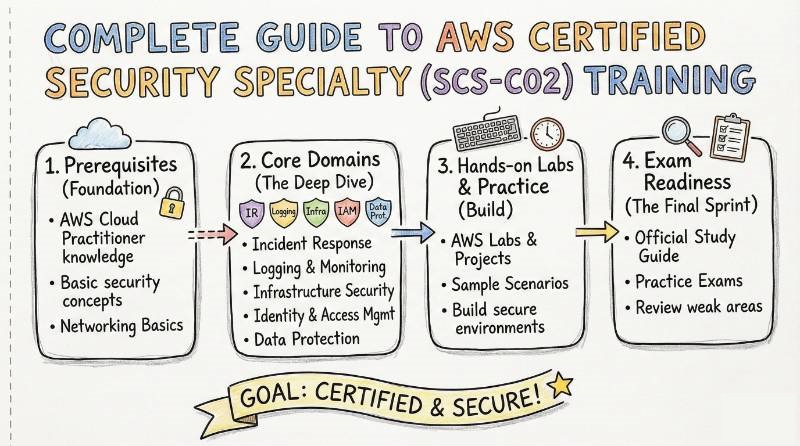
In the world of cloud computing, security has moved from a side task to the center of every project. Whether you are leading a team in India or working as an engineer on a global project, you know that keeping data safe is the most important job. The AWS Certified Security Specialty (SCS-C02) is the best way to prove you can handle this responsibility.
Having seen how technology has changed from old physical servers to the massive cloud systems we use today, I can tell you that this certification is more than a piece of paper. It shows you have the deep knowledge needed to protect a business. This guide will help you understand the training and how to use it to grow your career.
The Big Picture of AWS Certifications
Before looking at the security specialty, it helps to see where it fits in the AWS world. Use this table to plan your learning.
| Track | Level | Who it’s for | Prerequisites | Skills Covered | Recommended Order |
| Security | Specialty | Security Pros, Cloud Engineers | 2+ years AWS experience | IAM, Monitoring, Data Security | After Associate |
| Solutions Architect | Associate | Developers, Architects | None (Cloud Practitioner suggested) | Designing solid cloud systems | 1st or 2nd |
| SysOps Admin | Associate | Admins, SREs | Foundational AWS knowledge | Managing and fixing AWS systems | 2nd |
| Developer | Associate | Software Engineers | Basic AWS hands-on knowledge | Building apps on the cloud | 1st or 2nd |
| DevOps Engineer | Professional | Lead Engineers, SREs | Associate-level certification | Automation and governance | After Associate |
The Complete Guide to SCS-C02 Training
What it is
The SCS-C02 is a specialized certification that tests your ability to secure the AWS Cloud. It covers five main areas: Threat Detection, Logging and Monitoring, Infrastructure Security, Identity Management, and Data Protection. It is a tough exam because it asks you to solve real problems, not just remember facts.
Who should take it
This program is perfect for:
- Security Engineers who want to be experts in cloud protection.
- DevOps and SREs who need to build security into their automation.
- Cloud Architects who want to design systems that are safe from the start.
- Engineering Managers who need to lead their teams with a focus on risk and compliance.
Skills you’ll gain
This training helps you think like a defender. You will learn how to build walls around your data and how to spot an attack quickly.
- Identity Control: You will learn how to manage user access using IAM policies. This includes managing permissions across different accounts and making sure people only have the access they truly need.
- System Protection: You will learn how to build safe networks using VPCs, Web Application Firewalls (WAF), and protection against DDoS attacks.
- Data Safety: You will master how to hide data using encryption. This includes using the Key Management Service (KMS) to keep your encryption keys safe.
- Monitoring and Response: You will learn how to use tools like GuardDuty to find threats and how to set up automatic systems to fix security holes as soon as they appear.
Real-world projects you should be able to do
After this training, you will be able to handle complex tasks that companies deal with every day.
- Fixing Security Holes Automatically: You can build a system where if someone leaves a data folder open to the public, an automated script closes it instantly and alerts the team.
- Centralized Security Logs: You can set up a system where every action taken in dozens of different accounts is recorded in one single, safe place for auditors to check.
- Encryption for Global Apps: You can design a way for an app running in multiple countries to keep its data encrypted and safe while following local laws.
Preparation Plan
Choose a plan that works with your busy life. Consistency is the most important part of getting certified.
- 7–14 Days (The Fast Track): Use this if you already use AWS security tools every day. Spend your time taking practice exams and reading the official AWS documentation for tools you don’t use as often.
- 30 Days (The Professional Path): This is great for most engineers. Spend one hour every morning on a video course. On the weekends, spend four hours doing hands-on labs to practice what you learned.
- 60 Days (The Deep Dive): If you are new to security, take two months. Spend the first month just building things in AWS to see how they work. Spend the second month focusing specifically on the exam topics.
Common Mistakes
Many smart engineers fail this exam because they fall into these common traps.
- Ignoring the “Explicit Deny”: In AWS, if a rule says “No,” it always wins, even if another rule says “Yes.” Forgetting this logic causes many wrong answers.
- Not Practicing with KMS: Encryption keys are a huge part of the test. If you don’t understand how to share keys between accounts, you will lose a lot of points.
- Focusing Only on Names: Don’t just learn what a tool is named. Learn how it talks to other tools. For example, learn how a security alert triggers a fix using AWS Lambda.
Best Next Certification After This
After you pass the Security Specialty, the best next move is the AWS Certified DevOps Engineer – Professional. While security teaches you how to protect, DevOps teaches you how to automate. Combining these two makes you a master of DevSecOps, which is one of the most sought-after roles in the industry.
Choose Your Path: 6 Learning Paths
Your career doesn’t have to follow a single line. Here are six ways to use this certification:
- DevOps Path: Associate Developer → Security Specialty → DevOps Engineer Professional.
- DevSecOps Path: Associate SysOps → Security Specialty → Advanced Networking Specialty.
- SRE Path: Associate SysOps → Security Specialty → Professional DevOps Engineer.
- AIOps/MLOps Path: Cloud Practitioner → Machine Learning Specialty → Security Specialty.
- DataOps Path: Data Engineer Associate → Data Analytics Specialty → Security Specialty.
- FinOps Path: Cloud Practitioner → Security Specialty → FinOps Certified Practitioner.
Role → Recommended Certifications Mapping
| If you are a… | Focus on this Primary Cert | Add this for more value |
| DevOps Engineer | DevOps Engineer Professional | Security Specialty |
| SRE | SysOps Admin Associate | Security Specialty |
| Platform Engineer | Solutions Architect Associate | Security Specialty |
| Cloud Engineer | Solutions Architect Professional | SysOps Admin Associate |
| Security Engineer | Security Specialty | Solutions Architect Associate |
| Data Engineer | Data Engineer Associate | Security Specialty |
| FinOps Practitioner | Cloud Practitioner | Security Specialty |
| Engineering Manager | Solutions Architect Associate | Security Specialty |
Next Certifications to Take
Once you have finished the security guide, you have three main choices for your next step:
- Same Track (Specialization): AWS Certified Advanced Networking – Specialty. You can’t secure a network you don’t understand. This is for those who want to be top-level experts.
- Cross-Track (New Skills): AWS Certified Data Engineer – Associate. Data is what hackers want. Learning how to manage data pipelines while knowing how to secure them is a very strong combination.
- Leadership (Architecting): AWS Certified Solutions Architect – Professional. This is for those who want to lead the entire technical direction of a company, looking at the big picture.
Top Training Institutions for SCS-C02
Finding a good teacher is the fastest way to learn. Here are the top schools that can help:
- DevOpsSchool: This school is great for working professionals. They offer classes led by real teachers who focus on hands-on labs and real-world security problems.
- Cotocus: They specialize in bootcamps that get straight to the point. This is a good choice if you need to learn quickly and want to focus on the technical skills.
- Scmgalaxy: This is a large community where you can find many free and paid resources. It is perfect for people who like to learn at their own pace with community help.
- BestDevOps: They focus on making sure you are ready for a job, not just an exam. Their training covers how to use security tools in a real office setting.
- Devsecopsschool: As the name says, they are experts in merging security with development. Their classes are very helpful for those building modern software.
- Sreschool: If you care about making sure systems don’t crash, this school shows how security helps keep your systems running smoothly.
- Aiopsschool: This is for the future. They teach you how to use artificial intelligence to spot security threats before they become a problem.
- Dataopsschool: This school focuses on securing big data. It is a great choice if you work with massive amounts of sensitive customer information.
- Finopsschool: They teach you how to manage the cost of your cloud. Good security often means deleting old, unused resources, which saves money.
General Career & Certification FAQs
- Is the security exam very hard? Yes, it is harder than Associate exams because it requires you to solve complex problems, not just know the tools.
- How much time should I study every day? Try for one hour of focused study every day. Being consistent is better than studying for 10 hours once a week.
- Do I need another certificate first? It isn’t required, but it is much easier if you already have the Solutions Architect Associate certification.
- Will this help me get a job in India? Yes, Indian tech companies are hiring security experts faster than almost any other role right now.
- Is this respected globally? Absolutely. AWS certifications are recognized by companies all over the world.
- Does this certification expire? Yes, it is good for three years. You will need to take the exam again to stay current.
- Can I take the exam from home? Yes, you can take it online with a person watching you through your webcam.
- What is the passing score? You need a 750 out of 1000 to pass.
- How much does the exam cost? The standard price for a specialty exam is $300.
- Does the exam have coding? You don’t need to be a programmer, but you must be able to read and write simple JSON policies.
- How long is the test? You get about three hours to finish the exam.
- Are there prerequisites for SCS-C02? No formal ones, but AWS recommends two years of hands-on cloud security experience.
SCS-C02 Specific FAQs
- What is the main focus of the exam? The biggest parts are Identity Management (IAM) and Data Protection (Encryption).
- Is logging important? Yes, you must understand how to use CloudTrail and CloudWatch to see everything that happens in your cloud.
- Do I need to know about networking? Yes, you need to know how to set up safe network walls using VPCs and Security Groups.
- What is GuardDuty? It is an AWS tool that uses AI to find threats. It is a very common topic on the exam.
- Does the exam cover S3? Yes, you must know every way to lock down an S3 folder so data doesn’t leak.
- What is AWS KMS? It is the Key Management Service. You will be tested on how to use it to encrypt your data safely.
- How do I prepare for incident response? Learn how to use AWS tools to automatically fix a problem the moment a threat is found.
- Which practice tests are best? Look for tests that explain why an answer is wrong, not just which one is right.
Conclusion
Choosing to master AWS security is a major step in your career. As more businesses move their most important data to the cloud, they need people who can keep it safe. The SCS-C02 training isn’t just about passing a test; it’s about changing how you think about building systems. It teaches you to always be careful, to watch everything, and to be ready to act when something goes wrong. Whether you are an engineer looking for a promotion or a manager trying to build a safer team, this certification gives you the tools to succeed. By following a steady plan and learning from the right places, you are setting yourself up for a long and successful career in one of the most important fields in technology today.
