Limited Time Offer!
For Less Than the Cost of a Starbucks Coffee, Access All DevOpsSchool Videos on YouTube Unlimitedly.
Master DevOps, SRE, DevSecOps Skills!
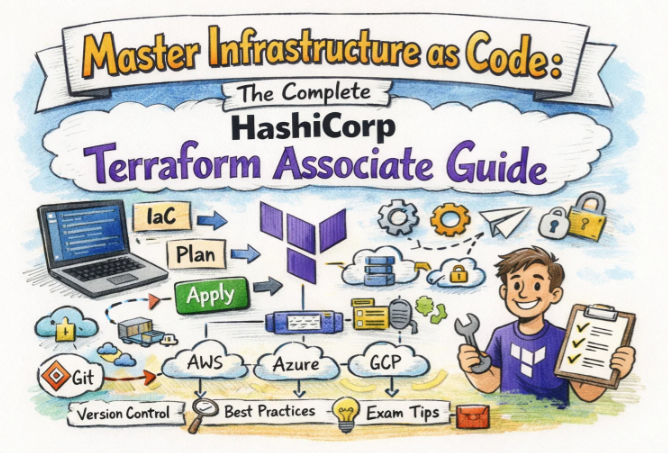
In today’s fast-moving tech world, manual work is a risk. If you are still setting up servers by clicking buttons in a cloud portal, you are falling behind. The industry has moved toward Infrastructure as Code (IaC). This means we treat our hardware, networks, and security just like software code. We write it, we test it, and we deploy it automatically.
At the center of this change is HashiCorp Terraform. It is the tool that everyone—from startup engineers in India to managers in global tech firms—is using to manage the cloud. As a mentor who has seen the industry change from physical server rooms to the cloud, I can tell you that learning Terraform is the best move you can make for your career. This guide will help you understand the certification path and how to grow from an engineer to a domain expert.
The Value of Infrastructure Automation Today
The need for speed and reliability in software delivery has made infrastructure automation a core requirement. It is observed that manual setups are often slow and lead to inconsistencies between environments. When infrastructure is managed through code, these risks are minimized. Every change is documented, and the entire setup can be replicated in minutes if needed.
For software engineers, mastering these skills is regarded as a way to increase professional value. For managers, it is seen as a strategy to reduce operational costs and improve system uptime. The ability to manage vast cloud resources with simple scripts is now a standard expectation in the global tech industry.
Connection to Observability Engineering
While building systems is essential, understanding their performance is equally vital. The Master in Observability Engineering Certifications Program is designed to provide deep insights into how systems behave. It is acknowledged that even the best-automated infrastructure needs to be monitored and analyzed to ensure peak performance.
Through this program, expertise is gained in tracking metrics, logs, and traces. It is often noted that automation and observability are two sides of the same coin. While one builds the system, the other ensures it remains healthy and efficient. Combining these skills allows an engineer to handle the full lifecycle of a modern application.
Certification Comparison Overview
A structured view of the certification landscape is provided below to help in selecting the right path for career growth.
| Track | Level | Who it’s for | Prerequisites | Skills covered | Recommended order |
| Infrastructure Automation | Associate | Engineers & Managers | Basic Cloud Knowledge | CLI, State, Modules, Providers | Primary Step |
Hashicorp Certified Terraform Associate
What it is
The Hashicorp Certified Terraform Associate is a professional credential that validates a foundational understanding of infrastructure automation. It is focused on the open-source version of the tool. Candidates are tested on their ability to manage resources, understand the core workflow, and implement basic automation tasks.
Who should take it
This certification is highly recommended for software engineers, cloud architects, and systems administrators. It is also suitable for managers who wish to gain a technical understanding of the tools used by their teams. Anyone looking to specialize in cloud-native technologies will find this a valuable starting point.
Skills you’ll gain
Comprehensive knowledge of the configuration language and lifecycle management is acquired. The ability to handle complex infrastructure states and ensure data integrity is mastered.
- Proficiency in writing configuration files is developed.
- Management of the terraform state file is learned.
- Techniques for creating and using reusable modules are mastered.
- Knowledge of how to interact with multiple cloud providers is gained.
- Mastery of core command-line operations is achieved.
Real-world projects you should be able to do
After the training is completed, several practical tasks can be handled with confidence. These projects reflect the demands of actual production environments.
- A complete cloud network with multiple security layers is built using code.
- Automated provisioning of scalable web application environments is achieved.
- Integration of infrastructure updates into existing delivery pipelines is managed.
- Multi-region disaster recovery setups are created and tested automatically.
Preparation plan
A disciplined approach to study is recommended to ensure a successful outcome.
- 7–14 days: This plan is best for those with existing hands-on experience. Focus is placed on reviewing documentation and taking practice exams.
- 30 days: This standard plan allows for a mix of theoretical reading and practical lab work. Two weeks are spent on concepts, followed by two weeks of practice.
- 60 days: This plan is suggested for beginners. The first month is dedicated to cloud basics, while the second month focuses entirely on automation logic.
Common mistakes
Errors are often made during the learning process that can be avoided with proper attention.
- The importance of state management is frequently underestimated, leading to errors in production.
- Hardcoding sensitive data in files is a common security mistake that must be avoided.
- The difference between various command flags is often confused by candidates.
- Using overly complex logic for simple tasks is a frequent architectural error.
Choose Your Path: 6 Specialized Learning Journeys
Career growth is achieved by following a path that aligns with specific professional goals. The following paths are recommended:
- DevOps Path: Automation is integrated into the heart of continuous delivery pipelines.
- DevSecOps Path: Security checks are embedded directly into the infrastructure code.
- SRE Path: The focus is placed on building resilient systems that can handle high traffic.
- AIOps/MLOps Path: Specialized environments for artificial intelligence and machine learning are automated.
- DataOps Path: Large-scale data processing systems are managed through code.
- FinOps Path: Cost-optimization strategies are implemented to manage cloud spending efficiently.
Role → Recommended Certifications Mapping
Specific certifications are suggested based on the desired job role:
- DevOps Engineer: Terraform Associate + Kubernetes Administrator.
- SRE: Terraform Associate + Master in Observability.
- Platform Engineer: Terraform Associate + Multi-cloud Professional.
- Cloud Engineer: Terraform Associate + Solutions Architect.
- Security Engineer: Terraform Associate + Hashicorp Vault.
- Data Engineer: Terraform Associate + Data Engineering Specialist.
- FinOps Practitioner: Terraform Associate + Cloud Financial Management.
- Engineering Manager: Terraform Associate + Digital Leadership.
Next Certifications to Take
Once the primary certification is earned, growth can continue in these directions:
- Same Track: Further specialization in the Hashicorp suite, such as Vault for security, is encouraged.
- Cross-Track: Learning container management with Kubernetes is a logical next step.
- Leadership: Moving into strategic management or architectural design certifications is recommended for long-term growth.
Institutions Providing Training and Certification Support
A wide range of technical courses is offered by this institution, with a strong focus on practical lab work. Their programs are designed to meet the needs of both individuals and large teams looking to modernize.
Cotocus
This provider is well-known for offering specialized workshops that focus on niche automation technologies. The instructors are experienced professionals who bring a wealth of practical knowledge to every session.
Scmgalaxy
A large community of learners is supported by this platform through extensive documentation and peer-to-peer learning opportunities. It serves as a valuable resource for staying updated on the latest trends.
BestDevOps
Focus is placed on career transformation through rigorous training schedules and comprehensive project work. This institution is dedicated to helping engineers achieve their professional goals quickly.
DevSecOpsSchool
The integration of security into the development lifecycle is the primary mission of this school. Students are taught how to build systems that are both automated and inherently secure.
Sreschool
The principles of site reliability are at the core of the training provided here. Learners are shown how to use automation to improve system uptime and performance.
Aiopsschool
Training is provided for those looking to apply automation to artificial intelligence and machine learning operations. This is a forward-thinking institution focusing on the future of technology.
Dataopsschool
The management of data infrastructure is simplified through the specialized courses offered here. It is an ideal choice for data professionals looking to improve their automation skills.
Finopsschool
The intersection of finance and cloud operations is explored in detail at this school. Engineers are taught how to build cost-effective infrastructure that aligns with business budgets.
FAQs (Career & Technical Focus)
1. How difficult is the certification exam?
It is considered a professional-level test that requires a solid grasp of both theory and practice.
2. What is the average time needed for preparation?
Most individuals find that 30 to 45 days of consistent study is sufficient for a successful result.
3. Are there formal prerequisites for the exam?
No formal requirements exist, but a basic understanding of cloud services is highly beneficial.
4. In what order should these certifications be taken?
It is recommended to start with the Terraform Associate before moving on to specialized tracks like Kubernetes.
5. What is the value of this certification in the market?
It is highly valued because it proves an engineer’s ability to handle modern, automated infrastructure models.
6. What career outcomes can be expected?
Opportunities for senior roles and specialized architect positions are often increased for certified professionals.
7. Can the exam be passed without hands-on practice?
It is very difficult, as many questions are based on actual command-line scenarios and tool behavior.
8. How long is the certification valid?
It is typically valid for two years, after which recertification is required to ensure knowledge remains current.
9. How does this tool compare to other software?
It is unique due to its cloud-agnostic nature, allowing it to work across multiple providers seamlessly.
10. Is knowledge of programming required?
While not strictly necessary, an understanding of basic programming logic is helpful when writing configuration files.
11. How is the observability program connected to this?
It provides the monitoring skills needed to manage the infrastructure that has been built through automation.
12. Can a manager benefit from this technical training?
Yes, it allows for better decision-making and more effective communication with technical teams.
FAQs on Hashicorp Terraform Training & Certification Program
1. Where is the official link for registration?
Details can be found at the official certification page.
2. What is the format of the exam?
The exam consists of multiple-choice, multiple-response, and true/false questions in an online proctored environment.
3. Is lab access provided during the training?
Yes, reputable providers like the ones listed above include lab environments for hands-on practice.
4. Can the exam be taken in India?
Yes, the exam is available globally and can be taken from any location with a stable internet connection.
5. What is the passing score for the certification?
A score of approximately 70% is generally required to pass and receive the credential.
6. Is there a retake policy?
Yes, a retake can be scheduled after a designated waiting period and payment of the exam fee.
7. Are these certifications recognized globally?
The skills and credentials gained are recognized by technology companies all over the world.
8. Will this help in passing technical interviews?
The practical knowledge gained is directly applicable to the types of questions asked during technical screenings.
Conclusion
The journey toward mastering infrastructure automation is seen as a transformative step for any professional in the technology sector. It is observed that as organizations move further away from manual processes, the demand for automation experts continues to grow. By following a structured training program and achieving professional certification, individuals are equipped with the skills needed to build and manage the complex infrastructure of the future. This guide has provided a comprehensive overview of the path to success, emphasizing the importance of both building through automation and understanding through observability. It is encouraged that every engineer and manager continues to invest in these critical skills to remain relevant and impactful in an ever-changing digital landscape. Through dedication and practical experience, a high level of expertise can be attained, leading to a rewarding and long-term career.
