Limited Time Offer!
For Less Than the Cost of a Starbucks Coffee, Access All DevOpsSchool Videos on YouTube Unlimitedly.
Master DevOps, SRE, DevSecOps Skills!
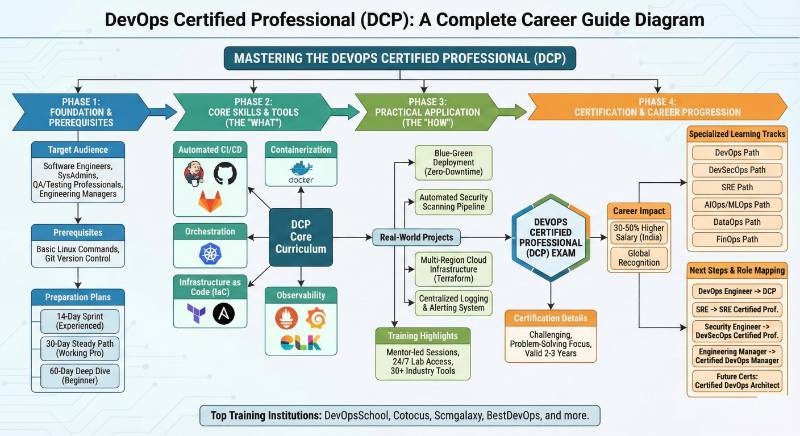
The global software landscape has shifted from “moving fast” to “moving with stability and security.” As organizations worldwide embrace digital transformation, the role of a DevOps professional has evolved from a niche specialty to a core organizational pillar. Whether you are an engineer in India’s tech hubs or managing global teams across time zones, staying relevant requires a validated, standardized set of skills.
The DevOps Certified Professional (DCP) program, offered by DevOpsSchool, serves as the definitive benchmark for engineers and managers who want to master the art of automation, orchestration, and continuous delivery.
The Master Ecosystem of Software Engineering Certifications
Navigating the world of certifications can be overwhelming. To provide clarity, here is a high-level view of the current certification landscape. This table outlines the tracks and levels required to transition from a generalist to a domain expert.
Master Certification Comparison Table
| Track | Level | Who it’s for | Prerequisites | Skills Covered | Recommended Order |
| DevOps | Professional | Engineers, Developers | Basic Linux & Git | CI/CD, Docker, K8s, IaC | 1st (Foundation) |
| SRE | Specialist | Ops & Reliability Eng | DevOps Basics | SLOs, Error Budgets, Toil | 2nd (Stability) |
| DevSecOps | Specialist | Security & DevOps Eng | DevOps Basics | SAST/DAST, Vault, Compliance | 2nd (Security) |
| AIOps/MLOps | Advanced | Data Scientists, Ops | Python, Data Basics | ML Pipelines, Model Drift | 3rd (Future-Tech) |
| DataOps | Specialist | Data Engineers | SQL, ETL knowledge | Data Quality, Pipeline Automation | 2nd (Data Flow) |
| FinOps | Management | Managers, Practitioners | Cloud Basics | Cost Optimization, Cloud Billing | 2nd (Efficiency) |
Deep Dive: DevOps Certified Professional (DCP)
The DevOps Certified Professional (DCP) is a practitioner-focused program designed to validate your ability to build, manage, and scale modern software delivery pipelines. Unlike theoretical exams, the DCP focuses on the “how-to” of the DevOps ecosystem.
What it is
The DCP is an end-to-end certification covering the entire Software Development Life Cycle (SDLC). It bridges the gap between development and operations by providing deep technical expertise in automation tools and cultural frameworks.
Who should take it
- Software Engineers who want to master the deployment and scaling of their applications.
- System Administrators looking to transition into Infrastructure as Code (IaC) and Cloud-native roles.
- QA/Testing Professionals aiming to build automated testing frameworks within CI/CD pipelines.
- Engineering Managers who need to lead DevOps transformations with technical authority.
Skills you’ll gain
- Automated CI/CD: Proficiency in Jenkins, GitHub Actions, and GitLab CI.
- Containerization: Mastering Docker for consistent environments across the lifecycle.
- Orchestration: Deploying and managing complex applications using Kubernetes.
- Infrastructure as Code (IaC): Using Terraform and Ansible to automate environment provisioning.
- Observability: Implementing proactive monitoring and logging with Prometheus, Grafana, and ELK.
Real-world projects you should be able to do
- Design a “Blue-Green” deployment strategy for a zero-downtime microservices architecture.
- Build a fully automated pipeline that scans code for security vulnerabilities before deployment.
- Provision a multi-region cloud infrastructure using Terraform scripts.
- Set up a centralized logging system that triggers alerts based on real-time log analysis.
Preparation plan
- 14-Day Sprint: Best for experienced practitioners. Focus on refining syntax for Terraform/K8s and taking full-length mock exams.
- 30-Day Steady Path: Recommended for working professionals. Dedicate 10 hours a week to hands-on labs and 5 hours to theoretical concepts.
- 60-Day Deep Dive: Ideal for beginners. Spend the first 30 days on foundations (Linux, Git, Cloud basics) and the next 30 days on tool-specific mastery.
Common mistakes
- Over-focusing on Tools: Learning the tool but not the underlying DevOps philosophy or “why” behind the process.
- Ignoring Scripting: Attempting to master DevOps without a working knowledge of Bash or Python.
- Neglecting Security: Building pipelines that prioritize speed over security (DevSecOps integration is key).
Best next certification after this
- Same Track: Certified DevOps Architect (for high-level strategy).
- Cross-Track: DevSecOps Certified Professional (to add a security layer to your profile).
- Leadership: Certified DevOps Manager (to lead teams and organizational change).
Choose Your Path: 6 Specialized Learning Tracks
Every career journey is unique. Depending on your interests, you can specialize in one of these six high-demand domains within the DevOps ecosystem:
- The DevOps Path: The core track for those who love the “End-to-End” lifecycle, focusing on automation and culture.
- The DevSecOps Path: For the security-conscious engineer who wants to integrate “Security as Code” into every pipeline.
- The SRE Path: For those focused on reliability, scalability, and “Keeping the lights on” through engineering.
- The AIOps/MLOps Path: The intersection of Data Science and Operations, focusing on AI-driven automation.
- The DataOps Path: For data professionals who need to apply DevOps speed and quality to big data pipelines.
- The FinOps Path: A management-heavy track focused on cloud cost optimization and financial accountability.
Role-Based Certification Mapping
To maximize your career impact, align your certification journey with your current or target job role:
| Role | Primary Certification | Recommended Support |
| DevOps Engineer | DCP (Professional) | Certified Kubernetes Administrator (CKA) |
| SRE | SRE Certified Professional | Certified DevOps Architect |
| Platform Engineer | DCP (Professional) | Infrastructure as Code Specialist |
| Cloud Engineer | DCP (Professional) | AWS/Azure Solutions Architect |
| Security Engineer | DevSecOps Certified Professional | Kubernetes Security Specialist |
| Data Engineer | DataOps Professional | MLOps Specialist |
| FinOps Practitioner | FinOps Professional | Cloud Practitioner |
| Engineering Manager | Certified DevOps Manager | FinOps Professional |
Top Institutions for DCP (CDE) Training & Certification
Selecting the right training partner is crucial for hands-on success. These institutions provide specialized curriculum and mentor support for the DevOps Certified Professional program:
- DevOpsSchool: The primary global provider for DCP. They offer extensive mentor-led sessions, 24/7 lab access, and a curriculum covering over 30 industry tools.
- Cotocus: A leading provider for corporate upskilling, focusing on hands-on project implementation and real-world infrastructure scenarios.
- Scmgalaxy: A veteran community platform that specializes in Software Configuration Management, Build & Release, and DevOps lifecycle training.
- BestDevOps: Known for its intensive bootcamps designed to take professionals from beginner to job-ready in the DevOps domain.
- DevSecOpsSchool: The niche leader for security-focused DevOps training, integrating compliance and security into the core curriculum.
- SRESchool: Focuses specifically on the Site Reliability Engineering track, covering SLOs, error budgets, and incident response.
- AIOpsSchool: Provides forward-looking training on how AI and Machine Learning can be applied to optimize IT operations.
- DataOpsSchool: A specialized academy for data engineers looking to streamline their data delivery pipelines using DevOps principles.
- FinOpsSchool: The premier destination for learning cloud financial management and cost optimization strategies.
Frequently Asked Questions
1. How difficult is the DCP exam?
It is designed to be challenging. It tests your ability to solve real-world problems rather than just memorizing definitions.
2. How long does the certification last?
The certification is valid for 2–3 years, after which a refresher or higher-level certification is recommended to stay current.
3. Are there any prerequisites?
While anyone can take the course, a basic understanding of Linux commands and Git version control is highly recommended.
4. How does this impact my salary in India?
Certified DevOps Professionals in India often command 30-50% higher salaries compared to generalist software engineers.
5. Is this certification recognized in the US/Europe?
Yes. The DCP curriculum is built on global industry standards used by top tech firms worldwide.
6. Can a Manager take this certification?
Absolutely. It is essential for managers to understand the technical “ground truth” to lead their teams effectively.
7. Is coding mandatory for the DCP?
Yes. You need to be comfortable with scripting (Bash/Python/YAML) to automate tasks effectively.
8. Can I take the exam remotely?
Yes, the exam is conducted through an online proctored platform accessible from anywhere.
9. What is the sequence for someone starting fresh?
Start with Linux/Git Foundations -> DCP (Professional) -> Specialized Track (SRE/Security).
10. Do I get help with projects?
Yes, training through providers like DevOpsSchool includes hands-on labs and project guidance.
11. Is there a retake policy?
Yes, most providers offer a retake option if you do not pass on your first attempt.
12. Does this cover Cloud platforms like AWS?
Yes, the program teaches you how to implement DevOps tools on major cloud providers.
Frequently Asked Questions: DCP Specifics
1. What is the official URL for the DCP?
You can find all official details here: DevOps Certified Professional.
2. Is the training live or recorded?
Most providers offer a hybrid approach—live mentor-led sessions combined with a recorded library for self-paced learning.
3. What are the core tools covered in the DCP?
The “Core Five” are Docker, Kubernetes, Jenkins, Terraform, and Ansible.
4. How is the DCP different from a Cloud Provider certification (e.g., AWS DevOps)?
Cloud certifications are vendor-specific. The DCP is tool-agnostic, teaching you skills that apply across any cloud or on-prem environment.
5. Is there a community for DCP holders?
Yes, you gain access to global forums and alumni networks through platforms like Scmgalaxy and DevOpsSchool.
6. How often is the DCP curriculum updated?
The syllabus is updated bi-annually to include the latest industry trends like GitOps and Serverless automation.
7. Does the DCP cover soft skills?
Yes, a significant portion focuses on the “DevOps Culture,” communication, and breaking down organizational silos.
8. How do I verify my certification?
Each certificate comes with a unique ID and a digital badge that can be verified on the official provider’s website.
Conclusion
In the current tech economy, a certification is more than just a piece of paper—it is a signal to the market that you possess the discipline and technical depth to handle complex, high-stakes environments. The DevOps Certified Professional (DCP) program provides a comprehensive roadmap for anyone looking to transition from a traditional role into the high-growth world of DevOps and Site Reliability Engineering.
By choosing the right path, aligning your skills with your career goals, and training with reputable institutions, you can future-proof your career and become a leader in the next generation of software engineering.
