Limited Time Offer!
For Less Than the Cost of a Starbucks Coffee, Access All DevOpsSchool Videos on YouTube Unlimitedly.
Master DevOps, SRE, DevSecOps Skills!
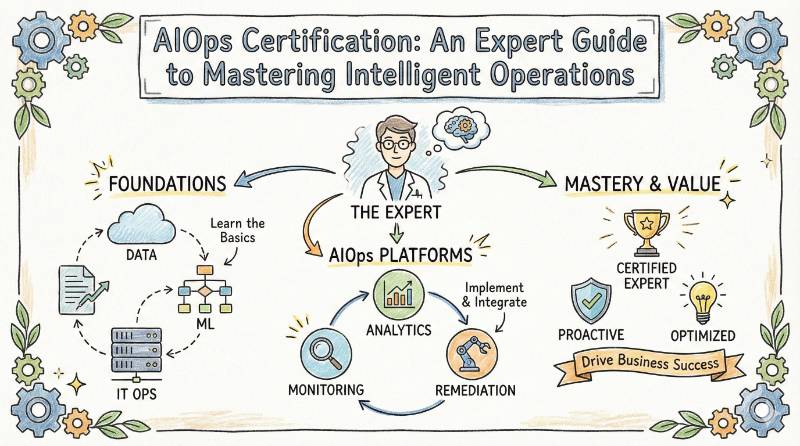
Managing modern IT systems has become a massive challenge. In my time helping organizations scale their infrastructure, I have seen a clear shift. We used to manage a few dozen servers; now, we manage thousands of microservices, containers, and cloud functions. This scale creates so much data that humans simply cannot keep up with the alerts.
This is where AIOps or Artificial Intelligence for IT Operations becomes the hero of the story. It is the practice of using machine learning and big data to automate and enhance IT operations. If you are an engineer or a manager looking to stay ahead, understanding AIOps is no longer optional—it is a requirement. This guide will walk you through everything you need to know about getting certified and mastering this domain.
Why AIOps is the Future of Operations
The traditional way of “waiting for something to break and then fixing it” is dead. Today, businesses demand 99.99% uptime. To achieve this, you need systems that can predict failures before they happen. AIOps allows you to:
- Reduce Alert Fatigue: No more waking up at 3 AM for “noise” alerts. AI filters out the junk.
- Root Cause Analysis (RCA): Instead of spending hours looking through logs, AI tells you exactly where the problem started.
- Predictive Maintenance: AI models can see patterns in CPU or memory usage and warn you days before a crash occurs.
- Automation: Routine tasks like scaling up resources or restarting failed pods can be handled entirely by smart algorithms.
AIOps Certification Training Course Overview
The AIOps Certification Training Course | AIOps program is designed to take a standard DevOps or SRE professional and turn them into an “Intelligent Operations” expert. It bridges the gap between raw data and actionable intelligence.
| Track | Level | Who it’s for | Prerequisites | Skills Covered | Recommended Order |
| AIOps Certified Professional | Intermediate | DevOps, SRE, Managers | Basic Linux & Python | ML in Ops, ELK Stack, Anomaly Detection | 1 |
| AIOps Expert | Advanced | Architects, Leads | AIOCP Certification | Predictive Analytics, Neural Networks for Logs | 2 |
| AIOps Master | Leadership | Directors, CTOs | 5+ years Ops exp | AIOps Strategy, ROI of AI, Tool Selection | 3 |
Deep Dive: AIOps Certification Training Course | AIOps
What it is
This certification is a deep-dive program that teaches you how to apply Artificial Intelligence (AI) and Machine Learning (ML) to the IT operations lifecycle. It focuses on using data science techniques to solve infrastructure problems, automate monitoring, and improve system reliability through intelligent patterns rather than static rules.
Who should take it
This course is perfect for Software Engineers, DevOps Engineers, Site Reliability Engineers (SREs), and IT Managers. If you are responsible for keeping systems running and you feel overwhelmed by the volume of logs and alerts, this program is designed for you. It is also highly beneficial for Cloud Architects who want to build “self-healing” clouds.
Skills you’ll gain
- Data Ingestion & Management: Learn how to collect data from thousands of sources using tools like Fluentd and Logstash.
- Machine Learning for Ops: Understand how to train models to recognize what a “normal” system looks like versus an “anomalous” one.
- Pattern Recognition: Identify recurring issues in logs that a human eye would miss.
- Automated Remediation: Build workflows that fix common problems automatically using AI triggers.
- AIOps Tooling: Gain hands-on experience with platforms like Moogsoft, BigPanda, or custom ELK-based AI solutions.
- Statistical Analysis: Use math to predict future resource needs and optimize cloud spending.
Real-world projects you should be able to do
- Smart Incident Management: Build a system that automatically groups 500 related alerts into a single incident report, saving the on-call engineer hours of work.
- Log Anomaly Detector: Create a tool that scans millions of log lines and highlights the “unusual” ones that preceded a system crash.
- Predictive Scaling: Develop a model that predicts a traffic spike based on historical data and scales up the Kubernetes cluster before the traffic hits.
- Self-Healing Database: Set up an AIOps workflow that detects a database slowdown, identifies a “runaway” query, and kills it without human intervention.
Preparation plan
- Day 1–14 (Foundations): Focus on refreshing your Linux skills and learning basic Python. Understand the “Four Pillars of AIOps”: Data Selection, Pattern Discovery, Inference, and Collaboration.
- Day 15–30 (The Tech Stack): Work with the ELK stack (Elasticsearch, Logstash, Kibana). Learn how to create dashboards and how the “Machine Learning” features of these tools work.
- Day 31–60 (Advanced Implementation): Build your own ML models for time-series forecasting. Practice integrating these models with CI/CD pipelines and notification systems like Slack or PagerDuty.
Common mistakes
- Expecting Magic: AI cannot fix a broken process. You must have a solid DevOps foundation before adding AI.
- Ignoring Data Quality: If your logs are messy, your AI will give you wrong answers. Focus on “Data Hygiene” first.
- Over-Complication: Don’t use a neural network when a simple statistical threshold will work. Start small and grow.
- Not Monitoring the AI: AI models can drift and become inaccurate over time. You must monitor your AI just like you monitor your servers.
Best next certification after this
After completing this, the most logical step is to expand your expertise into related “Ops” domains:
- MLOps Certified Professional (MLOCP): To learn how to manage the lifecycle of the models you just built.
- DevSecOps Certified Professional (DSOCP): To ensure your AI-driven systems are secure.
Choose Your Path: 6 Learning Journeys
Depending on your career goals, you can choose one of these specialized paths:
- DevOps Path: Focuses on the speed of delivery. This is for those who love CI/CD and automation.
- DevSecOps Path: The “Security First” path. You learn how to integrate security into every step of the software lifecycle.
- SRE Path: Focuses on the “Service Level.” This path is for engineers who love stability, performance, and uptime.
- AIOps/MLOps Path: The “Intelligence” path. This is about using data and models to manage and scale complex systems.
- DataOps Path: Focuses on the data pipeline. You ensure that data flows smoothly and accurately from source to consumer.
- FinOps Path: The “Financial” path. You learn how to optimize cloud costs and ensure the business gets the most value for every dollar spent.
Role → Recommended Certifications
If you are currently in one of these roles, here is your path to the top:
- DevOps Engineer: Start with AIOps Certified Professional + Certified Kubernetes Administrator.
- SRE: Focus on AIOps Certified Professional + SRE Certified Professional.
- Platform Engineer: Go for AIOps Certified Professional + Terraform Certification.
- Cloud Engineer: Combine AIOps Certified Professional with AWS/Azure Solutions Architect.
- Security Engineer: Take the DevSecOps Certified Professional course + AIOps for Security.
- Data Engineer: Focus on DataOps Certified Professional + AIOps Certified Professional.
- FinOps Practitioner: Start with Certified FinOps Professional + AIOps for Cost Optimization.
- Engineering Manager: Look at Certified DevOps Manager + AIOps for Executives.
Next Certifications to Take
To keep your edge in the market, consider these options after your AIOps training:
- Option 1: Same Track (Deep Dive)
- MLOps Certified Professional (MLOCP): This is the next level. While AIOps uses AI to help Ops, MLOps is about how to do Ops for AI. It covers model versioning, deployment, and monitoring.
- Option 2: Cross-Track (Broaden Your Skills)
- DevSecOps Certified Professional (DSOCP): As you automate more with AI, security becomes even more critical. This cert helps you secure your automated pipelines.
- Option 3: Leadership (Career Growth)
- Site Reliability Engineering Certified Professional (SREC): This is a globally recognized standard. It teaches the mindset of treating operations as a software problem, which perfectly complements AIOps.
Top Institutions for AIOps Training and Certifications
When choosing where to study, quality matters. Here are the top institutions that provide help in Training cum Certifications for AIOps Certification Training Course | AIOps (CDE):
- DevOpsSchool: This is a leading global institution for high-end technical training. They provide a massive library of resources, 24/7 support, and real-world projects that make the learning experience very practical for working professionals.
- Cotocus: Known for their enterprise-grade training, Cotocus helps large teams transition to AIOps. They focus heavily on consulting and ensuring that the skills learned can be applied directly to company-wide infrastructure.
- Scmgalaxy: A fantastic community-driven platform. Scmgalaxy is perfect for those who want deep technical knowledge, tutorials, and a strong network of experts to help them solve day-to-day technical challenges.
- BestDevOps: They offer streamlined and highly focused training programs. If you are a busy professional looking for a “no-nonsense” approach to learning AIOps quickly and effectively, this is a great choice.
- DevSecOpsSchool: While they specialize in security, their AIOps modules are excellent for learning how to use AI to detect security threats and automate responses to cyber-attacks.
- Sreschool: Dedicated to the world of Site Reliability Engineering, this school helps you integrate AIOps into the SRE framework of SLIs, SLOs, and Error Budgets.
- Aiopsschool: A specialized portal that focuses purely on the AIOps domain. They offer niche labs and scenarios that specifically target the automation of monitoring and incident response.
- Dataopsschool: If you want to understand the “Data” side of AIOps, this institution provides the best training on building reliable data pipelines that feed your AI models.
- Finopsschool: They help you use AIOps specifically for financial management. Learn how AI can predict cloud spending and alert you to “cost anomalies” before they blow your budget.
FAQs on AIOps Certification Training Course | AIOps
- Is AIOps different from MLOps? Yes. AIOps uses AI to help manage IT systems (monitoring, alerts, logs). MLOps is about the process of putting machine learning models into production safely.
- How long does it take to finish the AIOps certification? Typically, it takes about 40 to 60 hours of training followed by another 20 to 30 hours of hands-on project work. Most professionals finish it in 2 months.
- Do I need to be a Data Scientist to learn AIOps? No. You need to be an operations person who is willing to learn how to use data science tools. The course teaches you the math you need.
- What is the passing score for the exam? Most certifications require a score of 70% or higher. The exam usually consists of multiple-choice questions and a practical lab assessment.
- Can I take this course online? Yes, most providers like DevOpsSchool offer both live instructor-led online classes and self-paced video formats.
- Will this certification help me get a job at a top tech company? Major companies like Google, Amazon, and Netflix use AIOps heavily. Having this cert shows you have the modern skills they are looking for.
- What is the average salary hike after getting AIOps certified? While it varies, many professionals report a salary increase of 25% to 40% as they move into “Architect” or “Lead” roles.
- Does AIOps replace humans in IT? No. It replaces the boring, repetitive parts of the job. It allows humans to focus on creative problem solving and high-level architecture.
- What tools will I learn in this course? You will likely work with ELK, Prometheus, Grafana, Splunk, and various Python libraries for machine learning.
- Is there a renewal fee for the certification? Most certifications are valid for 2 or 3 years. You may need to take a refresher exam or earn “credits” through continuous learning to renew.
- Are there any prerequisites for the AIOCP exam? A basic understanding of DevOps and at least one scripting language (like Python or Bash) is highly recommended.
- What makes DevOpsSchool different for this training? They offer a unique blend of “theory + labs + projects” and provide a certificate that is recognized by major IT firms globally.
FAQs: AIOps Certification Training Course | AIOps
1. What makes the DevOpsSchool program different? They focus on “Project-Based Learning.” You build real AIOps systems during the course, not just watch slides.
2. Do I need to be a Data Scientist? No. You need to be an engineer who understands how to apply Data Science to operations.
3. Will I get help with the labs? Yes, top-tier schools provide 24/7 technical support for their lab environments.
4. Is there a certificate of completion? Yes, you receive a professional certification after passing the evaluation.
5. Can this be done alongside a full-time job? Yes, the schedules are designed for working professionals with weekend and evening batches.
6. What kind of salary hike can I expect? AIOps specialists often see a 20-40% increase in compensation compared to traditional DevOps roles.
7. Is Python mandatory? While not mandatory to start, you will learn the Python necessary for AIOps during the training.
8. How do I enroll? Visit the Official Provider website to find the next available batch and registration details.
Conclusion
The world of IT operations is moving fast. If you stay stuck in the old ways of manual monitoring and reactive troubleshooting, you risk falling behind. The AIOps Certification Training Course | AIOps is your ticket to the next level of your career. It gives you the power to handle massive amounts of data and turn it into a reliable, self-healing infrastructure.
By choosing a reputable training partner like DevOpsSchool or its sister institutions, you ensure that you are getting the most up-to-date knowledge from experts who live and breathe this technology. It is time to stop being a “firefighter” and start being the “architect” of an intelligent future.
