Limited Time Offer!
For Less Than the Cost of a Starbucks Coffee, Access All DevOpsSchool Videos on YouTube Unlimitedly.
Master DevOps, SRE, DevSecOps Skills!
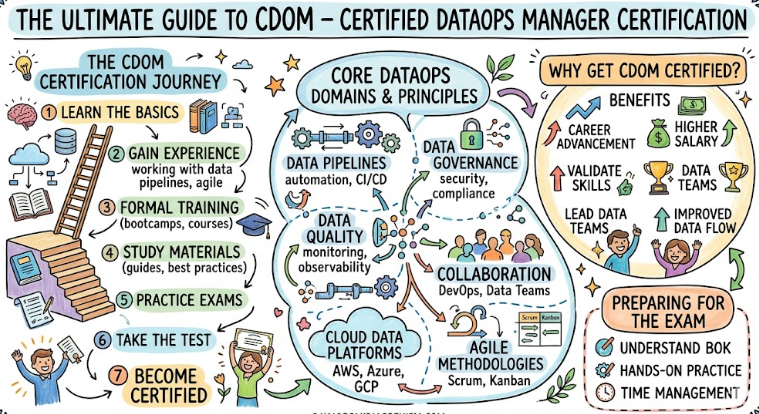
Introduction
The modern data landscape is shifting from simple storage to complex, automated delivery pipelines. This guide focuses on the CDOM – Certified DataOps Manager designation, a professional standard designed for those leading data transformation initiatives. As organizations struggle with data silos and slow delivery cycles, the role of a DataOps manager becomes critical for bridging the gap between data engineering and business value. This resource is curated by DataOpsSchool to provide a clear roadmap for engineers and managers looking to master the art of data orchestration. We will explore how this certification acts as a catalyst for career growth within the DevOps and platform engineering ecosystems.
What is the CDOM – Certified DataOps Manager?
The CDOM – Certified DataOps Manager is a specialized professional credential that validates an individual’s ability to manage and optimize the data lifecycle using DevOps principles. Unlike traditional data management courses that focus purely on database administration, this program emphasizes automation, continuous integration, and continuous delivery of data. It represents a shift toward treating data as code, ensuring that data pipelines are as resilient and scalable as modern software applications.
The curriculum is built around real-world production environments where data quality and speed are paramount. It exists to provide a framework for reducing the cycle time of data analytics while improving the reliability of data products. Professionals who earn this certification demonstrate that they understand how to align technical data workflows with enterprise-level governance and compliance requirements. It is a bridge between the technical intricacies of data engineering and the strategic oversight required in modern engineering leadership.
Who Should Pursue CDOM – Certified DataOps Manager?
This certification is ideally suited for senior data engineers, database administrators, and cloud architects who want to transition into leadership roles. Engineering managers who oversee data teams will find the program invaluable for understanding the technical bottlenecks that slow down their departments. Furthermore, SREs and platform engineers who are increasingly tasked with managing data infrastructure will benefit from the structured approach to data orchestration provided in this course.
In the context of the global market, including the rapidly expanding tech sector in India, the demand for structured data management is at an all-time high. Beginners with a strong foundation in cloud computing can use this certification to specialize early, while experienced professionals can use it to formalize their years of practical experience. It is also highly relevant for security and compliance officers who need to ensure that data pipelines remain secure without sacrificing the speed of delivery.
Why CDOM – Certified DataOps Manager is Valuable and Beyond
The longevity of a career in technology depends on the ability to manage complex systems rather than just specific tools. CDOM – Certified DataOps Manager provides this longevity by focusing on the underlying principles of data flow and organizational efficiency. As enterprises move toward decentralized data architectures like data mesh and data fabric, the need for managers who can coordinate these moving parts becomes a non-negotiable requirement for success.
Investing time in this certification offers a high return because it addresses one of the biggest pain points in modern business: the “data graveyard” problem. By learning how to turn raw data into actionable insights through automated pipelines, professionals become indispensable assets to their organizations. The certification ensures that your skills remain relevant even as specific database technologies or cloud providers change, as the core logic of DataOps remains constant across all platforms.
CDOM – Certified DataOps Manager Certification Overview
The CDOM – Certified DataOps Manager program is delivered via the official training portal and is hosted on the primary certification site. The program is structured to move candidates through various stages of competency, starting with foundational concepts and moving toward advanced managerial strategies. It utilizes a combination of theoretical assessments and practical, project-based evaluations to ensure that the candidate can handle real-world scenarios.
The assessment approach is designed to be rigorous, reflecting the high standards required in production-grade data environments. Ownership of the certification resides with a body of experts who continuously update the curriculum to reflect current industry trends and emerging technologies. This ensures that the certification is not just a one-time achievement but a continuous validation of a professional’s expertise in the evolving field of data operations.
CDOM – Certified DataOps Manager Certification Tracks & Levels
The certification path is divided into three distinct levels: Foundation, Professional, and Advanced. The Foundation level focuses on the terminology, core principles, and the cultural shift required to implement DataOps within a team. It is the starting point for anyone new to the methodology, providing the essential building blocks for more complex studies.
The Professional level dives deeper into toolchains, automation strategies, and specific specialization tracks such as FinOps for data or DevSecOps integration. Finally, the Advanced level is designed for aspiring directors and principal engineers who need to manage multiple teams and cross-departmental data strategies. This tiered approach allows professionals to progress at their own pace, aligning their learning with their current career stage and future aspirations.
Complete CDOM – Certified DataOps Manager Certification Table
| Track | Level | Who it’s for | Prerequisites | Skills Covered | Recommended Order |
| Core Management | Foundation | Junior Leads | Basic Data Knowledge | DataOps Culture, CI/CD | 1 |
| Technical Ops | Professional | Data Engineers | 2 Years Experience | Pipeline Automation, Orchestration | 2 |
| Strategy & Governance | Advanced | Managers/Directors | 5 Years Experience | Compliance, Team Scaling, ROI | 3 |
| Security Integration | Specialist | Security Engineers | CDOM Foundation | Data Masking, Access Control | 4 |
| Financial Ops | Specialist | Cloud Architects | CDOM Foundation | Cloud Data Cost Management | 5 |
Detailed Guide for Each CDOM – Certified DataOps Manager Certification
CDOM – Certified DataOps Manager – Foundation
What it is
This certification validates the candidate’s understanding of the fundamental principles of DataOps and its role in modern engineering. It covers the core vocabulary and the primary goals of data pipeline automation.
Who should take it
It is suitable for entry-level data professionals, software engineers transitioning to data roles, and project managers who need to understand the technical workflows of their teams.
Skills you’ll gain
- Understanding of the DataOps manifesto and principles.
- Knowledge of basic CI/CD concepts applied to data.
- Ability to identify bottlenecks in manual data processes.
- Familiarity with data quality and testing frameworks.
Real-world projects you should be able to do
- Designing a basic automated data ingestion workflow.
- Creating a data quality checklist for a small project.
- Mapping a manual data process to a semi-automated pipeline.
Preparation plan
- 7-14 Days: Focus on the official study guide and understanding the core terminology.
- 30 Days: Participate in community forums and complete basic lab exercises on data orchestration.
- 60 Days: Conduct a mock audit of a data pipeline to apply theoretical knowledge to a practical scenario.
Common mistakes
- Overlooking the cultural aspects of DataOps in favor of focusing solely on tools.
- Failing to understand the difference between DevOps for software and DataOps for data.
Best next certification after this
- Same-track option: CDOM Professional
- Cross-track option: Cloud Practitioner
- Leadership option: Project Management Professional (PMP)
CDOM – Certified DataOps Manager – Professional
What it is
This level confirms that the professional can implement and manage complex data toolchains in a production environment. It focuses on the technical execution of DataOps strategies at scale.
Who should take it
This is designed for experienced data engineers, SREs, and technical leads who are responsible for the daily operation of data pipelines.
Skills you’ll gain
- Advanced orchestration of multi-stage data pipelines.
- Integration of automated testing and monitoring in data workflows.
- Implementation of version control for data and metadata.
- Management of environment-specific configurations for data processing.
Real-world projects you should be able to do
- Building a self-healing data pipeline that alerts on quality failures.
- Implementing a data versioning system for a machine learning team.
- Automating the deployment of data infrastructure using code.
Preparation plan
- 7-14 Days: Review advanced automation patterns and tool-specific documentation.
- 30 Days: Execute end-to-end pipeline projects in a sandbox environment.
- 60 Days: Optimize an existing pipeline for performance and reliability metrics.
Common mistakes
- Neglecting the monitoring and alerting aspects of the pipeline.
- Hardcoding configurations instead of using environment variables.
Best next certification after this
- Same-track option: CDOM Advanced
- Cross-track option: Certified SRE Professional
- Leadership option: Engineering Manager Certification
CDOM – Certified DataOps Manager – Advanced
What it is
This advanced credential validates the ability to lead organizational change and manage large-scale data departments. It focuses on strategy, governance, and the business impact of DataOps.
Who should take it
Principal engineers, Directors of Data, and CTOs who need to align data initiatives with overall business objectives.
Skills you’ll gain
- Designing enterprise-wide data governance frameworks.
- Managing large technical teams and cross-functional stakeholders.
- Calculating and improving the ROI of data operations.
- Implementing security and compliance at the architectural level.
Real-world projects you should be able to do
- Creating a five-year data strategy for an enterprise organization.
- Leading a migration from a legacy data silo to a modern DataOps framework.
- Establishing a company-wide data quality standard and enforcement policy.
Preparation plan
- 7-14 Days: Study case studies of enterprise data transformations.
- 30 Days: Focus on the financial and legal aspects of data management.
- 60 Days: Draft a comprehensive governance plan for a theoretical large-scale organization.
Common mistakes
- Losing sight of technical feasibility when designing high-level strategies.
- Underestimating the resistance to cultural change within large organizations.
Best next certification after this
- Same-track option: CDOM Fellow
- Cross-track option: Enterprise Architect Certification
- Leadership option: Executive MBA or Leadership Program
Choose Your Learning Path
DevOps Path
Engineers following this path should focus on the integration of data pipelines into existing software delivery cycles. This involves learning how to treat data migrations and schema changes with the same rigor as application code deployments. The goal is to create a unified pipeline where data and code move together seamlessly toward production.
DevSecOps Path
The security-focused path emphasizes the protection of data throughout its lifecycle. Professionals here learn to implement automated security scanning within the data pipeline and manage access controls programmatically. This ensures that data sensitivity is respected while maintaining the high speed of delivery required by modern businesses.
SRE Path
For Site Reliability Engineers, the CDOM focus is on the availability and performance of data systems. This path teaches how to apply SRE principles like Error Budgets and Service Level Objectives to data pipelines. It ensures that the data infrastructure is resilient enough to handle unexpected loads and failures without impacting the end user.
AIOps Path
In the AIOps track, professionals learn to use artificial intelligence to monitor and manage data operations. This involves using machine learning models to predict pipeline failures and automate the remediation process. It is a forward-looking path that combines traditional management with cutting-edge predictive technology.
MLOps Path
The MLOps path is specifically tailored for those supporting machine learning teams. It focuses on the unique challenges of managing training data, model versioning, and feature stores. The objective is to ensure that data scientists have a reliable and reproducible environment for developing and deploying AI models.
DataOps Path
The pure DataOps path is the core of this certification, focusing on the end-to-end management of the data lifecycle. It covers everything from ingestion and transformation to visualization and archival. This path is ideal for those who want to be the primary architects of a company’s data strategy.
FinOps Path
The financial operations path focuses on the cost-effectiveness of data cloud resources. Professionals learn to monitor spend, optimize storage costs, and ensure that the data infrastructure is providing maximum value for the investment. This is critical for organizations operating on large-scale public cloud platforms.
Role → Recommended CDOM – Certified DataOps Manager Certifications
| Role | Recommended Certifications |
| DevOps Engineer | CDOM Foundation, CDOM Professional |
| SRE | CDOM Foundation, SRE Track |
| Platform Engineer | CDOM Professional, CDOM Advanced |
| Cloud Engineer | CDOM Foundation, FinOps Track |
| Security Engineer | CDOM Foundation, DevSecOps Track |
| Data Engineer | CDOM Foundation, CDOM Professional |
| FinOps Practitioner | CDOM Foundation, FinOps Track |
| Engineering Manager | CDOM Foundation, CDOM Advanced |
Next Certifications to Take After CDOM – Certified DataOps Manager
Same Track Progression
Once the advanced level is reached, professionals should look toward specialized fellowships or contributing to the body of knowledge within the DataOps community. This might involve publishing research or developing new frameworks that address niche industry problems. Deep specialization ensures that you remain a top-tier expert in the technical aspects of data management.
Cross-Track Expansion
Broadening your skills into adjacent fields like Cloud Architecture or Cybersecurity is a smart move for those who want to be versatile. By combining CDOM with a certification in AWS, Azure, or Google Cloud, you position yourself as a multi-talented engineer who understands both the infrastructure and the data that runs on it. This cross-pollination of skills is highly valued in modern flat organizational structures.
Leadership & Management Track
For those aiming for the C-suite, the transition from technical management to business leadership is essential. Certifications in executive leadership, project management, or even general business administration can complement the technical depth of the CDOM. This combination allows you to speak both the language of the developers and the language of the boardroom.
Training & Certification Support Providers for CDOM – Certified DataOps Manager
DevOpsSchool
This provider offers extensive resources for professionals looking to master the intersection of software development and operations. Their curriculum is known for its practical approach, ensuring that students can apply what they learn immediately in their workplace. With a focus on hands-on labs and real-world scenarios, they bridge the gap between theory and practice effectively. Their instructors are seasoned veterans who bring years of industry experience to the classroom, making them a reliable choice for career advancement.
Cotocus
Focusing on high-end technical training, this provider specializes in niche areas of modern engineering. They provide tailored learning paths that help individuals and teams stay ahead of the technology curve. Their commitment to quality is evident in their structured course delivery and comprehensive support systems. They often partner with industry leaders to ensure their training materials are up-to-date with the latest market demands and technological shifts.
Scmgalaxy
This community-driven platform serves as a hub for professionals interested in configuration management and automation. They provide a wealth of free and paid resources, including tutorials, webinars, and certification prep materials. Their focus on building a strong community of learners makes them an excellent choice for those who value peer-to-peer learning. They have a long history of supporting engineers in their journey to become experts in automation and delivery.
BestDevOps
As the name suggests, this provider aims to offer the best-in-class training for DevOps and its related disciplines. They focus on delivering comprehensive courses that cover the entire software development lifecycle. Their training programs are designed to be intensive and results-oriented, helping candidates achieve their certification goals in a shorter timeframe. They are known for their high success rates and the quality of their post-training support.
devsecopsschool.com
This institution focuses exclusively on the critical field of DevSecOps, integrating security into every stage of the development process. Their courses are essential for professionals who want to ensure that speed does not come at the cost of safety. They provide deep insights into automated security tools and processes that are becoming mandatory in today’s regulatory environment. Their specialized focus makes them a top choice for security-conscious engineers.
sreschool.com
Dedicated to the principles of Site Reliability Engineering, this provider helps engineers build systems that are both scalable and reliable. Their curriculum covers everything from monitoring and alerting to incident response and capacity planning. They emphasize the mathematical and logical foundations of reliability, making their training highly valuable for those working on mission-critical infrastructure. Their approach is data-driven and focuses on continuous improvement.
aiopsschool.com
This provider leads the way in training for the next generation of operations, where artificial intelligence plays a central role. Their courses help professionals understand how to leverage machine learning to automate complex operational tasks. They focus on practical applications of AI in monitoring, root cause analysis, and predictive maintenance. This training is vital for those looking to stay at the forefront of technological innovation in the operations space.
dataopsschool.com
The primary host for the CDOM program, this school is the authority on all things related to data operations. They provide the most direct and comprehensive training for the certification, ensuring that candidates are perfectly prepared for the exams. Their curriculum is designed by the same experts who manage the certification, providing an unparalleled level of alignment. They are the go-to resource for anyone serious about a career in DataOps management.
finopsschool.com
As cloud costs continue to rise, this provider offers essential training in financial management for cloud resources. They help professionals understand how to balance technical performance with budget constraints. Their courses provide practical strategies for cost optimization and financial accountability in decentralized cloud environments. This training is increasingly important for organizations looking to maximize their cloud investment without overspending.
Frequently Asked Questions (General)
- How difficult is the CDOM – Certified DataOps Manager exam?
The exam is moderately difficult and requires a solid understanding of both data engineering and management principles. It is designed to test practical application rather than just rote memorization. - What are the prerequisites for the Foundation level?
There are no formal prerequisites, but a basic understanding of data systems and software development concepts is highly recommended for success. - How long does it take to complete the entire certification path?
Most professionals complete all three levels within twelve to eighteen months, depending on their existing experience and the amount of time they can dedicate to study. - Is the certification recognized globally?
Yes, the standards taught in the program are based on universal DataOps principles that are applicable in tech hubs across the world, from Silicon Valley to Bangalore. - Does the certification focus on specific tools like Jenkins or Airflow?
While the course uses common tools for demonstrations, the focus is on the underlying principles and workflows that can be applied to any toolchain. - What is the return on investment for this certification?
Professionals often see significant salary increases and access to higher-level management roles after obtaining the CDOM credential. - Can I take the exams online?
Yes, the certification body provides a secure online proctoring system that allows candidates to take the exam from anywhere in the world. - Are there any renewal requirements for the certification?
The certification is typically valid for two to three years, after which professionals must demonstrate continued learning or pass a recertification exam. - How does CDOM differ from a standard Data Engineering certification?
CDOM focuses on the management, automation, and orchestration of the entire data lifecycle, whereas data engineering certifications often focus on specific technical skills like SQL or Spark. - Is there a community for CDOM certified professionals?
Yes, there is a vibrant global community where certified individuals can network, share best practices, and find job opportunities. - Does the program cover data privacy laws like GDPR?
Yes, the Advanced level includes significant sections on data governance and compliance with international privacy regulations. - Are there group discounts for corporate training?
Most of the support providers listed offer customized training packages and discounts for organizations looking to certify their entire teams.
FAQs on CDOM – Certified DataOps Manager
- What makes a DataOps manager different from a traditional Project Manager?
A DataOps manager possesses deep technical knowledge of data pipelines and automation, allowing them to lead technical teams more effectively than a generalist project manager. They focus specifically on the velocity and quality of data delivery. - Why is the CDOM program important for SREs?
SREs are increasingly responsible for the reliability of data systems. CDOM provides them with the specific frameworks needed to apply reliability engineering to complex data architectures. - Can a beginner in tech start with CDOM?
While possible, it is recommended to have at least a year of general IT experience to fully grasp the concepts of automation and delivery cycles taught in the program. - How does CDOM address data quality issues?
The program emphasizes “shifting left” on data quality, meaning that testing and validation are integrated into the earliest stages of the data pipeline. - Is the CDOM curriculum updated frequently?
Yes, the curriculum is reviewed annually to ensure it includes emerging trends like data mesh, real-time streaming, and AI-driven operations. - What is the most challenging part of the CDOM Professional level?
Most candidates find the orchestration of multi-cloud data pipelines and complex version control strategies to be the most demanding aspects of the professional level. - Does CDOM help in transitioning to a CTO role?
Yes, the Advanced level provides the strategic and financial oversight skills that are essential for high-level executive positions in technology-driven companies. - Is the CDOM certification vendor-neutral?
Yes, the certification is designed to be vendor-neutral, ensuring that the skills learned are applicable regardless of whether an organization uses AWS, Azure, or on-premise solutions.
Final Thoughts: Is CDOM – Certified DataOps Manager Worth It?
The decision to pursue a certification should always be based on its ability to solve real-world problems and advance your career. The CDOM – Certified DataOps Manager is not just a badge; it is a comprehensive training program that prepares you for the realities of modern data management. As the industry moves away from manual processes toward automated, high-velocity delivery, those who hold this certification will be the ones leading the charge.
If you are looking for a way to differentiate yourself in a crowded market and demonstrate that you have the skills to manage complex, production-grade data environments, then this certification is a sound investment. It provides the structure, the knowledge, and the community support needed to excel in one of the most exciting and critical fields in technology today. Take the step toward becoming a leader in the data operations space and secure your professional future.
