Limited Time Offer!
For Less Than the Cost of a Starbucks Coffee, Access All DevOpsSchool Videos on YouTube Unlimitedly.
Master DevOps, SRE, DevSecOps Skills!
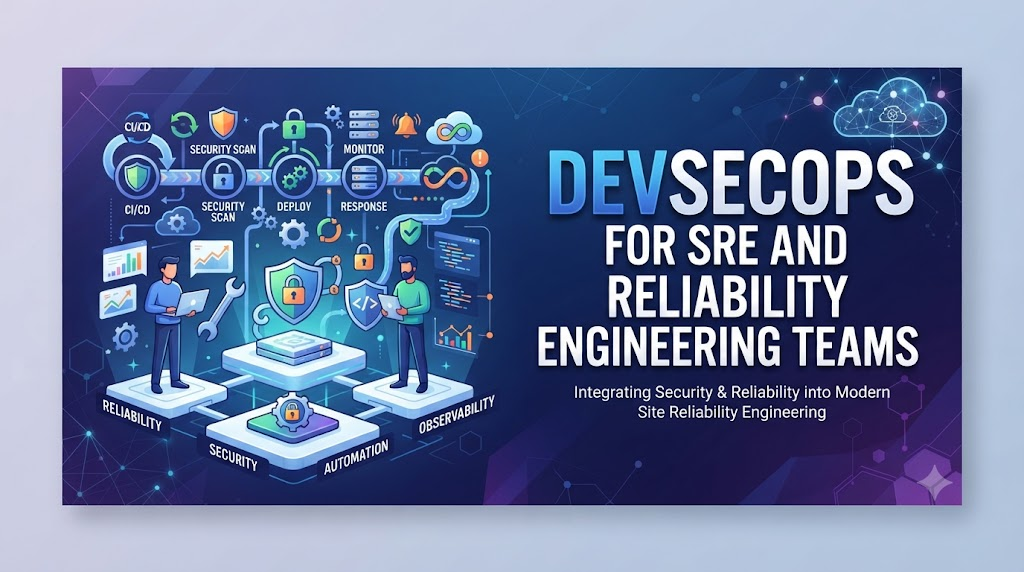
Introduction
Imagine an SRE team managing a large-scale Kubernetes platform on a major cloud provider. The pipeline deploys microservices continuously, monitoring dashboards show green metrics, and error budgets remain comfortably intact. Suddenly, an automated vulnerability scanner flags an unauthenticated remote execution flaw in a widely used logging library. Simultaneously, an external actor uses an exposed API key—accidentally committed to a public repository—to provision unauthorized crypto-mining nodes, spiking resource utilization and crashing the core payment gateway.
While the incident started as a security failure, it immediately manifested as a severe reliability outage. Availability dropped, latency spiked, and the incident response team had to scramble to revoke credentials, isolate compromised nodes, and roll back deployments.
This scenario illustrates a fundamental reality of modern engineering: a security failure can quickly become a reliability failure. Security and reliability cannot operate as completely separate silos. When SREs and DevSecOps engineers align their workflows, security practices directly support availability, resilience, incident prevention, and production stability.
What Is DevSecOps?
DevSecOps is the practice of integrating security considerations into every phase of the software delivery lifecycle. Rather than treating security as a gatekeeper review at the end of the development cycle, DevSecOps embeds security controls directly into planning, development, testing, CI/CD pipelines, infrastructure provisioning, deployment, and operational monitoring.
Moving from security as a separate checkpoint to security as part of continuous engineering means shifting security left. Automated scans run during code commits, infrastructure changes undergo automated policy checks before deployment, and runtime environments continuously verify configuration integrity.
What Is SRE?
Site Reliability Engineering applies software engineering principles to infrastructure and operations. SRE focuses on creating systems that are reliable, measurable, and operationally sustainable. Core SRE practices include managing availability, scalability, performance, automation, monitoring, incident response, error budgets, service level objectives (SLOs), service level indicators (SLIs), and systematic toil reduction.
DevSecOps vs SRE
| Area | DevSecOps | SRE |
| Primary Focus | Security throughout delivery | Reliability and resilience |
| Key Concern | Security risk and vulnerability | Service reliability and uptime |
| Automation | Security automation and scanning | Operational and infrastructure automation |
| Monitoring | Security signals and audit logs | Reliability and performance signals |
| Incident Response | Security incidents and breaches | Reliability and availability incidents |
| Goal | Secure delivery and risk reduction | Reliable and scalable services |
While their primary metrics differ, these disciplines complement each other. Secure systems form the foundation of reliable systems, which ultimately enable resilient operations.
Why DevSecOps Matters to SRE Teams
Security vulnerabilities, misconfigurations, and credential leaks directly threaten uptime, latency, data integrity, and recovery times. When SRE teams ignore security risks, they expose production environments to operational instability.
For instance, compromised credentials allow unauthorized modifications that break infrastructure automation. Vulnerable container images introduce runtime instability or unexpected crashes. Cloud misconfigurations can expose internal networks, leading to outages caused by denial-of-service or data corruption. Integrating DevSecOps practices helps SRE teams catch these risks before they disrupt production.
Shared Responsibilities Between DevSecOps and SRE
Both SRE and DevSecOps teams share a deep interest in automation, monitoring, immutable infrastructure, incident management, and risk reduction. To avoid creating operational friction, teams should collaborate across:
- Infrastructure Provisioning: Ensuring infrastructure-as-code templates are secure and stable.
- Continuous Integration: Combining security gates with automated testing and deployment.
- Observability: Centralizing logs, metrics, and security audit trails.
- Incident Management: Establishing unified response playbooks for complex operational and security events.
Security as a Reliability Concern
Security failures frequently translate directly into reliability failures. Consider the following failure modes:
- Credential Compromise: Unauthorized access can lead to accidental deletion of critical infrastructure or database corruption.
- Vulnerable Dependencies: Flawed software packages can trigger application crashes, memory leaks, or unexpected exceptions under load.
- Cloud Misconfiguration: Overly permissive storage buckets or security groups can cause data leaks or disrupt dependent cloud services.
- Container Vulnerability: Flaws in base operating system layers can lead to kernel panics or resource exhaustion.
- Supply-Chain Attacks: Compromised build artifacts can inject malicious code that alters application behavior and destabilizes production.
DevSecOps and SRE Metrics
Effective engineering teams balance reliability indicators with security telemetry to make informed decisions without drowning in alerts.
- SRE Metrics: Service Level Indicators (SLIs), Service Level Objectives (SLOs), error budgets, availability, latency, incident frequency, and Mean Time to Recovery (MTTR).
- Security Metrics: Vulnerability age, Mean Time to Remediate (MTTR), critical vulnerability backlog, secret detection rate, and dependency risk score.
Tracking a focused set of actionable metrics helps teams prioritize engineering work effectively.
CI/CD Security Integration
Integrating security into the delivery pipeline requires balancing thorough checks with deployment velocity. SRE teams should work with developers and security engineers to embed automated validation into the workflow:
$$\text{Code} \rightarrow \text{Build} \rightarrow \text{Test} \rightarrow \text{Security Checks} \rightarrow \text{Package} \rightarrow \text{Deploy} \rightarrow \text{Verify} \rightarrow \text{Monitor}$$
Security checks should include Static Application Security Testing (SAST), Software Composition Analysis (SCA), secret scanning, container image scanning, Infrastructure as Code (IaC) linting, and policy validation.
Infrastructure as Code Security
Infrastructure as Code (IaC) is foundational for SRE teams managing cloud environments. Treating infrastructure as software enables peer review, version control, automated testing, and consistent configuration management.
SREs should integrate automated IaC scanning tools into pull request workflows to catch misconfigurations, excessive permissions, and network exposure before code reaches production environments.
Secure Cloud Infrastructure for SRE
Operational resilience depends on secure cloud foundations. Key areas include:
- Identity and Access Management (IAM): Enforcing strict least privilege access.
- Network Segmentation: Utilizing private subnets, strict firewall rules, and service meshes.
- Encryption: Encrypting data at rest and in transit across all storage and communication channels.
- Logging and Auditing: Centralizing immutable audit logs for troubleshooting and forensic analysis.
Kubernetes and Containerized Environments
Running containerized workloads at scale requires tight alignment between Kubernetes security and reliability. SRE teams should enforce:
- Image Provenance: Using verified base images and signing artifacts.
- Role-Based Access Control (RBAC): Limiting cluster-level permissions.
- Resource Quotas and Limits: Preventing noisy neighbor problems and resource starvation.
- Runtime Monitoring: Detecting abnormal container behavior and unauthorized system calls.
Secrets Management
Hardcoded secrets, API keys, and database passwords are major risks to both security and stability. Best practices include:
- Centralized secrets management engines.
- Short-lived, dynamically generated credentials.
- Automated credential rotation.
- Eliminating secrets entirely from source code repositories and container images.
Leaked credentials often lead to resource hijacking and unexpected production outages.
Identity and Access Management
Managing human and machine identities requires rigorous enforcement of least privilege principles. Implementing role-based access, multi-factor authentication, temporary access tokens, and regular access reviews reduces the blast radius of compromised credentials and limits accidental administrative errors.
Security Monitoring and Observability
SRE teams can extend existing observability platforms—such as Prometheus, Grafana, and centralized logging stacks—to ingest security telemetry. Monitoring authentication failures, abnormal API request rates, privilege escalation attempts, and system audit logs alongside standard error rates provides a holistic view of system health.
Security Incident Response
When security incidents occur, SRE teams bring valuable expertise in triage, containment, and restoration. An integrated incident response lifecycle includes:
- Detect: Identifying anomalies through monitoring and alerting.
- Triage: Determining scope, severity, and potential impact.
- Contain: Isolating affected instances or networks.
- Investigate: Analyzing logs and artifacts to find root causes.
- Recover: Restoring normal, secure service operations.
- Learn: Conducting blameless post-mortems to prevent recurrence.
Disaster Recovery
Disaster recovery plans must account for security posture. Backups must be encrypted, access-controlled, tested regularly, and stored immutably to prevent ransomware encryption. A recovery strategy is ineffective if restored backups contain unpatched vulnerabilities or compromised administrative accounts.
Error Budgets and Security Risk
Balancing security urgency with reliability error budgets requires nuanced decision-making. While critical zero-day vulnerabilities demand immediate remediation, patching every low-severity finding can exhaust engineering capacity and increase deployment risk. Teams must evaluate security findings based on actual exploitability and business impact rather than treating all alerts identically.
Secure Automation
Automation eliminates manual toil, but automated workflows must be secure. Provisioning scripts, deployment pipelines, and operational runbooks should adhere to secure coding standards, undergo rigorous code reviews, and operate under restricted service accounts.
Reducing Toil Through DevSecOps
Manual security reviews create bottlenecks and operational toil. Automating vulnerability scanning, dependency updates, compliance evidence collection, and secret rotation frees up SRE engineers to focus on high-value reliability and architecture projects.
Change Management
Stable operations rely on disciplined change management. Secure changes must be version-controlled, peer-reviewed, tested in staging environments, audited, and easily reversible. Combining robust change control with automated security gates ensures rapid, low-risk deployments.
Secure Deployment Strategies
Techniques such as blue-green deployments, canary releases, and feature flags allow teams to limit the blast radius of bad code or insecure configurations. However, deployment strategies complement security validation—they do not replace pre-deployment scanning and testing.
Supply Chain Security for SRE Teams
Software supply-chain security involves verifying the integrity of third-party dependencies, open-source libraries, build agents, and container registries. Generating and reviewing Software Bills of Materials (SBOMs) helps SRE teams understand exactly what code runs in production.
Policy as Code
Policy as Code allows teams to codify security and operational standards into automated guardrails. Using policy engines, organizations can enforce rules on infrastructure templates, Kubernetes manifests, and cloud configurations automatically during CI/CD execution.
DevSecOps Culture and Collaboration
Culture dictates engineering success. Security teams should not act solely as gatekeepers; they should act as engineering partners. Fostering shared ownership, blameless post-mortems, transparency, and continuous learning bridges the gap between development, security, and SRE teams.
Common DevSecOps Challenges for SRE Teams
- Alert Fatigue: Overwhelming volumes of false-positive vulnerability reports.
- Tool Overload: Managing too disconnected security tools without unified visibility.
- Slow Pipelines: Security scans that add excessive latency to deployment workflows.
- Skill Gaps: Navigating complex security domains without adequate training.
Common Mistakes
- Treating security as solely the security team’s responsibility.
- Blocking every deployment on minor vulnerability findings.
- Ignoring developer experience and workflow friction.
- Neglecting runtime security and cloud misconfigurations.
- Failing to test disaster recovery and incident response playbooks.
DevSecOps and SRE Implementation Roadmap
- Phase 1 — Assess: Review current architecture, CI/CD pipelines, cloud infrastructure, and monitoring capabilities.
- Phase 2 — Prioritize: Identify high-risk security and reliability gaps.
- Phase 3 — Integrate: Embed automated security checks into existing workflows.
- Phase 4 — Automate: Implement automated scanning, policy checks, and remediation workflows.
- Phase 5 — Monitor: Extend observability to cover key security and reliability signals.
- Phase 6 — Respond: Unify incident response procedures between security and SRE teams.
- Phase 7 — Improve: Use post-mortems and metric reviews to continuously refine processes.
30/60/90-Day Plan for SRE Teams
- First 30 Days: Audit current architecture, review IAM roles, catalog secrets management practices, and establish baseline security metrics.
- Days 31–60: Introduce automated CI/CD vulnerability scanning, integrate IaC linting, and refine secret management workflows.
- Days 61–90: Expand automated policy controls, conduct disaster recovery and security incident simulations, and scale successful practices across engineering teams.
Tool Categories
Teams should select tools that integrate smoothly into existing workflows:
- Source Control & CI/CD: GitHub, GitLab, Jenkins, ArgoCD.
- Application Security: SAST, SCA, and secret scanning utilities.
- Container & Kubernetes Security: Image scanners, admission controllers, and runtime security tools.
- Infrastructure & Cloud Security: IaC linters, Cloud Security Posture Management (CSPM), and Policy as Code engines.
- Observability: SIEM, APM, and centralized logging platforms.
Measuring Success
Success is measured by improved overall engineering outcomes, including balanced vulnerability remediation times, high SLO compliance, low change failure rates, and efficient incident recovery.
Role of DevOpsSchool
Strengthening organizational capability in modern engineering requires continuous learning and structured professional development. Programs focused on DevOps, cloud engineering, automation, containers, Kubernetes, and DevSecOps practices help engineering professionals master the skills needed to build secure, scalable, and reliable systems. Organizations looking to upskill their engineering, SRE, and platform teams often leverage specialized training providers like DevOpsSchool to build comprehensive technical competence across modern toolchains and operational methodologies.
Future of DevSecOps for SRE
The intersection of SRE and DevSecOps continues to evolve with platform engineering, AI-assisted operations, cloud-native runtime security, software supply-chain provenance, and continuous compliance automation. SRE teams should evaluate these emerging technologies based on genuine operational needs.
Frequently Asked Questions
What is DevSecOps in SRE?
It is the integration of automated security controls into site reliability engineering practices to ensure systems are both secure and dependable.
How are DevSecOps and SRE related?
Both disciplines rely heavily on automation, observability, and robust engineering workflows to protect production environments from failure.
Why should SRE teams care about security?
Security vulnerabilities, misconfigurations, and compromised credentials frequently trigger major reliability and availability incidents.
What security practices should SRE teams adopt first?
Secret management, IAM least-privilege enforcement, and IaC security scanning provide high-impact initial protection.
How can SRE teams integrate security into CI/CD?
By embedding automated SAST, SCA, secret scanning, and container checks directly into pipeline stages without blocking deployment unnecessarily.
Does DevSecOps replace SRE?
No. They are complementary disciplines focusing on different primary outcomes—security risk versus system reliability.
How can security affect system reliability?
A security breach or misconfiguration can cause downtime, data loss, performance degradation, and complex recovery efforts.
What DevSecOps skills should an SRE learn?
Container security, IAM fundamentals, secure infrastructure-as-code practices, and threat modeling.
How can SRE teams measure DevSecOps success?
By tracking vulnerability remediation times, deployment frequency, change failure rates, and security incident response metrics.
How can organizations build collaboration between SRE and security teams?
By aligning incentives, automating security guardrails, establishing shared incident response playbooks, and treating security as an engineering partner.
Final Thoughts
DevSecOps and SRE share complementary objectives focused on keeping modern systems running dependably. Security problems frequently translate into reliability and operational problems, making it vital for SRE teams to understand security risks across cloud infrastructure, CI/CD pipelines, containers, and applications.
Automation reduces both security toil and operational toil, while comprehensive monitoring ensures visibility into both operational metrics and security signals. For SRE teams, DevSecOps is not about turning reliability engineers into full-time security specialists. It is about building security into the same automated, measurable, and reliability-focused engineering practices that keep modern systems dependable.
