
Skip to content
Menu
DevSecOps Now!!!
  • About
  • Certifications
  • Contact
  • Courses
  • DevSecOps Consulting
  • DevSecOps Tools
  • Training
  • Tutorials
DevSecOps Now!!!

Complete Guide: How to Download, Install, and Run Drupal

Posted on July 31, 2025

Limited Time Offer!

For Less Than the Cost of a Starbucks Coffee, Access All DevOpsSchool Videos on YouTube Unlimitedly.
Master DevOps, SRE, DevSecOps Skills!
Enroll Now

Introduction

Drupal is a powerful open-source content management system (CMS) used for building dynamic websites and web applications. Installing it locally on your Windows machine lets you develop, test, and experiment in a safe environment.


System Requirements

  • Windows 10/11 (or compatible)
  • Minimum 4 GB RAM (8 GB+ recommended)
  • Internet connection for downloading files
  • No prior Linux or coding experience required for XAMPP method

Step 1: Install XAMPP

XAMPP provides a bundled package of Apache (web server), MySQL/MariaDB (database), and PHPโ€”all required to run Drupal.

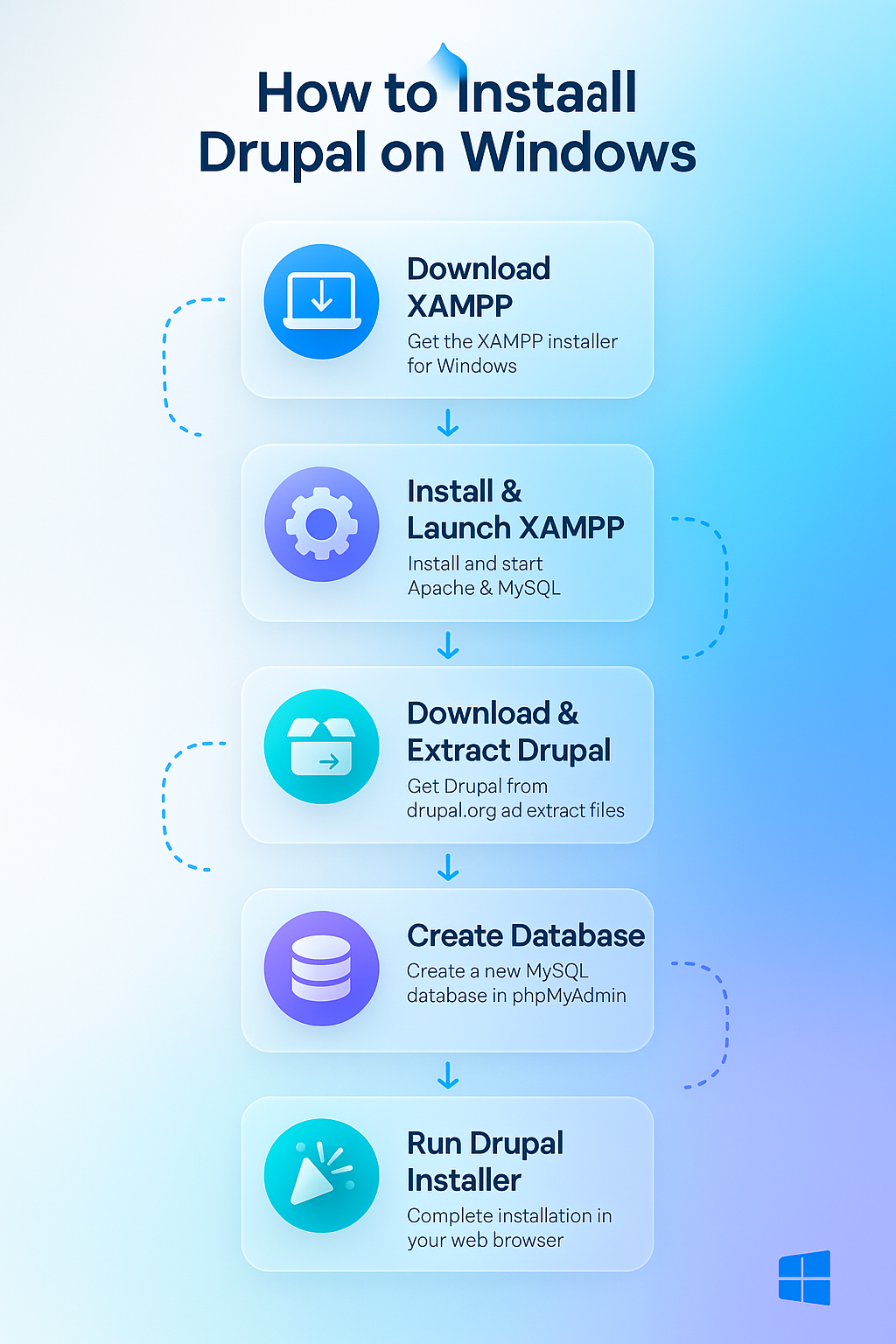
1. Download XAMPP

  • Go to https://www.apachefriends.org/index.html
  • Click Download for the latest Windows version.

2. Install XAMPP

  • Run the installer you downloaded.
  • During installation, leave the default components selected (Apache, MySQL, PHP at minimum).
  • Install to the suggested folder (e.g., C:\xampp).

3. Launch XAMPP

  • Find XAMPP Control Panel in your Start Menu and open it.
  • Click Start next to Apache and MySQL.
    Both should show a green background.

Step 2: Download and Prepare Drupal

1. Download Drupal

  • Visit https://www.drupal.org/download
  • Download the latest recommended release, typically named like drupal-10.x.x.zip.

2. Extract Drupal

  • Right-click the ZIP file and choose Extract All…
  • Youโ€™ll get a folder, e.g., drupal-10.x.x.
    Tip: Rename it to something simple, like mydrupal.

Step 3: Move Drupal to XAMPPโ€™s Web Directory

1. Locate the htdocs Folder

  • Navigate to C:\xampp\htdocs in File Explorer.

2. Copy Drupal Files

  • Copy your extracted/renamed Drupal folder (mydrupal) into htdocs.
  • Your path will look like: C:\xampp\htdocs\mydrupal

Step 4: Create a MySQL Database for Drupal

1. Open phpMyAdmin

  • In your browser, go to http://localhost/phpmyadmin

2. Create a New Database

  • Click Databases in the top menu.
  • Enter a database name (e.g., drupaldb)
  • Click Create
  • You donโ€™t need to create tablesโ€”Drupal will do this during installation.

Step 5: Install Drupal via the Web Installer

1. Start the Drupal Installer

  • Open your browser and go to: http://localhost/mydrupal

2. Select Language

  • Choose your language (e.g., English) and continue.

3. Choose Installation Profile

  • Select Standard (recommended for most users).

4. Database Configuration

  • Database type: MySQL/MariaDB
  • Database name: drupaldb (the name you created above)
  • Database username: root
  • Database password: (leave blank; XAMPP uses no password for root by default)
  • Leave Advanced options as they are, unless you know you need to change them.

5. Install and Configure

  • Drupal will set up its database and files (this takes a few minutes).
  • Fill out Site Information: site name, email address, admin username/password.
  • Save your admin credentials!

Step 6: Explore Your New Drupal Site

  • Once installation is complete, youโ€™ll be redirected to your new siteโ€™s home page.
  • Log in with your admin credentials at http://localhost/mydrupal/user/login
  • Start building pages, adding content, installing themes/modules, and exploring Drupalโ€™s features.

Bonus: Drupal Installation Using Composer (Recommended for Advanced/Professional Use)

Why Composer?
Using Composer is the modern way to manage Drupal projects. It handles core, modules, themes, and dependencies in a single, upgradeable workflow.

1. Install Composer

  • Download and install Composer from https://getcomposer.org/

2. Use Composer to Create a New Drupal Project

Open Command Prompt and run:

cd C:\xampp\htdocs
composer create-project drupal/recommended-project mydrupal
  • This will create a new Drupal site in C:\xampp\htdocs\mydrupal

3. Continue from Step 4 above (create database, then install via web browser at http://localhost/mydrupal/web)


Troubleshooting Common Issues

  • Port Errors: If Apache wonโ€™t start, something else may be using port 80 (Skype, IIS). Change Apacheโ€™s port in XAMPP config, or stop the other service.
  • Blank Page/Error 500: Usually a missing PHP extension or corrupted file. Ensure XAMPP is up-to-date and all files are extracted correctly.
  • Database Connection Errors: Double-check the database name, username, and password.
  • Access Denied: Make sure the mydrupal/sites/default folder and settings.php file are writable during installation. You may need to manually copy default.settings.php to settings.php.

FAQs

Q: Can I install multiple Drupal sites in XAMPP?
A: Yes! Just create new folders in htdocs and new databases for each site.

Q: How do I update Drupal?
A: With Composer, run composer update. With manual installs, download and replace filesโ€”see Drupalโ€™s update guide.

Q: Is it safe to run Drupal on Windows?
A: Yes, for local development. For production, Linux servers are recommended.


Conclusion

You now have a fully functioning local Drupal site on Windows!
Use this environment to learn, develop, and experiment with Drupalโ€™s powerful CMS capabilities

Post Views: 865
  • and Run Drupal
  • Complete Guide: How to Download
  • Drupal
  • How to Download Drupal
  • How to install drupal
  • how to run drupal
  • Install
Subscribe
Login
Notify of
guest
guest
0 Comments
Oldest
Newest Most Voted
Inline Feedbacks
View all comments
  • Certified AIOps Engineer: The Complete Career Path and Certification Guide
  • How to Rename Apache Virtual Host Files Safely (Step-by-Step Guide for Linux)
  • AIOps Foundation Certification: Everything You Need to Know to Get Certified
  • DevOps to Certified Site Reliability Professional: A Senior Mentorโ€™s Guide
  • Certified Site Reliability Manager Training, Preparation, and Career Mapping
  • Certified Site Reliability Architect: The Complete Career Guide
  • What Is a VPN? A Complete Beginner-to-Advanced Tutorial
  • How to Install, Secure, and Tune MySQL 8.4 on Ubuntu 24.04 for Apache Event MPM and PHP-FPM
  • Complete Guide to Certified Site Reliability Engineer Career
  • Certified DevSecOps Professional Step by Step
  • Certified DevSecOps Manager: Complete Career Guide
  • Certified DevSecOps Engineer: Skills, Career Path and Certification Guide
  • Step-by-Step: Become a Certified DevSecOps Architect
  • Tuning PHP 8.3 for Apache Event MPM and PHP-FPM on Ubuntu: A Complete Step-by-Step Production Guide
  • Complete Step-by-Step Guide to Configure Apache Event MPM, Create index.php, Set Up VirtualHost, and Fix Ubuntu Default Page
  • Convert XAMPP Apache to Event MPM + System PHP-FPM
  • The Gateway to System Observability Engineering (MOE)
  • How to Finetune Apache and Prove It Works: A Real-World Guide to Testing Performance, Concurrency, HTTP/2, Memory, CPU, and Security
  • Building a High-Performance Apache Event MPM + PHP-FPM + MariaDB Stack (Advanced Server Optimization Guide)
  • Master Infrastructure as Code: The Complete Hashicorp Terraform Associate Guide
  • Building a High-Performance Apache Server with Event MPM + PHP-FPM (Step-by-Step Guide)
  • Is XAMPP Safer for Production Than Using Apache and PHP as Root? 2026 Practical Guide
  • Unlock Cloud Security Expertise with Certified Kubernetes Security Specialist (CKS)
  • How to Fix wpDiscuz Not Replacing Default WordPress Comments in Block Themes
  • Complete Guide to Certified Kubernetes Application Developer Certification
  • Overview of Certified Kubernetes Administrator (CKA) Certification
  • How to Install and Configure XAMPP on Ubuntu 24 Server (Latest Version โ€“ 2026 Complete Guide)
  • Mastering the Google Cloud Professional DevOps Engineer
  • Mastering Azure Cloud Security: The AZ-500 Path
  • Why AZ-400 is Essential for Global Cloud Engineering Roles

Recent Comments

  1. digital banking on Complete Tutorial: Setting Up Laravel Telescope Correctly (Windows + XAMPP + Custom Domain)
  2. SAHIL DHINGRA on How to Uninstall Xampp from your machine when it is not visible in Control panel programs & Feature ?
  3. Abhishek on MySQL: List of Comprehensive List of approach to secure MySQL servers.
  4. Kristina on Best practices to followed in .httacess to avoid DDOS attack?
  5. Roshan Jha on Git all Commands

Archives

  • March 2026
  • February 2026
  • January 2026
  • December 2025
  • November 2025
  • October 2025
  • September 2025
  • August 2025
  • July 2025
  • June 2025
  • May 2025
  • April 2025
  • March 2025
  • February 2025
  • January 2025
  • December 2024
  • November 2024
  • October 2024
  • September 2024
  • August 2024
  • July 2024
  • June 2024
  • May 2024
  • April 2024
  • March 2024
  • February 2024
  • January 2024
  • December 2023
  • November 2023
  • October 2023
  • September 2023
  • August 2023
  • July 2023
  • May 2023
  • April 2023
  • March 2023
  • February 2023
  • January 2023
  • December 2022

Categories

  • Ai
  • AI Blogging
  • AiOps
  • ajax
  • Android Studio
  • Antimalware
  • Antivirus
  • Apache
  • Api
  • API Security
  • Api Testing
  • APK
  • Aws
  • Bike Rental Services
  • ChatGPT
  • Code Linting
  • Composer
  • cPanel
  • Cyber Threat Intelligence
  • Cybersecurity
  • Data Loss Prevention
  • Database
  • dataops
  • Deception Technology
  • DeepSeek
  • Devops
  • DevSecOps
  • DevTools
  • Digital Asset Management
  • Digital Certificates
  • Docker
  • Drupal
  • emulator
  • Encryption Tools
  • Endpoint Security Tools
  • Error
  • facebook
  • Firewalls
  • Flutter
  • git
  • GITHUB
  • Google Antigravity
  • Google play console
  • Google reCAPTCHA
  • Gradle
  • Guest posting
  • health and fitness
  • IDE
  • Identity and Access Management
  • Incident Response
  • Instagram
  • Intrusion Detection and Prevention Systems
  • jobs
  • Joomla
  • Keycloak
  • Laravel
  • Law News
  • Lawyer Discussion
  • Legal Advice
  • Linkedin
  • Linkedin Api
  • Linux
  • Livewire
  • Medical Tourism
  • MlOps
  • MobaXterm
  • Mobile Device Management
  • Multi-Factor Authentication
  • MySql
  • Network Traffic Analysis tools
  • Paytm
  • Penetration Testing
  • php
  • PHPMyAdmin
  • Pinterest Api
  • Quora
  • SAST
  • SecOps
  • Secure File Transfer Protocol
  • Security Analytics Tools
  • Security Auditing Tools
  • Security Information and Event Management
  • Seo
  • Server Management Tools
  • Single Sign-On
  • Site Reliability Engineering
  • soft 404
  • software
  • SuiteCRM
  • SysOps
  • Threat Model
  • Twitter
  • Twitter Api
  • ubuntu
  • Uncategorized
  • Virtual Host
  • Virtual Private Networks
  • VPNs
  • Vulnerability Assessment Tools
  • Web Application Firewalls
  • Windows Processor
  • Wordpress
  • WSL (Windows Subsystem for Linux)
  • X.com
  • Xampp
  • Youtube
©2026 DevSecOps Now!!! | WordPress Theme: EcoCoded
wpDiscuz